

CPT Code 30801: Superficial turbinate ablation billing guide
CPT Code 30801: Official descriptor and procedure overview The American Medical ...

Last Updated: Nov 27, 2026
27535 is the CPT code for open treatment of tibial fracture, proximal (plateau); unicondylar, includes internal fixation, when performed. It covers open reduction of a fracture through one tibial condyle, medial or lateral, with plates or screws when the surgeon uses them.
The code carries a 90-day global period. When both condyles are fixed, the correct code is 27536, and closed treatment of the fracture uses 27530 or 27532.
Let Pabau's smart automation suggest the right codes, reduce claim denials, and keep your practice compliant—effortlessly.
Automate repetitive tasks and focus on what matters most—your patients.
Reduce coding errors and ensure compliance with the latest regulations.
Clean claims, fewer denials, and faster reimbursements.
Powerful insights and reporting to help your practice thrive.
HIPAA compliant SOC 2 certified GDPR-compliant Trusted by 4,000+ clinics worldwide

CPT Code 27535 covers open treatment of a unicondylar tibial plateau fracture, meaning one condyle, medial or lateral, but not both.
Schatzker types I to IV are generally unicondylar and take 27535, while types V and VI involve both condyles and take 27536.
Pair 27535 with a tibial condyle code, S82.12- for the lateral condyle or S82.13- for the medial condyle, plus the right 7th character.
Most payers expect the -LT or -RT modifier, and a missing laterality modifier is a leading denial trigger for 27535 claims.
Pabau’s claims management software sends 837P claims through Claim.MD and warns the team when a case is missing its prior authorization.
The American Medical Association defines CPT Code 27535 as open treatment of tibial fracture, proximal (plateau); unicondylar, includes internal fixation, when performed. It sits in the Musculoskeletal System section of CPT, under fracture and dislocation care of the femur and knee joint.
The key term is “unicondylar,” meaning the fracture involves only one tibial condyle. When the surgeon opens the knee, reduces the fracture, and fixes it with plates or screws on a single condyle, 27535 is the correct code.
Fixing both condyles of the same knee is a bicondylar repair, and it belongs under 27536. CMS’s January 2026 ASC update lists the two codes side by side with those descriptors. Closed treatment of the same fracture uses 27530 or 27532 instead.
CPT 27535 covers a unicondylar fracture, and CPT 27536 covers a bicondylar fracture, where both the medial and lateral condyles need open fixation. Selecting the wrong code is the most common audit trigger for tibial plateau billing. The distinction is a clinical call made by the surgeon, not the coder.
The Schatzker classification provides the practical framework. Schatzker types I through IV involve a single condyle and generally support CPT 27535. Schatzker types V and VI involve both condyles and require 27536.
Because the classification carries clinical nuance, coders should not assign it on their own. The operative note names the condyle treated, and the coder selects the code from that documentation.
When the operative note documents “both condyles” or fixation on both sides, 27536 is appropriate and 27535 is an undercoding error. When only one condyle is documented, 27535 is correct, and billing 27536 is upcoding. The chart below puts the whole decision in one place, from open versus closed treatment to the S82 code that pairs with 27535.
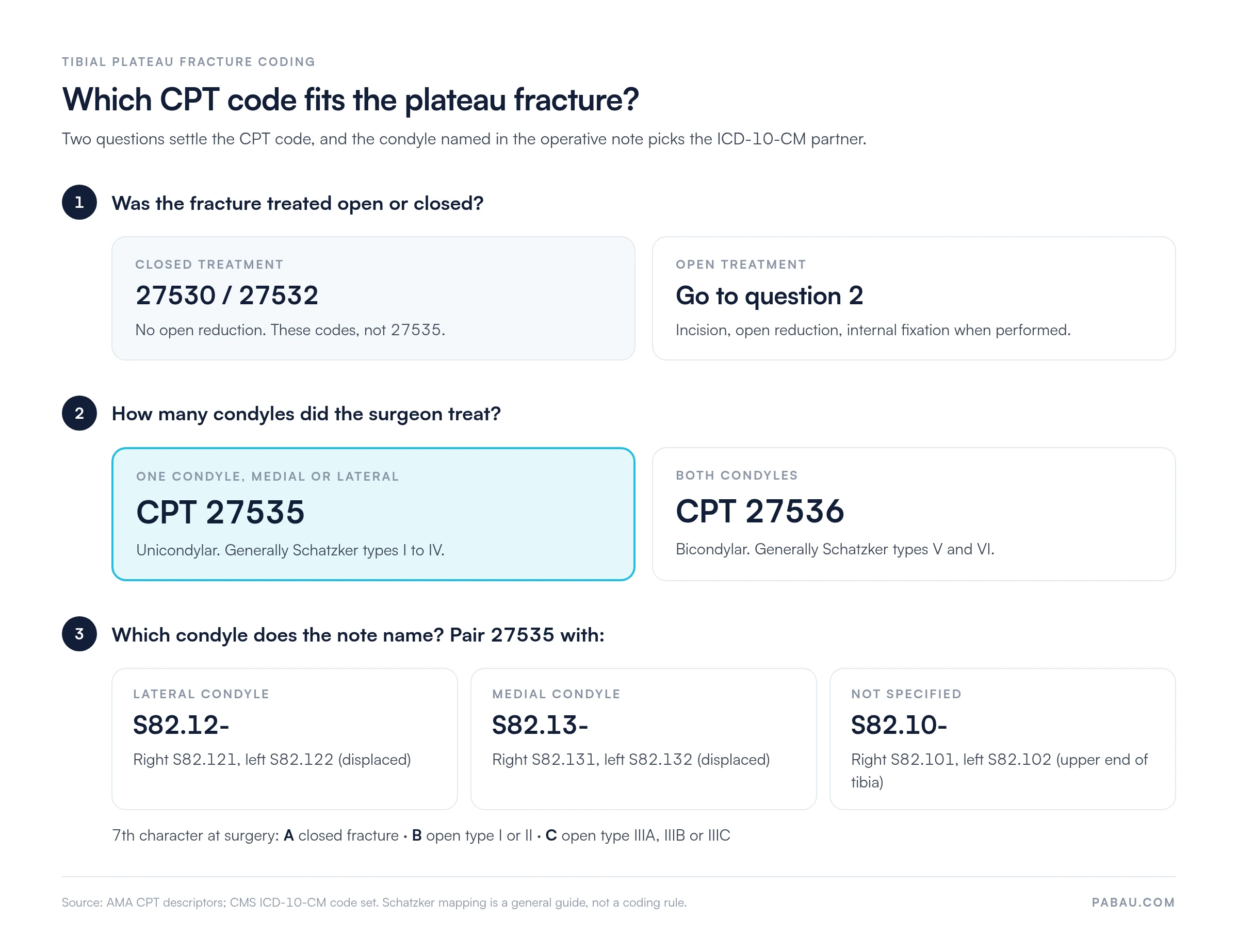
CPT 27535 pairs with a tibial plateau code from the S82.1- category. Use S82.12- for the lateral condyle, S82.13- for the medial condyle, and S82.10- when the record doesn’t name one.
Payers run medical necessity crosswalks that check whether the diagnosis supports the procedure. A code without laterality triggers an automatic denial on many payer systems.
CMS publishes the ICD-10-CM code set and its guidelines each year, so check the code against the current release.
The 7th character records the encounter type. At the first surgery, a closed fracture takes A as its 7th character. An open fracture takes B for type I or II, and C for type IIIA, IIIB or IIIC. Follow-up for routine healing takes D, but routine visits inside the 90-day global period don’t generate a separate claim.
Modifiers attached to CPT Code 27535 determine whether a payer processes the claim at full value, reduces it, or routes it to manual review. A wrong or missing modifier does as much damage as the wrong base code.
Modifier -22 carries particular audit risk. Use it only when the operative note explains why the case took substantially more physician work than usual. Unusual anatomy, comorbidities that changed the approach, and intraoperative complications all qualify. Routine use without that documentation is a compliance red flag, and it can trigger a focused review of the practice’s surgical billing.
Medicare pays CPT Code 27535 on its total relative value units (RVUs), multiplied by the annual conversion factor. The Geographic Practice Cost Index (GPCI) then adjusts it for the practice location. The CMS Physician Fee Schedule lookup tool provides current payment amounts by locality.
For the most current 2026 figures, use the FastRVU 2026 RVU lookup, which pulls directly from the CMS data release.
The facility rate applies when the procedure is performed in a hospital or ambulatory surgical center. The non-facility rate applies in an office setting, and it is typically higher because the practice carries the overhead. For CPT Code 27535 the facility rate is the one that matters, because tibial plateau ORIF is almost always performed in a surgical facility.
Verify RVU values directly against the CMS MPFS every January. The conversion factor changes annually. Billing teams that carry over prior-year payment estimates can miss expected reimbursement by several percentage points across a year of surgical claims. Build a calendar reminder to pull the updated fee schedule file on the first business day of each year.
CPT Code 27535 carries a 90-day global surgery period under Medicare. All routine post-operative care in those 90 days is bundled into the 27535 payment. A separate evaluation and management (E&M) code for a standard wound check or fracture healing visit will be denied or recouped.
Several services can be billed separately within the global period, but each needs a specific modifier to signal the exception to the payer:
The most common error during the global period is billing a standard post-op fracture visit as an E&M without modifier -24. Without the modifier, the payer is right to deny the claim. The fix is to resubmit with -24 and documentation showing the visit addressed an unrelated condition.
Most commercial payers and Medicare Advantage plans require prior authorization for CPT Code 27535 before the procedure takes place. Original Medicare (Parts A and B) does not currently require prior auth for this code. Medicare Advantage plans set their own policies, which often differ from Original Medicare rules.
A typical prior authorization submission for CPT 27535 must include:
Emergency and urgent cases may allow a retrospective authorization review. Start it within the payer’s window, commonly 24 to 48 hours after the procedure, or the denial can’t be appealed on procedural grounds. State the emergency explicitly in the clinical notes, because payers look for language that justifies skipping standard prior auth.
The operative note is the primary audit document for CPT 27535 claims. Vague notes are the most common reason a correctly coded claim fails on retrospective review.
According to AMA coding guidance, the operative report must support every component of the code descriptor. For 27535, the note should address each point below, which is what both payers and medical billing compliance reviews look for:
A clean claim starts with the operative note. A claim that is coded correctly but unsupported by the clinical note won’t survive a payer’s pre-payment or post-payment audit.
Denials for CPT 27535 cluster around a predictable set of errors, and each has a known fix. For a broader framework, see Pabau’s guide to denial management workflows. The reference on denial codes explains the payer response codes that come back with these rejections.
Run every CPT 27535 claim through an NCCI edit check before submission. NCCI edits are updated quarterly, so a companion code that was separately billable in Q1 may be bundled by Q2. Build the quarterly NCCI update review into your compliance calendar alongside the annual fee schedule refresh.
Several codes are commonly billed alongside CPT 27535 when the operative note supports them. Each needs its own documentation. Billing a companion code the note doesn’t support is an unbundling error, whether or not an NCCI edit exists.
Payers often question CPT 77002 for intraoperative fluoroscopy, because some payer policies treat it as bundled with the surgical procedure. Check the payer’s LCD or coding policy before billing 77002 separately. “Fluoroscopy was used” is not enough for the note. It must state that the operating surgeon obtained and interpreted the images.
A tibial plateau claim depends on details that live in different places. The condyle sits in the operative note, the laterality modifier on the claim line, and the authorization number with the payer. When each lives in a separate tool, someone copies it across by hand, and that copy step is where 27535 claims pick up errors.
Pabau’s claims management software keeps those details on one patient record. Claims go out as 837P files through Claim.MD, Pabau’s US clearinghouse partner, which connects to thousands of payers. Eligibility checks run before the surgery date, and ERA remittances post back against the same record.
Prior authorization sits on the patient’s case, with the auth code, dates and sessions recorded. Pabau warns the team when an authorization is missing, so a 27535 claim doesn’t leave without the number the payer expects.
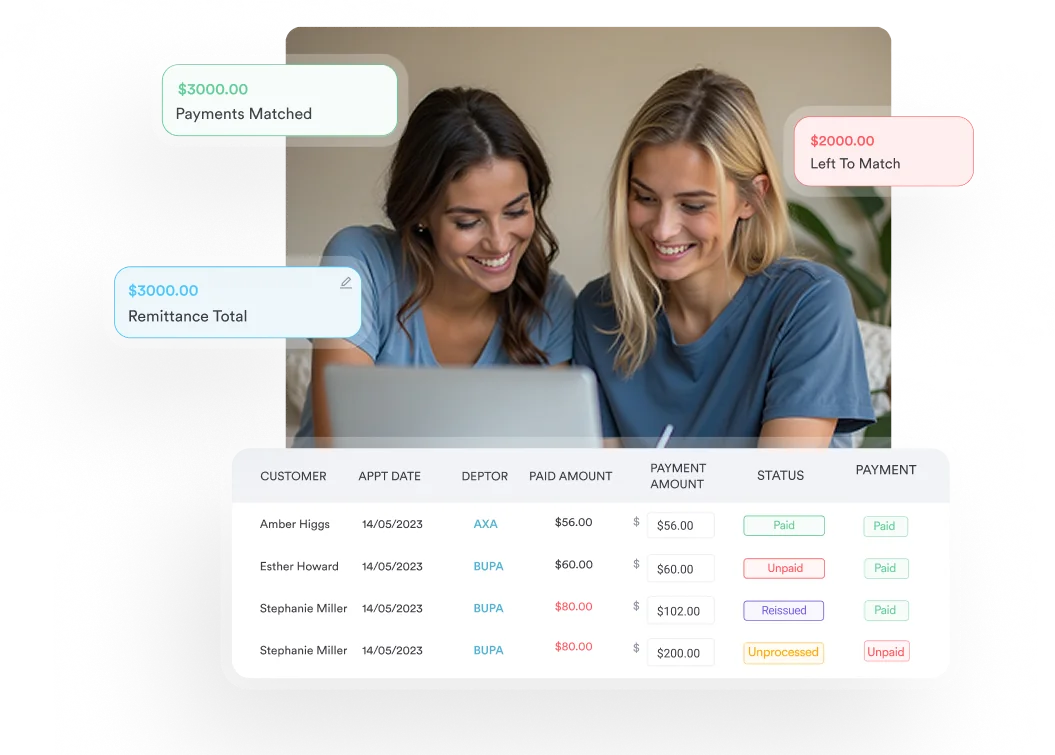
Medical billing fundamentals still apply to every surgical claim. Software that holds the op note, the authorization and the claim together removes the re-keying step between them.

Pabau sends 837P claims through Claim.MD, checks eligibility before surgery, and warns your team when a prior authorization is missing. Book a demo to see it on an orthopedic workflow.

Coding 27535 correctly comes down to one line in the operative note: which condyle the surgeon opened and fixed. Get that line written plainly on the day of surgery, and the CPT code, the S82 code and the laterality modifier all follow from it.
The judgment calls sit in the extras. Modifier -22, 77002 and bone graft codes each pay only when the note supports them. Bill them when the documentation is there, and leave them off when it isn’t. Book a demo to see how Pabau keeps the operative note, the authorization and the claim in one place for orthopedic practices.

Want to understand how the clearinghouse submission process works? Claim.MD clearinghouse guide explains how 837P electronic claims reach payers and what happens when they’re rejected at the EDI level.
CPT Code 27535 covers open treatment of a proximal tibial (plateau) fracture that involves one condyle, including internal fixation when performed. It applies when a surgeon opens the knee, reduces a medial or lateral condyle fracture, and stabilizes it with plates or screws. It does not cover closed treatment or bicondylar plateau fractures.
CPT 27535 covers a unicondylar fracture, meaning one condyle, medial or lateral. CPT 27536 covers a bicondylar fracture, where both condyles are involved. The surgeon documents the distinction in the operative note, and it generally follows the Schatzker classification. Types I to IV point to 27535, and types V and VI to 27536. Selecting the wrong code is the most common audit trigger for tibial plateau billing.
Most payers require -LT (left tibia) or -RT (right tibia) for laterality. Modifier -22 marks increased procedural complexity and needs supporting documentation. Modifier -59 marks a distinct procedural service when companion codes are involved, and -51 marks multiple procedures in the same session. Modifiers -24 and -79 cover unrelated services during the global period.
CPT Code 27535 carries a 90-day global surgery period under Medicare. All routine post-operative visits related to the fracture repair are bundled into the global period payment. Services billed separately within those 90 days need a modifier. Use -24 for an unrelated E&M visit and -58 for a planned staged procedure. Use -79 for an unrelated procedure and -78 for a return to the OR for a related complication.
CPT 77002 for intraoperative fluoroscopy may be separately billable alongside CPT 27535, but payer policies vary. Some LCDs consider it bundled with the surgical procedure. When billing 77002, the operative note must state that fluoroscopic guidance was used for reduction or hardware placement. It must also state that the operating surgeon obtained and interpreted the images. Confirm the payer’s specific LCD before billing 77002 separately.
The primary ICD-10-CM pairings for CPT 27535 are the tibial condyle codes. S82.121 and S82.122 cover a displaced lateral condyle fracture of the right and left tibia, and S82.131 and S82.132 cover the medial condyle. S82.101 and S82.102 cover an unspecified fracture of the upper end of the right or left tibia. At the initial surgery, each takes the 7th character A, B or C to match the fracture type.




