ICD-10 Code T45.7X1S: Coagulant and vitamin K poisoning
ICD-10 Code T45.7X1S: Quick reference summary ICD-10 Code T45.7X1S reports a res...

Last Updated: Nov 25, 2026
Billable Code Specific Code
S82.002K is the billable ICD-10-CM code for unspecified fracture of left patella, subsequent encounter for closed fracture with nonunion.
Coders assign it at an orthopedic follow-up visit once the physician documents that a closed left kneecap fracture has failed to unite. The note must state left laterality, a subsequent encounter, and nonunion. Confusing the 7th character K with D (routine healing) or G (delayed healing) is a common cause of denials.
Let Pabau's smart automation suggest the right codes, reduce claim denials, and keep your practice compliant—effortlessly.
Automate repetitive tasks and focus on what matters most—your patients.
Reduce coding errors and ensure compliance with the latest regulations.
Clean claims, fewer denials, and faster reimbursements.
Powerful insights and reporting to help your practice thrive.
HIPAA compliant SOC 2 certified GDPR-compliant Trusted by 4,000+ clinics worldwide

ICD-10 code S82.002K is a valid, billable ICD-10-CM code in the FY2027 code set, which took effect on October 1, 2026.
The 7th character K means a subsequent encounter for a closed fracture with nonunion, not routine follow-up care.
Physician documentation must confirm left laterality, a subsequent encounter, and nonunion status to support this code.
Pabau, a practice management platform, submits US claims through Claim.MD, with eligibility checks and ERA remittances in the same record.
ICD-10 code S82.002K is the billable code for an unspecified left patella fracture at a subsequent encounter for closed fracture with nonunion. The code is listed in the CDC’s FY2027 ICD-10-CM release, which covers services from October 1, 2026, through September 30, 2027. The table below is the at-a-glance reference.
Each of the seven characters in S82.002K (S, 8, 2, 0, 0, 2, K) carries one piece of clinical information. Reading them in order is the quickest way to catch a wrong character before the claim goes out.
The 5th character “0” means the fracture pattern is unspecified. When the physician documents a specific pattern, code that subcategory instead of S82.00-. The patterns are osteochondral (S82.01-), longitudinal (S82.02-), transverse (S82.03-), comminuted (S82.04-), and other (S82.09-). Within those subcategories the 6th character records both displacement and side. S82.012K, for example, is a displaced osteochondral fracture of the left patella with nonunion.
A left patella fracture nonunion is a kneecap fracture that has failed to achieve bony union, confirmed by clinical examination or imaging. ICD-10-CM sets no time threshold for nonunion. The determination rests on the physician’s documented judgment, usually backed by serial imaging that shows no further healing.
Nonunion is easy to confuse with three related healing states, and each one takes a different 7th character:
Coders should not assign S82.002K unless the physician explicitly documents nonunion or failed union. A note that says “fracture not healed” or “fracture healing slowly” does not support K on its own. The note must reflect clinical or radiological confirmation that healing has stopped.
The 7th character on S82.002 carries both the encounter type and the healing status. Per ICD-10-CM Official Guidelines Section I.C.19.c, character K is restricted to subsequent encounters where nonunion is documented. It cannot be used for an initial encounter.
Characters E, F, H, J, M, N, Q, and R cover the open fracture variants with their healing status. The code family table below lists all of them, and the CDC/NCHS ICD-10-CM web tool confirms them for the current fiscal year.
Run a simple two-question check before assigning any K-character fracture code: (1) Has the physician explicitly documented nonunion or failed union? (2) Is this encounter number two or later for the same injury? Both must be yes. If the note says ‘slow healing’ or ‘fracture visible on X-ray’ without a nonunion statement, default to G (delayed healing) until the physician clarifies.
The table below lists all 16 codes in the S82.002 family, with their official descriptors. Use it to check sibling codes and confirm the 7th character matches the documented clinical scenario. ICD-10 code S82.002K is the closed-fracture nonunion slot.
For an open fracture, the Gustilo type picks the letter. M is nonunion of a type I or II open fracture, and N is nonunion of a type IIIA, IIIB, or IIIC. The AAPC ICD-10-CM code lookup lists the same family by range.
The codes most often confused with S82.002K are S82.002D, S82.002G, S82.002P, and S82.002S. The choice hinges on what the physician note says, not on the time elapsed since the injury. Ask the questions below in order and stop at the first yes.
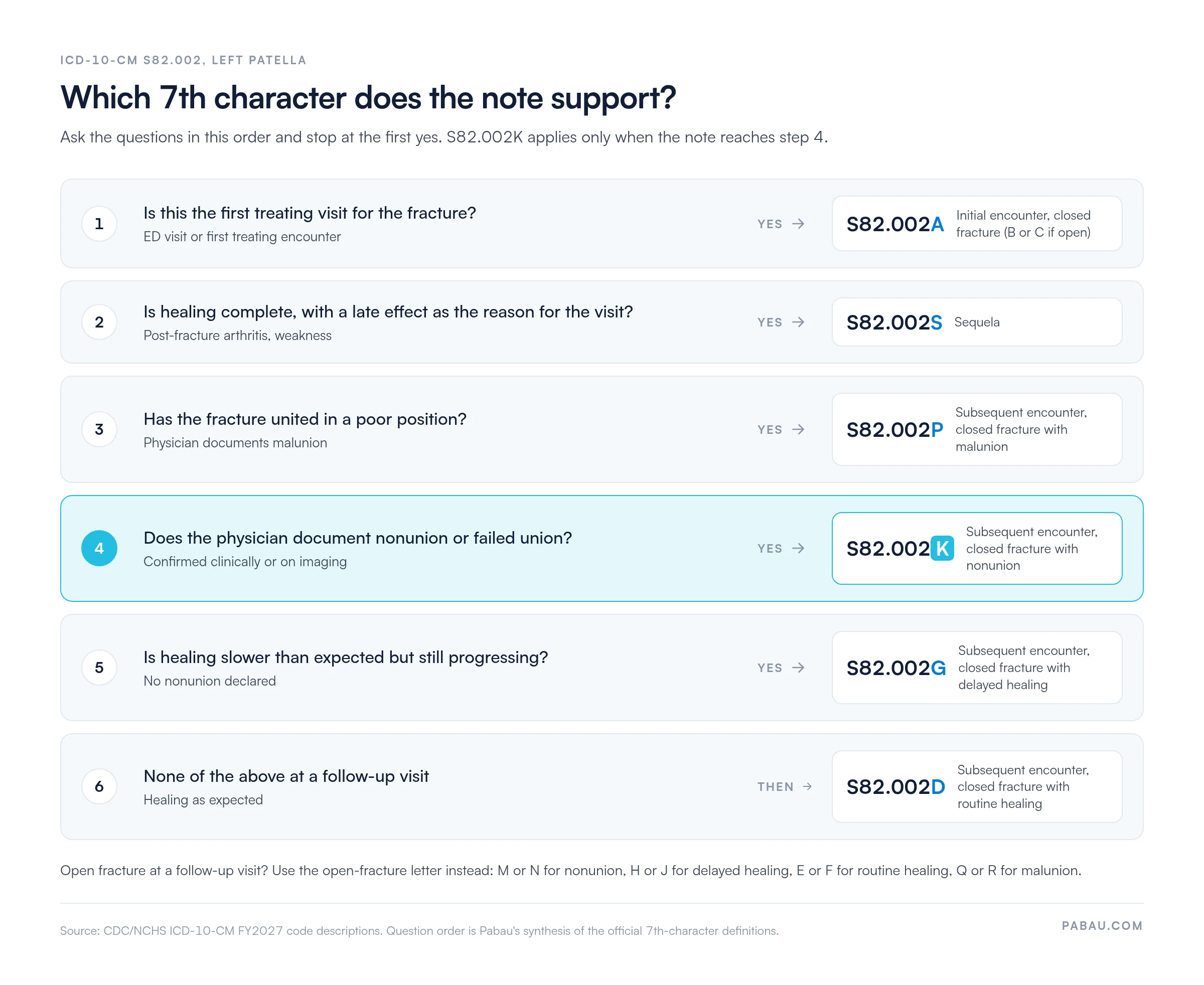
S82.002K and S82.002S are mutually exclusive 7th characters. Nonunion (K) means the fracture is still in the healing phase, with a complication. Sequela (S) means that phase is over and a downstream condition is now the reason for the visit. Per ICD-10-CM Official Guidelines, the two are never used interchangeably or together.
Documentation for the unspecified left patella fracture nonunion code has to cover four elements. Missing any of them is a common cause of medical necessity denials.
Category S82 carries official ICD-10-CM tabular notes that govern coding combinations. Coders must review these before assigning any S82 code.
The Excludes1 for traumatic amputation is confirmed in the CMS ICD-10-CM update files. Any note where the lower leg was amputated cannot simultaneously carry an S82 fracture code.
CMS requires ICD-10 code S82.002K to pair with a clinically appropriate CPT procedure code. The claim line is not payable on the diagnosis code alone.
Common CPT codes that pair with S82.002K for nonunion treatment include:
These CPT pairings are examples. Coders must verify medical necessity and National Correct Coding Initiative (NCCI) edits with each payer before submitting. For the procedure side of the claim, the 27524 reference covers open patellar fixation, and 20902 covers a major bone graft.
Pabau’s claims software for orthopedists sends US claims through the Claim.MD clearinghouse as 837P files. Eligibility checks run before the visit, and ERA remittances come back against each claim.
Medicare coverage of nonunion treatment depends on the condition and the payer. A claim carrying S82.002K is not covered automatically. The physician must document that conservative management has failed or is not appropriate, and that the intervention is medically necessary.
Place-of-service (POS) codes must match the site of service. Office visits use POS 11, outpatient hospital visits use POS 22, and inpatient admissions use POS 21. A mismatched POS code is another common reason these claims are denied.
Check the Local Coverage Determination (LCD) for your MAC before submitting S82.002K with a bone stimulator or bone graft code. Several MACs publish LCD policies for electrical bone stimulation in nonunion cases, such as E0747 (non-spinal electrical osteogenesis stimulator). They require documentation of fracture age, prior conservative treatment, and physician attestation. A claim that misses the LCD criteria is denied, however accurate the ICD-10 coding.
A wrong 7th character and missing nonunion documentation are common causes of denials for this code family. The table below maps the usual denial triggers to their corrective actions.
Tracking denials by reason is the quickest way to spot a pattern. Each ERA remittance carries the payer’s adjustment reason codes, and our payer denial code reference explains what each one means. Pair that with a denial management workflow so coders fix the root cause rather than resubmitting blind.
For clean claim principles that cut first-pass denials, work through the clean claim checklist alongside your NCCI edit review.
At many orthopedic practices, the nonunion finding lives in the physician’s note, and the claim is built later at the billing desk. A coder reads the note, picks a 7th character, and keys the claim into a separate clearinghouse portal. When the note and the claim drift apart, the payer is the first to notice.
In Pabau, the visit note, the patient’s insurance policy, and the claim sit in the same patient record. US claims go to Claim.MD as CMS-1500/837P claims, with eligibility checks before the visit and secondary claims when a second payer is involved. Prior authorization codes, dates, and sessions are tracked on the case, with a warning when one is missing.
ERA remittances come back against each claim. A denial for the wrong 7th character then lands next to the record the coder needs to fix it. Your billing team spends its time correcting root causes instead of re-keying claims.

Pabau keeps the visit note and the claim in one patient record, then submits US claims through Claim.MD with eligibility checks and ERA remittances.

Code S82.002K only when the note gives you all three facts: Left side, a subsequent encounter, and documented nonunion. If any one is missing, query the physician before the claim goes out rather than after a denial.
The trade-off worth remembering sits in the 5th character. S82.002K fits only when the fracture pattern is unspecified, and a documented pattern moves the claim to a more specific subcategory.
Pabau keeps the note, the claim, and the remittance in one record, so fracture follow-ups are easier to code and to audit. To see that workflow for orthopedic billing, book a demo.

Need a step-by-step guide to medical claim submission? Medical billing fundamentals explains the full claim lifecycle from encounter to payment posting.
Trying to reduce your first-pass denial rate? Medical billing compliance covers payer rules, documentation standards, and audit-readiness for orthopedic and clinical practices.
Looking for how Claim.MD connects to your practice workflow? Claim.MD clearinghouse overview details how the integration handles 837P claim submission, eligibility verification, and ERA remittances.
ICD-10 code S82.002K is the billable ICD-10-CM code for an unspecified left patella fracture at a subsequent encounter for closed fracture with nonunion. It is valid for HIPAA-covered transactions in FY2027 and applies only to follow-up visits, not initial fracture encounters.
S82.002D is used when the left patella fracture is healing as expected at a subsequent encounter. S82.002K is used when the physician documents that healing has stopped or failed (nonunion). Both are subsequent encounter codes for a closed fracture, but only K requires explicit physician documentation of nonunion.
Use 7th character K when the visit is a subsequent encounter, not the first treating visit. The physician must also have explicitly documented fracture nonunion or failed union, confirmed clinically or radiologically. Per ICD-10-CM Official Guidelines Section I.C.19.c, K cannot be assigned at an initial encounter or without documented nonunion status.
Nonunion (7th character K) means the fracture is still in the healing phase but has stalled, so the fracture remains the active condition being treated. Sequela (7th character S) means the acute healing phase is over. The patient now presents with a late-effect condition from the original injury, such as post-fracture arthritis or functional impairment. The two characters are mutually exclusive.
Medicare coverage of left patella fracture nonunion treatment is not automatic. The physician must document that conservative management has failed and that the proposed intervention is medically necessary. Bone stimulator coverage, for example, requires MAC-specific LCD criteria including fracture age, prior conservative treatment duration, and physician attestation. Confirm coverage criteria with the relevant Medicare Administrative Contractor before submitting.
Common CPT codes paired with S82.002K include 27520 for closed patellar fracture treatment and 27524 for open treatment with internal fixation. Code 20902 covers a bone graft for nonunion repair. Coders should verify NCCI edits and local coverage determinations with their payer before submitting, as pairing requirements vary by payer and place of service.