

HCPCS Code Q4185: Cellesta flowable amnion billing guide
HCPCS Code Q4185: definition and official descriptor HCPCS Code Q4185 is the Lev...

Last Updated: Nov 20, 2026
29505 is the CPT code for application of a long leg splint, running from the thigh to the ankle or toes. It reports the splint application only, not fracture care or the splinting supplies.
The code sits in the casting and strapping subsection (29000–29799) of the musculoskeletal system and carries a 0-day global period. When a fracture care code covers the same leg at the same encounter, the splint is bundled into that code and 29505 is not reported.
Let Pabau's smart automation suggest the right codes, reduce claim denials, and keep your practice compliant—effortlessly.
Automate repetitive tasks and focus on what matters most—your patients.
Reduce coding errors and ensure compliance with the latest regulations.
Clean claims, fewer denials, and faster reimbursements.
Powerful insights and reporting to help your practice thrive.
HIPAA compliant SOC 2 certified GDPR-compliant Trusted by 4,000+ clinics worldwide

CPT 29505 reports the application of a long leg splint running from the thigh to the ankle or toes. It is a splint, not a cast, and it does not cover fracture care.
Most payers require modifier LT or RT, and a same-day E/M needs modifier 25. CPT 29505 carries a 0-day global period.
Billing 29505 with a definitive fracture care code for the same leg is the leading denial trigger. The splint is bundled into the fracture care global.
Medicare does not accept A4570 for splint supplies. Long leg splint materials go on Q4041–Q4044, or Q4051 for miscellaneous supplies, in non-facility settings.
Pabau, the practice management platform we build, sends CPT 29505 claims through Claim.MD and matches ERA remittances to each claim.
CPT code 29505 reports the application of a long leg splint that runs from the thigh to the ankle or toes. The official descriptor, as listed in Minnesota DHS casting and splinting codes, reads: Application of long leg splint (thigh to ankle or toes). The code sits in the casting and strapping subsection (29000-29799) of the musculoskeletal system and covers the splint application, not fracture care.
The splint always starts at the thigh and ends either at the ankle or past the foot at the toes. Either way it immobilizes the knee, which is what separates it from a short leg splint. A splint is non-circumferential, so the material does not fully encircle the limb. That distinction separates splints from casts and decides code selection.
Common indications include tibial or fibular fractures awaiting definitive management, acute ankle injuries requiring temporary immobilization, ligament injuries, and post-operative immobilization of the lower extremity. The code does not include fracture care itself. It covers the splint application only.
CPT 29505 bundles the work of applying the splint. That covers patient positioning, padding placement, splinting material application, molding and shaping, and the neurovascular check after application. The code also includes the clinician’s time supervising the application and providing immediate post-application instructions.
Fracture care is not included in 29505. Fracture care codes (such as 27750 for closed treatment of a tibial shaft fracture) carry their own global periods and include incidental splinting. Billing 29505 alongside a fracture care code for the same encounter is an unbundling error and a leading cause of claim denial.
Splinting materials are billed separately only in non-facility settings, and the supply code depends on the payer. Medicare and Medicare Advantage do not accept HCPCS A4570. Long leg splint supplies go on Q4041–Q4044 (adult or pediatric, plaster or fiberglass), and Q4051 covers miscellaneous splint supplies.
A4570 is payer-dependent and belongs only on commercial claims whose contracts still accept it, so confirm each contract first. In a facility (hospital outpatient or ED), the facility bills for supplies, and the professional claim covers the application only.
Payers audit 29505 claims for medical necessity, so the medical record must support both the diagnosis and the specific procedure performed.
A complete 29505 note contains seven core elements. Building a documentation template around these elements, or leveraging superbill documentation that flags them, reduces audit exposure significantly.
In physical therapy settings, the documentation must also show that the splinting was performed by or under the direct supervision of the billing provider.
CPT 29515 reports a short leg splint (calf to foot), and it is the code most often confused with 29505. The distinction is anatomical. A splint that starts at the thigh is 29505, and one that covers only calf to foot is 29515. The wrong code can also create a diagnosis-to-procedure mismatch, which triggers claim review.
A key rule: 29505 and 29515 cannot be billed together for the same extremity on the same date. If documentation shows both codes were reported for the same leg on the same encounter, payers will deny one as unbundled.
Check the splint’s proximal boundary before selecting 29505 vs 29515. If the note says ‘below-knee posterior splint,’ that is 29515. If it says ‘long leg posterior splint’ or specifically extends above the knee, that is 29505. When the documentation is ambiguous, query the provider before billing. A code correction is faster than a denial appeal.
Modifier selection for CPT 29505 is straightforward in most encounters, but missing a required modifier is one of the fastest paths to a denial. These are the modifiers coders encounter most often with this code, along with billing compliance requirements for each.
The modifier 25 scenario is the most misunderstood. A same-day E/M is separately billable only when the visit involved a significant, separately identifiable evaluation. That evaluation has to go beyond the decision to apply the splint. For example, a patient presents with leg pain, the provider performs a detailed history and examination, reviews imaging, and then decides to apply a splint. The evaluation that led to the splinting decision is a distinct service. The E/M gets modifier 25, and 29505 carries only its LT or RT modifier.
Sometimes the whole encounter is placing a splint that was already ordered, with no separate evaluation. Modifier 25 is not supported then, and the E/M will deny.
Payers run automated edits that match diagnosis codes against the procedure to confirm medical necessity. A tibial fracture diagnosis paired with 29505 passes; a sprained wrist paired with 29505 flags immediately. These are the ICD-10-CM codes most frequently linked to long leg splint applications.
Use the 7th character A (initial encounter) for the active treatment visit when the splint is first applied. Character D (subsequent encounter) applies to follow-up visits after the initial treatment. Using D on the initial application visit is a documentation error that can trigger a medical necessity review.
Medicare reimbursement for 29505 is based on the CMS Physician Fee Schedule, which assigns relative value units (RVUs) to each code. The national average payment fluctuates annually with the Medicare Conversion Factor and varies by geographic locality. Use the FastRVU 2026 lookup tool to retrieve current year-specific work, practice expense, and malpractice RVU values for your locality.
As a general benchmark, 29505 carries a moderate work RVU, higher than short arm splint code 29125 but lower than long leg casting codes. Non-facility reimbursement is typically higher than facility reimbursement because the practice expense RVU component compensates for overhead in an office or urgent care setting.
CPT 29505 carries a 0-day global surgery period under the Medicare Physician Fee Schedule. Follow-up evaluation and management visits after the splint application are separately billable starting the next day, with no bundling window for post-procedure care.
This is a critical distinction from definitive fracture care codes. A tibial fracture care code such as 27750 carries a 90-day global period. Related E/M services within those 90 days are bundled into the global payment. When the splint goes on at the same encounter as a fracture care code, the splinting is incidental to the fracture care. It cannot be billed separately.
An evaluation and management code is separately billable on the same day as 29505, but only when the documentation supports a significant, separately identifiable service. It is never automatic, and the record has to justify it.
The test: Would the E/M documentation stand alone as a billable visit if no procedure had been performed? If the history, examination, and medical decision-making sections address clinical concerns beyond “patient needs a splint,” the E/M is supportable. If the entire note describes only the splinting procedure, it is not.
Emergency department encounters are the most common setting where this question arises. An ED provider evaluates a patient with a leg injury, reviews imaging, documents findings, and applies a splint. The evaluation and the splinting are distinct clinical acts, so the modifier 25 E/M is appropriate. In contrast, a follow-up visit at which a splint is simply checked and adjusted, with no new evaluation, does not support a separate E/M.
Every 29505 encounter that includes an E/M needs its own documentation checklist. Each note needs a chief complaint and a history of present illness. It also needs exam findings beyond the splinted extremity, plus medical decision-making on diagnosis and management. If any element is missing, the modifier 25 E/M is at risk on audit.
Most 29505 denials are preventable. The patterns repeat across payers, and each one maps to a specific documentation or coding correction. Denial management workflow for orthopedic practices should track 29505 denials by reason code to spot systemic issues quickly.
When a denial does occur, the appeal strategy follows the root cause. The adjustment reason code on the remittance names that cause, and our guide to medical billing denial codes maps each one to a fix. Missing modifier denials typically reprocess on a corrected claim.
Medical necessity denials need the clinical note attached, showing the qualifying diagnosis and the examination findings that justified the splint. Submitting a clean claim the first time, with every modifier and diagnosis code verified, is always faster than an appeal.
Most of the denials in the table trace back to four checks made in the wrong order, or skipped. The decision path below runs them in the order a coder meets them on a splint encounter.
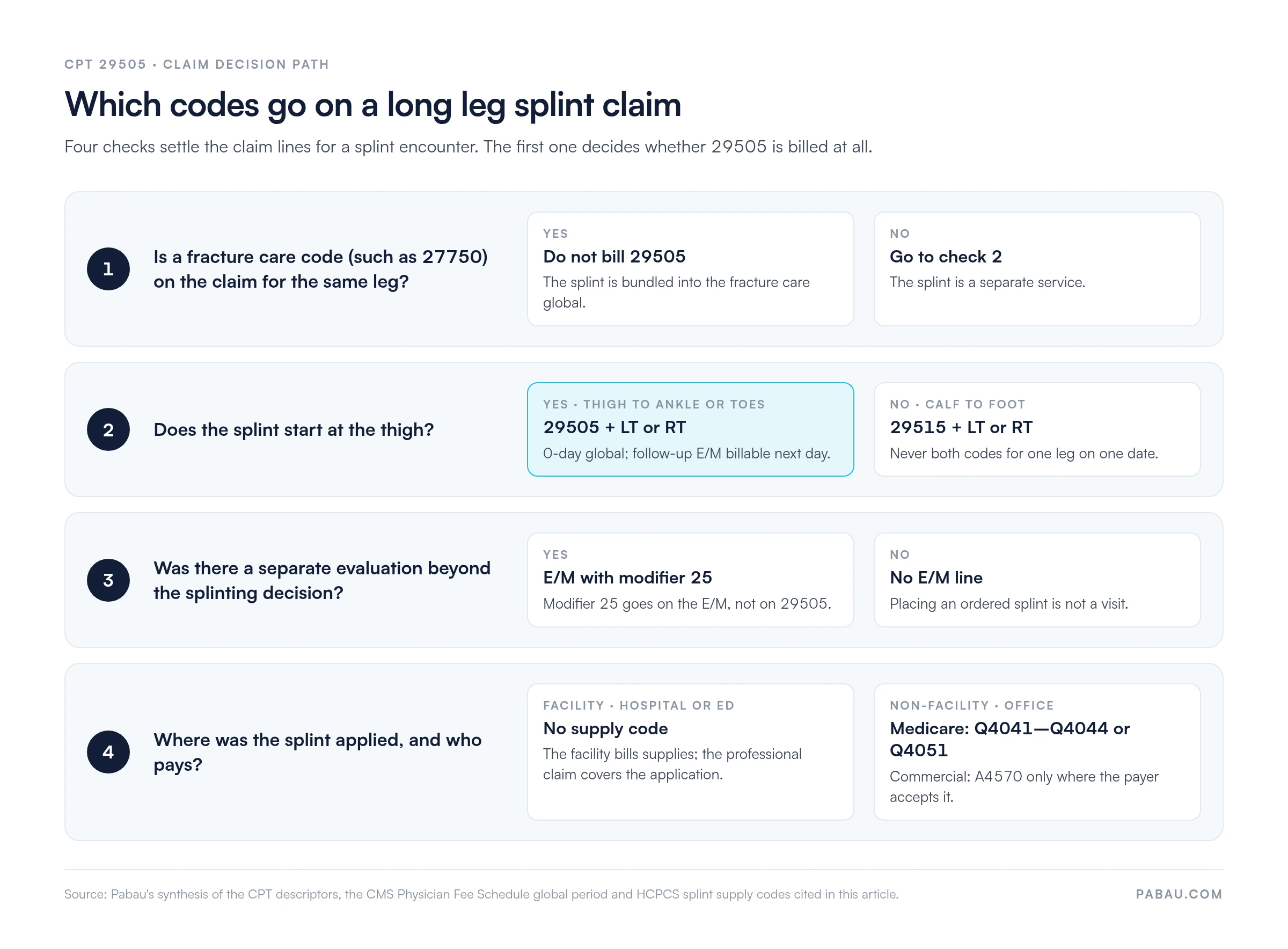
Many orthopedic and emergency billing teams build 29505 claims in one system and chase payments in another. A missing LT modifier or a splint billed beside 27750 then surfaces weeks later as a denial, and someone reworks the claim by hand.
Pabau, the practice management platform we build, puts the splint code, its laterality modifier and the ICD-10 diagnosis on a claim built from the visit. US practices send it as a CMS-1500/837P claim through Claim.MD, with an eligibility check before the encounter.
ERA remittances flow back into Pabau’s orthopedic claims management software, so each payment lines up against its 29505 claim. An underpaid or denied line stands out while it can still be corrected and resubmitted.
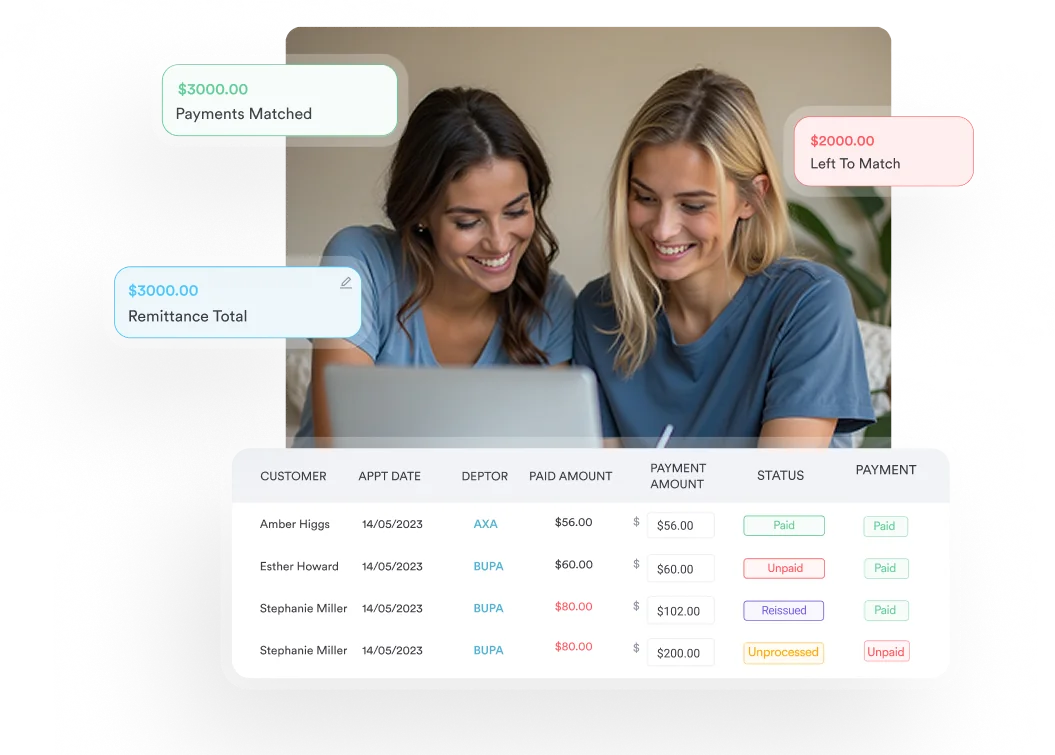

Pabau sends CPT 29505 claims through Claim.MD, runs eligibility checks and matches ERA remittances to each claim. Your billing team spots an underpaid or denied splint claim while it can still be fixed.

CPT 29505 rewards one habit above the rest. Check the claim for a fracture care code before the splint line goes out. If 27750 or another definitive code covers the same leg, 29505 comes off the claim. If not, the splint bills on its own with LT or RT, and follow-up visits bill from the next day.
Supplies are where payer rules diverge most. Medicare wants Q4041–Q4044 or Q4051, while A4570 survives only on commercial contracts that still list it. Set those payer rules up once in your claim workflow, and most remaining denials come down to documentation.
Book a demo to see how Pabau sends and tracks splint claims for orthopedic and emergency practices.

Need to understand clean claim submission? Clean claim fundamentals covers the elements every musculoskeletal claim needs to avoid first-pass denials.
Tracking denial patterns across your orthopedic claims? Denial codes in medical billing explains CARC codes and how to build a denial resolution workflow.
Looking for clearinghouse options for CPT claims? Medical claims clearinghouse guide explains how clearinghouses validate and route claims to payers.
CPT code 29505 covers the application of a long leg splint extending from the thigh to the ankle or toes. It includes the splint application, padding, molding, and immediate neurovascular assessment. It does not include fracture care, splinting materials billed separately, or same-day evaluation and management services, which require their own codes.
CPT 29505 is a long leg splint covering the thigh to the ankle or toes. CPT 29515 is a short leg splint covering only the calf to the foot. The anatomical boundary above the knee determines which code applies. Both are non-circumferential splints, but they cannot both be billed for the same extremity on the same date.
Yes, Medicare reimburses CPT 29505 under the Physician Fee Schedule when medical necessity is documented and the claim is submitted with correct modifiers. Reimbursement rates vary by geographic locality and site of service (facility vs. non-facility). Use the CMS Physician Fee Schedule lookup tool for current year-specific amounts in your location.
Yes, in non-facility settings where the payer allows separate supply billing. Medicare and Medicare Advantage do not accept HCPCS A4570, so long leg splint supplies go on Q4041–Q4044, or Q4051 for miscellaneous supplies. A4570 applies only to commercial payers that still accept it. In hospitals and hospital outpatient departments, the facility bills for supplies and the professional claim covers only the application.
CPT 29505 carries a 0-day global surgery period under the Medicare Physician Fee Schedule. Follow-up evaluation and management visits are separately billable from the day after splint application. This contrasts with definitive fracture care codes, which typically carry 90-day globals that bundle all related follow-up care.
Most denials come from four errors. The claim lacks laterality modifier LT or RT, or 29505 is billed beside a definitive fracture care code that already bundles the splint. The diagnosis may not justify a long leg splint, or a same-day E/M lacks modifier 25. Each has a specific fix, and most reprocess cleanly on a corrected claim.





