ICD-10 code S61.201A: Open wound of left index finger without nail damage
ICD-10 code S61.201A covers a left index finger wound of unstated type ICD-10 co...

Last Updated: Oct 16, 2026
Billable Code Specific Code
S82.031A is the billable ICD-10-CM code for displaced transverse fracture of right patella, initial encounter for closed fracture.
Most denials on this code trace back to two documentation problems. In one, the provider notes "patella fracture" without confirming displacement or fracture pattern. In the other, the coder assigns 7th character D on what was an initial active-treatment visit. Getting both right before submission spares the rework.
Let Pabau's smart automation suggest the right codes, reduce claim denials, and keep your practice compliant—effortlessly.
Automate repetitive tasks and focus on what matters most—your patients.
Reduce coding errors and ensure compliance with the latest regulations.
Clean claims, fewer denials, and faster reimbursements.
Powerful insights and reporting to help your practice thrive.
HIPAA compliant SOC 2 certified GDPR-compliant Trusted by 4,000+ clinics worldwide

S82.031A covers a displaced transverse fracture of the right patella at an initial closed-fracture encounter. The left-side code is S82.032A and the non-displaced equivalent is S82.034A.
7th character A applies only while the patient is receiving active treatment. Use D for routine follow-up during healing, and S for late effects such as post-fracture arthritis.
Payers routinely deny S82.031A when the coder falls back to the unspecified-laterality code S82.033A, or when the radiology report never confirms displacement. Both are worth a provider query.
Practice management software like Pabau flags missing or mismatched claim details before submission, which cuts the manual auditing load on orthopedic billing teams.
ICD-10 Code S82.031A is the billable diagnosis code for a displaced transverse fracture of the right patella, initial encounter for closed fracture.
It applies while the patient is still under active treatment for that fracture. The record has to document the transverse pattern, the displacement and the right side. The table below captures every field a coder verifies before the claim goes out.
ICD-10 Code S82.031A is a seven-character code where each position encodes a distinct clinical fact. Misreading any single character is enough to trigger a payer edit. The table below decodes each position.
The sixth character is where most coding errors originate. “1” encodes a displaced fracture of the right patella, while “4” encodes the non-displaced version on the same side. If the radiology report does not explicitly state that fragments have separated, the coder must query the provider before assigning S82.031A rather than S82.034A.
The 7th character is the most frequently miscoded element in patella fracture claims. Per the ICD-10-CM Official Guidelines for Coding and Reporting (FY2026), “A” applies as long as the patient is receiving active treatment. The number of prior visits does not change that. Selecting “D” on an initial emergency department visit is one of the most common sources of denial on this code. Encounter type follows the treatment phase, not the number of visits already billed.
Open fracture note: An open wound at the fracture site replaces character A with B or C in the code. Which of the two applies depends on the Gustilo-Anderson classification (type I/II versus IIIA/B/C), which must be documented first. Defaulting to A on an open fracture is clinically inaccurate and a compliance risk under CMS guidelines.
Always read the operative note or the ED triage note before you assign the A extension. The record may show a second opinion or a wound check after treatment began elsewhere. That encounter still qualifies as “initial” for as long as active treatment continues. Query the attending provider whenever the encounter type is ambiguous.
S82.031A, S82.031D, and S82.031S describe the same fracture at three different clinical moments. Confusion between A and D accounts for a significant share of initial denials on patella fracture claims. The timeline below follows one right patella fracture from the emergency visit through to a late complication.
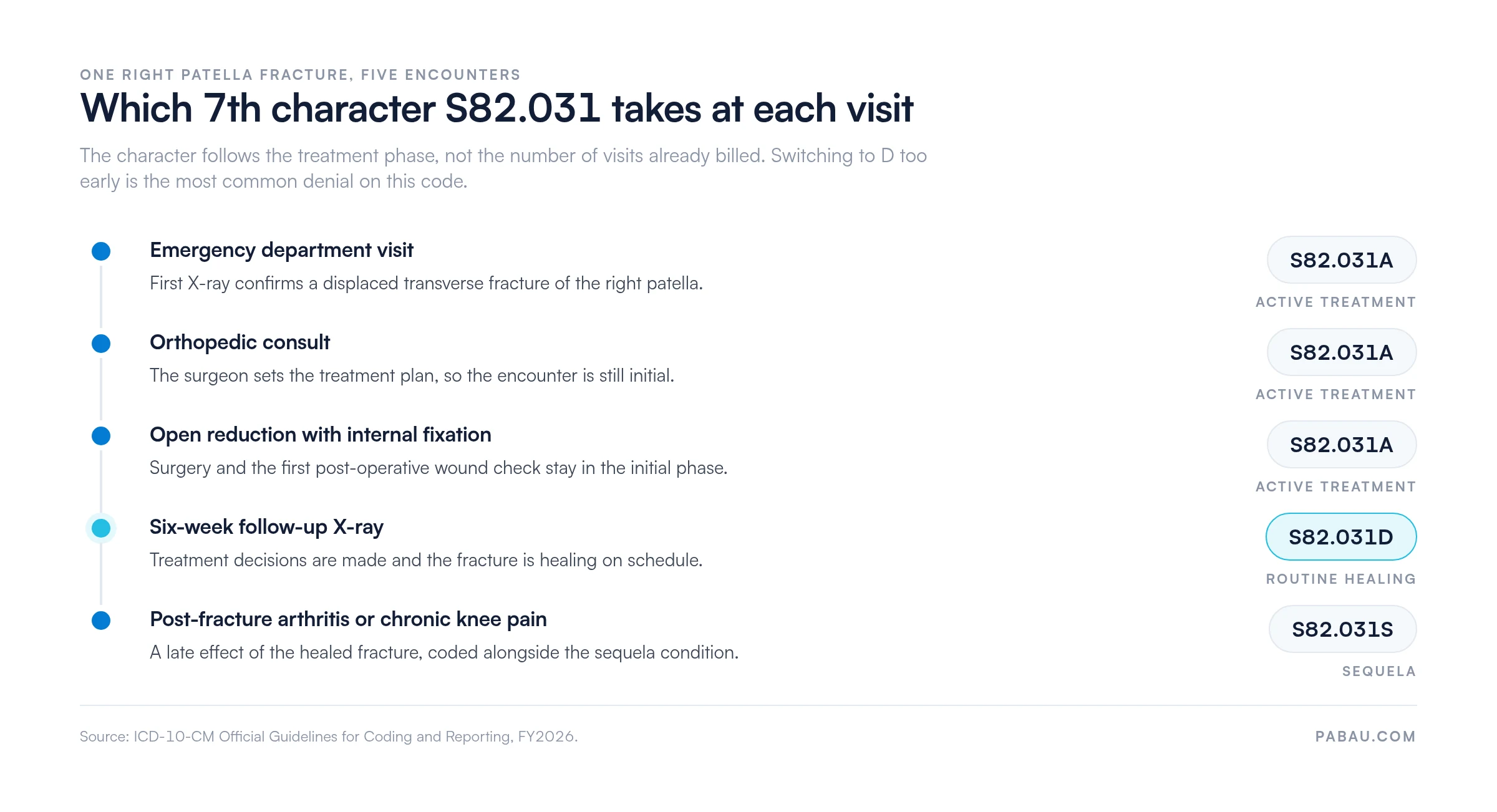
Common coder mistake: Assigning D on the first orthopedic visit because it is a “follow-up” after the ED. If the orthopedist is formulating a treatment plan at that visit, the encounter is still an initial one. Ordering surgery, applying a cast, and prescribing weight-bearing restrictions all count as active treatment.
Displaced and non-displaced fractures of the right patella share the same anatomical location but require different codes. They also require different documentation to support them, and displacement status has to come from the radiology or operative report rather than from clinical inference.
Per ICD-10-CM Official Guidelines, when documentation is ambiguous between displaced and non-displaced, coders should query the provider rather than default to the non-displaced code. Displacement is clinically meaningful, since it usually drives the choice between surgical and conservative treatment. Payers may also audit the CPT code pairing against the displacement status in the ICD-10 code.
Laterality is mandatory in ICD-10-CM. S82.031A encodes the right patella and S82.032A encodes the left. The unspecified laterality code S82.033A is an automatic denial trigger with most commercial payers and Medicare. Reach for it only when the imaging report does not identify the injured knee.
Unspecified laterality carries its own open-fracture variants too. When the side stays undocumented and the wound grades Gustilo type IIIA, IIIB or IIIC, the initial-encounter code is S82.033C.
Documentation tip: Always confirm laterality from the radiology report header, not the clinical note alone. Operative notes occasionally reference the contralateral limb for comparison, which can introduce laterality confusion during coding. Cross-reference the X-ray or MRI impression for the definitive side statement before assigning the code. Laterality errors sit among the top five denial codes on orthopedic claims.
The CPT code selected must match the documented procedure and the fracture’s displacement status in the ICD-10 code. Pairing a surgical open-reduction CPT with a non-displaced ICD-10 code is an audit flag. So is billing a closed treatment CPT with S82.031A after open surgery. Confirm every CPT pairing against the operative report before submitting. Practices that track these pairings systematically use software built for cleaner claims management, which surfaces CPT-ICD mismatch edits before claims leave the practice.
Upcoding risk: CPT 27524 (open treatment with internal fixation) billed alongside a non-displaced code such as S82.034A raises a red flag. Non-displaced transverse patella fractures are rarely treated with open reduction internal fixation as a first-line intervention. Payers may request the operative note to confirm medical necessity when this pairing appears.
The medical record must support every dimension of ICD-10 Code S82.031A before the claim is submitted. A missing element gives payers grounds to deny or downcode. A documentation checklist built into the clean claim workflow catches the omission before submission rather than during appeal. Here is what the record must contain:
When provider documentation is silent on fracture pattern or displacement, the coder should issue a provider query before assigning S82.031A. Coding from inference rather than documentation is a compliance violation. Pabau supports electronic claim submission through Claim.MD, our US clearinghouse partner, which processes CMS-1500 and 837P claims for thousands of US payers. It also flags missing or conflicting diagnosis fields before the claim is transmitted.
Most denials on ICD-10 Code S82.031A are preventable. The table below maps the five most common denial reasons to their root cause and corrective action. After a denial, read the CARC code on the remittance advice before deciding whether to appeal or recode.
S82.031A is one entry in the S82.0 patella fracture family. Coders working across several fracture presentations in the same patient population benefit from keeping this reference block in view. The same character logic governs every code in it: chapter, anatomy, pattern, laterality, encounter type. The AAPC ICD-10-CM lookup and the ICD List tool provide full tabular navigation for the S82 block.
In most orthopedic practices the coding check happens twice, and both times by hand. A coder reads the operative note and the imaging impression, assigns S82.031A, and a biller re-reads the same record before the batch goes out. Anything either of them misses surfaces weeks later as a denial, when the encounter is cold and the notes take longer to reconstruct.
Pabau, our practice management software, keeps the imaging report, the operative note and the coded diagnosis on one patient record. The coder stops chasing documents across systems. The billing workflow flags missing or mismatched claim details before submission, and claims go out electronically through Claim.MD to thousands of US payers.
For a fracture-heavy caseload that means a shorter review cycle. Fewer claims come back over a detail that was in the chart all along. Every subscription includes the full feature set, so a two-surgeon practice runs the same claims workflow as a multi-site group.

Pabau’s billing workflow flags missing or mismatched claim details before submission, so your orthopedic claims reach payers clean the first time.

ICD-10 Code S82.031A is precise, and the precision is what makes it denial-prone. Three elements have to line up on every claim: a transverse pattern with confirmed displacement, right-side laterality, and an encounter that qualifies as active treatment. When one of them is missing or ambiguous, the claim comes back.
A provider query before submission costs a coder a few minutes. An appeal six weeks later costs far more, and the money sits unpaid while it runs. Build the pattern, displacement and laterality checks into the pre-submission review, and most of this code’s denial volume disappears. Book a demo to see how Pabau handles orthopedic claims from coding through to remittance.

Need guidance on denial management workflows? Denial management in healthcare covers systematic approaches to reducing claim rejection rates across billing teams.
Want to understand how clearinghouses validate claims? Medical claims clearinghouse explains how 837P files are validated before they reach payers.
Reading a denial on the remittance? Electronic remittance advice walks through the CARC and RARC codes that tell you why a claim was cut.
Looking for a billing compliance framework? Revenue cycle management fundamentals outlines the end-to-end process from coding through payment posting.
ICD-10 Code S82.031A is the billable diagnosis code for a displaced transverse fracture of the right patella, initial encounter for a closed fracture. Each character encodes a specific clinical fact. S82 identifies the lower leg block, 0 specifies the patella and 3 indicates the transverse fracture pattern. The 6th character 1 marks a displaced fracture on the right side, and the 7th character A marks the initial active-treatment encounter.
Yes, S82.031A is a billable ICD-10-CM diagnosis code. It has been valid since FY2016 and remains current through FY2026. The parent code S82.031 is not billable without the 7th character, so claims must carry the complete seven-character code.
S82.031A applies while the patient is receiving active treatment for the fracture, such as the emergency visit, the surgical consult, or the initial cast application. S82.031D applies during routine follow-up once treatment decisions are made and the fracture is healing. Using D on an initial visit is one of the top denial triggers for this code family.
S82.031A encodes the right patella and S82.032A encodes the left. Laterality is mandatory in ICD-10-CM. Using the unspecified code S82.033A when the imaging report identifies the affected side will typically result in a payer denial. Always confirm laterality from the radiology report impression before code assignment.
CPT 27520 (closed treatment without manipulation), CPT 27522 (closed treatment with manipulation), and CPT 27524 (open treatment with internal fixation) are the most common pairings. CPT 27524 suits displaced fractures requiring open reduction internal fixation, and the operative note must confirm the open approach and the fixation device used.
The medical record must include a radiology report confirming a transverse fracture pattern with documented displacement. It also needs an explicit statement of right-side laterality, plus evidence that the visit was an active treatment encounter. If the provider note says only “patella fracture” without pattern or displacement detail, the coder should issue a provider query before assigning S82.031A.