CPT Code 62284: Injection procedure for myelography
CPT Code 62284: official descriptor and procedure overview The American Medical ...

Last Updated: Oct 19, 2026
25075 is the CPT code for excision, tumor, soft tissue of forearm and/or wrist area, subcutaneous; less than 3 cm. It covers removing a benign mass, such as a lipoma, from the fat layer above the deep fascia.
Coders often confuse it with 25071 (subcutaneous, 3 cm or greater) and 25076 (subfascial). Other common mix-ups are 24075 (elbow or upper arm) and 11406 (skin lesion excision). These errors often trigger denials or downcodes. Size is the greatest tumor diameter plus the excised margin, never the incision length. The operative note must also confirm the subcutaneous plane.
Let Pabau's smart automation suggest the right codes, reduce claim denials, and keep your practice compliant—effortlessly.
Automate repetitive tasks and focus on what matters most—your patients.
Reduce coding errors and ensure compliance with the latest regulations.
Clean claims, fewer denials, and faster reimbursements.
Powerful insights and reporting to help your practice thrive.
HIPAA compliant SOC 2 certified GDPR-compliant Trusted by 4,000+ clinics worldwide

CPT code 25075 covers excision of a subcutaneous soft tissue tumor of the forearm or wrist that measures less than 3 cm.
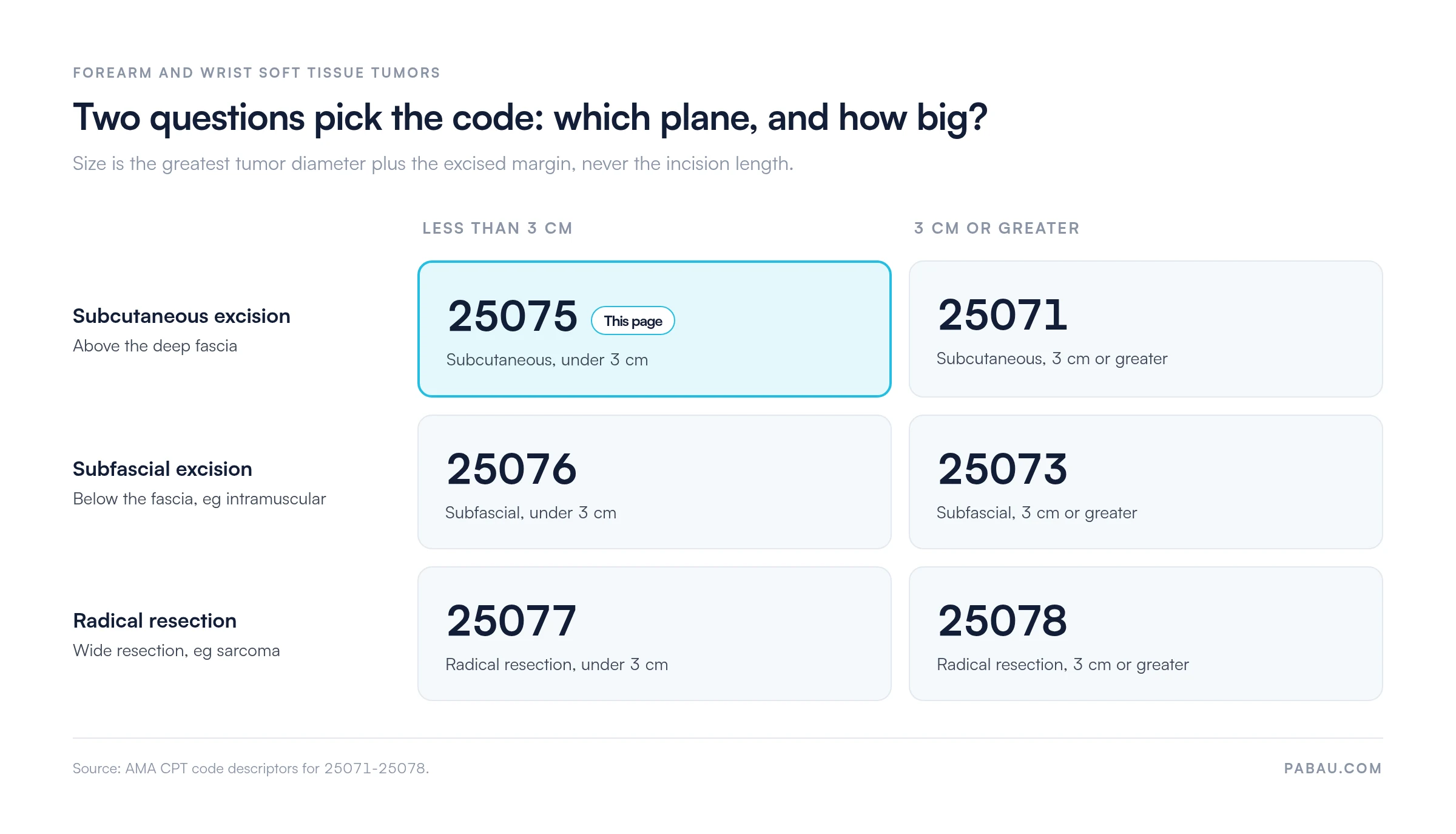
Size is the greatest tumor diameter plus the excised margin, so a subcutaneous tumor of 3 cm or more moves to 25071.
A tumor below the deep fascia goes to 25076 or 25073, and a radical resection goes to 25077 or 25078.
Billing a skin lesion code (11406) or an upper arm code (24075) for a forearm soft tissue tumor is a frequent cause of denials.
The operative note must record the site, the tissue plane and the measured size, or the claim is open to denial.
CPT code 25075 covers excision of a subcutaneous soft tissue tumor of the forearm or wrist. It applies when the tumor measures less than 3 cm. The American Medical Association (AMA) places it in the musculoskeletal surgery section of CPT. It sits in the forearm and wrist subsection, codes 25000-25999.
In practice, that means a benign lump such as a lipoma, removed from the fat above the deep fascia. Here are the parameters a coder checks first.
Use CPT code 25075 only when all four of these hold. If one fails, a different code applies.
Lipomas, fibromas, benign fibrous histiocytomas and other benign connective tissue tumors commonly qualify. Ganglion cysts don’t. A wrist ganglion goes to CPT 25111, or 25112 when it recurs.
Two more lookalikes need their own codes. A mass arising from a tendon sheath or joint capsule is reported with 25110. A lesion that starts in the skin belongs in the 11400 series instead.
Two questions settle the code in this family. Did the tumor sit above or below the deep fascia? And how big was it, margin included? Radical resection of a tumor such as a sarcoma has its own pair, 25077 and 25078.
CPT sizes these excisions by the greatest tumor diameter plus the excised margin. The length of the skin incision doesn’t count. Say a surgeon removes a 2 cm lipoma through a 4 cm incision. The claim is still 25075, as long as tumor and margin stay under 3 cm.
Auditors look for that measurement in the operative note or pathology report. An undocumented size is treated as missing, not assumed. The grid below shows how plane and size combine across the six codes.
Outside the 2507x family, two codes cause most of the confusion on forearm excisions. The difference comes down to anatomical site and tissue system, not surgical technique.
CPT 24075 covers the same subcutaneous tumor at the upper arm or elbow. So the operative note’s site wording decides it. A mass at the distal radius is 25075, while one at the lateral epicondyle is 24075.
CPT 11406 is an integumentary code for benign lesions that start in the skin. Using it for a forearm lipoma puts the claim in the wrong tissue system and the wrong fee schedule line. Payers audit this crossover, so check where the lesion arose before you pick the code.
Every CPT code 25075 claim rests on an operative report that supports each part of the descriptor. Miss one element and the claim is open to denial or recoupment.
Solid notes also support medical billing compliance during post-payment audits. A template that prompts the surgeon for each element at the point of care beats a retrospective addendum every time.
Build an operative note template for forearm and wrist soft tissue excisions with a mandatory field for tumor size in centimeters. Auditors read late addenda that add a size as a red flag, so capture the measurement during surgery.
CPT code 25075 takes the standard surgical modifiers. A wrong or missing modifier is a frequent cause of claim edits and payment delays.
When 25075 is the secondary procedure in a session, modifier -51 applies and payers cut its allowed amount by 50%. Billing it alongside a carpal tunnel release or fracture repair? Confirm with each payer whether -51 or -59 fits, because bundling edits vary by MAC.
The diagnosis has to show a benign soft tissue neoplasm or a discrete mass. An inflammatory, skin-origin or vascular lesion won’t support the excision. Payers screen diagnosis-to-procedure pairs, and a mismatch is a quick route to denial.
Document the diagnosis clinically before the procedure date. A diagnosis that first appears on the date of service, with no office visit note behind it, invites audit risk. Code the pre-operative finding, and let the pathology report confirm or refine it afterwards.
Under the Medicare Physician Fee Schedule (MPFS), CPT code 25075 carries work, practice expense and malpractice relative value units (RVUs). Medicare multiplies the total RVUs by the conversion factor. It then adjusts for the Geographic Practice Cost Index (GPCI) of the practice location.
Rates change every January, so we don’t publish dollar figures here. The CMS Physician Fee Schedule Look-up tool gives the current national and local rates for 25075. The FastRVU 2026 RVU lookup is a free second reference for the RVU components.
Facility and non-facility rates differ. The non-facility (office) rate is usually higher, because the practice supplies the equipment and supplies itself.
Traditional Medicare doesn’t routinely require prior authorization for CPT code 25075. Medicare Advantage plans and commercial insurers often do for elective soft tissue excisions. Send these with the request:
Requirements vary by plan and change every year, so verify them before you schedule. Practices submitting claims electronically through Claim.MD can check eligibility ahead of the appointment, which cuts same-day surprises at billing.
Denials on CPT code 25075 follow a predictable pattern. Most start with thin documentation or the wrong code, and a short pre-billing review catches them.
Each rejection comes back with a reason code, and the medical billing denial codes tell staff where to start. Three reason codes are frequent causes of denial for excision claims. They are CARC 11 (diagnosis inconsistent with procedure), CARC 4 (modifier inconsistent or missing) and CARC 50 (not medically necessary).
A good denial management workflow routes each reason code to a pre-built appeal template. That way, staff don’t start from scratch on every rejection.
Medicare gives CPT code 25075 a 90-day global surgical period. The package covers same-day pre-operative care, the procedure itself and routine post-operative care for 90 days. Bill any of these separately and expect a denial or recoupment.
The classic global period error is a routine wound check billed as a separate E&M visit. That visit is bundled and can’t be billed. Only an unrelated problem takes modifier -24 (unrelated E&M), and an unrelated procedure takes modifier -79.
Billing routine follow-up anyway is an overclaim, and it carries False Claims Act risk. Claims management software that holds each claim until its required fields are complete gives your team one more checkpoint before submission.
Flag every patient billed with CPT code 25075 for 90 days. Any E&M or procedure claim for that patient inside the window should get a modifier check before it goes out.
Each line below maps to one of the denials above. A quick pass now costs far less than an appeal later.
Many of the errors above start as a detail that never made it onto the claim form. A coder retypes the code from the operative note, drops the laterality modifier, or sends the claim before the authorization number is on file.
Pabau, the practice management and billing platform we build, pre-fills the claim from the patient record. The CPT code attached to the service lands on the charge line, and the diagnosis slots draw on the recorded problem list. The claim can’t be sent until required fields, such as membership numbers and authorization codes, are complete.
For US practices, Pabau submits through Claim.MD, checks eligibility before the visit and posts remittances when payment arrives. Each step makes a clean claim on the first pass more likely, so your team spends less time on appeals.

Pabau pre-fills each claim from the patient record and holds it until required fields are complete. Fewer 25075 claims come back for rework.

CPT code 25075 rewards precision more than speed. Confirm the plane, measure the tumor with its margin, and match the forearm site. Get those three right and the code almost picks itself.
The trade-off is a little extra time in the operating room. A surgeon who records the measurement there saves the coder a query and the practice an appeal. Build that field into your operative note template now, before an audit forces the change.
Book a demo to see how Pabau pre-fills forearm excision claims from the patient record before they reach the payer.

Need a reference for the medical billing process from charge capture to payment? What is medical billing walks through each stage of the revenue cycle with practical workflow guidance.
Want to understand how electronic remittance advice connects to denial resolution? Electronic remittance advice explained covers ERA file structure, CARC codes, and how to automate posting.
Looking for guidance on submitting 837P claims electronically? 837 file overview explains the transaction format and what payers validate at intake.
Use 25071 when the subcutaneous tumor is 3 cm or greater, and 25075 when it’s smaller. Measure the greatest tumor diameter plus the excised margin. If the tumor sits below the deep fascia, neither code fits. 25076 is the subfascial code for tumors under 3 cm.
11406 is an integumentary code for excising a benign skin lesion with an excised diameter over 4.0 cm, on the trunk, arms or legs. 25075 covers a soft tissue tumor in the subcutaneous layer of the forearm or wrist. Choose by where the lesion arises.
Simple and intermediate repair are included in 25075, so don’t report them on their own. A complex repair, such as one needing extensive undermining, can be reported separately. Document the closure method and wound length so the repair code holds up.
No, the procedure code follows what the surgeon did. The diagnosis changes instead, for example to a C49.1- code for a malignant soft tissue tumor of the upper limb. A planned wide resection for a sarcoma would go to 25077 or 25078.
Report each separately excised tumor on its own line, sized by its own measurement. Add laterality to both lines. When the payer’s edits require it, add modifier 59 or XS to the second line.