

CCSD Code D1010: Radical mastoidectomy including meatoplasty
CCSD Code D1010: Definition and clinical scope CCSD Code D1010 is the UK private...

Last Updated: Nov 25, 2026
T6000 is the CCSD code for repeat excision of ganglion, a surgical operation to remove a ganglion that has come back after an earlier excision. It applies when the surgeon cuts out a recurrent ganglion at or near the site of the first operation, most often at the wrist.
The code sits in chapter 16 of the CCSD schedule used by UK private medical insurers, under connective tissue, tendon and muscle. A first excision of a ganglion is billed as T5900.
Let Pabau's smart automation suggest the right codes, reduce claim denials, and keep your practice compliant—effortlessly.
Automate repetitive tasks and focus on what matters most—your patients.
Reduce coding errors and ensure compliance with the latest regulations.
Clean claims, fewer denials, and faster reimbursements.
Powerful insights and reporting to help your practice thrive.
HIPAA compliant SOC 2 certified GDPR-compliant Trusted by 4,000+ clinics worldwide

CCSD code T6000 covers repeat excision of a ganglion. A first operation on the ganglion is billed as T5900 instead.
CCSD is the Clinical Coding & Schedule Development Group, whose codes UK private medical insurers such as Bupa, AXA Health and Aviva use.
National Friendly’s October 2025 schedule bands T5900 and T6000 as Intermediate, with the same £303 fee for both.
UK claims pair T6000 with WHO ICD-10 code M67.4, Ganglion. US ICD-10-CM codes don’t belong on a UK claim.
Most insurers expect pre-authorization for planned surgery, so get the reference number before the operation date.
CCSD code T6000 is the code UK private medical insurers use for repeat excision of a ganglion. Insurer schedules built on CCSD, such as National Friendly’s schedule of fees, list it with the narrative “Repeat excision of ganglion”.
CCSD stands for the Clinical Coding & Schedule Development Group. It was formed by the UK private health sector to set one standard of procedure codes for reimbursement. Bupa, AXA Health, Aviva, Vitality and WPA all bill against CCSD codes from its schedule.
A ganglion is a benign, fluid-filled swelling that grows from a joint capsule or tendon sheath, most often at the wrist. T6000 applies when a ganglion has come back after an earlier surgical excision and the surgeon removes it again. A first excision is billed as T5900.
The CCSD Group revises its schedule over time, and each insurer prints its own edition. Check the version your payer works from before you invoice.
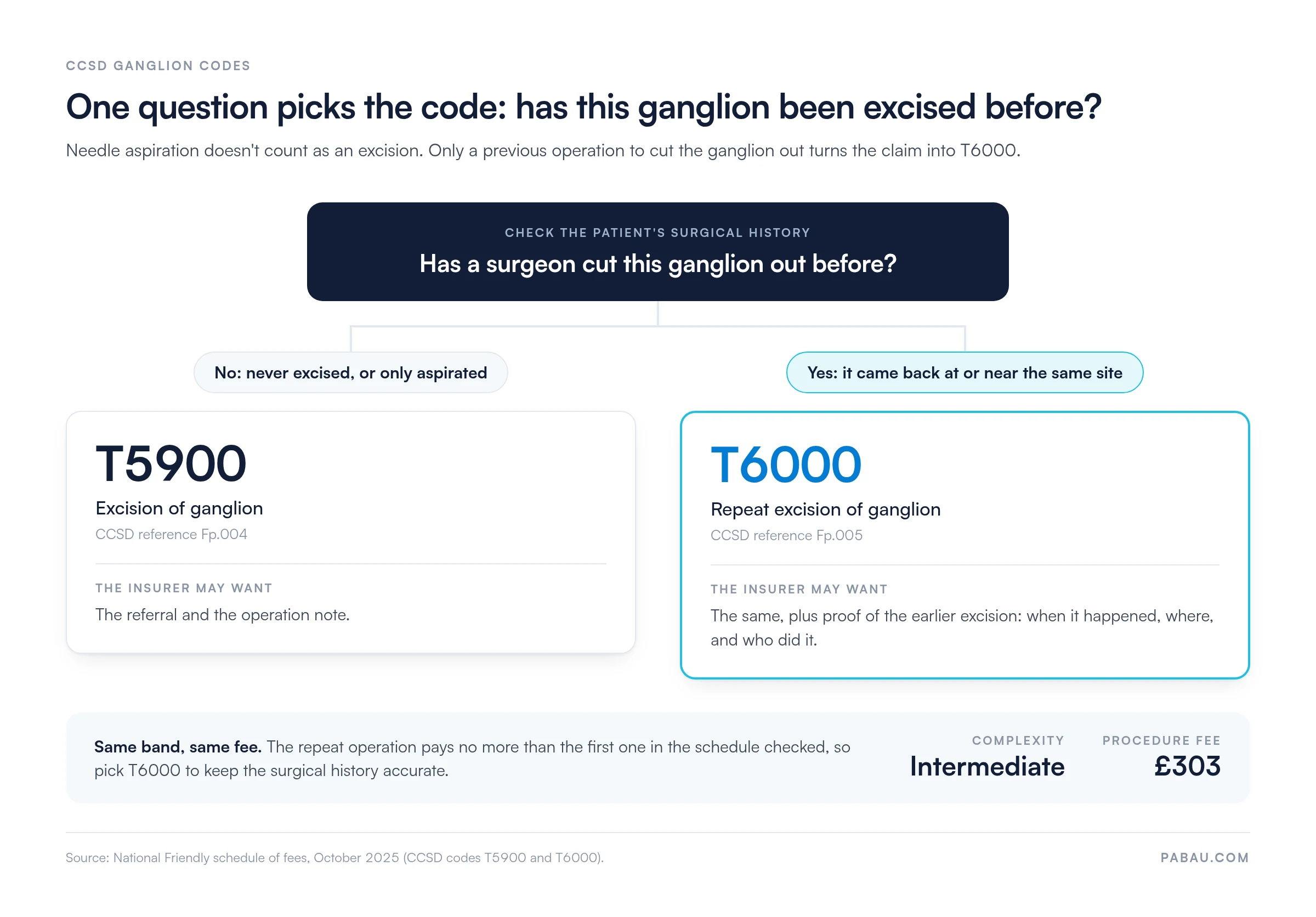
The two ganglion codes sit side by side in chapter 16, and only the patient’s surgical history separates them. If the ganglion has never been cut out before, the claim is CCSD code T5900. If it was excised and has come back, the claim is T6000.
The schedule we checked pays the same fee for both codes, even though a repeat operation means dissecting through scar tissue. The reason to code T6000 correctly is the record. It tells the insurer, and the next coder, that the ganglion has been operated on before. Fees differ between insurers, so check each payer’s own figure.
Aspiration doesn’t count as an earlier excision. A ganglion that was only drained with a needle, then cut out for the first time, is billed as T5900. Never put T5900 and T6000 on one claim for the same ganglion, because one operation is either a first excision or a repeat. The diagram below sums up that decision.
A repeat excision is harder than a first one. Scar tissue from the earlier operation hides the normal planes, so the surgeon dissects more slowly around nerves and vessels. The aim is to remove the cyst together with its stalk and the patch of capsule or sheath it grows from.
Recurrent ganglia tend to appear at the same sites as first-time ones:
When a UK insurer asks for a diagnosis, the code for a ganglion is M67.4, Ganglion. The UK uses the WHO edition of ICD-10, and the ICD-10 5th Edition defines M67.4 as a ganglion of a joint or tendon sheath. It is a four-character code, and the UK edition adds no site character to it.
Two exclusions matter here. A cyst of a bursa or of the synovium is coded M71.2 to M71.3, not M67.4. And US ICD-10-CM codes such as M67.431 add laterality that the UK edition doesn’t use, so they shouldn’t appear on a UK claim.
A T6000 claim is only as strong as the note behind it. If the note reads like a first excision, the coder may pick T5900, or the insurer may query the code. Record these points every time:
Ask surgeons to title repeat operations “Repeat excision of ganglion” with the site, such as “Repeat excision of ganglion, left dorsal wrist”. The title then carries the code decision, and the coder doesn’t have to search the body of the note.
The work starts before the operation. Most insurers want planned surgery approved in advance, and the patient’s policy decides what is covered. Use the table as a starting point, then confirm each detail with the payer.
Once the operation is done, the claim follows the same steps whichever insurer pays it:
The anesthetist bills their own fee for the same operation, on a separate invoice. An assistant surgeon is a different matter. Under Bupa’s benefit limits, hospitals cover the cost of assistant surgeons, while a second operating surgeon can still charge. Other insurers set their own rules, so ask before the operation.
If T6000 is performed in the same session as another operation, each procedure carries its own CCSD code. The CCSD technical guide explains that some codes can’t be billed together, and the CCSD website lists those combinations for each code.
Each slip below can get a T6000 claim queried or returned, and each one has a direct fix.
If a claim is still refused, check the insurer’s current provider manual for its appeal process. Only commit to a deadline you have confirmed there.
In many hand and orthopedic practices, the authorization sits in an email and the operation note sits in another system. The claim is then keyed in by hand. Each handoff is a chance to lose the reference number or pick the wrong ganglion code.
Pabau keeps those steps on the patient record. Its claims management software sends claims electronically through Healthcode and to Bupa. The authorization code and dates sit on the patient’s case, with a warning when one is missing.
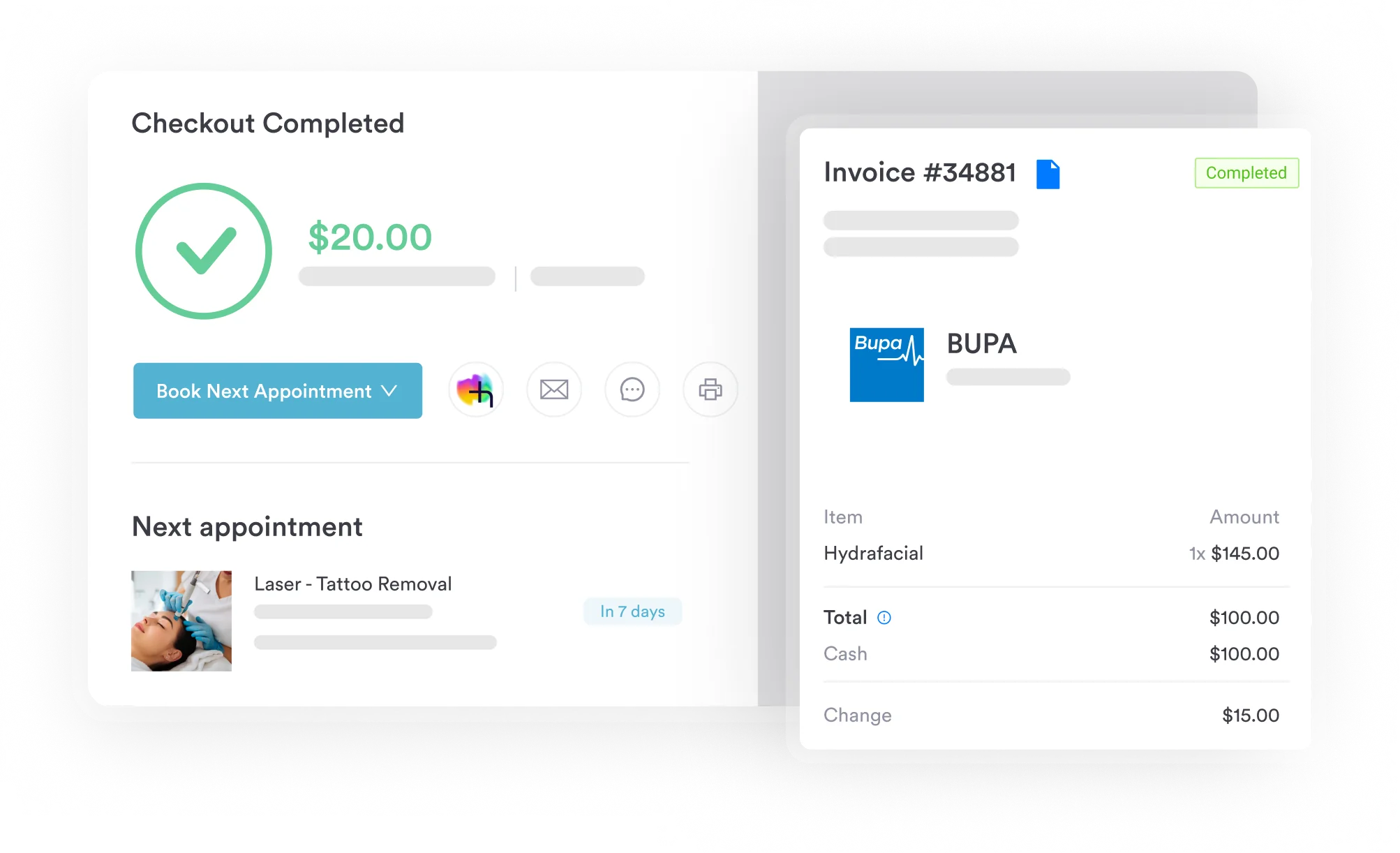
The earlier excision sits in the same record as the new operation note. The coder sees that history before choosing between T5900 and T6000. Your team spends less time on rework and more time on patients.

Pabau keeps the operation history, authorization codes and claims on one patient record. Claims go electronically through Healthcode and to Bupa, and you see each one’s status without phoning the insurer.

T6000 is a straightforward code once the note proves the ganglion has been cut out before. Most trouble comes from a note that reads like a first excision, an old fee schedule or a missing authorization. You can catch all three before the claim leaves.
Ask surgeons to name the repeat in the procedure title, and check each insurer’s current fee before you invoice. Those two habits remove most of the queries that slow ganglion payments. Book a demo to see how Pabau tracks authorizations and sends your Healthcode claims from one patient record.

Billing a first ganglion excision instead? CCSD code T5900 covers excision of a ganglion with no earlier operation on it.
Need a full Bupa CCSD billing reference? Bupa CCSD codes covers Bupa’s procedure list and how its claims work.
Checking Bupa fees before you invoice? Bupa procedure codes and fee schedule explains how to look up a code’s fee.
CCSD code T6000 covers repeat excision of a ganglion. It applies when a ganglion has come back after an earlier surgical excision and is removed again. A first excision is billed as T5900.
T5900 is excision of a ganglion that has never been operated on. T6000 is a repeat excision after an earlier operation. National Friendly’s October 2025 schedule bands both as Intermediate, with the same £303 fee.
Usually, yes. Most UK private insurers, including Bupa, expect planned surgery to be authorized before it happens. Get the reference number before the operation date and put it on the claim.
UK claims use WHO ICD-10 code M67.4, Ganglion. The UK edition has no site fifth character for it. US ICD-10-CM codes don’t apply.
No. Aspiration drains the cyst with a needle and isn’t a surgical excision. The first operation to cut the ganglion out is billed as T5900, even if it was aspirated before.
The anesthetist sends a separate invoice for their own fee for the same operation. It never goes on the surgeon’s claim. Check the insurer’s anesthetist schedule for the amount.
Bupa, AXA Health, Aviva, Vitality, WPA and Healix all work from CCSD-based schedules. Cover still depends on the patient’s policy, so confirm it with the payer first.




