CPT Code 27425: Lateral retinacular release billing guide
CPT Code 27425: Official descriptor and procedure overview CPT code 27425 is def...

Last Updated: Nov 16, 2026
25071 is the CPT code for excision, tumor, soft tissue of forearm and/or wrist area, subcutaneous; 3 cm or greater.
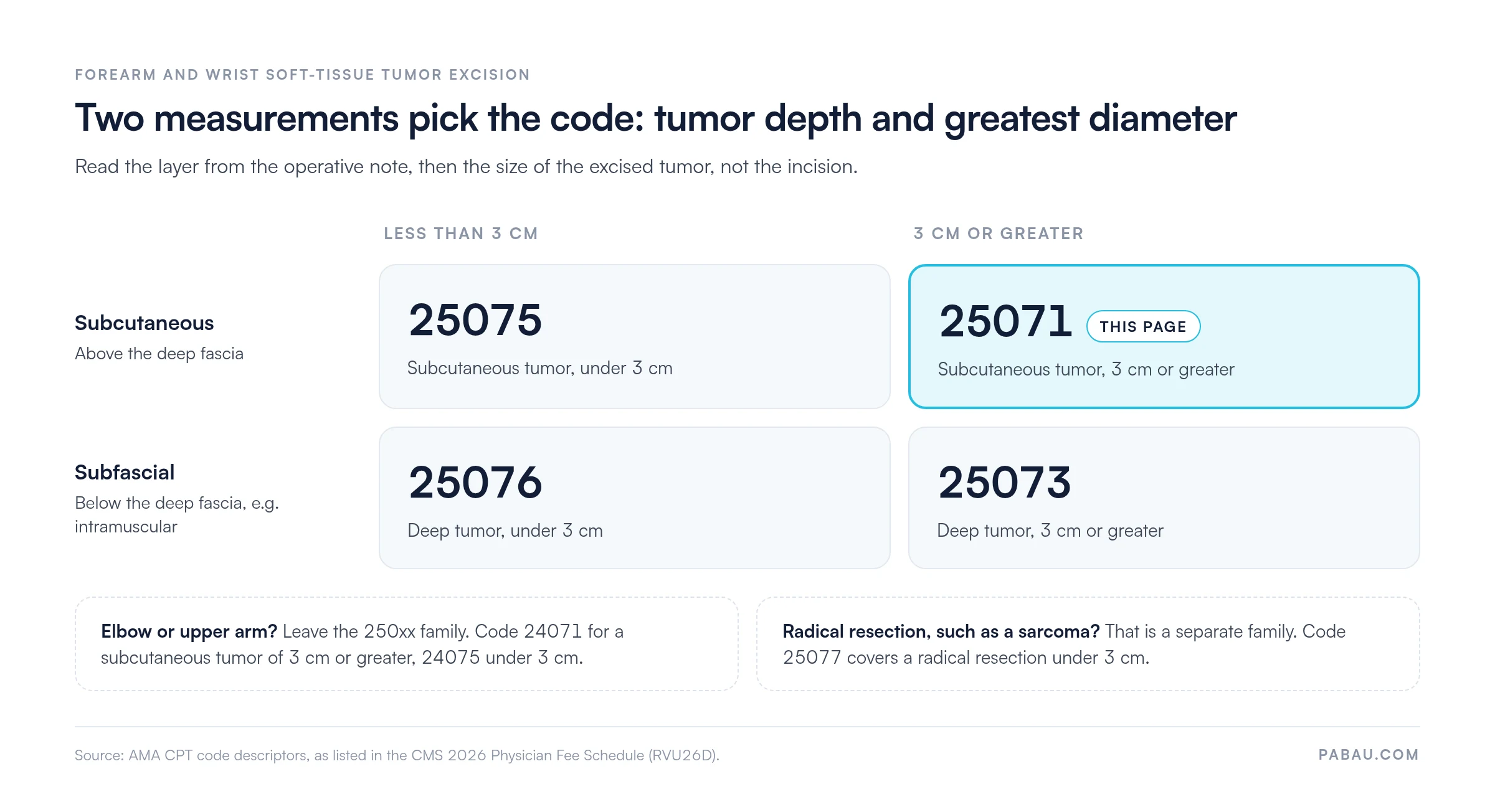
It is one of four forearm and wrist excision codes split by tumor depth and size. A subcutaneous tumor under 3 cm takes 25075, and a deep tumor takes 25076 or 25073. Medicare pays 25071 as major surgery with a 90-day global period.
Let Pabau's smart automation suggest the right codes, reduce claim denials, and keep your practice compliant—effortlessly.
Automate repetitive tasks and focus on what matters most—your patients.
Reduce coding errors and ensure compliance with the latest regulations.
Clean claims, fewer denials, and faster reimbursements.
Powerful insights and reporting to help your practice thrive.
HIPAA compliant SOC 2 certified GDPR-compliant Trusted by 4,000+ clinics worldwide

CPT code 25071 covers excision of a subcutaneous forearm or wrist tumor that measures 3 cm or greater at its greatest diameter.
Size is measured at the tumor itself, not the incision length. Documenting the wrong measurement is the top denial trigger.
Select 25075 for subcutaneous tumors under 3 cm, 25076 or 25073 for deep tumors, and 24071 for an elbow or upper arm tumor.
Medicare’s 2026 fee schedule lists 25071 as major surgery, with a 90-day global period and 5.76 work RVUs.
Pabau’s claims management software codes from the operative note and submits 25071 claims through the Claim.MD clearinghouse.
CPT code 25071 describes the surgical excision of a subcutaneous soft-tissue tumor of the forearm or wrist whose greatest diameter is 3 cm or greater. The descriptor is maintained by the AMA’s CPT Editorial Panel. It reads: Excision, tumor, soft tissue of forearm and/or wrist area, subcutaneous; 3 cm or greater.
The code sits in the musculoskeletal system section of CPT (codes 20100-29999), within the forearm and wrist subsection (25000-25999). Medicare treats it as major surgery with a 90-day global period.
The surgical package covers the operation, local anesthesia, and routine follow-up visits in that window. If surgical claims are new to your team, our guide to medical billing fundamentals explains how a code moves from the chart to a claim.
CPT code 25071 covers excision of a single subcutaneous soft-tissue tumor on the forearm or wrist measuring 3 cm or more at its greatest diameter. Subcutaneous means the tumor lies above the deep fascia. The code does not distinguish by tumor type, so a lipoma or another benign subcutaneous mass qualifies when the site and size criteria are met.
The following list clarifies what 25071 does not cover:
The difference between CPT 25071 and 25075 is a single measurement. CPT 25071 applies when the tumor is 3 cm or greater in greatest diameter, and 25075 applies when it is smaller. Both codes cover subcutaneous tumors of the forearm and wrist, so size is the only deciding variable.
The measurement that matters is the greatest diameter of the excised tumor, not the length of the skin incision.
A surgeon may make a 5 cm incision to remove a 2.4 cm lipoma, and the correct code is still 25075. Operative notes that record incision length rather than tumor size are a leading denial trigger, because payers cannot tell which code applies.
CPT 25071 and CPT 25076 both cover forearm and wrist tumor excision, but they describe different tissue layers. CPT code 25071 is for subcutaneous tumors above the deep fascia. CPT 25076 covers deep or subfascial tumors under 3 cm, and CPT 25073 covers deep tumors of 3 cm or greater.
Payers require the operative note to explicitly state the layer. Phrases such as “within the subcutaneous fat” or “superficial to the deep fascia” support 25071. If the note says “beneath the fascia,” “intramuscular,” or “subfascial,” 25071 will be denied in favor of the deep-tumor codes.
When depth is ambiguous, payers often downcode to 25075, the lower-valued subcutaneous code in a facility setting. Put depth and size together and each of the four codes gets its own cell, as the grid below shows.
An excision coded to CPT code 25071 follows a standard outpatient surgical workflow. The operative note must capture each element listed below for the claim to survive payer review.
Document tumor size in centimeters in both the operative note and the pathology requisition. When the two records carry different measurements, payers may downcode to 25075 regardless of what the surgeon recorded.
Every CPT code 25071 claim requires a supporting ICD-10-CM diagnosis code that establishes medical necessity. The diagnosis must reflect the nature of the tumor and its forearm or wrist location. Payers cross-reference the CPT and ICD-10 codes on the claim to determine whether the procedure is clinically appropriate for the documented condition.
Always use the most specific laterality code available. D21.10, the unspecified code, triggers payer requests for more documentation and delays payment. A confirmed lipoma takes D17.21 or D17.22 rather than a D21 code. Confirm every ICD-10-CM code against the current fiscal year’s tabular list, since codes update each October.
Medicare payment for CPT code 25071 is calculated from the Relative Value Unit (RVU) values published in the annual CMS Physician Fee Schedule (MPFS). Reimbursement rates are locality-adjusted and change each January. Always confirm current figures in the CMS Physician Fee Schedule lookup tool before quoting payment amounts to surgeons or billing staff.
The table below gives the national RVUs that CMS’s 2026 relative value file lists for CPT code 25071. CMS flags the code as rarely performed in an office, so the non-facility and facility values match.
At the 2026 conversion factor of $33.4009, the 12.11 total RVUs come to about $404 nationally before locality adjustment. FastRVU’s 2026 RVU lookup applies your geographic adjustment factor.
Applying the wrong modifier to CPT code 25071, or omitting a required one, is a consistent source of denials. The table below covers the modifiers coders meet most often with forearm subcutaneous tumor excisions. Our guide to medical billing compliance covers the audit rules behind modifier use.
Prior authorization (PA) requirements for CPT code 25071 vary by payer and plan. Medicare does not require prior authorization for 25071 as a standard rule, but it does require documented medical necessity.
The clinical record must show why excision was indicated, such as symptom burden, growth, or the need to rule out malignancy. The code alone does not justify payment.
Commercial payers are inconsistent. Some require PA for any soft-tissue excision, while others require it only for specific diagnosis codes. A PA request usually needs the same documentation as a clean claim:
Turnaround times run from 1 to 5 business days for most commercial payers, though complex or high-cost plans may take longer.
Most CPT code 25071 denials share one root cause. The operative note does not give the payer enough to confirm the size, depth, or site criteria. A structured denial management workflow and a working knowledge of medical billing denial codes help billing teams catch these patterns early.
Run a quarterly audit of your 25071 denials and filter by denial code. If CO-4 (procedure code inconsistent with modifier) or CO-16 (claim lacks information) dominate, the template is the problem. Add a mandatory size-and-depth field to your operative note template.
Most 25071 denials begin in the operative note, before anyone opens the claim. A tumor size recorded as incision length, or a layer left unstated, travels onto the claim exactly as written.
Pabau, the practice management platform we build, keeps the operative note and the claim in one patient record. Your billing team codes from the note itself, so the diameter and the fascial layer are on screen when 25071 is selected. Our claims software for surgeons also runs eligibility checks before the appointment.
Claims go out through the Claim.MD clearinghouse, which connects to thousands of US payers. Remittance data comes back against the same record, so a downcode to 25075 is visible as soon as the remittance arrives.

Pabau links your operative notes to claim generation and routes CPT 25071 claims through Claim.MD to thousands of US payers. Eligibility checks run before the patient arrives.

A 25071 claim stands or falls on two lines in the operative note: the tumor’s greatest diameter and the layer it came from. Write both in plain words on the day of surgery, and the modifiers and the ICD-10 pairing follow from them.
The 90-day global period is the trade-off to plan around. Follow-up visits in that window are already paid for, so schedule them without billing them separately. Book a demo to see how Pabau keeps surgical notes and claim submission in one workflow.

Need a broader overview of the claims submission process? What is revenue cycle management explains how claim capture, submission, and denial management connect across a practice’s billing workflow.
Looking for a plain-language explanation of clearinghouse billing? Claim.MD clearinghouse guide covers how Pabau’s US clearinghouse partner routes claims and returns remittance data.
Want to understand how superbills feed into CPT claims? Medical superbill guide walks through how a completed superbill translates into a clean CMS-1500 claim for CPT procedure codes.
Billing the smaller subcutaneous tumor? CPT code 25075 covers forearm and wrist excisions under 3 cm, with the same depth and documentation rules.
Tumor sits at the elbow or upper arm? CPT code 24071 is the upper arm and elbow counterpart for subcutaneous tumors of 3 cm or greater.
CPT code 25071 covers surgical excision of a subcutaneous soft-tissue tumor on the forearm or wrist when its greatest diameter is 3 cm or greater. It includes the operation and routine follow-up during the 90-day global period. Deep tumors take 25076 or 25073, and tumors under 3 cm take 25075. A subcutaneous elbow or upper arm tumor of 3 cm or greater takes 24071.
The threshold is 3 cm. Use CPT 25071 when the tumor’s greatest diameter is 3 cm or greater, and CPT 25075 when it is less than 3 cm. The measurement is taken at the excised tumor itself, not the skin incision. Operative notes that record incision length rather than tumor size cannot support 25071 and are routinely downcoded to 25075.
RT or LT shows laterality and is expected on most claims. Modifier 51 marks 25071 as a secondary procedure on the same date, and modifier 59 marks a distinct procedure at a different site. Modifier 22 signals unusually complex work and needs an operative note that explains it.
Medicare does not require prior authorization for CPT code 25071 as a standing rule, but it does require documented medical necessity. Commercial payers vary widely. Some require prior authorization for all soft-tissue excisions, and others only for specific diagnosis codes. Check the payer’s current policy before scheduling, and record symptoms, imaging findings, and the clinical indication in the pre-operative note.
Yes, when two separate tumors are excised at distinct sites on the same date and each meets its own size criterion. Append modifier 59 to the lower-valued code to establish the distinct service. Without modifier 59, payers bundle the codes and reject the secondary procedure. Document the site and size of each tumor separately in the operative note.
The most common reason is incomplete size documentation. The operative note records incision length instead of tumor diameter, or omits a measurement, so the payer downcodes to 25075. Other causes include an unstated tissue layer, a missing laterality modifier, and an elbow tumor coded as 25071 instead of 24071. Bundling two procedures without modifier 59 is another.
Yes, when the lipoma is subcutaneous and measures 3 cm or greater in greatest diameter. Lipoma is the most common subcutaneous tumor excised from the forearm. Pair it with ICD-10-CM D17.21 for the right arm or D17.22 for the left arm. Make sure the pathology report confirms the lipoma, which supports both the CPT selection and medical necessity.