

HCPCS Code Q4185: Cellesta flowable amnion billing guide
HCPCS Code Q4185: definition and official descriptor HCPCS Code Q4185 is the Lev...

Last Updated: Nov 20, 2026
Billable Code
26111 is the CPT code for excising a subcutaneous soft-tissue tumor or vascular malformation of the hand or finger that measures 1.5 cm or greater. The lesion sits above the deep fascia, and the operative note records its measured size.
It belongs to a four-code hand family split by size and depth. 26115 covers subcutaneous lesions under 1.5 cm, 26116 covers subfascial lesions under 1.5 cm, and 26113 covers subfascial lesions of 1.5 cm or greater.
Let Pabau's smart automation suggest the right codes, reduce claim denials, and keep your practice compliant—effortlessly.
Automate repetitive tasks and focus on what matters most—your patients.
Reduce coding errors and ensure compliance with the latest regulations.
Clean claims, fewer denials, and faster reimbursements.
Powerful insights and reporting to help your practice thrive.
HIPAA compliant SOC 2 certified GDPR-compliant Trusted by 4,000+ clinics worldwide

CPT 26111 covers excision of a subcutaneous tumor or vascular malformation of the hand or finger measuring 1.5 cm or greater. Skin excision and debridement use other codes.
Size and depth decide the code. A subcutaneous lesion under 1.5 cm is 26115, and a subfascial lesion of 1.5 cm or greater is 26113.
The operative note must record the measured lesion size. An estimated or missing measurement is the leading denial reason for this code.
A ganglion or tendon-sheath cyst of the hand or finger is reported with 26160, not 26111.
Pabau, the practice management platform we build, sends 26111 claims through the Claim.MD clearinghouse, runs eligibility checks and tracks each claim to its ERA remittance.
CPT code 26111 describes the excision of a subcutaneous soft-tissue tumor or vascular malformation of the hand or finger measuring 1.5 cm or greater. The American Medical Association (AMA) maintains the CPT code set and publishes the official descriptor. It reads: “Excision, tumor or vascular malformation, soft tissue of hand or finger, subcutaneous; 1.5 cm or greater.”
The code belongs to the musculoskeletal surgery section of the CPT codebook, within the hand and finger subsection (26010-26989). It applies to benign subcutaneous neoplasms such as lipomas and to vascular anomalies such as hemangiomas. The dissection must stay above the deep fascia, and the measured size must meet the threshold. A ganglion or tendon-sheath cyst of the hand or finger is not a tumor excision and is reported with 26160 instead.
The procedure covered by CPT code 26111 is a subcutaneous excision. The surgeon dissects through skin and subcutaneous fat to reach the tumor, removes it, and closes the wound. The plane deep to the fascia is never entered. Payers audit that depth directly, because it decides between 26111 and 26113.
Practices billing this code should build these six clinical elements into the operative note template, so each one is captured every time.
This code does not apply to skin lesion excisions (use codes in the 11400-11446 range), debridement procedures (see CPT 11042-11047), or trigger finger releases (26055). Applying 26111 to a skin-level lesion is a common upcoding error that generates medical necessity denials.
The four codes in this family differ on two axes: Lesion size and tissue depth. A subfascial lesion under 1.5 cm is 26116, and the grid below shows where each code sits. Getting either axis wrong means an underpayment from downcoding or a denial.
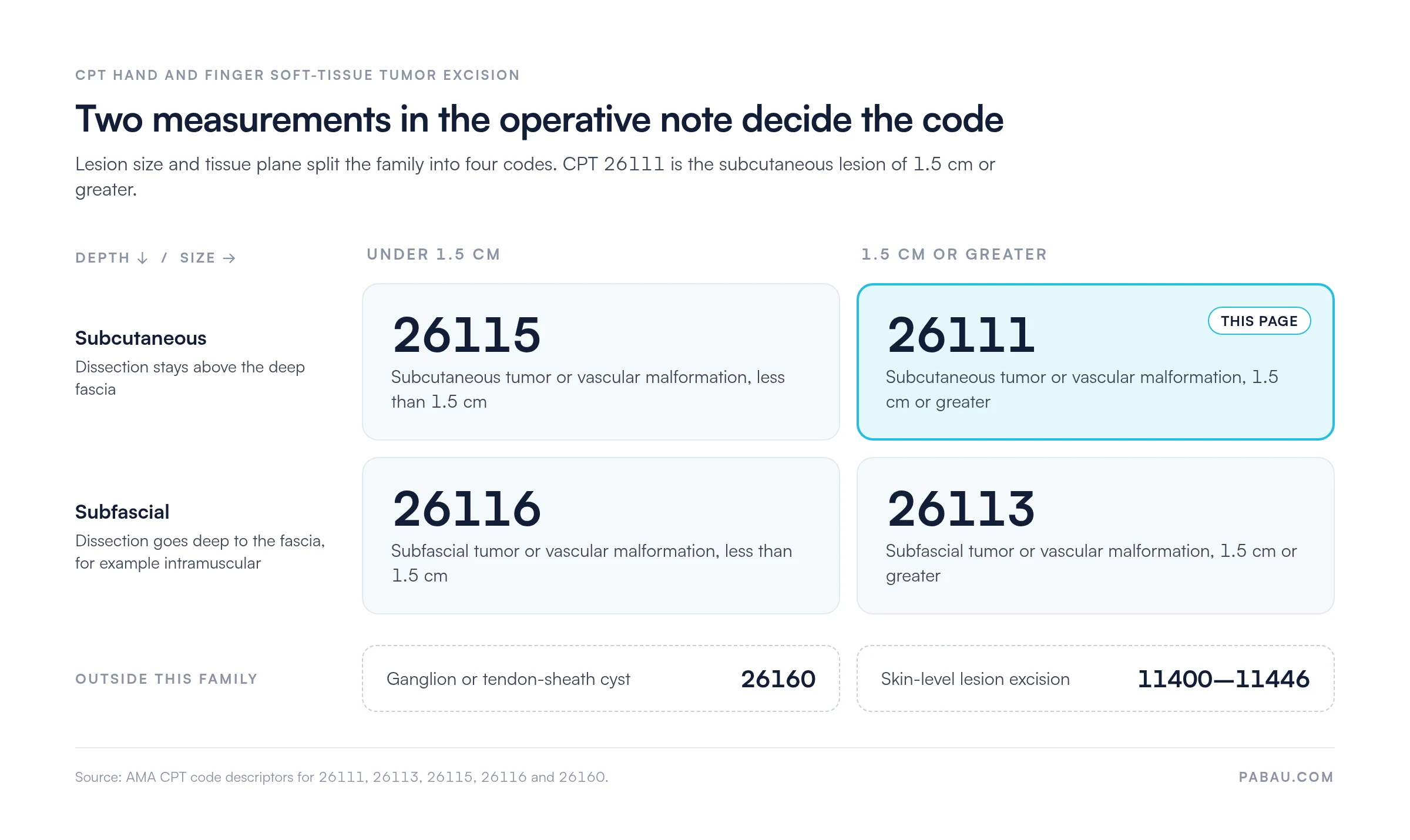
Size is measured from the excised specimen, not the pre-operative imaging estimate. A lesion that appeared 2 cm on ultrasound but measured 1.3 cm on the pathology report should be billed as 26115, not CPT code 26111. Document the discrepancy in the operative note to defend the code selection if queried.
CPT code 26111 needs an ICD-10-CM diagnosis that supports both medical necessity and the site, a subcutaneous lesion of the hand or finger. Pairing it with the wrong diagnosis is a common denial trigger.
When pathology has not yet returned at the time of billing, use the clinical working diagnosis, such as D21.1- for a soft-tissue mass. Update the claim with the confirmed pathology code if the payer accepts amended submissions. Never use a malignant neoplasm code with CPT code 26111. A malignancy requires wider excision and different coding entirely.
Documentation is the backbone of a payable 26111 claim. Payers audit these elements on recoupment requests and prior authorization reviews. The operative note must include all of the following.
Understanding medical billing fundamentals helps front-desk and billing staff recognize which operative note elements are non-negotiable before a claim is submitted.
Modifier selection for CPT code 26111 depends on the number of lesions excised, their anatomical location, and whether other procedures were performed the same day.
When excising tumors on two separate digits of the same hand on the same operative day, bill CPT code 26111 twice with different digit modifiers. Do not combine both excisions under a single line item.
Medicare reimbursement for CPT code 26111 is calculated using the Medicare Physician Fee Schedule (MPFS). The Centers for Medicare and Medicaid Services (CMS) updates it annually. Rates vary by locality through the Geographic Practice Cost Index (GPCI). Use the CMS Physician Fee Schedule lookup tool for the current-year rate at your practice location.
The 90-day global surgery period means that routine post-operative visits within 90 days of the procedure are bundled into the payment for CPT code 26111. Separate billing for a standard wound check in that window will be denied. If a new, unrelated problem is addressed during a post-operative visit, append modifier -24 (unrelated E/M service) and document the separate issue clearly.
Commercial payers typically reimburse at a percentage of the MPFS, though rates vary by contract.
Many commercial health plans and Medicare Advantage plans require prior authorization for CPT code 26111 before the procedure is performed. Payer requirements change and vary by plan, so verify authorization requirements directly with the insurer before scheduling the case. When prior authorization is required, payers generally apply the following medical necessity criteria.
When prior authorization is obtained, the authorization number must appear on the claim. A claim submitted after the authorization window expires is treated as if no authorization existed.
Most 26111 denials trace back to the operative note rather than to the code itself. Each cause below pairs with the fix that prevents it.
Reviewing medical billing denial codes alongside your CARC/RARC explanations helps billing staff categorize these rejections quickly. Structured denial management workflows then send each denial type to its fix, such as an operative note amendment or an appeal.
Bundling awareness is essential when CPT code 26111 appears on the same claim as other hand surgery codes. The National Correct Coding Initiative (NCCI) edits establish which code pairs are mutually exclusive or require a modifier to override bundling. Verify the current quarter’s edits at the CMS NCCI tables – edits are updated quarterly.
A clean claim for CPT code 26111 starts with checking every NCCI edit pair before the claim leaves your billing system. The AAPC Codify CPT lookup includes NCCI edit indicators alongside code descriptors, which speeds up pre-submission bundling checks.
On a typical hand surgery case, a biller reads the operative note, keys the code and digit modifier, and submits the claim. Follow-up then depends on someone remembering which claims are still open.
In Pabau, US claims go out electronically as CMS-1500/837P claims through the Claim.MD clearinghouse, which connects to thousands of US payers. The practice runs eligibility checks before surgery, and ERA remittances come back into the same system.
Prior authorization is tracked on the patient’s case, with the auth code, dates and sessions recorded and a warning when one is missing. Pabau’s claims management software then tracks each 26111 claim from submission to remittance. Billing staff can see which claims are still outstanding before they age.
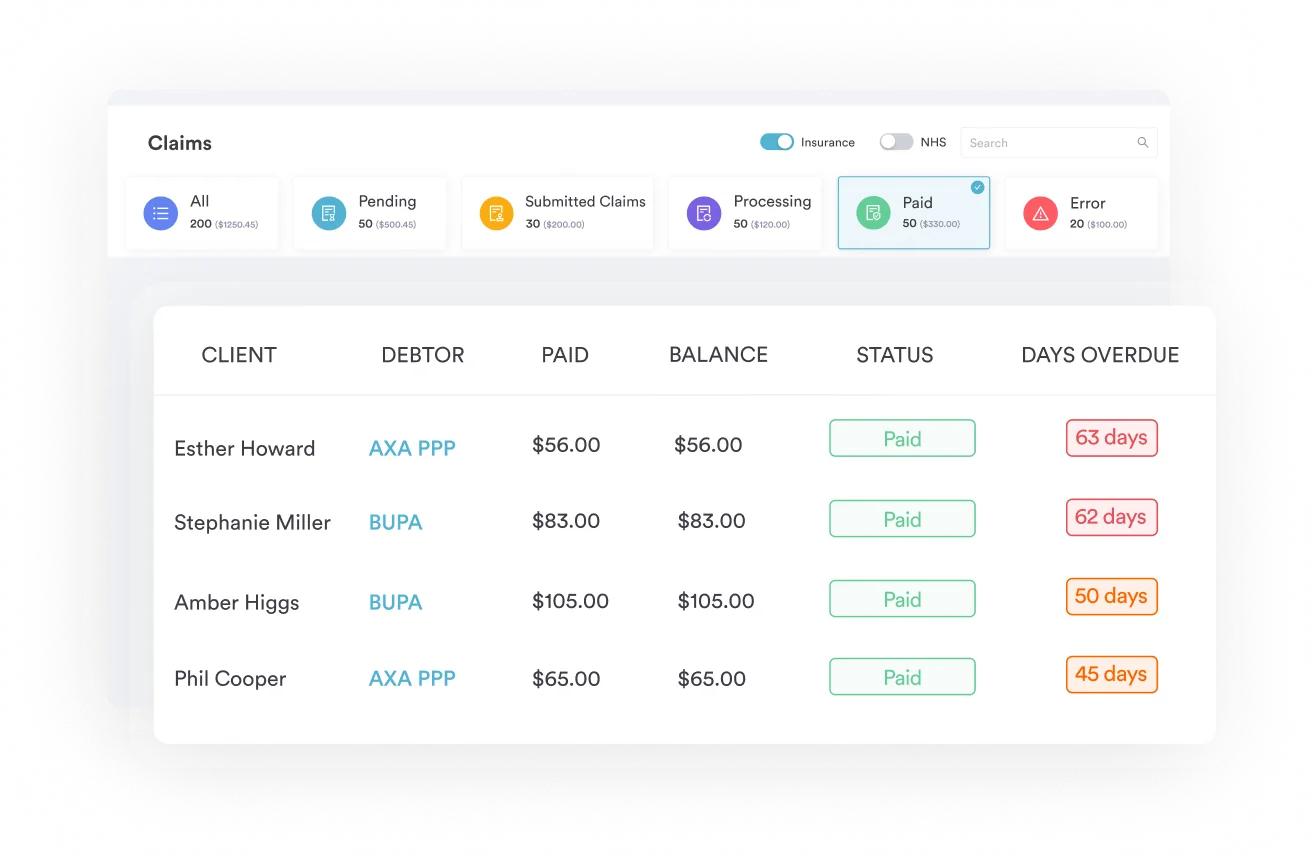

Pabau sends CPT 26111 claims electronically through Claim.MD, checks patient eligibility before surgery, and tracks every claim to remittance. See how it works for hand and plastic surgery practices.

CPT code 26111 pays cleanly when the operative note settles two facts: The measured lesion size, and a dissection that stayed above the deep fascia. With both written down, the choice between 26111, 26113, 26115 and 26116 follows from the note rather than from a guess at the billing desk.
Two sentences of dictation per case cost far less than a downcode or a records request months later. To see how Pabau sends 26111 claims through Claim.MD and tracks them to remittance, book a demo.

Need a clearinghouse for hand surgery claims? Our Claim.MD clearinghouse guide explains how the integration handles electronic claim submission and ERA remittances for US practices.
Trying to understand revenue cycle fundamentals? What is revenue cycle management walks through the full claim lifecycle from patient registration to final payment posting.
Looking for a superbill template for surgical visits? Pabau’s superbill guide covers what must appear on a compliant superbill for CPT surgical codes including global period codes.
CPT code 26111 covers the excision of a subcutaneous soft-tissue tumor or vascular malformation of the hand or finger, measuring 1.5 cm or greater. It applies only to lesions above the deep fascia. Skin-level excisions, debridement and subfascial tumors use other codes.
CPT 26111 covers subcutaneous lesions above the deep fascia, while CPT 26113 covers subfascial tumors, such as intramuscular ones. Both require a lesion size of 1.5 cm or greater. Using 26113 for a subcutaneous lesion to capture higher reimbursement is upcoding and a significant audit risk. The operative note must confirm which plane was entered.
Digit modifiers FA and F1-F9 identify the specific finger and already specify left or right. Use -LT or -RT only when no digit modifier applies, such as for a palm or dorsum lesion. Modifier -59, or an X{EPSU} equivalent, applies when another hand procedure is billed the same day on a different site. Modifier -22 covers unusually complex lesions. Modifier -25 goes on a same-day E/M code, not on 26111.
Prior authorization requirements vary by payer and plan. Many commercial plans and Medicare Advantage plans require it, while traditional Medicare generally does not. Verify directly with the insurer before scheduling. When authorization is required, the authorization number must appear on the claim. A claim submitted after the authorization window expires is treated as if no authorization was obtained.
The most common pairing is D21.1-, benign neoplasm of connective and soft tissue of the upper limb, coded with laterality. D17.2- fits a lipoma, D18.09 a hemangioma, and Q27.31 an arteriovenous malformation of the upper limb. The diagnosis must reflect the confirmed or presumed pathology and support medical necessity. A cosmetic indication without functional symptoms will not support a medically necessary claim.
Claims for CPT 26111 are usually denied for one of five reasons. The operative note may leave the size undocumented, or the lesion may measure under 1.5 cm. The note may not state the tissue depth as subcutaneous, or the ICD-10 pairing may be wrong. Payers also reclassify the case as cosmetic when no functional symptom is documented. Post-operative visits billed inside the 90-day global period are denied as well. A size error needs an operative note amendment supported by pathology, and a cosmetic reclassification needs an appeal with symptom documentation.





