CPT Code 69610: Tympanic membrane patch repair (myringoplasty)
CPT code 69610: official descriptor and procedure overview CPT code 69610 descri...

Last Updated: Oct 19, 2026
24071 is the CPT code for excision, tumor, soft tissue of upper arm or elbow area, subcutaneous; 3 cm or greater. It covers a tumor removed from the fatty layer between the skin and the deep fascia, such as a large lipoma.
The family numbers run out of size order, which trips up many coders. CPT 24075 is the smaller subcutaneous code, for tumors under 3 cm, while deeper subfascial tumors move to 24076 or 24073. Two facts in the operative note settle the choice: the tissue depth, and the tumor size plus margin measured at excision.
Let Pabau's smart automation suggest the right codes, reduce claim denials, and keep your practice compliant—effortlessly.
Automate repetitive tasks and focus on what matters most—your patients.
Reduce coding errors and ensure compliance with the latest regulations.
Clean claims, fewer denials, and faster reimbursements.
Powerful insights and reporting to help your practice thrive.
HIPAA compliant SOC 2 certified GDPR-compliant Trusted by 4,000+ clinics worldwide

CPT code 24071 covers excision of a subcutaneous soft tissue tumor of the upper arm or elbow area measuring 3 cm or greater.
Its smaller counterpart is 24075, for subcutaneous tumors under 3 cm. Subfascial tumors move to 24076 or 24073 at a 5 cm threshold.
Size is the tumor’s greatest diameter plus the narrowest margin needed for complete excision, measured at the time of surgery.
CMS assigns 24071 a 90-day global period and 11.73 total RVUs, about $392 nationally in 2026.
Modifier 57 covers the decision-for-surgery visit, while 24, 58 and 78 cover care inside the 90-day global period.
The American Medical Association defines CPT code 24071 as “Excision, tumor, soft tissue of upper arm or elbow area, subcutaneous; 3 cm or greater.” It sits in the Musculoskeletal System section, in the Humerus (Upper Arm) and Elbow range, 24000-24999.
Two conditions must both hold. First, the tumor sits in the subcutaneous layer, above the deep fascia. Second, its size, measured with the excision margin, is 3 cm or more. Lipomas are the typical example, but the code covers any soft tissue tumor that meets both tests.
The subcutaneous layer is the fatty tissue between the dermis and the deep fascia. A tumor confined to that layer belongs in 24071 or 24075. Once the surgeon goes through the fascia or into muscle, the subfascial codes apply instead. A lesion arising in the skin itself usually codes to the benign lesion excision range, 11400-11406.
Payers read the operative note to confirm the code. These are the details a coder needs before assigning 24071:
A note that only says “subcutaneous mass excised” leaves the coder guessing. When the size is missing, expect a records request or a denial.
The 24071 family trips up coders because the numbers run out of size order. The smaller subcutaneous code is 24075, not 24073. Pick by depth first, then by size.
Work RVUs come from the CMS 2026 Physician Fee Schedule relative value file. A deep tumor under 5 cm has its own page, CPT code 24076.
Step 1: confirm depth. Subcutaneous tumors use 24071 or 24075. Subfascial or intramuscular tumors use 24076 or 24073. A radical resection for a suspected or confirmed malignancy uses 24077 or 24079.
Step 2: confirm size. For a subcutaneous tumor, 3 cm or greater means 24071, and a smaller one is 24075. The chart below maps both checks across all six codes.
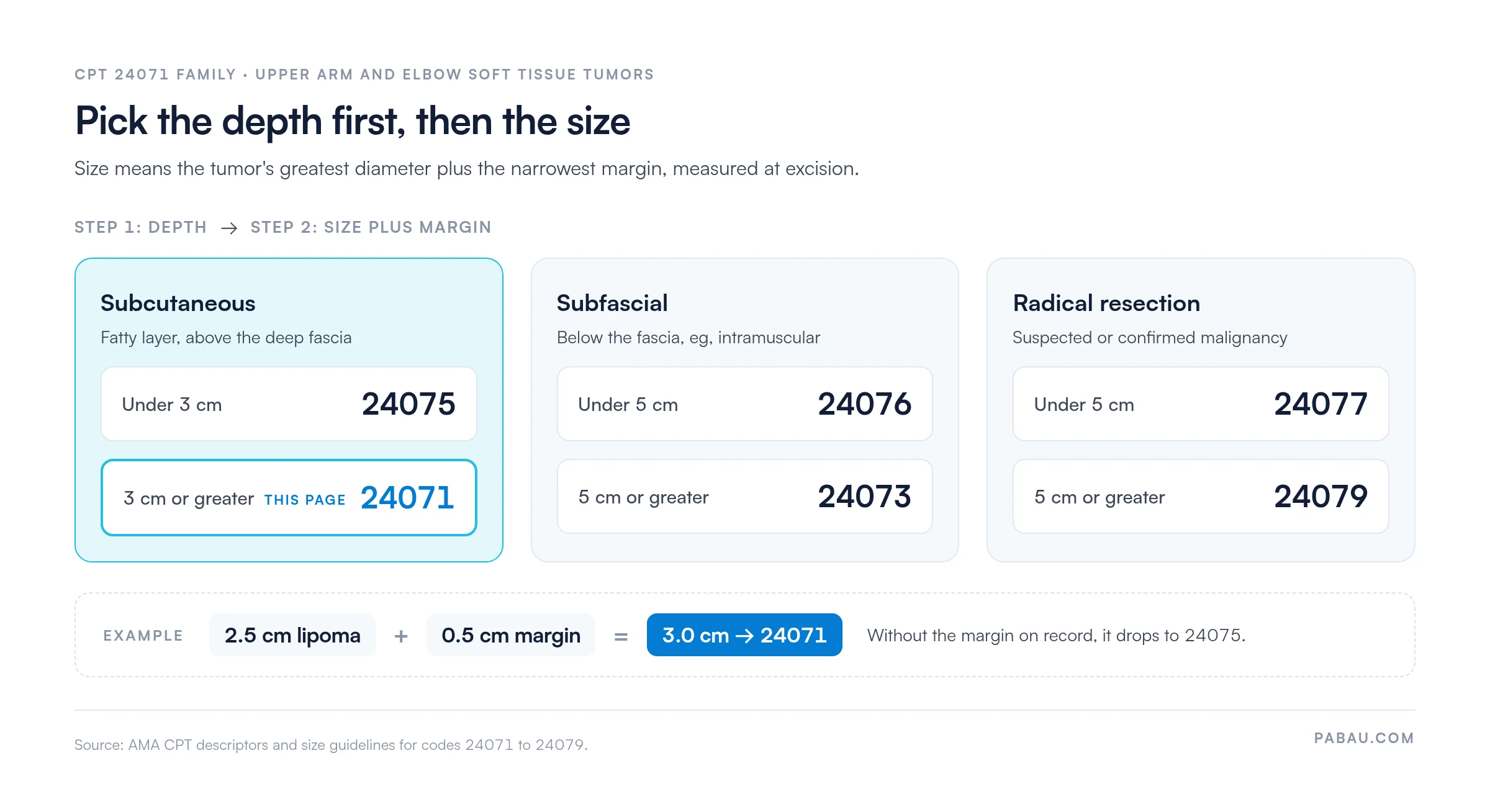
CPT guidelines base the size on the tumor’s greatest diameter plus the narrowest margin needed to remove it completely. The surgeon takes that measurement at the time of excision. The pathology report is a weaker source, because specimens shrink once removed and the margin is not added.
Here is a quick worked example. Take a 2.5 cm lipoma excised with a 0.5 cm margin. Diameter plus margin reaches 3 cm, so the op note supports 24071. Without the margin recorded, the same case drops to 24075.
CPT code 24071 needs a diagnosis that shows why the tumor came out. The ICD-10-CM codes below fit subcutaneous upper arm and elbow tumors. Match the diagnosis side to the procedure side, and code a confirmed malignancy from the C-series instead.
Check codes against the CDC/NCHS ICD-10-CM browser tool each fiscal year. Descriptions and laterality rules can change every October 1.
A 90-day global period makes 24071 a major procedure under Medicare rules. That status changes which evaluation and management (E/M) modifiers apply, so confirm payer-specific rules before billing.
Check the current CMS NCCI procedure-to-procedure edits before billing CPT 24071 with another procedure on the same date. Edits update quarterly, so a pair that billed cleanly last quarter may be bundled now.
Each check below catches a different denial reason, so work through them in order. A clearinghouse then scrubs the claim before the payer sees it, and this Claim.MD clearinghouse review shows what those scrubs look at.
The 2026 national Medicare payment for CPT code 24071 is about $392. That is 11.73 total RVUs at the $33.4009 conversion factor. Figures come from the CMS 2026 relative value file, October release. Check your local rate with the CMS Physician Fee Schedule lookup tool.
CMS flags the office practice expense for 24071 as NA, meaning the procedure is rarely done in an office. The office and facility totals are therefore the same 11.73 RVUs. Its small sibling, 24075, carries an office total of 17.05 RVUs, so the larger code can pay less in an office.
Your locality’s geographic practice cost index (GPCI) then adjusts the national figure. Qualifying APM participants use the $33.5675 conversion factor, which gives about $394. Commercial contracts often use Medicare as their baseline, too.
CPT code 24071 carries a 90-day global period. Routine postoperative visits in those 90 days are part of the surgical payment. The preoperative visit on the day before or day of surgery is included too. An E/M billed in that window without a modifier is denied as bundled, and the electronic remittance advice shows the adjustment code.
These services stay separately billable during the global period:
The denial management patterns for soft tissue excision codes repeat, with wrong size and missing laterality near the top. Catching them before submission is faster than appealing afterward.
When a claim does come back, the denial codes on the remittance show whether you need a corrected claim or an appeal. The AAPC CPT code lookup helps confirm neighboring codes.
A soft tissue excision claim often comes back for a clerical reason, such as a blank field or a mistyped code. Each rework costs your billing team time on a claim that was already coded correctly.
In Pabau’s claims management software, the claim is pre-filled from the patient record. Coders look up 24071 and the diagnosis in searchable CPT/HCPCS and ICD-10-CM code libraries. Required-field checks then hold an incomplete claim back before it goes to Claim.MD.
Your team can also run eligibility checks before the appointment. When the payer responds, ERA posting applies the payment to the right invoice. That leaves your coders more time for the depth and size decisions that set the code.
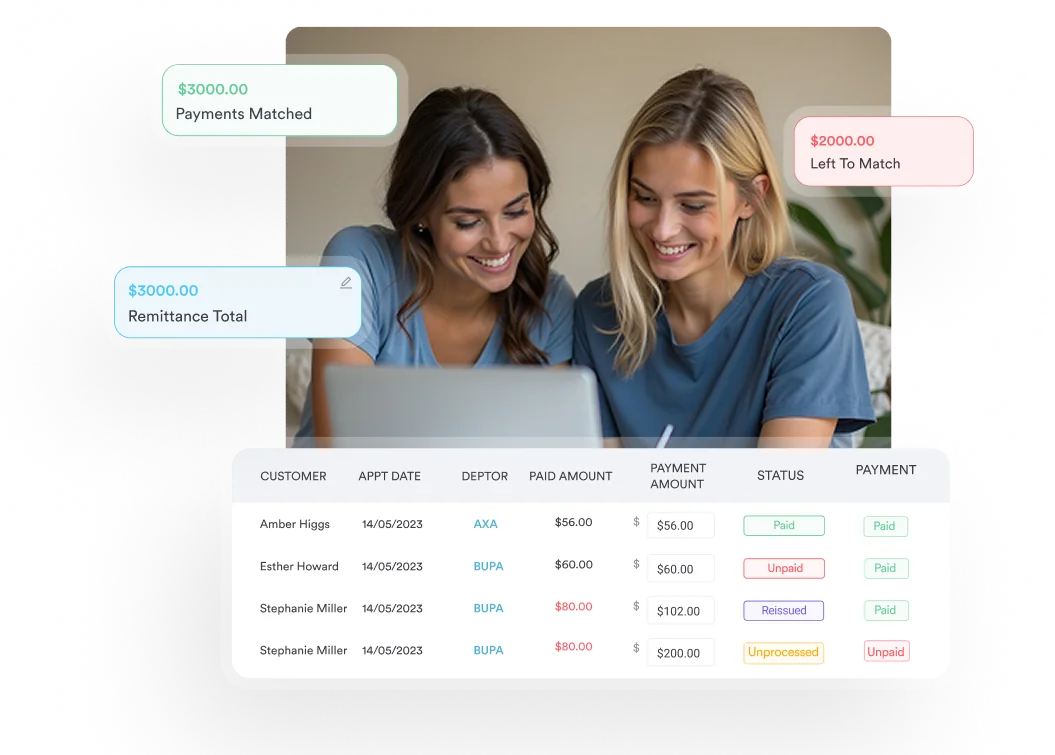

Pabau pre-fills claims from the patient record, checks required fields, submits through Claim.MD and posts ERA payments. See how it fits a practice billing excision codes like 24071.

CPT code 24071 rewards the practice that measures at the table. Once the op note records depth, diameter and margin, choosing between 24071 and 24075 stops being a judgment call.
The longer commitment is the 90-day global period. Note the surgery date where your billing team will see it, so later visits carry modifier 24, 58 or 78 when they apply.
If your team wants claims that leave complete and post back cleanly, book a demo to see Pabau’s billing workflow.

Need to understand how clearinghouse validation works? What is a medical claims clearinghouse? explains the role clearinghouses play in catching CPT and modifier errors before they reach payers.
Building a denial prevention process for your practice? What is revenue cycle management? covers the full claims lifecycle from coding through payment posting and denial appeals.
Looking for the complete guide to CPT billing compliance? Medical billing compliance outlines documentation standards, NCCI rules, and audit risk areas for outpatient surgical procedures.
Is the tumor below the fascia? CPT code 24076: Excision of subfascial soft tissue tumor, upper arm or elbow covers the deeper code in the same family.
Working on a shoulder excision instead? CPT code 23073: Shoulder soft tissue tumor excision guide walks through the shoulder-area codes and their size rules.
Yes, for simple and intermediate repair. CPT bundles those closures into the excision. A complex repair is reported separately, using 13120 to 13122 for the arm.
Location sets the code family. A subcutaneous shoulder tumor of 3 cm or greater is 23071, and one of the forearm or wrist is 25071. The elbow area stays with 24071.
Yes, when separate tumors come out through separate excisions. Code each tumor by its own depth and size. Add 59 or XS where an NCCI edit applies, and expect the multiple procedure reduction.
No. The CPT code follows the procedure performed and the size measured at excision. Pathology can change the diagnosis, for example to a C-series code when the tumor proves malignant.