CCSD code H4430: Examination of rectum under anaesthetic
CCSD code H4430 pays for the examination alone CCSD code H4430 is the UK private...

Last Updated: Oct 20, 2026

CPT code 22532 reports arthrodesis by the lateral extracavitary technique at one thoracic vertebral segment, including the minimal discectomy.
22532 is a primary procedure code, and 22534 is the add-on reported for each additional vertebral segment.
For contiguous segments such as T12 and L1, NCCI allows only one primary code, with 22534 covering the second level.
Documentation must name the lateral extracavitary approach, the thoracic level treated, and the discectomy performed to prepare the interspace.
Practice management software like Pabau checks code pairings and NCCI conflicts as the claim is built, before it reaches the payer.
CPT code 22532 reports arthrodesis, or spinal fusion, performed by the lateral extracavitary technique at a single thoracic vertebral segment. The descriptor includes the minimal discectomy used to prepare the interspace, other than for decompression. It is a primary procedure code, so it stands on its own claim line.
Payment turns on details a general medical billing primer never reaches. Which segment the surgeon treated, whether the levels were contiguous, and what the operative report actually says all decide the outcome. The sections below work through each one.
CPT code 22532 describes arthrodesis by the lateral extracavitary technique, including minimal discectomy to prepare the interspace, at the thoracic level. The American Medical Association maintains the CPT code set. Within this family, only 22534 carries the + symbol that marks an add-on code.
The lateral extracavitary approach reaches the thoracic vertebral body and disc space through a posterolateral incision, without entering the chest cavity.
The minimal discectomy in the descriptor prepares the interspace for fusion. It is not a standalone decompression, so billing a discectomy code separately at the same level triggers an NCCI bundling edit.
Clinical indications for the lateral extracavitary approach include degenerative disc disease, spinal stenosis, vertebral fractures, tumors, and infections. All of them share one requirement: anterior column support at the thoracic level, without a thoracotomy.
The three codes divide by spinal region and by segment count. 22532 covers one thoracic segment, 22533 covers one lumbar segment, and 22534 covers each additional segment in either region. Choosing between them starts with the level list in the operative report.
Anterior interbody fusion splits by level in a similar pattern. Add-on 22585 reports each additional interspace, and it follows a primary code rather than standing alone.
How many primary codes a claim can carry depends on whether the segments touch. CMS answers this in the NCCI policy manual with two worked examples.
Arthrodesis at T12 and L1 is contiguous, so only one primary code applies and the second segment goes on 22534. Arthrodesis at T10 and L4 through separate skin incisions is not contiguous, so 22532 and 22533 may both be reported.
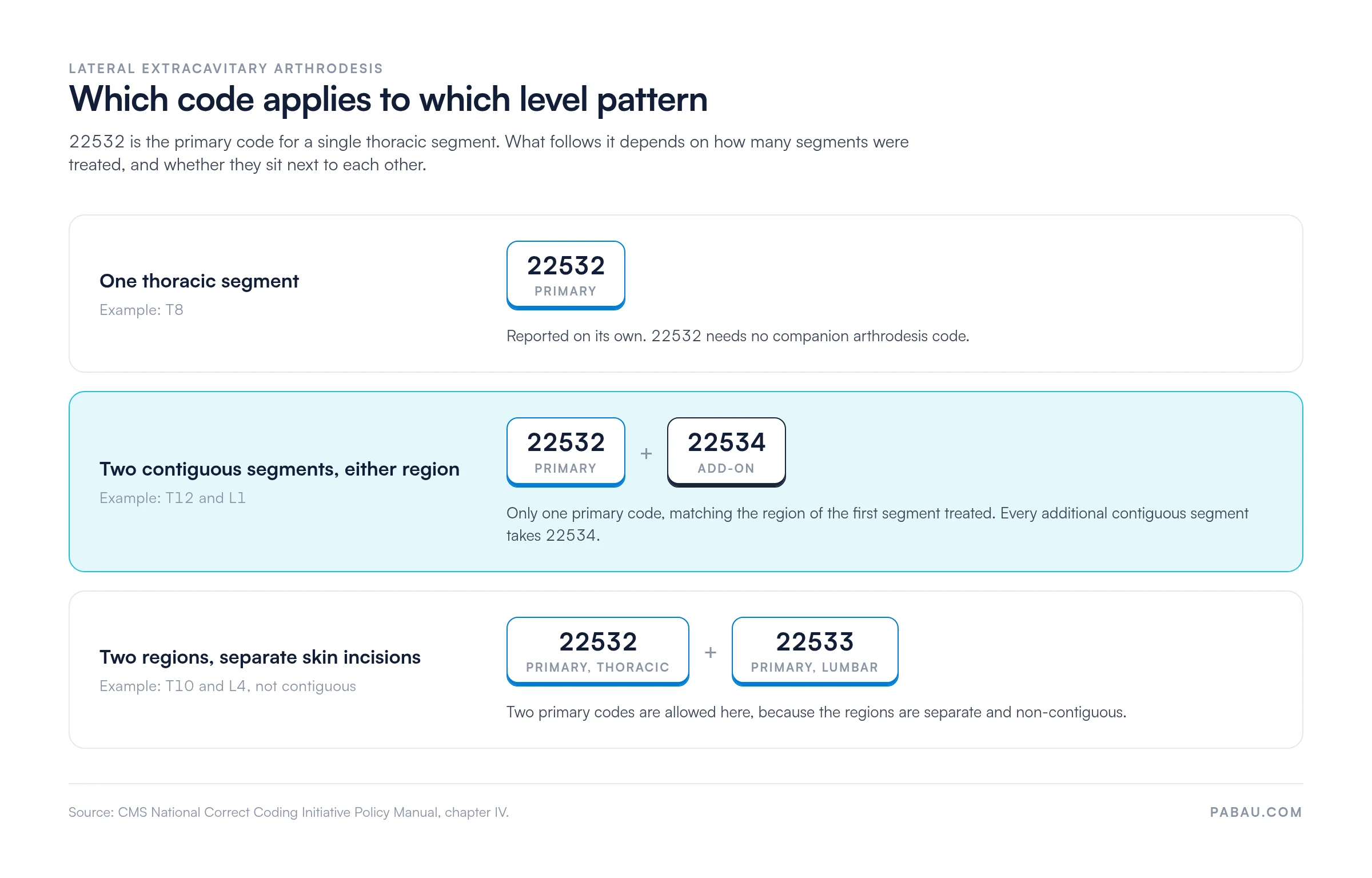
22534 is the add-on code, so it never appears on a claim by itself. It has to follow 22532 or 22533 on the same claim, and it repeats once for every further segment. Sent alone, it denies.
Add-on codes behave the same way across the CPT book, whether the procedure is a spinal segment or a skin graft. 15221 carries the identical dependency on a primary code.
Payer rules then sit on top of the CPT rules. Some commercial plans require prior authorization for lateral extracavitary procedures, and some cap the segments they will pay for in one session. Insurance eligibility verification before the surgery date surfaces both.
Modifier choice depends on who operated, how the session was structured, and whether another procedure might bundle. Modifier 51 is the one to settle first. It can apply to 22532 when other separately reportable procedures happen in the same session, depending on payer policy. It is never appended to 22534.
Medicare contractors apply the multiple-procedure payment reduction automatically, so modifier 51 is usually unnecessary on a Medicare claim. Commercial payers vary. Sending modifier 51 on 22534 invites a reprocess at the wrong rate, which surfaces weeks later as an underpayment.
Medical necessity for 22532 has to be supported by an appropriate ICD-10-CM diagnosis code. Payers cross-reference the diagnosis against their local coverage determinations to confirm the procedure is indicated. Per the CMS ICD-10 codes page, use the most specific code the documentation supports.
The diagnosis also has to match the level the surgeon treated. A cervical code such as code such as S12.131D supports a cervical procedure, not a thoracic one, even when both conditions are documented in the chart.
Listing a diagnosis code does not guarantee coverage. Local coverage determinations define which diagnoses support medical necessity for lateral extracavitary arthrodesis, and they differ by jurisdiction. The diagnosis must reflect what the clinical record says. Coding toward an LCD criterion the notes do not support is an audit risk. The visit level rests on documented history, examination and medical decision making, not on the minutes spent.
Medicare pays 22532 through the Resource-Based Relative Value Scale. The code’s relative value units are multiplied by the annual conversion factor, then adjusted by the geographic practice cost index for the locality. A practice in Manhattan is paid a different allowable than one in rural Kansas for the same operation.
For current rates, use the CMS Physician Fee Schedule lookup tool. Select the year, enter 22532, and choose the pricing locality that applies to the practice. Rates move with each annual fee schedule, so check the current year before quoting a figure to anyone.
Payment details arrive as an electronic remittance advice, which lists the allowed amount, the adjustments, and any denial codes line by line. Practices submitting through the Claim.MD integration can read that remittance in the same place the claim was built.
Pull reimbursement figures from the CMS Physician Fee Schedule for the current calendar year. Third-party reference sites often lag behind the annual update. Across a high-volume spine service, a small rate difference compounds into a noticeable revenue difference over a billing cycle.
The National Correct Coding Initiative, maintained by CMS, defines which services are already paid for inside a more comprehensive procedure. For 22532, the first rule is the discectomy in its own descriptor. Billing a separate discectomy code at the same level and approach triggers an edit, and that charge denies.
Two further NCCI rules catch spine claims regularly. Only one anterior or posterior instrumentation code may be reported through a single skin incision. Spinal manipulation under anesthesia counts as part of the arthrodesis, so 22505 is not separately reportable.
Medical billing compliance is continuous work here, because the edit tables change every quarter. Check the current pairs in the CMS NCCI edit files before billing an unfamiliar combination.
Payers audit spine surgery at high rates, and the operative report is the document they read. Every element of the code descriptor has to appear in it. A superbill captures the encounter charges, but it proves nothing about technique or level.
Medical necessity rests on what happened before the operating room. Imaging findings, clinical notes, and a record of conservative treatment all have to support the approach the surgeon chose. Run the checklist below against every 22532 claim before it goes out.
Spine surgery produces some of the highest denial rates in surgical coding, and the errors cluster in predictable places. Most of them come from the level rules rather than the descriptor. Solid denial management workflows catch the pattern before it turns into a write-off.
Most billing teams check level, modifier, and diagnosis rules after the claim is built, or after a payer sends it back. Practice management software like Pabau moves those checks to the moment the claim is created, where fixing them costs minutes.
Pabau’s claims management software lets a team save procedure code templates for common spine cases. A saved template means 22534 never leaves the practice without 22532 or 22533 in front of it. Claim status, eligibility, and remittance data all return into the client record, so the billing history sits beside the clinical note.
Part of the record that supports medical necessity is usually created elsewhere. Practices running sports medicine software or physical therapy software hold the conservative treatment history a payer asks for. Where that care happens inside the same group, Pabau keeps those notes in the file the claim draws from.
Pre-submission scrubbing is where the software earns its place. Catching a bundling error inside the practice costs a few minutes of a coder’s day. Finding the same error through a denial and an appeal costs 30 to 90 days of payment delay.

Pabau pairs add-on codes with the primary codes they depend on. Claims are checked against payer rules before submission, and remittance data returns into the client record.

Two questions decide a 22532 claim. Which segments did the surgeon treat, and do those segments touch? Answer both from the operative report and the code stack follows on its own.
The trade-off worth remembering is that precision costs time at charge entry and saves it everywhere after. A scrubber rule that blocks 22534 without a primary code takes an afternoon to build. It repays that afternoon the first time a multi-level claim goes out clean.
Book a demo to see how Pabau checks surgical claims against payer and coding rules before they reach the clearinghouse.

CPT code 22532 reports arthrodesis by the lateral extracavitary technique at one thoracic vertebral segment. The descriptor includes the minimal discectomy performed to prepare the interspace, other than for decompression. It is a primary procedure code, so it can be reported on its own.
No. 22532 is a primary procedure code for a single thoracic segment. The add-on code in this family is 22534, which covers each additional vertebral segment. Only 22534 carries the + symbol and the modifier 51 exemption that comes with add-on status.
22532 covers a single thoracic segment and 22533 covers a single lumbar segment, and both are primary codes. 22534 is the add-on for each additional segment in either region. A two-level contiguous thoracic case uses 22532 once and 22534 once.
Only when the treated segments are not contiguous, sit in different spinal regions, and were reached through separate skin incisions. NCCI gives T10 and L4 as the example. For contiguous segments such as T12 and L1, report one primary code and 22534 for the second segment.
Modifier 59 separates a distinct procedure performed at another level, AS and 80 cover assistant surgeons, 62 covers two surgeons, and 22 covers unusual complexity. Modifier 51 may apply to 22532 under some payer policies. It is never appended to the add-on code 22534.
Medicare payment comes from the code’s relative value units multiplied by the annual conversion factor. That result is then adjusted by the geographic practice cost index for the locality. Rates change every year and vary by region, so check the current allowable in the CMS Physician Fee Schedule lookup tool.
The descriptor already includes minimal discectomy, so a separate discectomy code at the same level and approach denies. Only one anterior or posterior instrumentation code may be reported through a single skin incision. Spinal manipulation under anesthesia is included, so 22505 is not separately reportable.
The operative report must name the lateral extracavitary approach, the thoracic segments treated, and the minimal discectomy performed to prepare the interspace. It also needs graft and instrumentation detail. Pre-operative notes and imaging have to support medical necessity for the approach chosen.