ICD-10 Code S52.101P: Right radius fracture with malunion
ICD-10 Code S52.101P: definition and code details ICD-10 Code S52.101P is a bill...

Last Updated: Oct 19, 2026
Billable Code Specific Code
S14.118S is the billable ICD-10-CM code for complete lesion at C8 level of cervical spinal cord, sequela.
Let Pabau's smart automation suggest the right codes, reduce claim denials, and keep your practice compliant—effortlessly.
Automate repetitive tasks and focus on what matters most—your patients.
Reduce coding errors and ensure compliance with the latest regulations.
Clean claims, fewer denials, and faster reimbursements.
Powerful insights and reporting to help your practice thrive.
HIPAA compliant SOC 2 certified GDPR-compliant Trusted by 4,000+ clinics worldwide

ICD-10 Code S14.118S covers a complete lesion at the C8 level of the cervical spinal cord, coded as a sequela encounter.
The 7th character S is what makes the code billable. The parent code S14.118 cannot be submitted without it.
Use S14.118S when the visit treats a late effect, and S14.118D while the injury is still healing.
Code the residual condition first and list S14.118S second, so the claim shows what is being treated and why.
Practice management software like Pabau submits ICD-10 coded claims electronically through its Claim.MD integration.
ICD-10 Code S14.118S is a billable ICD-10-CM diagnosis code for a complete lesion at the C8 level of the cervical spinal cord, sequela. The code has been in the classification since October 1, 2015, when ICD-10-CM took effect for FY2016.
Use it when the encounter treats a condition that is a late effect of an earlier cervical cord injury. The code sits in category S14, which covers injuries to the nerves and spinal cord at the neck level. It is specific to complete lesions, rather than incomplete ones, at the C8 spinal cord level.
The trailing S marks a sequela encounter. Without that 7th character, the parent code S14.118 is non-billable, so medical billing teams see it rejected at the payer’s first edit.
S14.118S means a complete cervical cord lesion at C8 that is now being treated as a late effect. Each character of the code carries part of that meaning.
The International Classification of Diseases, 10th Revision, Clinical Modification (ICD-10-CM) is maintained by the Centers for Medicare and Medicaid Services (CMS). It requires coders to pick a 7th character that reflects the encounter, not the original injury. S14.118S is only correct when the visit treats a direct consequence of a previous C8 cord injury. Every payer sets its own timely filing window, and a correctly coded claim still fails once that window closes.
Confusing D (subsequent encounter) with S (sequela) is one of the most common errors in spinal cord injury coding. The phase of the patient’s care decides which one applies.
Fracture codes carry a longer set of 7th characters, as S52.042Q shows for a malunion. Cord injury codes in category S14 use only A, D, and S.
The ICD-10-CM Official Guidelines for Coding and Reporting also set the sequencing. The sequela code goes after the code for the residual condition being treated.
Say a patient presents with neurogenic bladder that developed after a complete C8 cord injury. The neurogenic bladder code is listed first. S14.118S follows as a secondary diagnosis, identifying the injury that caused it.
When coding a sequela visit, always sequence the residual condition code first, then ICD-10 Code S14.118S as secondary. Reversing this order is a common audit trigger and can result in claim denial or a request for additional documentation.
A complete lesion at the C8 spinal cord level means total disruption of motor and sensory pathways through the cord at that point. There is no eighth cervical vertebra. C8 names a cord segment, and its nerve root exits between the C7 and T1 vertebrae.
Functional consequences of a complete C8 spinal cord injury (SCI) typically include:
The complete or incomplete distinction matters for coding. A complete lesion, coded under S14.11x, is ASIA A on the American Spinal Injury Association Impairment Scale. No motor or sensory function is preserved in the sacral segments S4 and S5.
Incomplete lesions run from S14.12x to S14.15x, depending on the syndrome the record names.
A sequela encounter happens when the visit treats a condition caused by a prior injury. The original injury is no longer in an active healing phase, so what remains is the secondary condition it left behind. The chart below maps each phase of care to its code.
Use S14.118S when all of the following apply:
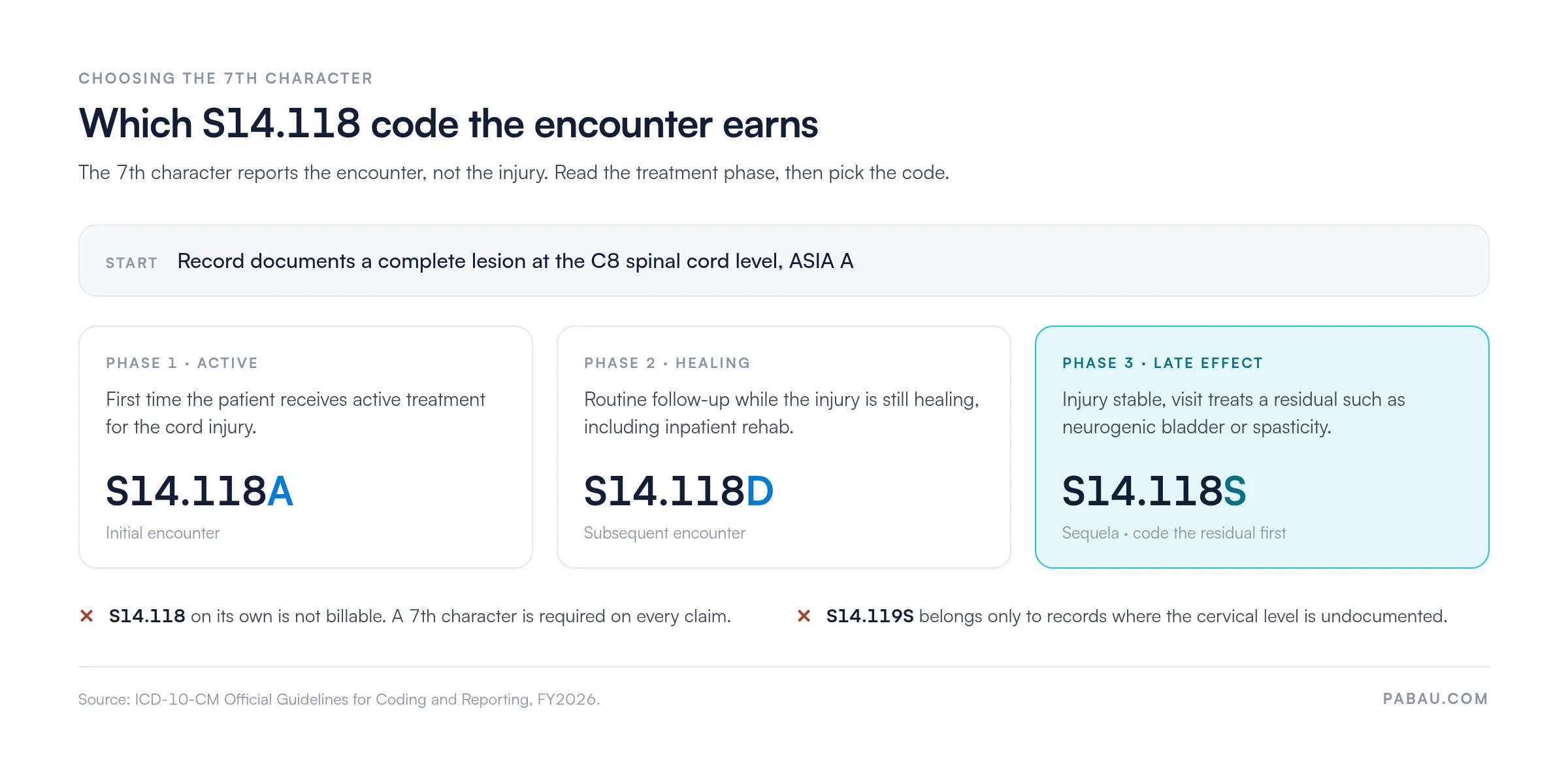
Do not use S14.118S while the patient is still in active rehabilitation for the original injury. Active rehab stays under S14.118D until the injury is medically stable and the focus shifts to residual conditions. That boundary is where revenue cycle management teams in rehabilitation facilities lose the most time to rework.
Missing a single documentation element is enough to trigger a denial for S14.118S. Payers audit sequela claims closely, because the 7th character S has to be backed by evidence that the encounter treats a late effect.
The medical record must contain all of the following to support S14.118S:
Solid documentation also supports medical billing compliance audits and lowers the risk of a retrospective recoupment request from Medicare or a commercial payer. The CDC ICD-10-CM tool carries the official tabular list and index, so you can check the record against the code’s own descriptors.
A record that names the residual condition and its cause is also what gets the claim through scrubbing on the first attempt. That is the difference between clean claims and a queue of rework.
S14.118S belongs to a structured family of cervical spinal cord injury codes. Knowing the parent and sibling codes helps you pick the right level of specificity.
Neighboring codes turn up in the same records. S12.131D covers a cervical vertebral injury still under active care, and S60.152S puts the same sequela character puts the same sequela character on a far smaller injury.
Always code the most specific cervical level documented. If the record confirms C8 and the lesion is complete, S14.118S is the correct sequela code. Defaulting to S14.119S when C8 is documented is a specificity error that can affect DRG assignment and risk adjustment.
Sequela codes carry billing rules that differ from initial and subsequent encounter codes. Getting them right protects revenue and cuts audit exposure.
S14.118S is exempt from POA reporting requirements. Under CMS POA reporting guidelines, sequela codes are assigned a POA indicator of exempt. Facilities do not have to determine whether the condition was present on admission. A sequela is a consequence of an earlier injury, not a newly acquired condition.
On inpatient hospital claims, failing to apply the exemption correctly can trigger an edit at the payer. The AAPC code lookup lists POA exempt status on each code page. When a claim does come back, denial management is where a billing team recovers the money.
Practices submitting S14.118S claims electronically can route them through the Claim.MD integration, the US clearinghouse Pabau submits through. Claim.MD validates codes against payer rules before submission, so a truncated or invalid code gets flagged before it reaches the payer.
Rejections still happen, and the remittance tells you why. Reading the reason codes against a list of common denial codes is faster than resubmitting blind.
In most rehabilitation practices the coder reads the note in the chart, then retypes the diagnosis into a separate billing tool. Each retype is another chance to drop the 7th character or reverse the sequencing.
Pabau keeps the record and the claim in one system. The codes attached to the visit carry into the claim without re-entry, and claims management software tracks what the payer sends back.
Pabau does not decide the code for you. It moves what your clinician documented to the payer without a second transcription, which is where most sequela errors start.
Long-term C8 caseloads mostly sit with physical therapy and occupational therapy teams, who bill the same sequela code month after month. One record per patient keeps the causal link in front of whoever codes the visit.

Pabau submits, tracks, and reconciles ICD-10 coded claims through the Claim.MD clearinghouse, so your team never switches systems mid-claim. Sequela codes travel with the record, and remittances land back against the same patient.

The judgment call on S14.118S is about timing. Once the cord injury itself is stable, the visit stops being injury care and starts being management of what the injury left behind. The 7th character has to follow that shift.
Coders tend to err in one direction. They hold on to D long after active treatment ended, because the patient is still in therapy. Therapy aimed at a residual condition is sequela care, even when it looks identical to rehab.
So write the causal link into the note while the patient is still in front of you. That one sentence is what survives an audit two years later. Book a demo to see how Pabau keeps sequela coding and claim submission in one place.

Billing the surgery behind the injury? CPT code 22842 covers posterior segmental instrumentation, including what the operative note has to record.
Billing an off-pump bypass procedure? Anesthesia for off-pump bypass grafting covers billing for off-pump coronary artery bypass grafting performed without a bypass pump.
Billing a heart or lung transplant? Anesthesia for heart or lung transplant covers billing for heart and lung transplant procedures, carrying 20 base units.
Wondering how the initial encounter character works? S46.921A shows the A character applied to a first active treatment visit.
Meeting a 7th character outside A, D, and S? S72.345C uses the open fracture characters that only fracture codes carry.
ICD-10 Code S14.118S is a billable ICD-10-CM diagnosis code for a complete lesion at the C8 level of the cervical spinal cord, sequela. The 7th character S designates a sequela, or late effect, encounter. The visit treats a condition that is a direct consequence of a prior C8 spinal cord injury, rather than the injury itself.
Yes, S14.118S is a billable ICD-10-CM code. The parent code S14.118 without a 7th character is non-billable and cannot be submitted for reimbursement. The 7th character (A, D, or S) is required to make any S14.118 code billable.
A complete lesion at C8 means total disruption of motor and sensory pathways at the C8 spinal cord level. It is classified as ASIA A on the American Spinal Injury Association Impairment Scale. Because the injury sits at a cervical level, it causes tetraplegia (quadriplegia) rather than paraplegia. Hand and finger function is relatively preserved, and autonomic dysfunction includes neurogenic bowel and bladder.
A subsequent encounter (7th character D) occurs while the original injury is still healing, such as during inpatient rehabilitation. A sequela encounter (7th character S) occurs after the injury has stabilized. The patient is then treated for a condition the injury caused, such as pressure ulcers, spasticity, or chronic neurogenic pain. The original injury is no longer actively treated in a sequela visit.
Use a sequela code once the original injury is medically stable and active treatment has concluded. The current visit has to address a late effect directly caused by that injury. Code the residual condition first, such as neurogenic bladder or spastic tetraplegia, then list S14.118S as an additional code to identify the causal injury.