CCSD code H4430: Examination of rectum under anaesthetic
CCSD code H4430 pays for the examination alone CCSD code H4430 is the UK private...

Last Updated: Oct 20, 2026
Billable Code
37238 is the CPT code for transcatheter placement of an intravascular stent in a peripheral vein (non-coronary), open or percutaneous, for the initial vein treated. It includes radiological supervision and interpretation. It also includes any angioplasty performed in the same vessel.
Coders confuse it most often with its arterial counterpart (CPT 37236) and with add-on code 37239. That add-on handles each additional venous vessel treated beyond the first. Payers scrutinize medical necessity documentation and prior authorization closely for non-coronary stent procedures. Intravascular ultrasound (37252) is sometimes separately billable, depending on the current quarterly NCCI edit file.
Let Pabau's smart automation suggest the right codes, reduce claim denials, and keep your practice compliant—effortlessly.
Automate repetitive tasks and focus on what matters most—your patients.
Reduce coding errors and ensure compliance with the latest regulations.
Clean claims, fewer denials, and faster reimbursements.
Powerful insights and reporting to help your practice thrive.
HIPAA compliant SOC 2 certified GDPR-compliant Trusted by 4,000+ clinics worldwide

CPT code 37238 covers initial peripheral venous stent placement, open or percutaneous, for one vein. Imaging guidance and same-vessel angioplasty are included in the code.
CPT 37239 is the mandatory add-on for each additional venous vessel stented in the same session. It cannot be reported without 37238.
Medicare coverage is governed by LCD L35998. Missing prior authorization and thin medical necessity documentation are the top denial triggers.
Pabau’s claims management software submits 37238 claims electronically, flags NCCI edit conflicts, and tracks denial reasons to support appeals.
CPT code 37238 is the code for transcatheter placement of an intravascular stent(s), open or percutaneous, in a peripheral vein (non-coronary), initial vein. The American Medical Association (AMA) descriptor adds “including radiological supervision and interpretation and including angioplasty within the same vessel, when performed.”
The code belongs to the vascular surgery section of the CPT code set, alongside add-on code 37239 and the arterial family (37236/37237).
The zero-day global period means pre-operative and post-operative work on the day of service is included. Separate E/M codes may still be billed on the same day when a separately identifiable service is documented. Routine post-procedure checks within the global period are not separately billable.
Peripheral venous stent placement treats obstructed or stenotic non-coronary veins, most often iliac, subclavian, or superior vena cava segments. Coders must confirm the operative note specifies a peripheral vein (not an artery and not a coronary vessel) before selecting CPT code 37238. The code does not cover superficial varicose veins in the leg. Removing those through more than 20 stab incisions in one extremity is reported with CPT code 37766.
The procedure typically follows this sequence, which should be reflected in the documentation:
The operative note must identify the vein by name and state the approach (open or percutaneous). It must also document stent type and size and record the post-deployment imaging findings. Without these elements, payer medical reviewers will typically deny or downcode the claim.
CPT 37239 is the add-on code reported once for each additional peripheral vein stented beyond the first vessel treated with 37238. It cannot be reported alone and cannot be reported with an arterial stent code (37236/37237).
Key rule: Counting is vessel-based, not stent-count-based. Two stents placed end-to-end in a single iliac vein still equal one vessel. Three stents across two separate venous segments (left iliac and right iliac, for example) equal two vessels: 37238 + 37239. The four questions below settle the code set for almost every venous stent case.
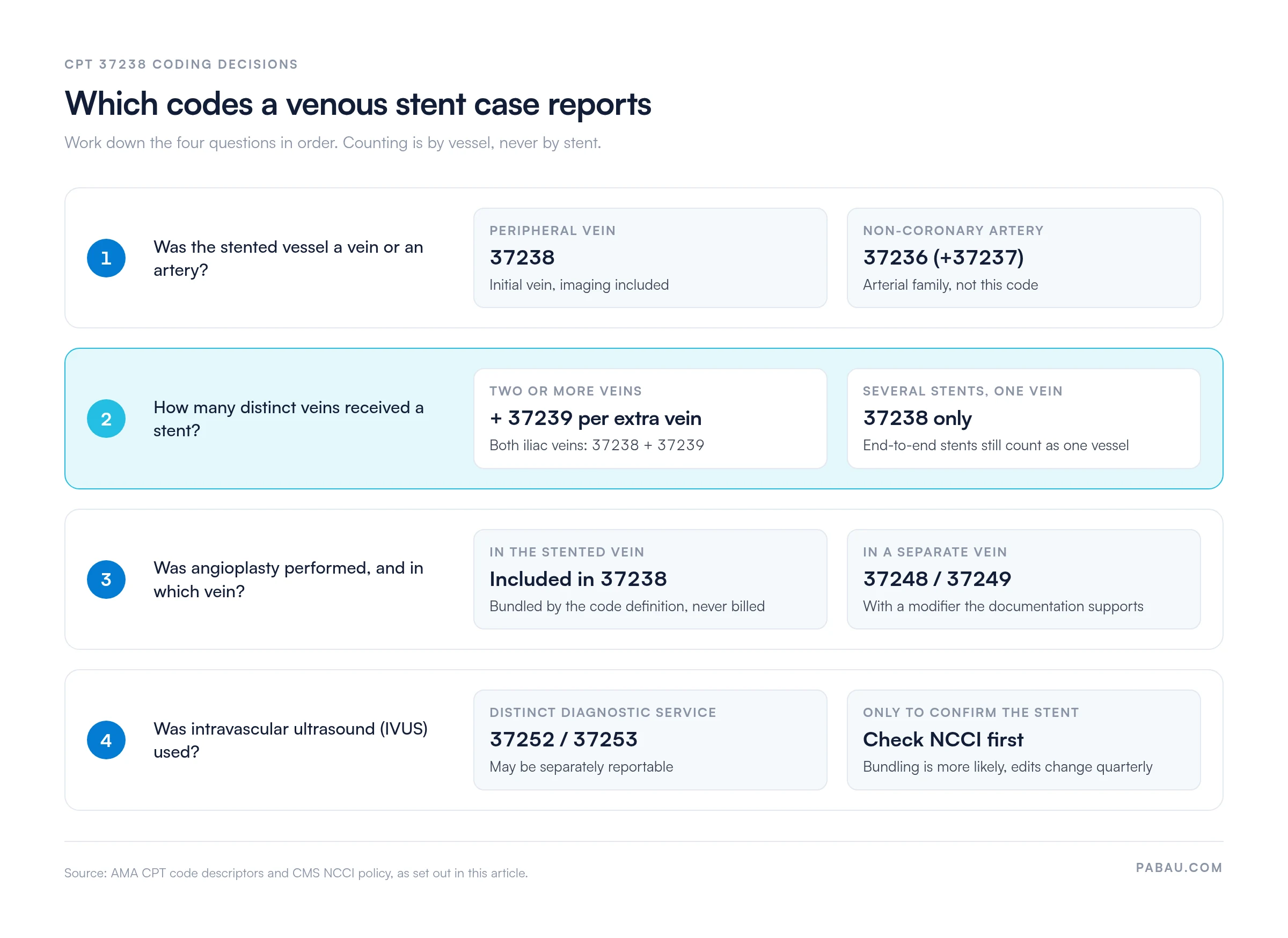
CPT 37236 covers arterial (non-coronary) stent placement, and CPT 37238 covers venous stent placement. Both involve transcatheter stent deployment with imaging included, so the vessel type alone determines the code. Using 37236 for a venous case is a misrepresentation that payer systems routinely catch on review.
Both code families fall under LCD L35998. The operative note’s vessel description is the determinative language, as in “left common iliac vein” vs “left common iliac artery.” Coders should never rely on the word “stent” alone to select a code without confirming the vessel type.
Several companion codes appear routinely alongside CPT code 37238. Same-vessel angioplasty is included by definition, while IVUS depends on the current NCCI edit table. CMS updates that table quarterly, so verify it before billing.
IVUS (37252/37253): Intravascular ultrasound is used to confirm stent sizing and apposition. When performed as a distinct diagnostic service before the treatment decision is finalized, it may be separately reportable. When used only to guide or confirm the stent already deployed, bundling is more likely. Confirm with the current NCCI policy manual.
Angioplasty (37248/37249): Pre-dilation of the lesion before stent deployment is common. Angioplasty in the same vessel is included in 37238 by CPT’s own code definition. That bundling is permanent and never shifts with the quarterly NCCI file. Codes 37248 and 37249 apply only to angioplasty in a distinctly separate vessel, never the treated one.
Run every 37238 claim through the current CMS NCCI edit table before submission. NCCI edits update quarterly, and a combination that was separately billable in Q1 may be bundled by Q3. Flag any claim pairing 37238 with 37248 or 37252 for manual review.
The National Correct Coding Initiative edits define which code pairs CMS considers integral to each other. When 37238 is the column-one code, several companion codes are bundled and cannot be separately billed unless a modifier applies. Pabau’s claims management software flags NCCI conflicts before submission, reducing preventable denials.
Key bundling principles for this code:
Verify the column-one/column-two relationship in the CMS NCCI edit files and the current NCCI policy manual before billing any companion code alongside CPT code 37238.
Medicare covers CPT code 37238 under LCD L35998 (Non-Coronary Vascular Stents), administered by regional Medicare Administrative Contractors (MACs). Coverage is not automatic, because the claim must satisfy specific covered indications and documentation standards. Medical billing compliance requirements for vascular procedures are among the most closely audited in the CMS program.
LCD L35998 covered indications for venous stent placement typically include:
Prior authorization requirements for 37238 vary by MAC region and commercial payer, so they are not universal. Where your MAC does demand it, a missing authorization is the single most common denial trigger for this code. Check your MAC’s LCD L35998 article and your specific payer contracts before scheduling elective cases.
Every clean claim for 37238 starts with the operative note. Payers look for seven specific documentation elements, and missing any one is enough to trigger a denial or medical review.
For percutaneous cases, the access note should also document the puncture site and catheter trajectory. For open cases, the note should include the surgical exposure technique and wound closure method.
Denials for CPT code 37238 cluster around four root causes. Each has a documented remediation path. Tracking denial reason codes through denial management workflows helps practices recapture revenue that would otherwise age into write-offs.
Appeals for denied 37238 claims should include the complete operative note and the pre-procedure imaging report. Add the payer’s LCD L35998 coverage criteria with the relevant covered indication highlighted.
Our guide to denial codes in billing maps each claim adjustment reason code to its fix. Most payers allow 60 to 180 days to appeal from the date of the denial explanation of benefits (EOB).
Medicare physician fee schedule (MPFS) rates for CPT code 37238 vary by geographic practice cost index (GPCI) and setting. Facility rates (hospital outpatient or ASC) are lower than non-facility rates because CMS assumes the facility absorbs overhead costs. The exact rates change annually, so do not rely on historical figures for current billing decisions.
Use the CMS Physician Fee Schedule Look-Up Tool to retrieve the current year’s rates for your specific MAC locality. Enter CPT 37238, select the relevant year and MAC locality, and compare facility vs non-facility payment amounts. For RVU-based calculations, the FastRVU 2026 lookup tool shows work, practice expense, and malpractice RVU components with the Medicare conversion factor applied.
Commercial payer rates for 37238 are typically negotiated as a percentage of MPFS or using a proprietary fee schedule. They vary substantially by contract and region. Request a fee schedule extract from each commercial payer to benchmark your contracted rate against the Medicare allowable.
Our overview of medical billing fundamentals shows how that rate flows from charge capture through payment posting.
Check the AAPC Codify crosswalk for CPT 37238 to confirm the ICD-10-CM codes your MAC accepts as covered diagnoses under LCD L35998. A diagnosis code outside that list is a common and avoidable denial, even when it accurately describes the patient’s venous disease.
Without a claims tool, a coder checks each 37238 claim by hand. They read the operative note, count the vessels, look up NCCI pairs, and confirm prior authorization. Each of those steps is a chance for a same-vessel 37239 or an unsupported 37248 to reach the payer.
Pabau routes 37238 claims electronically through its Claim.MD clearinghouse integration, which validates claim data against current CMS rules before submission. It flags NCCI edit conflicts on the claim itself. Electronic remittance advice (ERA) comes back into Pabau for automatic payment posting.
Your billing team fixes errors before the claim leaves, instead of after a denial lands. When a 37238 claim is denied anyway, Pabau records the CARC denial code against it, so the appeal starts with the reason already in hand.

Pabau submits CPT 37238 claims electronically through its clearinghouse integration and flags NCCI edit conflicts before submission. It also tracks denial reason codes, so your team can appeal faster and collect more.

CPT code 37238 pays reliably once three facts are settled before the claim is built. The coder needs the named vein, the count of distinct veins stented, and proof that prior authorization was on file.
The trade-off worth remembering is angioplasty. In the stented vein, it is already paid for inside 37238, so a 37248 line there invites a denial and an audit flag. In a separate vein, with documentation to match, it earns its own line.
Build those checks into your pre-submission routine and most 37238 denials never happen. Book a demo to see how Pabau catches NCCI conflicts and missing claim data on venous stent claims before they reach the payer.

Need a framework for your broader revenue cycle? What is revenue cycle management covers the end-to-end process from charge capture to payment posting.
Want to understand how clearinghouse submissions work? 837 file guide explains the electronic claim format used for 37238 and other CPT submissions.
Looking to reduce denial rework time? Denial codes in medical billing maps common CARC codes to actionable appeal steps.
CPT code 37238 covers initial open or percutaneous transcatheter placement of a stent in a non-coronary peripheral vein. It includes all radiological supervision and interpretation performed during the procedure, plus any same-vessel angioplasty. It is a parent code reported once per session for the first vessel treated.
CPT 37236 covers non-coronary arterial stent placement, and CPT 37238 covers peripheral venous stent placement. The distinction is vessel type, artery vs vein, which the operative note must clearly state. Both include imaging guidance and carry parallel add-on codes (37237 for arterial, 37239 for venous).
CPT 37239 is reported for each additional peripheral vein stented beyond the first vessel in the same session. It cannot be reported without 37238, and the count is vessel-based, not stent-count-based. Two stents in a single iliac vein still report 37238 only. Stents in two separate veins report 37238 plus one 37239.
Prior authorization requirements for CPT code 37238 vary by MAC region and individual payer, so they are not universal. Check your specific MAC’s LCD L35998 article and your commercial payer contracts before scheduling elective venous stent procedures. Failure to obtain required authorization where your MAC demands it is the leading denial reason for this code.
CPT 37252 (intravascular ultrasound, initial vessel) may be separately reportable with CPT code 37238 when IVUS is performed as a distinct diagnostic service. It is subject to NCCI edits that change quarterly. Always verify the current edit status in the CMS NCCI table before billing both codes on the same claim. Use the AAPC Codify CPT lookup to check current edit pairings.
The four leading denial triggers are: Missing or invalid prior authorization, thin medical necessity documentation, bundling conflicts, and misuse of add-on code 37239. Medical necessity fails when the note misses LCD L35998 criteria. Bundling conflicts come from billing same-vessel angioplasty (37248) or unsupported IVUS (37252). The 37239 error is billing it for multiple stents in a single vessel rather than multiple distinct vessels. Each has a clear remediation path through documentation improvement or modifier application.