CCSD code H4430: Examination of rectum under anaesthetic
CCSD code H4430 pays for the examination alone CCSD code H4430 is the UK private...

Last Updated: Oct 20, 2026
B0820 is the CCSD code for bilateral subtotal thyroidectomy. The surgeon removes most of both thyroid lobes and deliberately leaves a small remnant of thyroid tissue on each side.
The extent of resection in the operative note decides the code. Removing one lobe and the isthmus is B0830, while a total or near-total thyroidectomy is B0812, or B0813 with a lymph node block dissection.
Let Pabau's smart automation suggest the right codes, reduce claim denials, and keep your practice compliant—effortlessly.
Automate repetitive tasks and focus on what matters most—your patients.
Reduce coding errors and ensure compliance with the latest regulations.
Clean claims, fewer denials, and faster reimbursements.
Powerful insights and reporting to help your practice thrive.
HIPAA compliant SOC 2 certified GDPR-compliant Trusted by 4,000+ clinics worldwide

CCSD Code B0820 covers bilateral subtotal thyroidectomy, where most thyroid tissue is removed from both lobes and a small remnant stays on each side.
B0820 sits between B0830 (one lobe and the isthmus removed) and B0812 (total or near-total thyroidectomy). The extent of resection in the operative note decides which one applies.
UK private medical insurers (PMIs) typically require pre-authorization for this operation, and claims without a valid authorization reference are routinely denied.
Pabau, the practice management platform we build, helps private practices track pre-authorization, apply CCSD codes and submit clean invoices to UK insurers.
CCSD Code B0820 covers bilateral subtotal thyroidectomy. The surgeon removes most of the thyroid tissue from both lobes but deliberately leaves a small remnant of functioning thyroid on each side. The code sits in Chapter 6 (Face, mouth, salivary and thyroid) of the CCSD schedule, under Thyroid and Parathyroid Glands.
CCSD, the Clinical Coding & Schedule Development group, maintains the CCSD codes that UK private medical insurers (PMIs) use for billing.
Three neighboring codes in the same section are often confused with B0820. The table below sets them side by side, using the official CCSD descriptors.
Billing Bupa? Our guide to Bupa CCSD codes covers that insurer’s own requirements alongside the general schedule.
Bilateral subtotal thyroidectomy is performed through a transverse cervical incision, giving the surgeon access to both thyroid lobes at once. The operation runs in five stages.
Step 4 is what separates B0820 from a total thyroidectomy: remnant tissue is kept on both sides by design. Near-total thyroidectomy also leaves a small remnant, but the CCSD schedule codes it with total thyroidectomy under B0812. So the operative note has to name the procedure the surgeon performed, not only describe the remnant.
B0820 applies when bilateral subtotal thyroidectomy is performed for a documented clinical indication. Graves disease and toxic multinodular goiter are the two most common indications. Bilateral subtotal resection is one surgical option for both. Many surgeons now prefer total thyroidectomy for Graves disease, so the choice depends on the surgeon and the patient.
Common indications and their corresponding ICD-10 diagnosis codes for the claim:
Use the most specific ICD-10 code that reflects the documented diagnosis. Submitting a generic or mismatched diagnosis code is a common denial trigger for B0820 claims.
Picking the wrong thyroid code is one of the most common billing errors in endocrine surgery. The operative note settles it. Has the gland been operated on before? How much tissue came out of each lobe? Was a lymph node block dissection performed? The ladder below asks those questions in order.
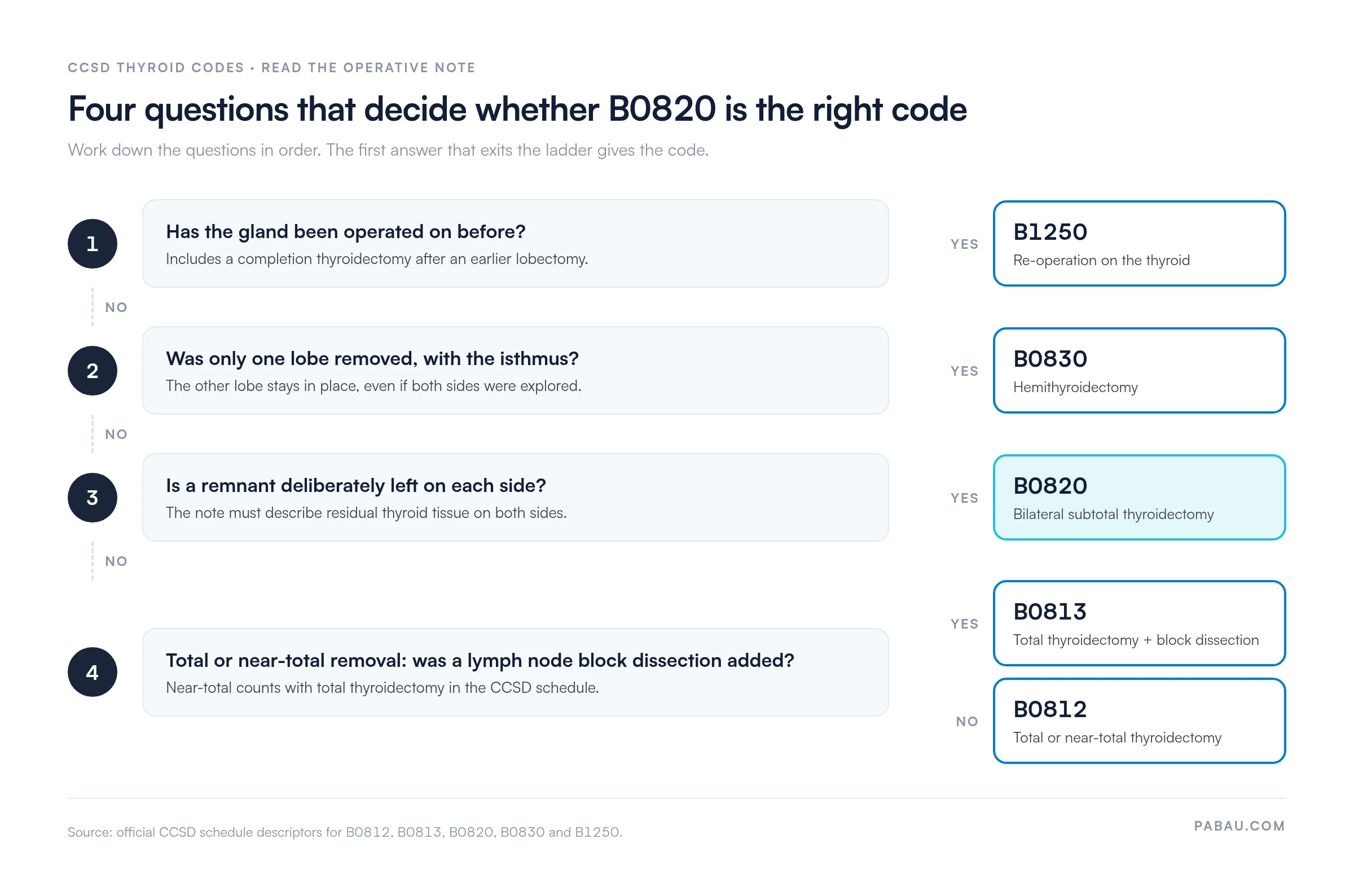
When the operative note describes a partial resection that none of those descriptors cover, the code is B0860, the residual entry for partial thyroidectomy. It applies only once the named thyroid codes above have been ruled out.
The costliest error is billing B0820 when the operative note describes a total or near-total thyroidectomy. In that case, B0812 is correct. The reverse mistake happens too: a hemithyroidectomy billed as B0820 because both sides of the neck were explored. If only one lobe came out, the code is B0830.
Payers audit operative notes against the submitted code, and a mismatch triggers a denial and sometimes a compliance review.
Knowing what the B0820 fee already covers prevents over-billing, where a component inside the base fee is claimed again. Procedures that may attract their own code are covered in the concurrent procedures section below.
Other endocrine procedures follow the same bilateral logic. Removing both adrenal glands laparoscopically carries its own CCSD code, B2223, covering both sides in one operative episode.
Before billing any add-on code alongside B0820, check the current edition of the CCSD Technical Guide and confirm with the relevant PMI. Bundling rules change between annual schedule updates, and what was separately billable in a prior year may now be included in the base code fee.
A complete operative note is the foundation of every B0820 claim. Payers audit surgical documentation against the code submitted. Missing elements produce denials, or requests for more information that delay payment.
The operative note for a B0820 claim must contain all of the following. A standard operative note template keeps these fields consistent across your surgical team.
Most major UK private medical insurers require pre-authorisation before bilateral subtotal thyroidectomy is performed. Requirements vary by insurer and policy year. The guidance below reflects standard practice at the major PMIs, but always check with the individual insurer before going ahead.
When requesting pre-authorization, include the proposed CCSD code (B0820) and the clinical indication with its ICD-10 code. Add the surgeon’s name and GMC number, the proposed date and hospital, and a brief clinical summary. Store the authorization reference number before the patient is booked. The reference must appear on the invoice.
In Pabau, private practices log pre-authorization reference numbers against patient records and flag procedures still waiting for approval. Pabau also sets expiry reminders for time-limited authorizations.
Healthcode is the main electronic billing platform for UK private claims, and the major PMIs accept it. Most technical rejections happen at this stage, before an insurer reviews the clinical detail.
Denial rates for complex thyroid surgery claims are higher than for straightforward elective procedures. The reasons cluster around four recurring issues.
Several procedures are commonly performed in the same operative session as bilateral subtotal thyroidectomy. Whether they attract a separate CCSD code depends on the CCSD Technical Guide (October 2025) and individual PMI contracts. Verify each add-on before billing it.
When claiming for any concurrent procedure, the operative note must include a separate description of that procedure. Lumping a concurrent parathyroid excision into the thyroidectomy narrative without a distinct procedural entry weakens the claim for any separately submitted add-on code.
Private practices submitting B0820 claims face a specific operational challenge. A clean claim needs the correct CCSD code, a valid pre-authorization reference, a matching ICD-10 code and a complete operative note.
The surgeon, medical secretary and billing team all have to line these up before the invoice goes out. If one of the four is missing, the claim comes back as one of the denials described above.
Pabau’s claims management software supports this workflow for UK private practices. CCSD code selection is built into the invoicing process, so billing staff work from a structured code library rather than manual entry.
Pre-authorization reference numbers are stored against the patient episode. Date-expiry alerts stop surgery being booked against an expired authorization. Invoice output is formatted to PMI submission standards, reducing the formatting rejections that are common with generic billing templates.
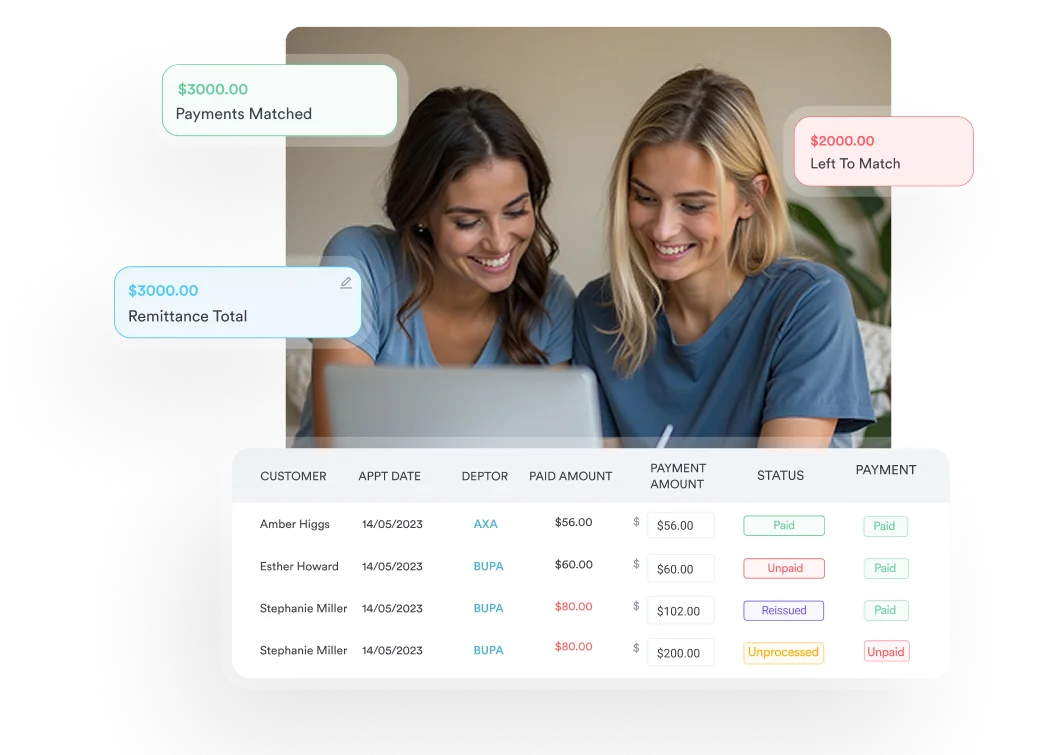
Pre-authorization tracking and a built-in CCSD code library take that admin load off medical secretaries handling high-volume surgical billing.

Pabau helps UK private practices manage CCSD invoicing, pre-authorization tracking and surgical documentation in one place. See how it works for endocrine surgery teams.

Treat the operative note as the claim. If it names a bilateral subtotal thyroidectomy and describes a remnant on each side, B0820 holds up at audit. If it doesn’t, fix the note or the code before the invoice goes out.
The check costs a coder a few minutes against B0812 and B0830. Skipping it can cost six to eight weeks of payer queries, or a recoded claim at a lower fee.
Pabau keeps the code, the authorization reference and the operative note on the same patient episode, so that check happens before submission. Book a demo to see how it handles CCSD billing for endocrine surgery teams.

Want to reduce claim rejections across your whole practice? Claims management software helps private practices track CCSD invoicing, pre-authorization and payer submission in one structured workflow.
CCSD Code B0820 is the UK private healthcare billing code for bilateral subtotal thyroidectomy. The surgeon removes most of the thyroid tissue from both lobes and intentionally keeps a small remnant on each side. It does not cover a unilateral lobectomy with isthmectomy (B0830) or a total or near-total thyroidectomy (B0812).
Bilateral subtotal thyroidectomy (B0820) leaves a small remnant of thyroid tissue on both sides. Total or near-total thyroidectomy is coded B0812, or B0813 when a lymph node block dissection is added. The operative note decides. If it describes a total or near-total resection, B0812 applies whatever the original plan was.
Use B0830, Unilateral total thyroid lobectomy & isthmectomy +/- microlaryngoscopy/laryngoscopy. It applies when one lobe and the isthmus are removed and the other lobe is left in place. B0820 requires resection of both lobes, with remnant tissue preserved on each side.
Yes. Most major UK private medical insurers, including Bupa, AXA Health, Aviva and Cigna, typically require pre-authorization before bilateral subtotal thyroidectomy. Requirements vary by insurer and policy. Always confirm with the specific PMI and get a valid authorization reference number before booking the operating room.
Intraoperative neuromonitoring (IONM) may attract a separate CCSD code alongside B0820. That depends on the current CCSD technical guide edition and individual PMI contract terms. Verify eligibility with the CCSD Technical Guide (October 2025 edition) and the relevant insurer before billing IONM as a separate add-on.
Four errors cause most denials. The first is billing B0820 when the operative note describes a total or near-total thyroidectomy, which should be B0812. The others are a missing pre-authorization reference, an operative note without remnant or RLN documentation, and an ICD-10 code that conflicts with the referral letter.