CPT code 51797: Intra-abdominal voiding pressure add-on
What CPT code 51797 covers CPT code 51797 is the add-on code for intra-abdominal...

Last Updated: Oct 19, 2026

CPT 15220 covers a full-thickness free skin graft of the scalp, arms, or legs measuring 20 sq cm or less
CPT code 15221 is its add-on (+15221), reported once for each additional 20 sq cm, or part thereof, of the same graft
Direct closure of the donor site is written into both descriptors, so simple repair codes 12001-12021 are not separately reportable
These are full-thickness grafts. A split-thickness autograft of the arms or legs is coded 15100 and 15101 instead
Add-on codes are exempt from modifier 51, and the unit count comes from the recipient site area rounded up
Practice management software like Pabau captures operative measurements and scrubs claims against NCCI edits before they reach the payer
CPT code 15221 covers each additional 20 sq cm, or part thereof, of a full-thickness free graft on the scalp, arms, or legs. In addition, it is always reported alongside its primary code, CPT 15220.
Two decisions account for most skin graft denials. The first is whether the extra graft area was billed with the add-on code at all. The second is graft family, since arms and legs appear in both the split-thickness and the full-thickness code sets.
This guide covers the AMA descriptor, the unit math, documentation, modifiers, ICD-10 pairings, Medicare reimbursement, and the errors that trigger denials.
CPT code 15221 is an add-on code. In fact, it carries a plus symbol (+15221) in the AMA’s CPT code set, which marks it as a code that is never reported on its own.
The official AMA descriptor opens: Full thickness graft, free, including direct closure of donor site; scalp, arms, and/or legs. The size clause completes it: each additional 20 sq cm, or part thereof (List separately in addition to code for primary procedure). Primary code CPT 15220 carries the same descriptor for the first 20 sq cm or less.
A full-thickness graft takes the epidermis and the entire dermis from the donor site. The surgeon closes that donor site directly, then insets the graft into the prepared recipient bed. Because the descriptor names donor site closure, that closure is paid inside the code. Therefore, accurate medical billing workflows start with reading the descriptor that closely. Practices billing in Australia check the current MBS descriptor before submitting, because descriptors are revised on a schedule. Time-based and complexity-based selection can point at different codes, so the documented medical decision making decides.
One caution about third-party code lists. Some of them label 15220 and 15221 as a free skin graft not elsewhere classified. However, that wording appears in no CPT edition for these codes.
The general unlisted skin code is 17999. Likewise, code 15999 is the unlisted procedure for excision of a pressure ulcer, and neither one belongs on a graft claim of this type.
CPT 15220 is the primary code for a full-thickness free graft of the scalp, arms, or legs, covering the first 20 sq cm or less. Once the grafted surface passes 20 sq cm, CPT code 15221 is added once for each further 20 sq cm increment or part of one.
The same parent and add-on structure runs through the skin substitute codes, including CPT 15271.
A practical note on measurement. The area that drives the unit count is the recipient site, meaning the defect the graft covers, not the size of the donor harvest. The donor site still belongs in the operative note, but it never adds units.
Missing that distinction produces undercoding and overcoding on the same claim. As a result, the ladder below shows how a partial increment still bills as a whole one.
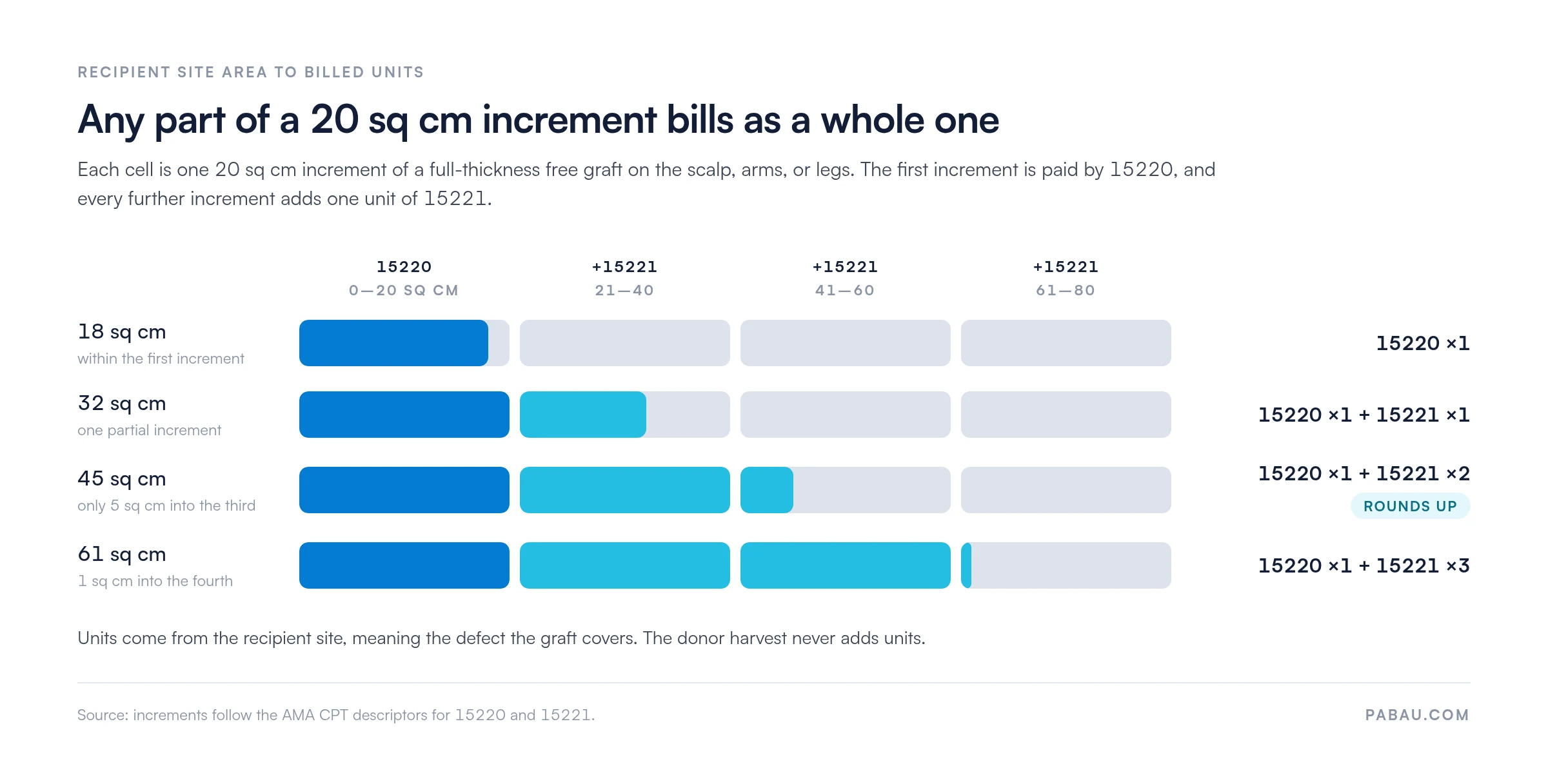
Grafts placed at more than one site in the same session need a second decision. Sum the areas when every site falls inside the same descriptor group, such as one arm and one leg. When a site sits in a different group, report that group’s own primary code instead of adding units to 15221.
Full-thickness free grafts are split across four code pairs, and anatomic site is the only thing that separates them. Each pair works the same way. Specifically, the first code covers 20 sq cm or less, and the add-on covers each additional 20 sq cm or part thereof.
The scalp is the site coders most often place in the wrong pair. It reads like a facial site, so it gets coded to 15240. In fact, CPT puts the scalp with the arms and legs in 15220. Code 15240 is reserved for the forehead, cheeks, chin, mouth, neck, axillae, genitalia, hands, and feet.
Correct billing of CPT code 15221 rests on three rules. Always pair it with 15220, never apply modifier 51, and count units from the recipient site area rounded up to the next 20 sq cm. Breaking any one of them, however, produces a National Correct Coding Initiative (NCCI) edit denial or an underpayment.
Producing a clean claim on a graft procedure depends on capturing the exact sq cm figures during surgery. Reconstructing them from memory afterwards rarely survives an audit. Indeed, most trouble with 15221 starts in the documentation phase.
The phrase sits inside the descriptor, so the work of closing the donor site is already paid by 15220 and 15221. Reporting a simple repair code from the 12001-12021 range for that closure is unbundling. Payers deny it, and a modifier 59 on the repair line does not make it payable.
Documentation has to support both medical necessity and the reported graft area. Payers request operative notes on audit, and a missing measurement is treated the same way as a missing procedure.
Before submitting a claim with more than two units of 15221, have your compliance team read the operative note. Unit counts of three or more on a single encounter often trigger pre-payment medical review. In fact, an operative report is the best defense against that review. It should state the graft thickness, the recipient area in sq cm, and how the donor site was closed.
Medicare pays CPT code 15221 through the Medicare Physician Fee Schedule (MPFS), which CMS updates every year. This article does not hardcode dollar figures for that reason. Instead, use the CMS Physician Fee Schedule lookup tool to pull the current facility and non-facility amounts for your locality.
The same tool returns the work, practice expense, and malpractice RVUs behind that amount. In turn, submitting through a Claim.MD integration lets a practice compare fee schedule data against submitted charges before the claim leaves the building.
Reading the electronic remittance advice (ERA) matters just as much after submission. The ERA shows the allowed amount per unit of 15221, any contractual adjustment, and the patient responsibility. In turn, tracking that per-unit allowable across payers shows which commercial contracts sit below the Medicare rate.
A graft claim without a supporting ICD-10-CM diagnosis is incomplete. The diagnosis has to establish medical necessity for the graft. Payers publish local coverage determinations (LCDs) that name the diagnoses justifying a full-thickness graft, so document the diagnosis fully before coding.
Keep the diagnosis and the procedure code pointing at the same body part. A trunk diagnosis on a 15220 claim contradicts the code’s own site list, and that mismatch is easy for an edit to catch. Separately, the CDC ICD-10-CM web tool confirms that each code is still valid in the current fiscal year.
The prior authorization process for graft procedures varies widely by payer and plan. Original Medicare generally does not require it for CPT 15221 in most settings. By contrast, Medicare Advantage plans run their own rules, and many of them do require pre-authorization for surgical procedures including skin grafts.
An authorization request for CPT 15221 should carry the primary diagnosis and the proposed codes with the anticipated unit count. Add the wound measurement and the record of prior conservative treatment. Overall, incomplete requests are the most common reason practices collect avoidable authorization denials.
CPT code 15221 sits in a wider family of graft, substitute, and repair codes. Knowing the neighbors prevents miscoding, and it settles most questions about which code a given operative note actually supports.
The distinction between 15100 and 15220 is graft depth rather than location. Both descriptors name the arms and the legs, so anatomy alone cannot pick the code.
A split-thickness harvest of a leg belongs to 15100, which uses a 100 sq cm first increment. By contrast, a full-thickness harvest of the same leg belongs to 15220, with a 20 sq cm first increment. The AMA CPT coding resources hold the integumentary guidelines that resolve the rest.
Skin graft billing generates far more claim edits than its procedure volume suggests, and most of those edits are preventable. The following errors show up repeatedly in post-payment audits and payer medical reviews of 15221 claims.
Proactive denial management workflows that flag high-edit CPT codes catch most of these before the claim leaves the practice. In turn, software that applies NCCI edit logic in the scrubbing layer stops the bundling errors above from reaching the payer at all.
Full-thickness graft billing fails at the documentation stage far more often than at the submission stage. The measurements that set the unit count for CPT code 15221 have to be captured during surgery. They belong in the operative note, in a form the billing workflow can read. When those two steps are disconnected, small errors compound into denials.
Practice management software like Pabau links clinical documentation to claim submission. The sq cm figures recorded in the operative note flow straight into charge capture. As a result, that removes the manual transcription step behind most unit count errors on 15221 claims.
Plastic surgery and dermatology practices bill these grafts often enough for edit checks to pay for themselves. Our claims management software scrubs claims against NCCI edit tables before submission, so a bundling error surfaces before a denial does.

Practices running a steady volume of graft procedures also gain from a connected plastic surgery EMR. Likewise, defects left by Mohs surgery put the same demands on a dermatology EMR.
Either one holds procedure-level documentation, authorization status, and claim outcomes in one place. That is where revenue cycle work stops being reactive on denials and starts preventing them.
A structured note template also creates the audit trail. Record graft thickness, recipient area, and donor site closure as discrete fields. A payer request for records is then answered from the chart, rather than rebuilt by hand months later.
Build a charge capture template for graft encounters with required fields for graft thickness, recipient site area in sq cm, and donor site closure method. In turn, prompting the surgeon for those three items at the time of service removes the most common source of 15221 unit count errors. It builds the audit trail at the same time.

Pabau captures surgical measurements at the point of care, flags NCCI edit conflicts before anything is submitted, and routes claims through our clearinghouse integration. Your billing team spends less time on rework and more time on collected revenue.

CPT code 15221 is simple in structure and unforgiving in detail. It reports each additional 20 sq cm of a full-thickness free graft on the scalp, arms, or legs, and it never travels without 15220.
Read the operative note for graft thickness first, then for the recipient area, then for the site. Those three facts decide the code family, the unit count, and whether the claim survives review.
Remember what the descriptor already includes. Direct closure of the donor site is paid inside 15220 and 15221, so a separate repair line only invites a denial.
Getting the rest right comes down to capturing measurements at the point of care and scrubbing claims against NCCI edits before they go out. Together, Pabau handles both steps for surgical and wound care practices. To see how it fits your billing workflow, book a demo with the team.

Coding an excision of excess skin at the thigh? CPT 15832 covers the descriptor, the unit rules, and the documentation payers ask for.
Same excision at the forearm or hand? CPT 15837 walks through site selection, modifiers, and the denial reasons that follow it.
Billing a debridement on the same day as the graft? CPT 11043 explains depth documentation and how the NCCI edits apply.
Coding a tissue cultured skin autograft instead? CPT 15150 covers a different graft family, built on 25 sq cm increments.
Coding a keratitis case without a matching subcategory? ICD-10 code for other keratitis It covers keratitis presentations a clinician identified that don’t fit the standard H16 subcategories.
CPT code 15221 reports each additional 20 sq cm, or part thereof, of a full-thickness free skin graft applied to the scalp, arms, or legs. It is reported in addition to primary code 15220, which covers the first 20 sq cm or less. Indeed, it cannot be billed on its own.
Yes. CPT 15221 carries the plus symbol designation in the AMA CPT codebook, which confirms add-on status. It is always listed on the claim in addition to its primary code, CPT 15220, and it is exempt from modifier 51. Its global indicator is ZZZ, so payment follows the primary procedure.
Full thickness. The descriptor for 15220 and 15221 names a full thickness graft, meaning the epidermis plus the entire dermis. Instead, a split-thickness or partial-thickness autograft is a different code family. For the trunk, arms, or legs, that family is 15100 and 15101, which use 100 sq cm increments.
Original Medicare generally does not require prior authorization for CPT 15221. By contrast, Medicare Advantage plans and most commercial payers do, and requirements vary by plan. Verify with the specific payer before scheduling, and include documentation of prior conservative wound care when the plan asks for it.
Common pairings include non-pressure chronic ulcers of the lower extremity (L97) and pressure ulcers (L89). In addition, burns (T20 to T32), skin cancers of the scalp, neck, and limbs (C44), and open wounds of the arm or leg also appear. The diagnosis has to justify medical necessity and point to the same body part as the code.