ICD-10 Code V28.01XD: E-bike driver noncollision accident, nontraffic, subsequent encounter
ICD-10 Code V28.01XD: Definition and billable status ICD-10 Code V28.01XD is the...

Last Updated: Oct 20, 2026
Billable Code Specific Code
S12.131D is the billable ICD-10-CM code for unspecified traumatic nondisplaced spondylolisthesis of second cervical vertebra, subsequent encounter for fracture with routine healing.
Coders who read S12.13 as a fracture subcategory pick the wrong sibling and invite a denial. Likewise, traumatic injury codes such as S52.042Q carry the same specificity burden, because payers check encounter type and healing status before they pay.
Let Pabau's smart automation suggest the right codes, reduce claim denials, and keep your practice compliant—effortlessly.
Automate repetitive tasks and focus on what matters most—your patients.
Reduce coding errors and ensure compliance with the latest regulations.
Clean claims, fewer denials, and faster reimbursements.
Powerful insights and reporting to help your practice thrive.
HIPAA compliant SOC 2 certified GDPR-compliant Trusted by 4,000+ clinics worldwide

ICD-10 Code S12.131D covers an unspecified traumatic nondisplaced spondylolisthesis of the second cervical vertebra, coded at a follow-up visit with routine healing.
S12.13 is a spondylolisthesis subcategory, not a fracture subcategory. Generic C2 fractures sit at S12.10, and dens fractures sit at S12.11 and S12.12.
S12.131 is the nondisplaced code and S12.130 is the displaced one. Reversing the pair creates a documentation mismatch that payers reject.
The 7th character D is mandatory at a follow-up visit. Using the initial-encounter character A after active treatment ends is the most common error in this family.
Pabau, our practice management software, validates the payer details on a claim, such as membership numbers and authorization codes, then submits and tracks it electronically.
S12.131D reports an unspecified traumatic nondisplaced spondylolisthesis of the second cervical vertebra at a subsequent encounter with routine healing. It is a billable, specific code valid for all HIPAA-covered electronic transactions, per the CMS ICD-10-CM annual code file. Therefore, use it when the record documents a nondisplaced traumatic spondylolisthesis of C2 and the patient is in follow-up care. Patients who claim reimbursement themselves need an itemized receipt, which is what a superbill template sets out.
Each character in ICD-10 Code S12.131D carries a specific clinical meaning. Consequently, reading the code character by character is the fastest way to confirm you are in the spondylolisthesis family and not the fracture family.
The .13 subcategory is a spondylolisthesis subcategory, so it is not the place to code a straightforward C2 fracture. Instead, a generic or unspecified C2 fracture belongs at S12.10, and a dens fracture belongs at S12.11 or S12.12. Therefore, if the record documents only a C2 fracture with no listhesis, S12.131D is the wrong code.
Traumatic spondylolisthesis of the axis is a bilateral fracture through the posterior elements of C2, usually the pars interarticularis. The C2 body then slips forward on C3. As a result, clinicians commonly call it a hangman’s fracture, after the mechanism of judicial hanging.
ICD-10-CM sorts the pattern by displacement and by type rather than by anatomical site. S12.13 is the unspecified spondylolisthesis subcategory, S12.14 covers the Type III pattern, and S12.15 covers other traumatic spondylolisthesis. Accordingly, teams supporting physical therapy and musculoskeletal care meet these codes throughout the follow-up phase.
Before you assign S12.131D, check that the imaging report names spondylolisthesis or anterior subluxation of C2 on C3. Additionally, confirm that the report calls the injury nondisplaced. Otherwise, a report that says only C2 fracture does not support S12.13x at all, so query the provider rather than defaulting to the nondisplaced sibling.
Most S12.13x coding errors start with the 7th character. Specifically, the CDC/NCHS ICD-10-CM Official Guidelines require a 7th character on every code in category S12. Six characters are available, and each one marks a different point in the injury episode.
D, G, and K all describe subsequent encounters, so the record has to state healing status. For example, a note that reads only that the patient returns for fracture follow-up supports none of the three. Similarly, the same healing-status rule separates S72.414P from its routine-healing sibling.
Every S12.131 code describes the same injury. In fact, that injury is an unspecified traumatic nondisplaced spondylolisthesis of C2. Only the 7th character changes, and it has to match what the encounter documents.
Check the displacement sibling as well. S12.130D covers a displaced spondylolisthesis at the same encounter type. Specifically, displacement status comes from the radiology or clinical record, never from inference. Therefore, submitting S12.131D when the record documents a displaced injury is a coding error.
Subcategory S12.1 covers every fracture and traumatic spondylolisthesis of the second cervical vertebra. Specifically, the codes split three ways. Generic C2 fractures sit in one group, dens fractures in another, and traumatic spondylolisthesis in a third. Consequently, knowing which group the documentation points to prevents most misassignments here.
Every code in that table needs a 7th character before submission. S12.14 also takes placeholder X in the sixth position, which produces codes such as S12.14XD for a subsequent encounter with routine healing. For example, the decision path below shows how a note travels through those three groups to a seven-character code.
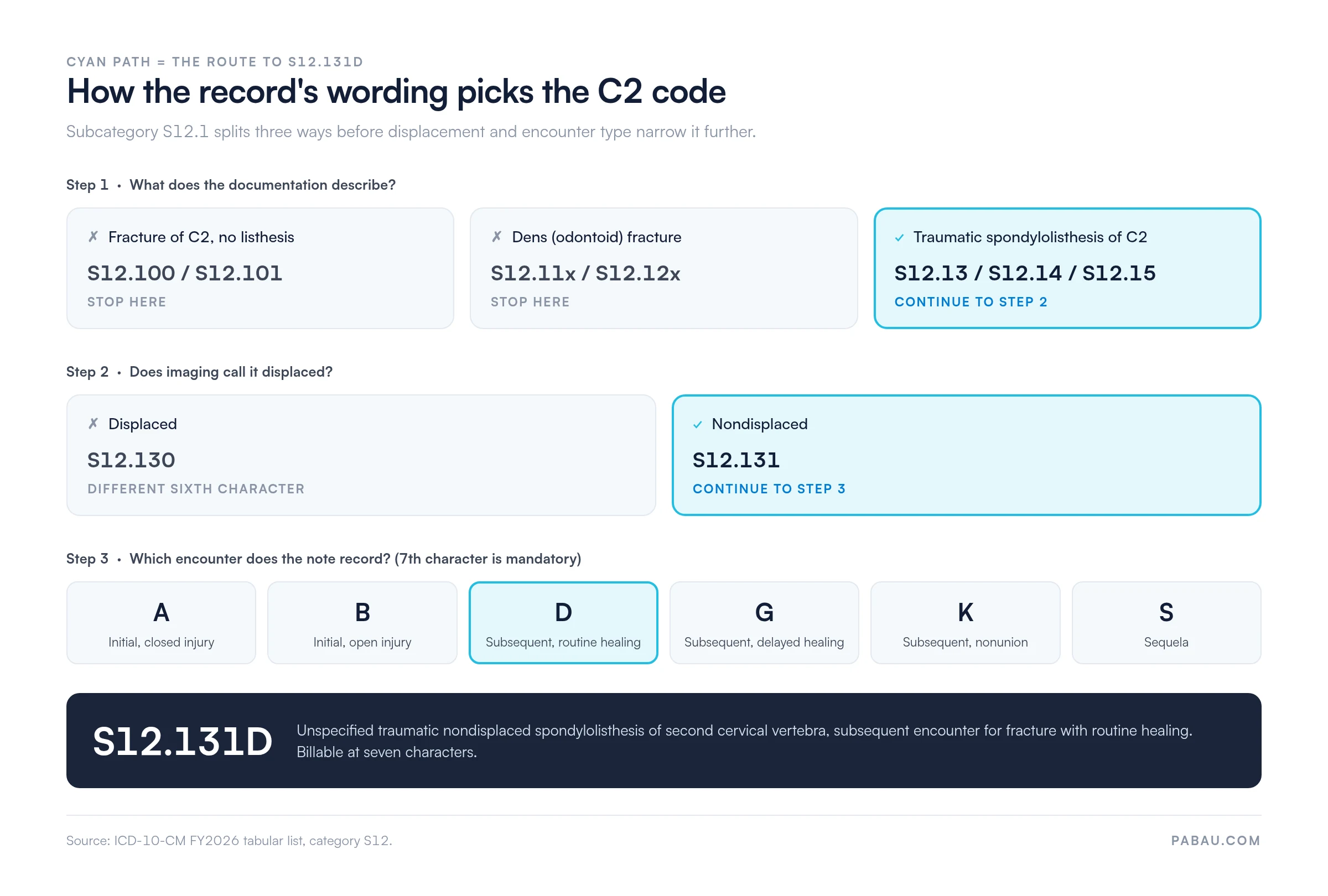
Provider notes rarely use ICD-10-CM wording word for word. Therefore, recognizing the clinical phrases that map to S12.131D helps coders match the record to the code. The AAPC ICD-10-CM code lookup is a useful cross-check when the documentation language is unfamiliar.
Documentation language does not have to match the descriptor exactly, provided every required specificity element is present in the record. In other words, what matters is that listhesis, displacement status, level, and healing status all appear somewhere in the note.
S12.131D sits at the bottom of a layered hierarchy. Consequently, walking the chain confirms the coder reached full specificity and did not stop at a non-billable parent. Ultimately, an accurate superbill entry needs the complete seven-character code.
Four tabular and chapter-level instructions govern this code. Fortunately, each one is checked during audit, and each one is straightforward to satisfy at the point of charting.
Payers reviewing an S12.131D claim look for five elements in the medical record. Therefore, a missing element is grounds for a denial or a documentation request. Strong medical billing compliance protocols catch these during charting rather than after a denial arrives. Similarly, good medical billing workflows build the check into every follow-up encounter.
The initial and subsequent distinction is clinical rather than calendar-based. For instance, a patient who reaches a sports medicine practice for the first time after the injury may still be in active treatment. Therefore, that keeps the encounter at character A.
Most S12.131D errors fall into five patterns. Consequently, catching them before submission is faster than working them through denial management processes afterward. Similarly, practices that take revenue cycle management seriously build these checks into the pre-submission audit.
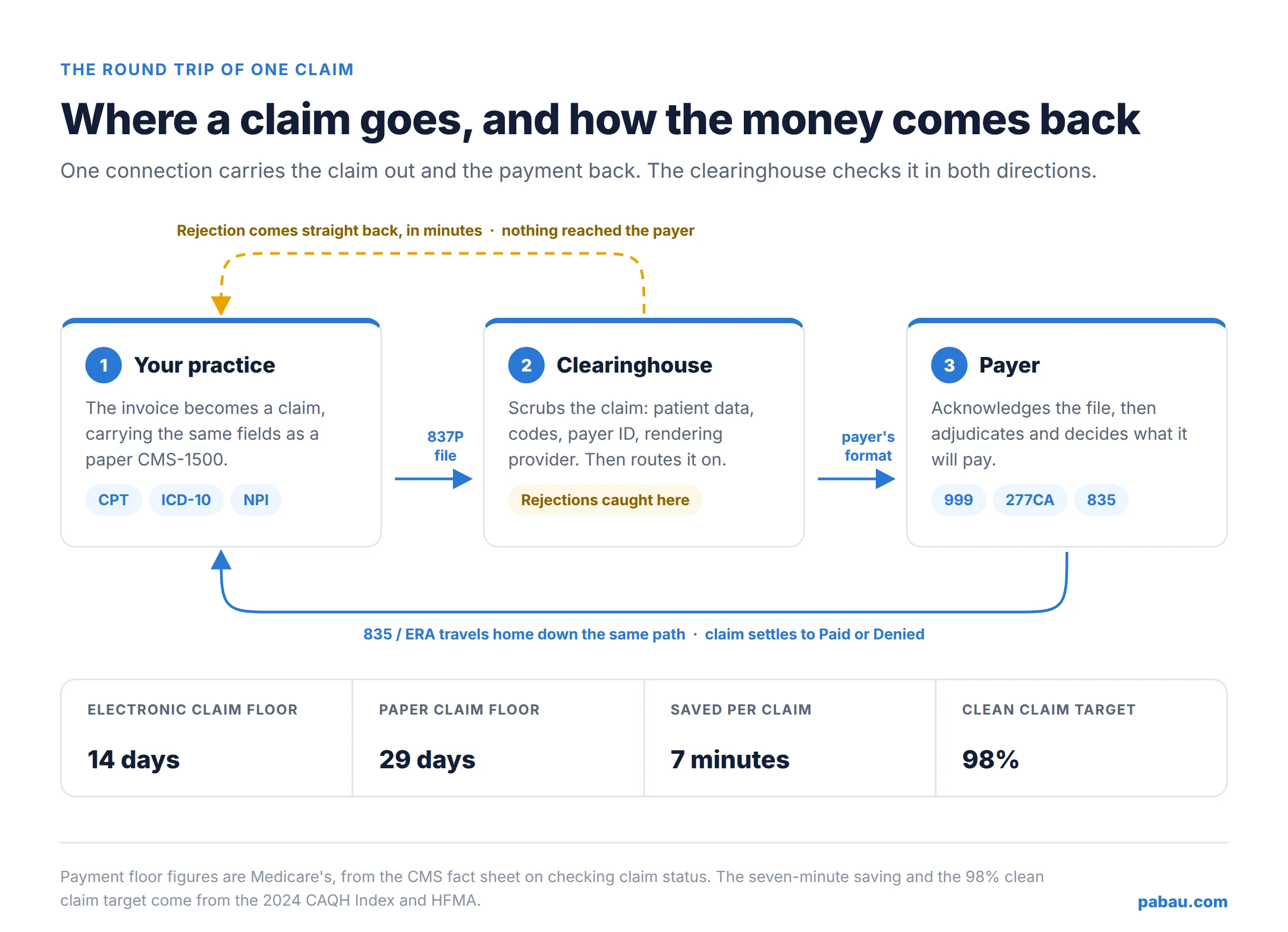
Pabau connects to the US clearinghouse Claim.MD, so the coded invoice moves from the patient record into a pre-filled submission. The Claim.MD integration also supports clean claim submission, because Pabau validates the payer fields before the claim goes out.
Code-level checks stay with your coding team. Therefore, verify the seven-character string in the CDC ICD-10-CM browser tool before you send.
Each month, pull every S12.1x claim that went out with the A character. Consequently, any such claim for a patient with earlier S12.1x billing history is a likely encounter-type error. Check the documentation and correct it before the payer audit logic finds it.
Many practices split this work across systems. The coder reads the follow-up note in one place, types the code into a separate billing tool, then rekeys insurer details into a payer portal. As a result, every hop is a chance for the 7th character to drift away from the encounter it describes.
Pabau keeps the record and the claim in one system. For example, custom charting forms let you add fields for displacement status and healing progress, so a follow-up note captures what S12.131D needs. When the invoice is ready, Pabau pulls the patient, treatment, and insurer details straight into a pre-filled claim.
Its claims management validation then runs in the background before the claim leaves. If a membership number or authorization code is missing, the send action stays blocked until someone fixes it. In the US, Pabau connects to Claim.MD for electronic submission, eligibility checks, claim status, and ERA posting.
Diagnosis-code selection stays with your coders, because Pabau validates payer fields rather than code specificity. Ultimately, what you get back is fewer resubmissions and less time chasing payments. The coding team can then focus on getting the seven characters right. Fewer resubmissions and faster payment also strengthen the practice’s overall revenue cycle health.
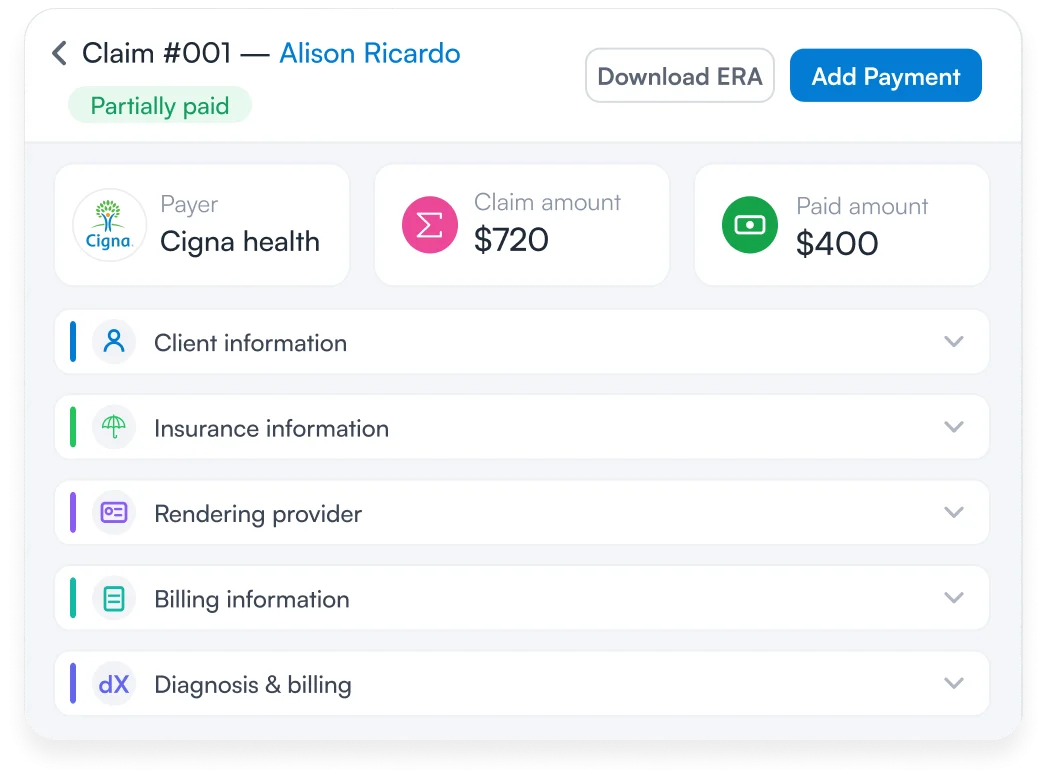

Pabau validates the payer details on every claim, then submits and tracks it through Claim.MD, so your follow-up encounters get paid without the rework.

ICD-10 Code S12.131D covers one narrow scenario. The patient has a traumatic nondisplaced spondylolisthesis of C2, and the follow-up record documents routine healing. In short, the trap in this family is the subcategory itself, because S12.13 describes spondylolisthesis rather than a plain fracture. Confirm the pattern, then confirm displacement, then choose the 7th character.
Pabau keeps the coded invoice, the clinical note, and the claim in one system, and validates the payer fields before submission. To see how it handles insurance claims across your practice, book a demo.

Billing a related neck vessel procedure? Anesthesia for neck vessel ligation covers billing CPT code 00352 for simple ligation of a major neck vessel.
Coding a healed injury rather than an active one? ICD-10 code S60.152S shows how the sequela character S works once the original injury has resolved.
Billing the surgical stabilization as well? CPT code 22842 covers posterior segmental instrumentation placed across 3 to 6 vertebral segments.
Billing anesthesia for a different procedure? Anesthesia for breast reconstruction covers anesthesia billing for reconstructive breast procedures such as reduction or augmentation mammoplasty.
Unsure what an unspecified descriptor demands? ICD-10 code S46.921A explains what the record has to carry at an initial encounter.
S12.131D is a billable ICD-10-CM code for an unspecified traumatic nondisplaced spondylolisthesis of the second cervical vertebra, at a follow-up visit with routine healing. Specifically, S12 identifies the cervical fracture category, and .13 identifies unspecified traumatic spondylolisthesis of C2. The .131 digit specifies nondisplaced, and D marks a subsequent encounter with routine healing.
It is a spondylolisthesis code. The S12.13 subcategory reads unspecified traumatic spondylolisthesis of second cervical vertebra, so the record has to document listhesis of C2 on C3. Instead, a generic C2 fracture is coded to S12.100 or S12.101, and a dens fracture is coded to S12.11 or S12.12.
S12.131 is nondisplaced. The displaced sibling is S12.130, so the pair runs opposite to what many coders assume. Specifically, at a subsequent encounter with routine healing, the two codes are S12.131D for nondisplaced and S12.130D for displaced.
Yes. S12.131D is a specific, billable ICD-10-CM code valid for all HIPAA-covered electronic transactions. It has been part of the code set since ICD-10-CM took effect on October 1, 2015, and the descriptor is unchanged for FY2026. However, the six-character parent S12.131 is not billable on its own.
A hangman fracture is a traumatic spondylolisthesis of the axis, coded in the S12.13 to S12.15 range. Use S12.130 or S12.131 when the record does not classify the pattern, S12.14 for Type III, and S12.15x for other traumatic spondylolisthesis. Additionally, every code needs a 7th character for encounter type.