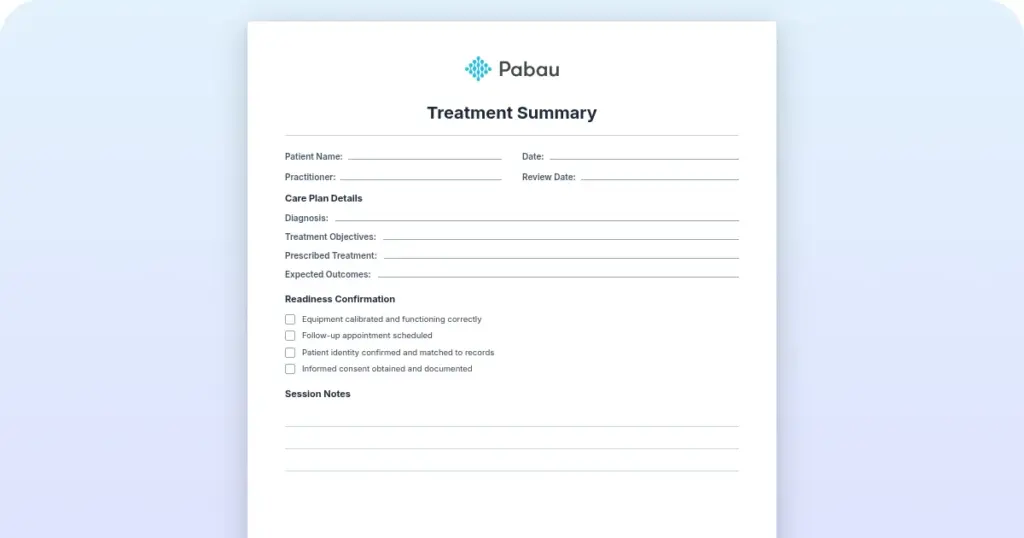
Treatment summary
A treatment summary is a written record of what care was delivered during an epi...

2
Last Updated: Oct 16, 2026

Medical decision making (MDM) is the structured clinical process physicians use to evaluate a patient’s condition – and it determines E/M code levels for billing under AMA and CMS guidelines.
MDM has three elements: number and complexity of problems, amount and complexity of data reviewed, and risk of complications or morbidity. Two of the three must meet a level to qualify.
Four complexity tiers exist: Straightforward, Low, Moderate, and High. Misclassifying the level is the leading cause of claim denials and compliance audits.
Practice management software like Pabau helps clinicians structure MDM notes accurately at the point of care with AI-powered documentation tools, reducing documentation burden and audit exposure.
Most claim denials tied to office visits are not caused by the wrong diagnosis code. They stem from inadequately documented medical decision making. For practices that also perform cosmetic injections, our medical spa software comparison covers injection charting and has a pick for medical-director-led med spas.
According to CMS (the Centers for Medicare and Medicaid Services), Evaluation and Management (E/M) services represent the largest single category of Medicare Part B expenditures. MDM documentation is the engine that determines reimbursement at every visit level.
This guide covers how medical decision making works, how to apply the three elements correctly, and how clinicians can document MDM to withstand audit. Whether you run a primary care practice, a specialty practice such as psychiatry, or a med spa with physician oversight, accurate MDM documentation protects both revenue and compliance standing.
Medical decision making is the cognitive work a physician performs when evaluating a patient, reviewing data, and selecting a management plan. It is one of two pathways used under the 2021 AMA E/M guidelines to select the appropriate CPT code for an office or outpatient visit, the other pathway being total time.
MDM replaced history-taking and physical exam as the primary coding determinant. That change shifted how clinical work is quantified for billing.
For clinicians, getting MDM right matters clinically and financially. Undercoding leaves revenue on the table. Overcoding – selecting a higher complexity level than the documentation supports – creates audit risk and potential repayment demands. According to MGMA, MDM accuracy directly affects both reimbursement levels and compliance exposure for practices of every size.
The AMA defines MDM by three elements. Two of the three elements must meet or exceed the threshold for a given level to assign that level to the visit. This is the “2-of-3 rule,” and it is the single most important mechanic to understand before scoring any encounter.
Your claims management software can flag mismatches, but the accuracy of the documentation behind it rests entirely with the clinician.
Every E/M encounter is scored on three distinct elements. Each one has its own criteria, and the overall MDM level is the highest level that at least two of the three elements support. Here is what each element measures and what qualifies.
This element captures the clinical burden of the visit. A self-limited problem (a cold, a minor cut) sits at the low end. A routine debridement billed as 11721 sits there too, whatever the number of nails treated. A chronic illness with exacerbation, or a new undiagnosed condition requiring workup, sits in the moderate-to-high range.
This element tracks the cognitive work of information gathering. Simply ordering a test is not sufficient. The clinician must review, interpret, or independently analyze the data to generate credit. Reviewing records from an external provider, independently interpreting an EKG, or discussing a case with a specialist all qualify under this element. Passive ordering without documented review does not.
Risk captures how consequential the management decisions are. Minimal risk covers self-care advice with little potential for complications. OTC drug management sits at low risk. Prescription drug management sits at moderate risk as a standalone decision. Decisions involving elective surgery with identified risk factors, or drug therapy requiring intensive monitoring, reach the high risk threshold. A kyphoplasty discussed as 22513 belongs in that group, and so does a transfusion billed as 36430.
The American College of Surgeons MDM reference notes that social determinants of health, when they significantly limit treatment options, can qualify as a moderate-to-high risk consideration. Capturing this category explicitly in digital intake forms and clinical notes supports a more accurate risk score.
The MDM complexity matrix is the practical tool clinicians and coders use to assign an E/M level. Two of the three elements must qualify at a given level for the visit to be coded at that level. A moderate-complexity new patient visit, for example, codes at moderate-complexity new patient visit. The table below summarizes the criteria for each complexity tier.
The 2-of-3 rule in practice: Consider a patient with known type 2 diabetes presenting with new-onset chest pain. The physician reviews prior labs, orders an EKG, and independently interprets it (moderate data).
The chest pain represents a new problem with uncertain prognosis (moderate problems). The physician continues the patient’s current medications and arranges outpatient cardiology follow-up, with no new prescription requiring monitoring (low risk). Two elements reach moderate, so the visit codes at Two elements reach moderate.
Documenting only the medication plan without noting the independent EKG interpretation would drop Element 2 to low, leaving only Element 1 at moderate. With just one element meeting the moderate threshold, the visit would legitimately code at meeting the moderate threshold instead.
Documentation is where most MDM failures occur. A visit can involve genuinely complex clinical work, yet code at a lower level if the documentation does not reflect that work. The AMA’s 2021 E/M guidelines shifted accountability squarely onto what is written, not what happened.
Keeping structured patient records that capture each element explicitly is the most reliable protection against audit. A format like a BIRP note enforces this same element-by-element structure. Here are the most common documentation errors practices encounter:
For practices concerned about HIPAA-compliant documentation and audit preparedness, structuring notes around each MDM element creates a defensible record. Templates that prompt clinicians to address problems, data, and risk separately are more effective than free-text notes that leave elements implied rather than stated. Robust compliance management tools can flag notes that are missing element-level documentation before claims are submitted.
Audit your last 20 office visit notes for Element 2 documentation specifically. Most undercoding errors live here: physicians review data but do not write that they reviewed it. A single sentence – ‘Reviewed external cardiology records from 2024; findings consistent with current presentation’ – captures the element and supports the code level.
Shared decision making (SDM) is the collaborative model in which clinicians and patients jointly evaluate treatment options, weigh evidence, and reach a management decision that reflects both clinical expertise and patient preferences.
SDM is distinct from standard MDM but intersects with it. When a patient declines a recommended procedure or selects a lower-risk alternative, the clinical reasoning behind accommodating that choice should be documented within the MDM record. A patient who turns down a hammertoe correction billed as 28285 is the everyday version of that.
Research published in PMC confirms that SDM improves patient satisfaction and treatment adherence without reducing clinical effectiveness. For billing purposes, documenting an SDM discussion can support the risk element of MDM when the conversation involves weighing treatment options with non-trivial consequences.
Practically, SDM documentation should capture: the options presented, the evidence discussed, the patient’s stated preferences, and the agreed plan. For spinal instrumentation such as 22845, that conversation is the record a payer later reads. This level of detail also matters in workflows where informed consent and treatment planning need to be linked to the clinical record.

Pabau’s AI-powered documentation tools help clinicians capture MDM elements at the point of care, reducing documentation burden and audit exposure across your practice.

Even experienced clinicians are vulnerable to systematic errors in judgment that stem from cognitive shortcuts, not lack of knowledge. These biases are well-documented in peer-reviewed literature and represent one of the more overlooked causes of both clinical and coding errors in MDM.
Addressing these biases protects patient safety and affects MDM accuracy directly: anchoring bias can cause underdocumentation of problem complexity, while confirmation bias can lead to incomplete data review documentation. Both reduce the defensible level of the visit. Tools that prompt clinicians to address each MDM element reduce the cognitive shortcuts that these biases exploit.
The documentation burden tied to MDM is a well-documented contributor to clinician burnout. In practices where clinicians spend more time on notes than on patient interaction, MDM documentation quality tends to suffer. This is the operational problem that clinical documentation tools directly address.
Structured note templates within a practice management platform solve the most common MDM failure: missing elements. When a template requires the clinician to explicitly address problems, data reviewed, and risk before completing the note, incomplete documentation becomes visible before the claim is submitted, which is far more reliable than post-hoc audit review.
Esteem Life Medical Group applied that same consistency across its team and cut consultation time by 15%. A structured discharge planning checklist enforces this same discipline for care-transition documentation.
Pabau’s AI-powered clinical documentation captures the encounter in real time, structures it into a note, and reduces the manual effort of documenting each MDM element. Where clinicians currently spend time after each visit writing up decisions they made during the consultation, AI scribe tools can surface and organize that cognitive work as it happens.
Research on AI scribes’ impact on patient care consistently shows reduced after-hours documentation time without compromising note quality, and the same benefits extend to more accurate coding when MDM elements are captured in real time rather than reconstructed from memory.
For practices exploring the transition, medical dictation tools offer an intermediate step that improves note completeness without a full AI integration.
Beyond documentation, practice management software with built-in EHR integration creates an audit trail that links documentation to billing decisions. When every MDM element is captured and timestamped within the clinical record, responding to a payer audit becomes a straightforward data retrieval task rather than a document reconstruction exercise.
Medical decision making sits at the intersection of clinical quality, revenue integrity, and compliance risk. Getting the three elements right, applying the 2-of-3 rule consistently, and documenting to the level of work actually performed are the three actions that protect both reimbursement and audit standing.
Pabau’s structured clinical documentation tools, including AI-powered note generation and MDM-aware templates, help practices capture each element at the point of care. To see how Pabau handles clinical documentation for your practice type, book a demo.

Coding an unspecified orbit disorder? ICD-10 code for orbit disorders covers the unspecified orbit disorder code and the new 2026 code for thyroid orbitopathy.
Coding an unspecified corneal scar? ICD-10 code for corneal scar covers the diagnosis code for a corneal scar or opacity that has no more specific subcode.
Coding an optic chiasm disorder? ICD-10 code for optic chiasm covers optic chiasm disorders not caused by inflammation, neoplasm, or vascular disease.
Medical decision making is the cognitive process a physician uses to evaluate a patient’s condition, review clinical data, and select a management plan. Under the AMA’s 2021 E/M guidelines, MDM is one of two pathways used to select the appropriate CPT code for office and outpatient visits, with the other pathway being total time. It comprises three elements: number and complexity of problems addressed, amount and complexity of data reviewed, and risk of complications or morbidity.
The three MDM components are: (1) number and complexity of problems addressed, which ranges from a single self-limited problem to conditions posing a severe threat to life; (2) amount and complexity of data reviewed and analyzed, covering everything from ordering a basic test to independently interpreting complex multi-specialty records; and (3) risk of complications and/or morbidity or mortality, which spans low-risk OTC management through drug therapy requiring intensive monitoring. Two of the three must meet a given level for the visit to be coded at that level.
The four MDM complexity levels are Straightforward (CPT 99202/99212), Low (99203/99213), Moderate (99204/99214), and High (99205/99215). Each level corresponds to specific thresholds across the three MDM elements, and the 2-of-3 rule means two elements must qualify at or above the chosen level to support that code selection.
MDM directly determines which E/M CPT code is selected for an office or outpatient visit. A higher complexity level supports a higher-paying code. Inadequate MDM documentation, even when the clinical work genuinely occurred, results in the visit coding at a lower level or being denied on audit. This is why element-specific documentation is as important as the clinical decision itself.
Correct MDM documentation requires explicitly addressing each element within the clinical note: naming the problem complexity and whether the condition is stable or exacerbating; noting what data was reviewed and what analysis was performed (not just what was ordered); and specifying the risk level of the management decision, including whether prescription drugs requiring monitoring were involved. Copy-paste notes that do not reflect individual visit complexity are a common audit trigger.
Clinical decision support (CDS) tools embedded in EHR and practice management platforms help by prompting clinicians to address each MDM element before completing a note, flagging potential undercoding or documentation gaps, and reducing reliance on memory-based documentation after the visit. AI-assisted tools can capture clinical reasoning in real time, which is more accurate than reconstructing decisions hours after the encounter.