

CPT Code 98981: RTM Treatment Management Billing Guide
CPT code 98981: Definition and official descriptor CPT code 98981 is an add-on c...

Last Updated: Nov 9, 2026
M5280 is the CCSD code for revision retropubic suspension of neck of bladder (including colposuspension and cystoscopy). It applies when an earlier anti-incontinence operation has failed and the surgeon re-operates through the retropubic space. A first-time retropubic suspension is coded M5220 instead.
M5280 sits in CCSD chapter 12, Urinary system and male reproductive organs, in the Bladder section. Cystoscopy is part of the code, so it is never billed as a separate line on the same claim.
Let Pabau's smart automation suggest the right codes, reduce claim denials, and keep your practice compliant—effortlessly.
Automate repetitive tasks and focus on what matters most—your patients.
Reduce coding errors and ensure compliance with the latest regulations.
Clean claims, fewer denials, and faster reimbursements.
Powerful insights and reporting to help your practice thrive.
HIPAA compliant SOC 2 certified GDPR-compliant Trusted by 4,000+ clinics worldwide

CCSD code M5280 covers a revision retropubic bladder neck suspension, so it applies only after an earlier anti-incontinence operation has failed.
A first-time retropubic suspension, including colposuspension, is coded M5220, and a suburethral tape sling is coded M7590.
Cystoscopy is part of the M5280 descriptor, so a separate cystoscopy line on the same claim is an unbundling error.
Bupa and AXA Health usually expect pre-authorisation, urodynamic results and the failed procedure’s details before revision pelvic surgery.
Pabau, the practice management platform we build, stores the pre-authorisation code with the appointment so it reaches the insurer with the claim.
CCSD code M5280 is the UK private healthcare code for a redo retropubic bladder neck suspension. Its official descriptor reads: Revision retropubic suspension of neck of bladder (including colposuspension and cystoscopy).
The code sits in chapter 12 of the CCSD schedule, Urinary system and male reproductive organs, under the Bladder section.
The Clinical Coding and Schedule Development group maintains the schedule. Private insurers across the UK use it for billing, including Bupa, AXA Health, Aviva and Vitality.
Three elements of the descriptor set the code’s scope and separate it from neighbouring codes:
The Burch colposuspension is the most common retropubic colposuspension, and M5280 describes its revision. The patient lies supine under general or regional anaesthesia. The surgeon re-enters the space of Retzius, between the pubic symphysis and the bladder. Adhesions and scarring from the first operation make this step harder in a revision case.
These surgical steps must appear in the operative note to support M5280 billing:
Cystoscopy is part of every M5280 procedure by definition. The operative note must therefore record its findings.
M5280 fits a patient with stress urinary incontinence (SUI) whose earlier anti-incontinence operation has failed or whose symptoms have returned. These scenarios justify a revision retropubic approach:
Insurers expect urodynamic studies confirming urodynamic stress incontinence before they approve the operation. Invasive urodynamic assessment is billed under its own code, M4780, usually in an earlier episode. A clinical note that cites only patient-reported leakage is routinely challenged at pre-authorisation.
Cystoscopy is included within M5280 and must not be billed separately. The official descriptor says so: “including colposuspension and cystoscopy.” UK private insurers audit for a separate cystoscopy code alongside M5280 and routinely deny it as unbundling.
Common mistake: A claim lists M5280 plus a standalone intraoperative cystoscopy code, treating the cystoscopy as a distinct diagnostic step. The insurer rejects the cystoscopy line, re-adjudicates the claim and flags the consultant for future audit.
Correct approach: Bill M5280 as the single procedure code, because the cystoscopy fee is already in its tariff. A cystoscopy earns its own code only as a separate episode, for a different indication, on a different date. A flexible cystoscopy in that situation is billed as M4510.
Check every M5280 claim before submission. If the claim also carries a cystoscopy or flexible cystoscopy code, remove that line. The descriptor bundles cystoscopy into the procedure fee, and billing both draws immediate insurer scrutiny.
M5280 sits in the Bladder section of CCSD chapter 12, beside the primary suspension code M5220. Several bladder neck codes share the M52 prefix, but the choice between them turns on two questions. The diagram below sets them out in order. Combined abdominal and vaginal surgery on the female bladder outlet sits outside the M52 group and is billed as CCSD M5100.
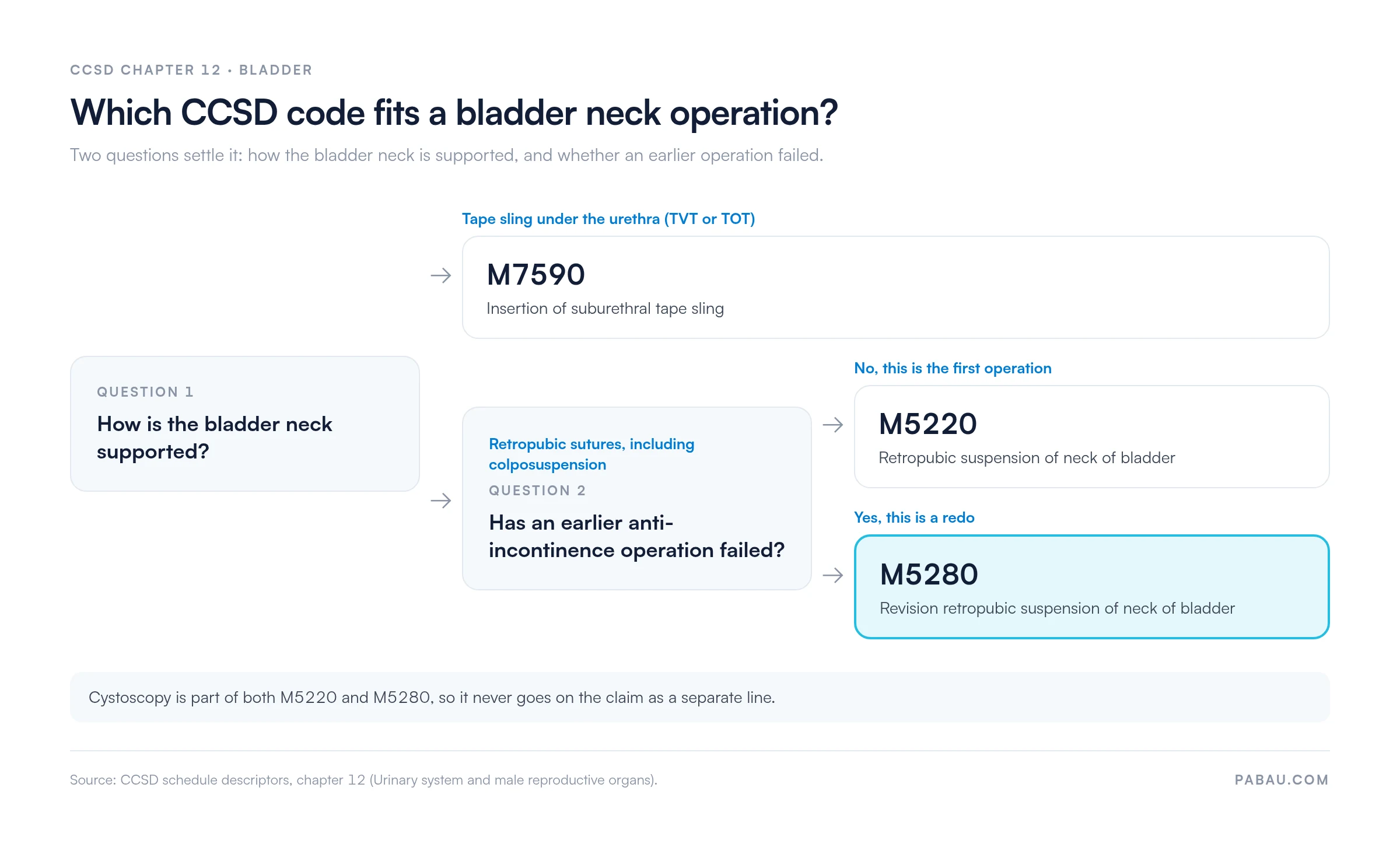
The table maps the codes coders most often confuse. Our CCSD code library lists the rest of the schedule when a case falls outside these four rows.
The M5280 descriptor says “retropubic”, which names the anatomical space rather than the surgical approach. Check your current CCSD edition for whether M5280 covers the laparoscopic route or a separate code applies.
Where the descriptor is unclear, ask the CCSD editorial team or the insurer’s coding advice line before submitting. Billing M5280 for a laparoscopic operation that has its own code creates a code-to-note mismatch, and the claim is denied.
M5280 claims are denied more often for thin operative notes than for wrong code selection. The note must show that the operation matches every element of the descriptor. A structured operative note template reduces omissions and makes insurer audit responses quicker.
A defensible M5280 claim needs these elements in the operative note:
UK private insurers almost always require pre-authorisation before revision pelvic surgery is billed under M5280. Approval does not guarantee payment, but going ahead without it virtually guarantees denial. Insurers typically ask for:
Each insurer sets its own expectations for M5280 pre-authorisation:
The pre-authorisation reference also has to reach the claim itself. A claim submitted without it in the header is the most avoidable M5280 denial of all.
M5280 denials follow a predictable pattern. The table lists the six most common reasons and the corrective action for each.
UK private insurers recognise M5280 within their CCSD-based fee schedules. Each insurer prices the consultant fee, the anaesthetist fee and the facility fee separately. CCSD does not set a fee, so confirm current figures with the insurer before quoting patients or raising invoices.
Bupa places M5280 in fee band Major 3, the same band as the primary code M5220. The consultant must hold recognised specialist status in urogynaecology or urology. The Bupa code search portal confirms the current descriptor and fee band.
Claims through Bupa’s online portal carry the pre-authorisation reference in its designated field. Paper submissions need the reference on the invoice header. Our guide to Bupa CCSD codes explains how Bupa processes procedure claims across the schedule.
AXA Health processes M5280 claims through its specialist procedure codes system. The AXA Health procedure codes portal confirms the current fee chapter for revision pelvic surgery. AXA pays different fees by consultant grade, so the consultant’s GMC-registered specialty must match the procedure category.
OPCS-4 is the NHS procedure classification for NHS episodes, while CCSD codes cover private billing. Teams running both NHS and private lists sometimes need to cross-reference the two systems. So do private facilities that receive NHS-funded patients.
In OPCS-4, category M52 covers abdominal operations to support the outlet of the female bladder. Its retropubic suspension codes are the nearest equivalents to M5280, though their scope may differ from the CCSD descriptor.
NHS England updates OPCS-4 regularly, so check the current version in the NHS Classifications Browser before cross-coding. Never assume a one-to-one match between M5280 and a single OPCS-4 code.
A patient may move between NHS and private episodes for the same condition. Record the CCSD code and the OPCS-4 code separately in the patient record. Mixing code systems on one invoice causes processing errors and delays payment from both NHS commissioners and private insurers.
Practices moving from NHS work into private billing often find that CCSD coding needs a different discipline from OPCS-4. Bundling rules, such as cystoscopy within M5280, and insurer-by-insurer pre-authorisation have no direct NHS equivalent.
Most M5280 claims fail on paperwork, not on the code. A pre-authorisation reference sits in an email, the operative note lives in a separate system, and the claim is keyed in by hand days later.
In Pabau’s claims management software, the insurer’s pre-authorisation is stored as a case. Attach the case when booking, and its code follows the appointment through to the claim. Bupa cover can be checked in seconds before the operation.
Claims go to Bupa, AXA Health, Vitality and other insurers through Healthcode. Each one then moves through a single dashboard from pending to paid. The operative note, urodynamic report and claim sit in the same patient record, so an insurer query is answered from one screen.
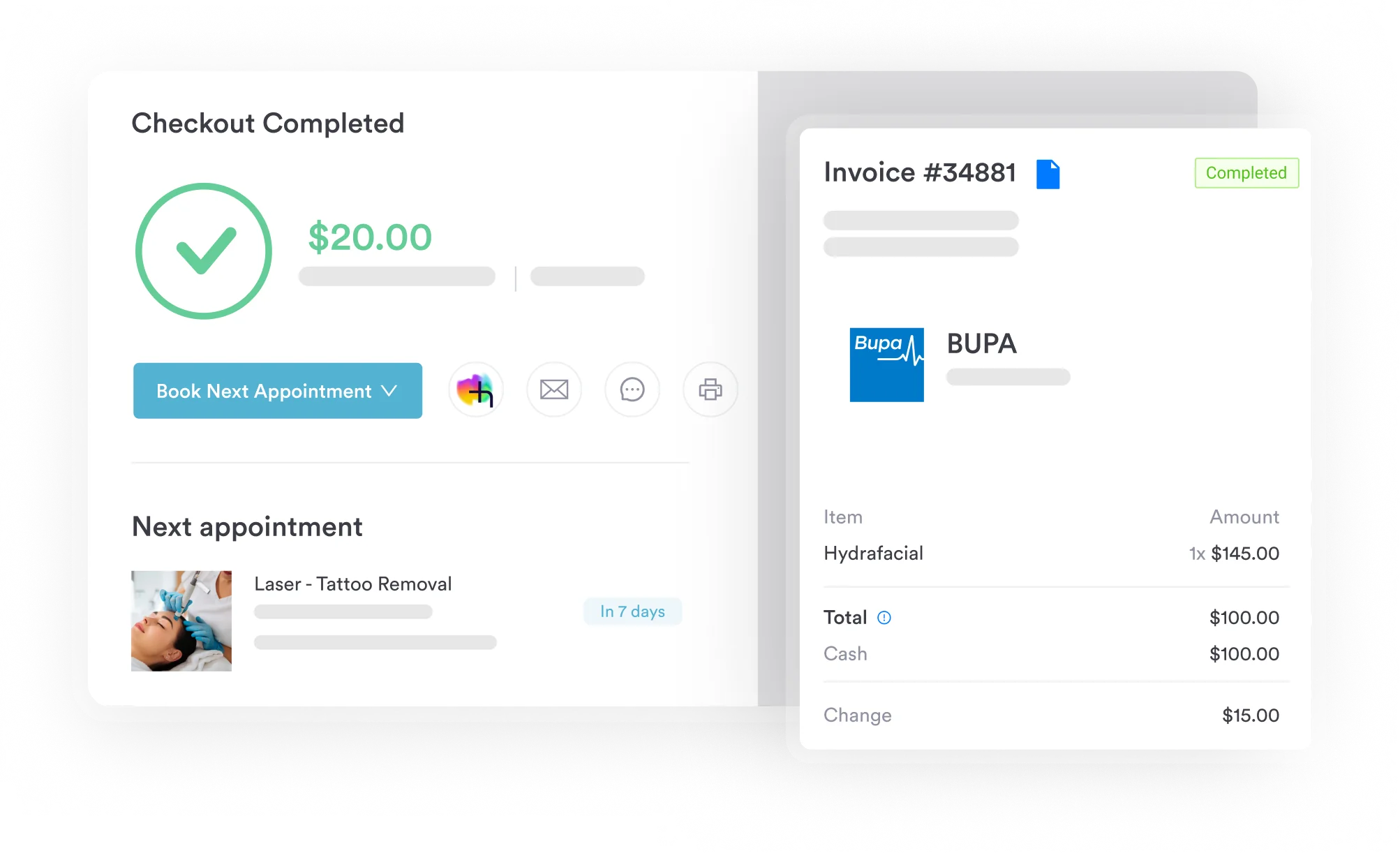

Pabau attaches the pre-authorisation code to the appointment and sends CCSD claims to Bupa, AXA Health and Vitality through Healthcode. See how it handles urogynaecology billing.

The code itself is rarely the hard part of an M5280 claim. Once the operative note states that this is a revision of a named earlier operation, M5280 follows. If the note does not, the insurer will treat the case as M5220 or query it.
Settle three points before the patient is admitted. The urodynamics should be on file and the pre-authorisation reference attached to the booking. The surgeon should also know that cystoscopy findings belong in the note.
A practice that does this turns a revision claim into a routine one. Book a demo to see how Pabau carries the pre-authorisation code from booking to a paid CCSD claim.

If the revision fails too? CCSD Code M5520: Artificial urinary sphincter implantation covers the scope, pre-authorisation and claim rules for the next surgical option.
Billing another bladder code with cystoscopy built in? CCSD code M3600: Bladder enlargement explains which elements the descriptor bundles and what insurers expect on the claim.
Recording a redo procedure in full? Operation notes template gives a free structure for each procedure, its findings and the operator sign-off.
Comparing billing tools for UK insurer claims? Best medical billing software in the UK reviews the platforms that handle private insurer billing for UK practices.
CCSD code M5280 covers revision retropubic suspension of the neck of the bladder, with colposuspension and intraoperative cystoscopy included. It applies when an earlier anti-incontinence operation has failed and the patient needs a redo retropubic operation. It does not cover a first-time colposuspension, which is coded M5220.
Cystoscopy is included in M5280 by its official descriptor and must not be billed separately. UK private insurers audit for a standalone cystoscopy code alongside M5280 and routinely deny it. Only a cystoscopy on a separate date, for a different indication, warrants its own code.
M5280 is the revision code for a patient who has already had an anti-incontinence operation. M5220 is the primary code, for a patient’s first retropubic suspension, including colposuspension. Billing M5220 for a patient with earlier surgery is a coding error that leads to denial when the insurer’s records show the previous operation.
Yes. Bupa and AXA Health both typically require pre-authorisation before revision pelvic surgery. They usually ask for urodynamic results, details of the failed earlier procedure and evidence of conservative management. Approval is a condition of payment, not a guarantee of it.
It depends on the current CCSD edition. The M5280 descriptor says retropubic, which names the anatomical space rather than the approach. Check with the CCSD editorial team or the insurer’s coding helpline before billing a laparoscopic revision under M5280.
The nearest NHS equivalents sit in OPCS-4 category M52, which covers abdominal operations to support the outlet of the female bladder. CCSD and OPCS-4 descriptors do not map one-to-one. Check the current OPCS-4 version in the NHS Classifications Browser before cross-coding.




