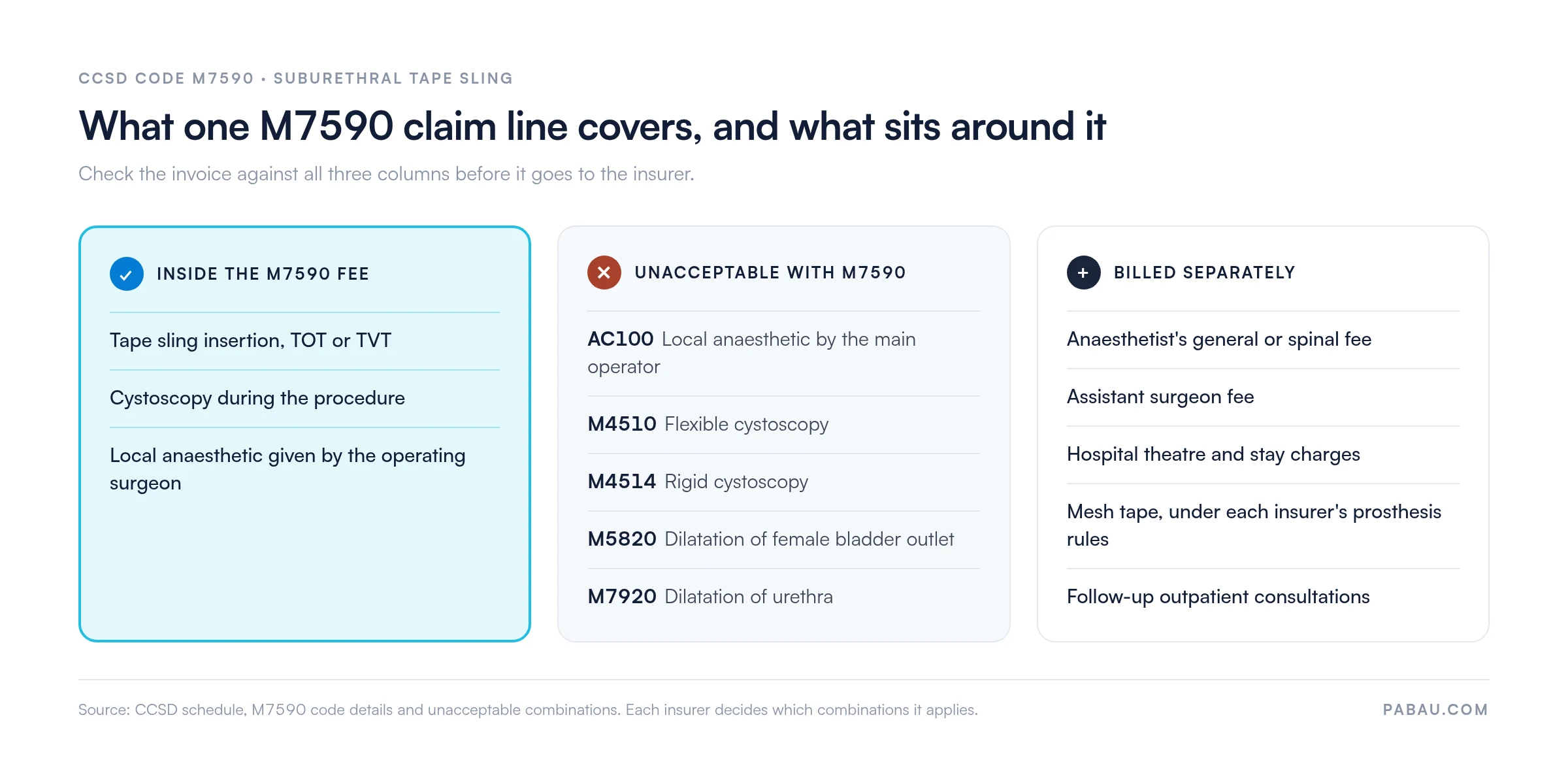
M7590 is the CCSD code for insertion of a suburethral tape sling, such as TOT or TVT, to treat stress urinary incontinence. One fee covers the sling, the cystoscopy done during surgery, and any local anaesthetic the operating surgeon gives.
The CCSD schedule files M7590 under 12.3.0 Bladder and 14.2.0 Suspension. It lists AC100, M4510, M4514, M5820 and M7920 as unacceptable alongside it, although each insurer decides which combinations it applies.
M7590Suburethral tape sling billing guideHigh match
Confidence score
98%
Why this code?
Matches patient diagnosis
Supported by clinical notes
Commonly used for this condition
Why practices choose Pabau
Save hours every week
Automate repetitive tasks and focus on what matters most—your patients.
Improve accuracy
Reduce coding errors and ensure compliance with the latest regulations.
Get paid faster
Clean claims, fewer denials, and faster reimbursements.
Grow with confidence
Powerful insights and reporting to help your practice thrive.
HIPAA compliant•SOC 2 certified•GDPR-compliant•Trusted by 4,000+ clinics worldwide
Key takeaways
CCSD Code M7590 covers suburethral tape sling insertion (TOT or TVT), with intraoperative cystoscopy included in the same fee.
Surgeon-administered local anaesthetic is bundled within M7590, while a separate anaesthetist’s fee and the mesh tape prosthesis are billed independently.
CCSD lists cystoscopy (M4510, M4514) and surgeon local anaesthetic (AC100) as unacceptable with M7590, and payers may reject or flag them.
Payers usually want pre-authorisation, proof of stress urinary incontinence and failed conservative treatment, so check each payer’s current policy.
Pabau’s claims management supports CCSD-coded claim submission and tracking, with consent forms and clinical notes on the same patient record.
CCSD Code M7590: Official descriptor and what it covers
CCSD Code M7590 has one official descriptor in the CCSD schedule of procedures. It reads: Insertion of suburethral tape sling (e.g. TOT or TVT) +/- administration of local anaesthetic by operating surgeon (including cystoscopy). The single procedure fee bundles three elements.
Suburethral tape sling insertion: The primary operation, performed via either the transobturator (TOT) or retropubic (TVT) approach. Both sit within a single code.
Intraoperative cystoscopy: A check cystoscopy performed during the procedure to confirm bladder integrity and correct tape positioning. The descriptor includes it explicitly.
Local anaesthetic by the operating surgeon: Peri-operative infiltration anaesthesia administered by the performing surgeon. The “+/-” notation signals it is optional, but when the surgeon gives it, it falls within M7590.
M7590 sits in the M-series of the schedule, which covers urinary tract procedures. The CCSD files it under two sub-chapters, 12.3.0 Bladder and 14.2.0 Suspension. The CCSD code library lists the neighbouring codes in the same series.
The CCSD Group’s member payers, Bupa, AXA Health, Aviva and Vitality, use these codes in their fee schedules and pre-authorisation portals. Confirm the code on Bupa’s code search portal before you quote it to a patient.
Clinical procedure: What happens during a suburethral sling insertion
A suburethral tape sling supports the mid-urethra to restore continence in patients with stress urinary incontinence (SUI). Knowing the surgical steps helps practice managers check that operative notes contain the elements payers look for.
The two approaches within CCSD Code M7590 differ in tape routing. TOT passes the tape laterally through the obturator foramen, while TVT passes it retropubically behind the pubic bone. Both are usually day-case procedures under general or spinal anaesthesia. The operating surgeon often adds local anaesthetic infiltration at the tape exit sites.
Surgical steps relevant to billing documentation
Anaesthetic induction: General, spinal, or local anaesthetic with sedation. If the surgeon administers local anaesthetic, record it in the operative note, because it falls within M7590.
Suburethral incision and dissection: A midline vaginal incision exposes the periurethral tissue at the level of the mid-urethra.
Tape passage: The surgeon passes the polypropylene mesh tape via the chosen route (obturator for TOT, retropubic for TVT) using a dedicated introducer needle.
Tension adjustment: The surgeon positions the tape without tension under the mid-urethra and confirms it with a cough test or similar dynamic assessment.
Intraoperative cystoscopy: A rigid or flexible cystoscope confirms bladder and urethral integrity, rules out tape penetration, and checks ureteric efflux. Record this step in the operative note, because the M7590 fee includes it.
Wound closure: Vaginal incision closed with absorbable suture.
Capture each of these steps as a structured field in the clinical note. The payer then finds what it checks at claim submission without querying the surgeon.
TOT vs TVT: Billing implications and code applicability
A single CCSD Code M7590 covers both approaches. There is no separate M-code for TOT versus TVT. The operative note must specify which technique the surgeon used, but you submit the claim under M7590 regardless.
Feature
TOT (transobturator tape)
TVT (tension-free vaginal tape)
CCSD code
M7590
M7590
Tape route
Lateral via obturator foramen
Retropubic (suprapubic)
Cystoscopy requirement
Included in M7590, with mandatory records
Included in M7590, with mandatory records
Operative note requirement
Must specify TOT approach and obturator route
Must specify TVT approach and retropubic route
NICE NG123 position
Not offered unless specific clinical circumstances rule out the retropubic route, so record the reason
The mesh sling route NICE includes in the surgical choice
If the surgeon converts from one technique to the other intraoperatively, the operative note should record the conversion, the reason, and the final approach. The claim remains under M7590, and no additional code applies to the technique change itself.
What M7590 includes: Bundled elements you cannot bill separately
The official descriptor makes the inclusions explicit. Billing any of the following separately on the same claim is unbundling, and payers may reject or flag the claim for it.
Intraoperative cystoscopy: The fee includes the cystoscopy performed to check tape position and bladder integrity. Do not add a cystoscopy-only CCSD code, such as M4510 or M4514, to the same invoice. CCSD lists both as unacceptable with M7590, and payers may reject or flag them.
Local anaesthetic administered by the operating surgeon: Peri-operative infiltration by the surgeon who performs the sling insertion is within the M7590 fee. CCSD lists AC100, local anaesthetic by the main operator, as unacceptable with M7590. This does not cover a separately contracted anaesthetist providing general or spinal anaesthesia.
Routine intraoperative checks: Standard surgical assessment steps performed during the sling procedure are part of the surgical episode covered by M7590.
What M7590 does not include: Separately billable items
Several legitimate costs fall outside the M7590 surgery fee, so you must invoice them on their own. Knowing the boundary prevents both under-recovery and inappropriate bundling.
Mesh tape prosthesis cost: The polypropylene suburethral tape, the implant itself, has its own charge as a prosthesis item. Under standard CCSD billing convention, you bill implant costs independently of the procedure fee. Check the prosthesis guidance in the CCSD technical preamble and confirm with each payer, as some cap prosthesis reimbursement or pre-approve the specific product.
General or spinal anaesthetist fee: Where a separate anaesthetist provides GA or regional anaesthesia, they submit their own claim. The surgeon billing M7590 covers only their own local anaesthetic within the procedure fee.
Assistant surgeon fee: If a qualified assistant participates, they bill their fee on its own under the applicable CCSD assistant surgeon tariff.
Hospital or facility charges: Theatre time, nursing, consumables, and any overnight stay are the hospital’s invoice, separate from the surgeon’s M7590 claim.
Post-operative consultations: Bill follow-up outpatient visits after the procedure under the relevant consultation code, not M7590.
Primary indication: Stress urinary incontinence and billing justification
Stress urinary incontinence (SUI) is the clinical indication that justifies CCSD Code M7590. SUI is involuntary leakage of urine on effort or exertion, or on sneezing or coughing. Payers ask for proof of the diagnosis before they authorise the procedure.
Urodynamic testing is not always part of that evidence. NICE NG123 advises against multichannel cystometry before primary surgery when SUI is diagnosed from a detailed history and shown on examination. It does recommend urodynamics first for groups such as women with unclear symptoms or previous SUI surgery.
Some payers set their own evidence rules on top of NICE. Check each payer’s current pre-authorisation policy, and attach whatever investigation results it names to the request.
Neighbouring CCSD codes: Avoid confusion and miscoding
Several codes sit close to M7590 in the CCSD bladder and suspension sub-chapters. Some describe a different bladder outlet operation, and CCSD lists others as unacceptable with M7590. The table maps both.
CCSD code
Procedure
How it relates to M7590
M7590
Insertion of suburethral tape sling (e.g. TOT or TVT), with or without surgeon local anaesthetic, including cystoscopy
Reference code covering the sling, cystoscopy and surgeon local anaesthetic
M5220
Retropubic suspension of neck of bladder (including colposuspension) (including cystoscopy)
Colposuspension and other retropubic bladder neck suspension, not a tape sling
M5300
Vaginal operations to support outlet of female bladder (including cystoscopy)
Vaginal outlet support, not a tape sling
M5100
Combined abdominal and vaginal operations to support outlet of female bladder (including sling procedures) (including cystoscopy)
Combined approach, so check the operative note
M4510
Diagnostic endoscopic examination of bladder (flexible cystoscopy) including any biopsy
Listed as unacceptable with M7590
M4514
Endoscopic examination of bladder (rigid cystoscopy) including any biopsy
Listed as unacceptable with M7590
M5820
Dilatation of outlet of female bladder (including cystoscopy)
Listed as unacceptable with M7590
M7920
Dilatation of urethra (including cystoscopy)
Listed as unacceptable with M7590
AC100
Local anaesthetic by the main operator
Listed as unacceptable with M7590, because the surgeon’s own local anaesthetic is already in the fee
The table covers insertion only. For removal or revision of an existing tape, search the CCSD schedule for the current code before you quote a fee.
The Bupa CCSD billing guide explains how payers interpret adjacent codes across the schedule. For a cystoscopy booked on its own date, M4510 is the flexible cystoscopy code.
Five codes CCSD lists as unacceptable with M7590 each duplicate work the fee already pays for. Combinations come from the CCSD schedule’s M7590 code details.
Pro Tip
Before submitting a claim for CCSD Code M7590, check the invoice for M4510, M4514 or AC100 on the same date of service. CCSD lists each as unacceptable with M7590, and payers may reject or flag the claim. Remove the extra line before you submit.
Pre-authorisation requirements for M7590
UK private payers usually ask for pre-authorisation before planned surgery such as CCSD Code M7590. Treating without an authorisation reference number puts payment at risk. Requirements vary by payer, so check each one’s current policy, including Bupa, AXA Health, Aviva, and Vitality. A request typically carries the following.
Proof of SUI: A detailed history and examination, plus urodynamic results where NICE NG123 or the payer calls for them.
Evidence of failed conservative treatment: Records showing that supervised pelvic floor muscle training was completed and proved inadequate. NICE NG123 recommends a trial of at least 3 months as first-line treatment, so check each payer’s policy for its own minimum.
Referring clinician letter: A GP or specialist referral letter confirming the diagnosis, duration of symptoms, and that surgical intervention is clinically indicated.
Mesh governance evidence: Confirmation of the MDT review, consent discussion and registry entry NICE NG123 sets out (see the NICE section below). Check each payer’s current policy for what it asks to see.
Procedure code and surgeon details: The pre-auth request must specify M7590 and the performing surgeon’s recognition number with the payer.
Record the authorisation number on the patient’s file before you confirm the theatre date. A procedure that goes ahead without it leaves both the practice and the patient exposed if the payer declines.
NICE guidance on mesh sling procedures and its impact on billing
NICE guideline NG123 sets the clinical rules for mesh slings in England. NICE published it in April 2019, after the July 2018 pause on vaginal mesh for SUI. NHS England and NHS Improvement ran that pause as a high vigilance restriction. The Independent Medicines and Medical Devices Safety Review then reported in 2020.
Payers do not publish one shared rule on NG123, but its recommendations shape what a complete M7590 file looks like.
MDT review: NG123 says local multidisciplinary teams should review the proposed treatment for every woman offered an invasive procedure for primary SUI.
Route: NICE includes the retropubic mesh sling in the surgical choice. It says not to offer a transobturator approach unless specific clinical circumstances, such as previous pelvic procedures, rule out the retropubic route.
Consent and implant details: The woman should be told the sling is a permanent implant and complete removal might not be possible. She should also get written details of the implant, its manufacturer, the insertion date and the surgeon.
Registry and reporting: Providers must record SUI procedures in a national registry, including the mesh material, manufacturer and product identification code. Confirmed mesh complications are also reported to the MHRA.
In England, the facility where M7590 is performed also needs CQC registration for the regulated activity of operations.
Documentation requirements: What operative notes must contain for M7590
An incomplete operative note is a common trigger for post-submission queries on CCSD Code M7590. Payers query claims where the note does not support the elements the descriptor includes. Use this checklist when reviewing notes before claim submission.
Records element
Why it matters for M7590 billing
Surgical technique (TOT or TVT)
Confirms the procedure falls within M7590 scope, and payers may query a note that leaves it out
Tape product, manufacturer and identification code
NICE NG123 asks for these in the national registry, and they support the prosthesis line if a payer audits it
Cystoscopy performed and findings
Confirms the included cystoscopy was performed, noting bladder integrity and ureteric efflux
Local anaesthetic given by the surgeon (dose and site)
Records the included local anaesthetic and heads off queries when an anaesthetist also gave systemic anaesthesia
Intraoperative complications
If a complication occurred (e.g. bladder perforation), record it and explain any additional procedures performed
Anaesthetic type (GA, spinal or local)
Clarifies whether a separate anaesthetist fee is legitimate with M7590
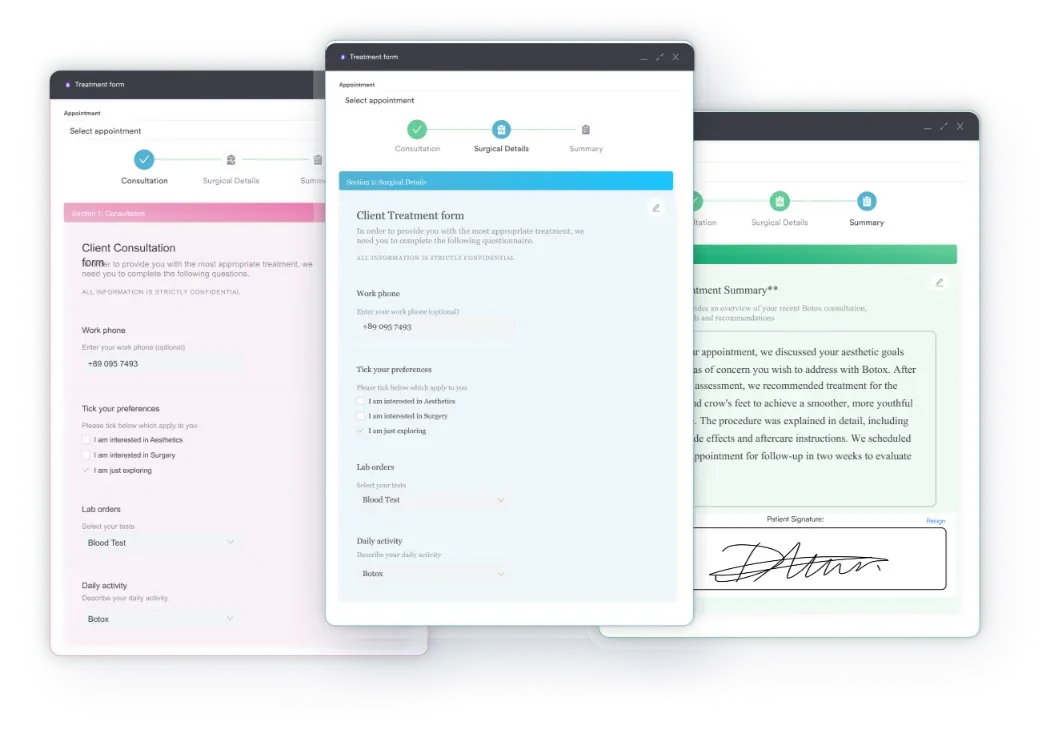
Digital consent forms and note templates can prompt for each field as staff write the note. The team then avoids rebuilding a missing element before claim submission.
Pabau’s customisable consent forms capture the mesh risk discussion NICE NG123 describes, so the signed form is on file before pre-authorisation.
Common claim denial reasons for M7590 and how to prevent them
Five preventable patterns sit behind most avoidable CCSD Code M7590 rejections and queries.
Missing pre-authorisation: The surgeon performed the procedure before the payer issued a valid authorisation number, or the pre-auth request quoted the wrong code. Prevention: Confirm the authorisation references M7590 and is in date before the procedure.
Unbundled cystoscopy: The practice bills M4510 or M4514 with M7590. Prevention: Audit every M7590 invoice for a cystoscopy line on the same date of service and remove it.
Thin proof: The pre-auth request does not show how SUI was diagnosed, or omits investigation results the payer asked for. Prevention: Check the payer’s current policy and attach what it names.
Mesh governance evidence absent: The payer cannot see that the NICE NG123 steps were followed. Prevention: Include the signed consent form covering mesh risks, the tape’s product details, and the MDT review in the submission.
Incomplete operative note: The note does not record the cystoscopy findings, the technique used, or the surgeon’s local anaesthetic. Prevention: Use the records checklist above before finalising and submitting.
How Pabau supports M7590 billing in private urology and gynaecology
An M7590 claim depends on a chain of documents, from the pre-authorisation request through the operative note to the payer claim. When those sit in different systems, the claim waits while someone gathers the evidence.
Pabau, the practice management platform we build, keeps those documents on one patient file. Its claims management software supports CCSD-coded claim submission and tracking through Healthcode, using details already on the patient record.
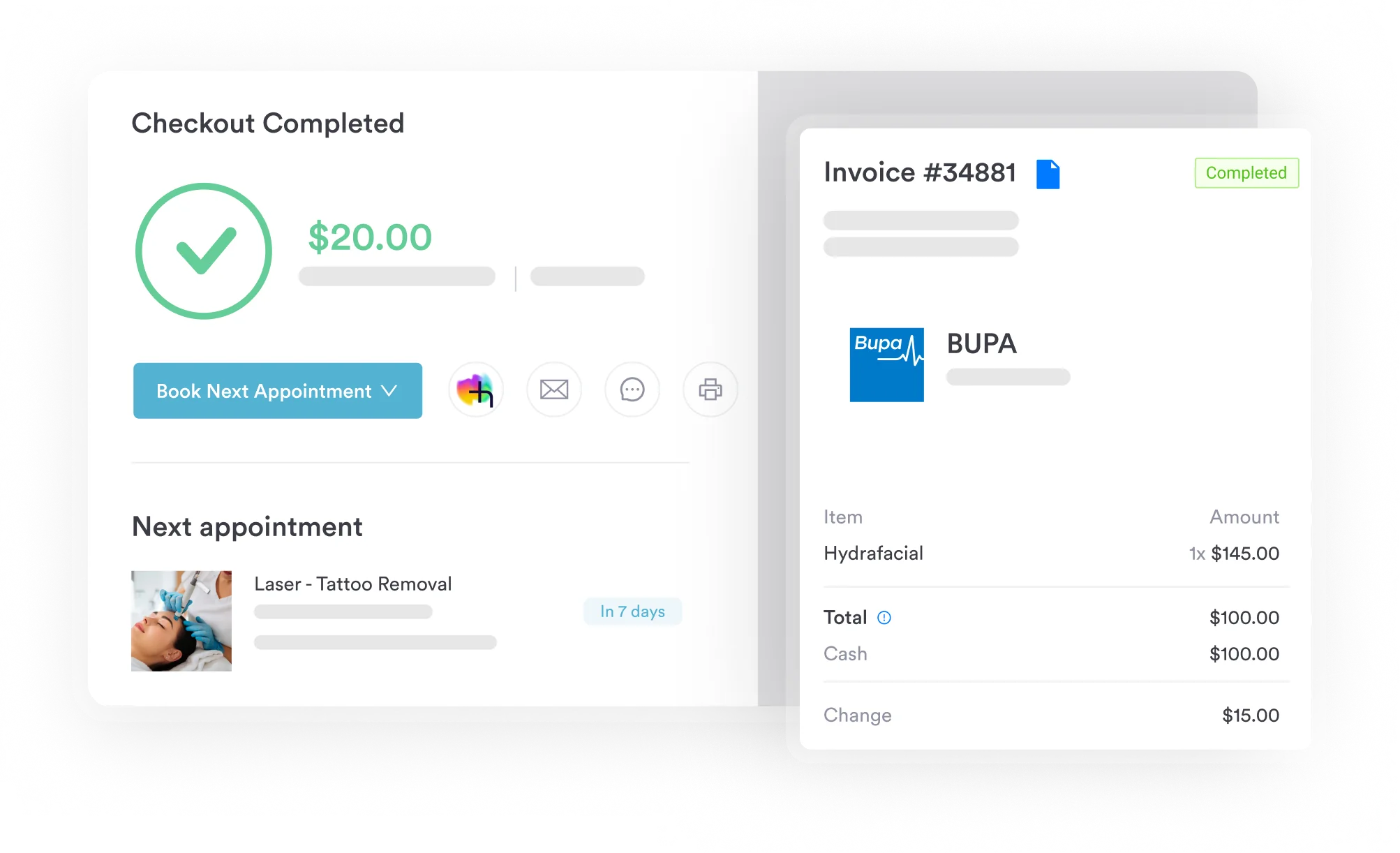
Pabau submits the CCSD-coded claim to Healthcode from the patient record, so the team tracks the M7590 claim beside its operative note.
Urodynamic results, physiotherapy history and the signed consent form sit in the same patient record as the invoice. When a payer queries the claim, the answer is already in one timeline rather than spread across inboxes.
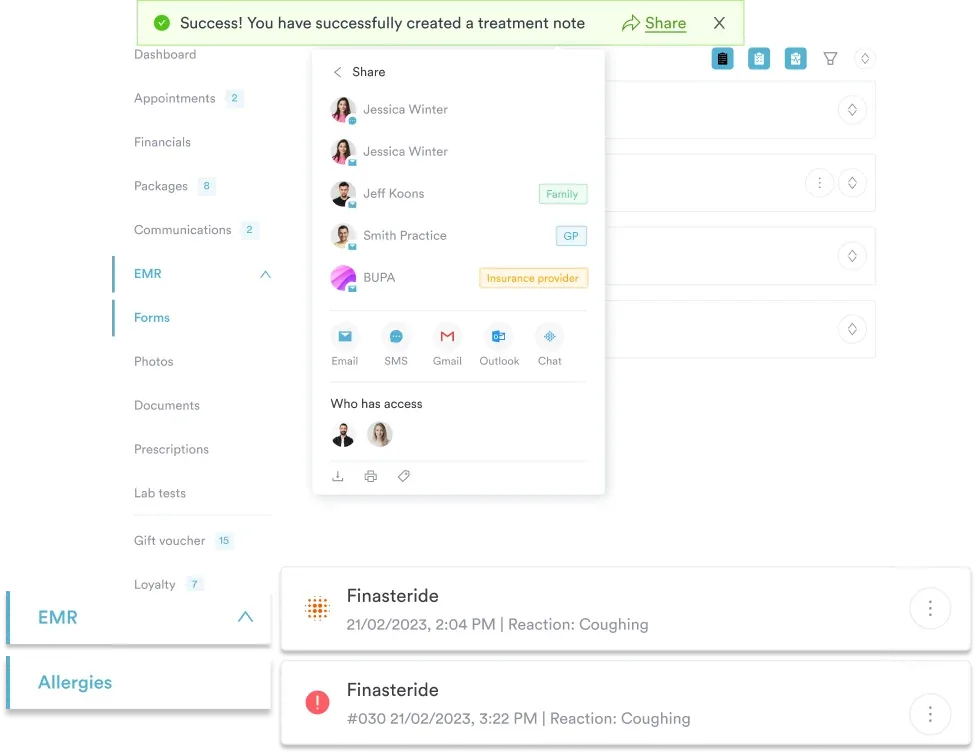
Pabau’s patient record keeps the consent form, operative note and invoice in one timeline, so you answer a payer query on M7590 from one place.
Keep CCSD claims and their evidence together
Pabau supports CCSD-coded claim submission and tracking, with consent forms and clinical notes on the same patient record. See how it fits your urology or gynaecology practice.
M7590 is one code with one fee, so the billing risk sits at its edges. Claims tend to fail on an extra cystoscopy code, a separate local anaesthetic line, or a missing authorisation number.
Build the file before the theatre date: the authorisation number, the MDT review, the signed consent and the implant details NICE NG123 lists. A practice that does this can reduce rejections and audit queries, because the practice answers the payer’s questions before it asks them.
Book a demo to see how Pabau keeps CCSD claims and their evidence on one patient record.
Continue your research
Need to understand how Bupa processes CCSD codes?Bupa CCSD billing guide covers the Bupa fee schedule framework and how to submit CCSD-coded claims correctly.
Billing a standalone flexible cystoscopy?CCSD Code M4510 explains when the cystoscopy code applies on its own date of service.
Coding a colposuspension instead of a tape sling?CCSD Code M5220 covers retropubic bladder neck suspension and how it differs from M7590.
Frequently asked questions
Is cystoscopy part of M7590 or billed on its own?
Cystoscopy is part of M7590 and should not be billed on its own on the same claim. CCSD lists the cystoscopy codes M4510 and M4514 as unacceptable with M7590, and payers may reject or flag the claim if one appears.
Can the operating surgeon bill for local anaesthetic under M7590?
No separate fee applies, because local anaesthetic given by the operating surgeon is part of M7590. CCSD lists AC100, local anaesthetic by the main operator, as unacceptable with it. A separately contracted anaesthetist providing general or spinal anaesthesia submits their own claim.
Does M7590 include the cost of the mesh tape implant?
No. The polypropylene mesh tape prosthesis has its own charge under standard CCSD billing convention. The M7590 fee covers the operation, and the implant is invoiced as a prosthesis item. Check each payer’s prosthesis rules, as reimbursement limits and pre-approval rules vary.
What records do payers require before authorising M7590?
Payers usually ask for proof of stress urinary incontinence, proof of failed supervised pelvic floor muscle training, and a referral letter. Many also want to see the NICE NG123 mesh governance steps. Requirements differ, so check each payer’s current pre-authorisation policy.