HCPCS Code T4543: Billing guide for incontinence supply claims
HCPCS Code T4543: Official descriptor and code definition HCPCS Code T4543 is th...

Last Updated: Nov 3, 2026
M4780 is the CCSD code for invasive urodynamic assessment including cystoscopy and pressure/flow measurements. It covers filling cystometry, a pressure/flow voiding study and an endoscopic examination of the bladder, performed in one session and billed as a single unit.
UK private medical insurers use M4780 for combined investigation of lower urinary tract symptoms, incontinence and suspected outflow obstruction. A session without the cystoscopy, or without the pressure/flow study, does not meet the M4780 descriptor.
Let Pabau's smart automation suggest the right codes, reduce claim denials, and keep your practice compliant—effortlessly.
Automate repetitive tasks and focus on what matters most—your patients.
Reduce coding errors and ensure compliance with the latest regulations.
Clean claims, fewer denials, and faster reimbursements.
Powerful insights and reporting to help your practice thrive.
HIPAA compliant SOC 2 certified GDPR-compliant Trusted by 4,000+ clinics worldwide

CCSD Code M4780 is the UK private billing code for invasive urodynamics with cystoscopy and pressure/flow measurements in one session.
Cystoscopy and the urodynamic components cannot be billed separately alongside M4780, because that is unbundling and grounds for claim rejection.
Major UK PMI providers generally require pre-authorisation before M4780, and a missing pre-auth reference is a common cause of denial.
The procedure note must record filling pressures, voiding pressures, flow rate and cystoscopic findings to satisfy insurer audits.
Pabau, practice management software with built-in claims tools, stores CCSD codes, attaches procedure notes to claims and submits them through Healthcode.
CCSD Code M4780 is the code in the Clinical Coding and Schedule Development (CCSD) Group schedule for invasive urodynamic assessment including cystoscopy and pressure/flow measurements. The code is maintained by the CCSD Group, whose schedule is the standard code set across UK private medical insurance (PMI) claims.
M4780 is a bundled code. Its descriptor covers both the cystoscopy and the physiological measurements: filling cystometry, a voiding pressure study and urinary flow rate. All of them are billed as a single unit.
The code is built for the combined session, where a urologist performs cystoscopy and urodynamic testing on the same patient at the same visit. Using M4780 for a cystoscopy-only or urodynamics-only session is a coding error, and an insurer audit may treat it as upcoding.
M4780 sits in the bladder section of chapter 12, which covers the urinary system and male reproductive organs. The full list of CCSD procedure codes shows its neighbours in that chapter.
A session billed under CCSD Code M4780 combines two investigations, performed one after the other under the same sterile setup. The billing team can use the components below to check that the procedure note captures each one before submission.
The International Continence Society (ICS) has published standardised terminology for urodynamic measurement, and documenting parameters using ICS-standard definitions supports both clinical accuracy and insurer audit. The procedure typically takes 30 to 60 minutes in a purpose-equipped urodynamics suite.
M4780 is appropriate when a urologist needs both endoscopic visualisation and pressure/flow data from the same session to reach a diagnosis. The combined approach avoids two separate investigative visits. It is typically ordered when simpler non-invasive tests have not resolved the clinical question.
NICE NG123 (urinary incontinence and pelvic organ prolapse in women) and CG97 (lower urinary tract symptoms in men) support urodynamic assessment in specific refractory presentations.
The table below maps common clinical scenarios to supporting ICD-10 codes for use alongside M4780. UK insurers use the WHO ICD-10 classification, so these codes differ from the US ICD-10-CM versions.
These ICD-10 codes are guidance only. Confirm with the insurer that the selected code supports medical necessity for M4780 under the patient’s policy terms.
A common coding error here is choosing a neighbouring code when the full combined procedure was performed, or the reverse. The table below compares M4780 with the cystoscopy-only codes and the ambulatory urodynamics code.
Check each descriptor against the current CCSD schedule before billing, because codes and descriptors can change at each schedule update.
Insurers auditing M4780 claims look for a procedure note that supports both components of the bundled code. A note with cystoscopic findings but no urodynamic data, or the reverse, is insufficient. It typically leads to a denial or a recovery demand. Digital procedure documentation with structured fields for each component lowers the risk of an incomplete record reaching the insurer.
The procedure note must contain all of the following:
Attach the printed or exported urodynamic trace directly to the claim file. Insurers reviewing M4780 claims may request the raw trace as evidence that the pressure/flow study was complete. Sending it with the claim avoids a back-and-forth that delays payment.
UK insurers generally require pre-authorisation (pre-auth) before an M4780 procedure in private practice. Major PMI providers treat invasive urodynamic investigation as needing prior approval. A claim submitted without a valid pre-auth reference from the insurer is a common reason for M4780 denials.
Check current requirements on each insurer’s provider portal, as policies change. The Bupa CCSD procedure codes guide covers Bupa-specific coding requirements in more detail.
The requirements above reflect general PMI practice for invasive investigations, so verify them with each insurer before every case. Consultant recognition also varies, and only the insurer can confirm it for a given consultant.
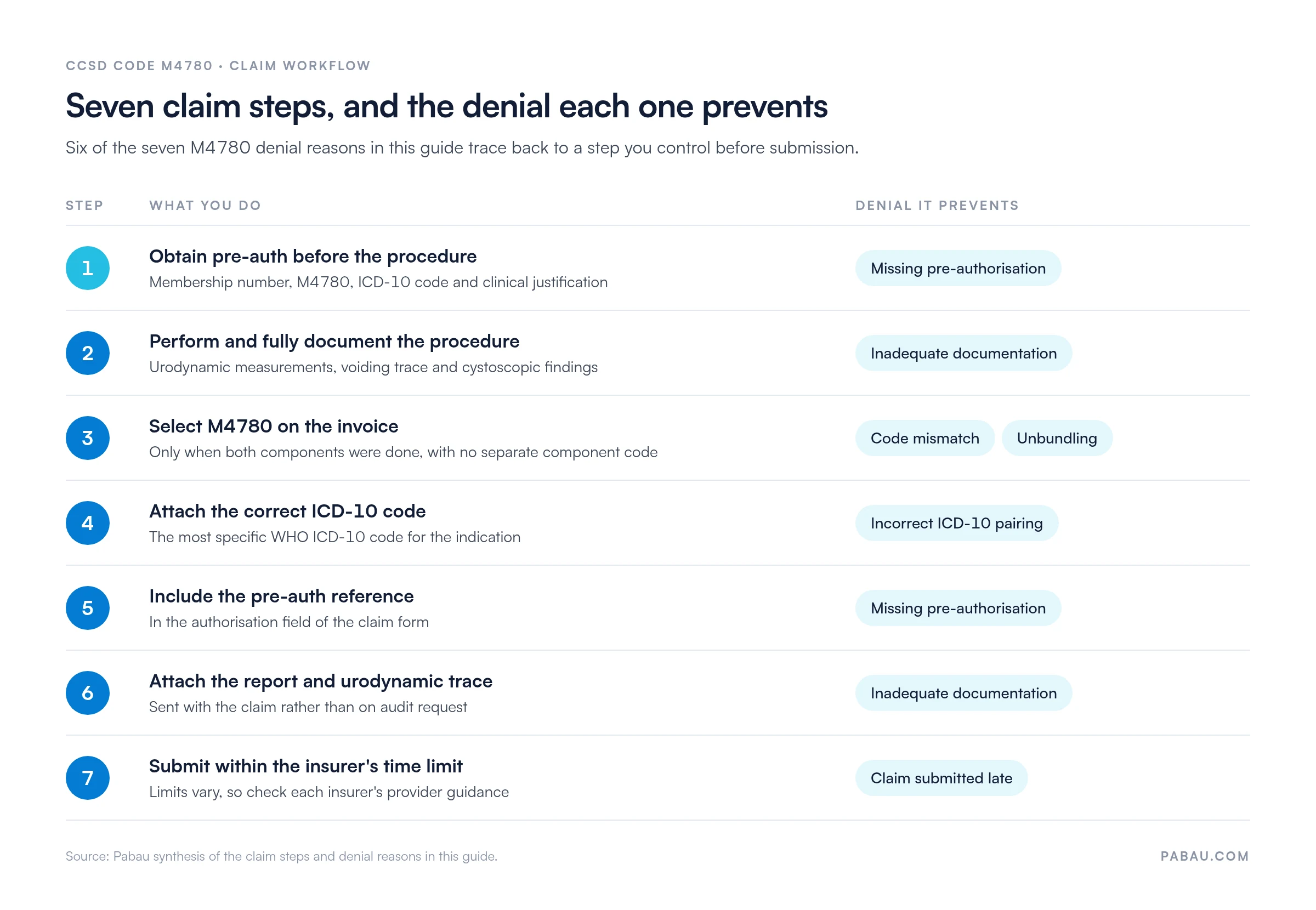
A complete M4780 claim reaches payment when each of the seven steps below is done correctly. Skipping one is the usual cause of a denial or delay.
Each step closes off one of the denial reasons covered later in this guide, as the map below shows.
You cannot bill M4780 alongside a separate code for a component its descriptor already covers. The descriptor includes cystoscopy and pressure/flow measurements. Billing either one as a separate CCSD code for the same session is improper unbundling.
A claim that pairs M4780 with component codes its descriptor covers risks payment recovery as well as denial. Unbundling rules can vary by payer, so check the permitted combination in the insurer’s billing guidance before submitting.
The table below lists common M4780 denial reasons, with a corrective action for each. Fixing them before submission costs far less time than managing them through appeals.
M4780 denials trace back to administration far more often than to clinical judgment. Missing pre-auth references, incomplete procedure notes and late submissions are workflow failures that billing software can help prevent.
Pabau’s claims management software stores CCSD codes, so billing staff pick M4780 from a list rather than typing it by hand. That lowers the risk of a neighbouring-code error. Procedure notes written in Pabau can be attached to the claim, so the urodynamic report travels with the invoice.
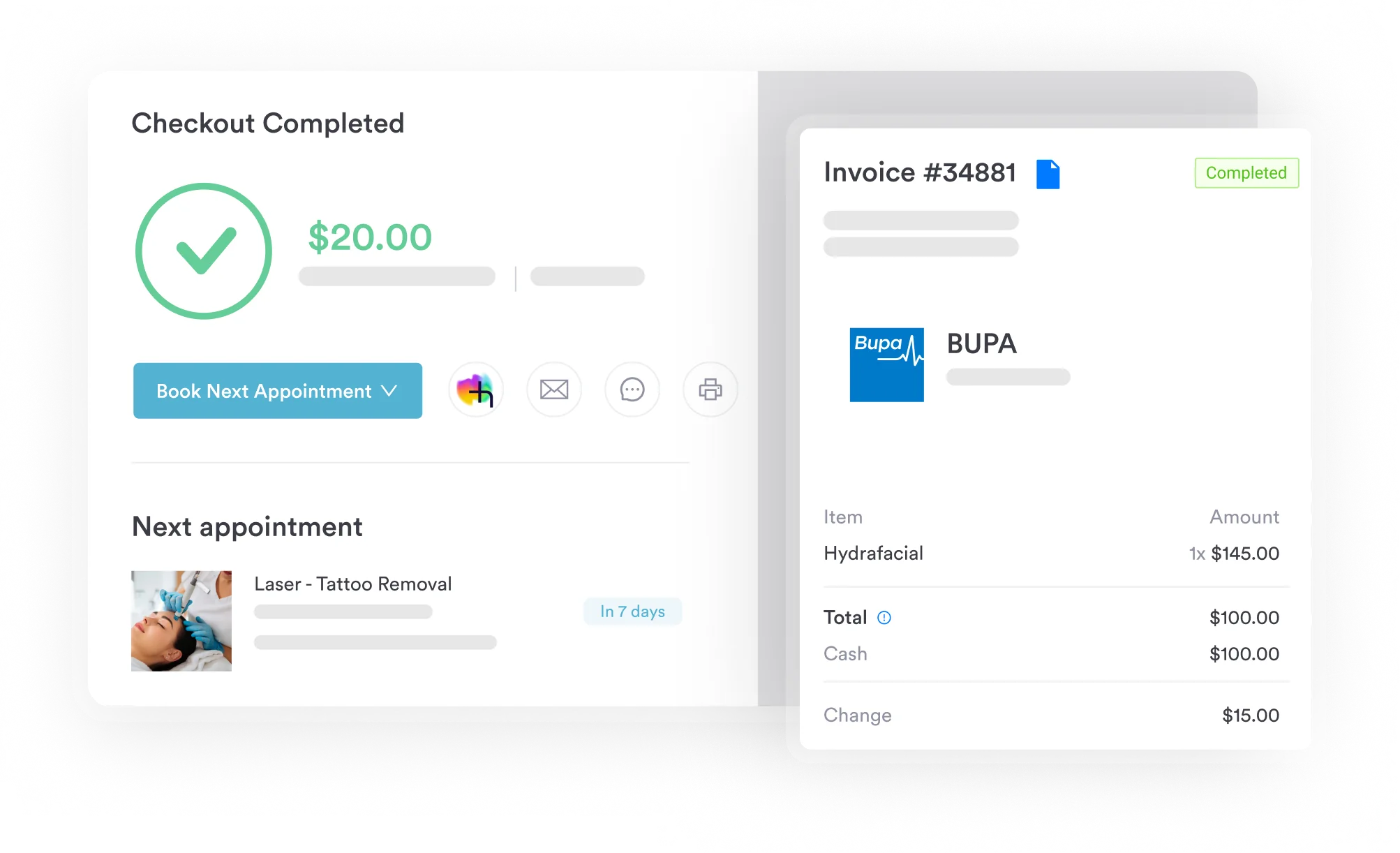
Claims then go to UK insurers through Healthcode. For practices running several CCSD-coded urology lists, keeping codes, notes and submissions in one system cuts the manual cross-checking before each claim leaves the practice.

Pabau stores your CCSD codes, attaches procedure notes to each claim and submits through Healthcode. Your M4780 claims reach the insurer with the report already attached.

Bill M4780 only when the cystoscopy and the invasive pressure/flow study both happened in the same session, and the note proves both. A session missing either component belongs under a different code, such as M4510 or M4514 for cystoscopy alone.
Most of the work sits with the billing workflow rather than the urologist. Secure the pre-auth reference before booking, use a report template that prompts for every measurement, and send the trace with the claim. A few minutes of checking per claim is cheaper than weeks of appeals.
Book a demo to see how Pabau keeps CCSD codes, procedure reports and Healthcode submissions together for your urology claims.

Need a structured guide to Bupa’s CCSD codes? Bupa CCSD procedure codes covers how Bupa maps its fee schedule to CCSD billing codes for UK private practice.
Looking up another procedure in the schedule? CCSD procedure codes lists the codes UK private insurers use, chapter by chapter.
Billing other bladder surgery? CCSD code M3640 explains documentation and claims for bladder exstrophy repair.
Working on urethral procedures too? CCSD code M5580 covers billing for excision of a urethral caruncle.
CCSD Code M4780 is the UK private healthcare billing code for invasive urodynamic assessment including cystoscopy and pressure/flow measurements performed together in a single session. It covers filling cystometry, voiding pressure study, urinary flow rate, and endoscopic examination of the bladder and urethra as one bundled procedure.
M4780 combines cystoscopy with invasive pressure/flow urodynamics in one session, while M4740 covers ambulatory urodynamic studies without cystoscopy. Ambulatory studies record bladder pressures over a longer period with natural filling. When only a cystoscopy is done, bill M4510 (flexible) or M4514 (rigid) instead.
Yes. Major UK PMI providers, including Bupa, AXA Health, Aviva and Vitality Health, generally require pre-authorisation for invasive investigations such as M4780. The pre-auth reference number must appear on the claim. Check current requirements on each insurer’s provider portal before booking, as policies change.
UK insurers use WHO ICD-10, and common supporting codes include R33 (retention of urine), N32.8 (other specified disorders of bladder) and N39.3 (stress incontinence). N39.4 (other specified urinary incontinence), N40 (hyperplasia of prostate) and N31.9 (neuromuscular dysfunction of bladder) are also used. Check the chosen code against the insurer’s medical necessity policy before submitting.
Yes. Because M4780 bundles cystoscopy and pressure/flow measurements into one code, neither component may be billed separately for the same session. Check the CCSD schedule and the insurer before billing an add-on such as EMG alongside M4780.