CCSD Code X1420: Billing guide for UK private practice
CCSD Code X1420: Definition and clinical description CCSD Code X1420 is a proced...

Last Updated: Nov 23, 2026
M5630 is the CCSD code for therapeutic injection of a peri-urethral bulking agent into the bladder neck to treat stress incontinence. The cystoscopy that guides the injection is part of the code, so it is never billed as a separate line for the same session.
The CCSD schedule files M5630 under 12.3.0 Bladder and also lists it under 14.2.0 Suspension. Anesthesia, pre-operative urodynamics, and follow-up visits are billed separately, and most UK private medical insurers require prior authorization first.
Let Pabau's smart automation suggest the right codes, reduce claim denials, and keep your practice compliant—effortlessly.
Automate repetitive tasks and focus on what matters most—your patients.
Reduce coding errors and ensure compliance with the latest regulations.
Clean claims, fewer denials, and faster reimbursements.
Powerful insights and reporting to help your practice thrive.
HIPAA compliant SOC 2 certified GDPR-compliant Trusted by 4,000+ clinics worldwide

CCSD code M5630 covers a peri-urethral bulking agent injected into the bladder neck, and the cystoscopy that guides it is part of the code.
Stress incontinence (ICD-10 N39.3) is the primary indication, and a urodynamic study confirming it strengthens the claim.
Most major UK private medical insurers require prior authorization for M5630, so get the reference number before the procedure date.
Each repeat injection is a new episode with its own authorization, operative note, and invoice.
Practice software such as Pabau keeps the CCSD code, operative note, and authorization reference on one record, so M5630 claims go out complete.
CCSD code M5630 covers therapeutic injection of a peri-urethral bulking agent into the bladder neck to treat stress incontinence, with cystoscopy included. The code sits in the CCSD procedure schedule, which UK consultants use to invoice private medical insurers. CCSD (Clinical Coding & Schedule Development Group) maintains that schedule.
The schedule files M5630 under 12.3.0 Bladder and also lists it under 14.2.0 Suspension. One code covers the whole episode: Passing the cystoscope, identifying the bladder neck, and delivering the bulking agent.
The key phrase in the descriptor is “including cystoscopy.” The cystoscopy performed during the injection session is bundled into M5630, so it cannot be billed as a separate code in the same episode. Billing it alongside M5630 is unbundling, and most private medical insurance (PMI) systems reject the extra line automatically.
A peri-urethral bulking injection under M5630 is a minimally invasive procedure performed under local or general anesthesia. The urologist or urogynecologist passes a cystoscope through the urethra to view the bladder neck. Once the target anatomy is confirmed, the agent is injected at one or more sites around the bladder neck. The added bulk helps the urethral sphincter close and restores passive continence.
The procedure is day-case or outpatient in most private settings. The number of injection points varies by agent and clinical judgment, typically two to four sites. Because the cystoscopy here is part of the therapeutic procedure rather than a standalone diagnostic evaluation, M5630 captures it.
M5630 is appropriate when a patient has confirmed stress urinary incontinence (SUI) from urethral sphincter deficiency. Conservative management should have been tried first, or be unsuitable. Urodynamic investigation confirming stress incontinence, rather than urgency or mixed incontinence, is the cornerstone of clinical justification for private insurers. The urodynamic study is a separate procedure, billed on the day it happens as M4780.
The British Society of Urogynaecology and the British Association of Urological Surgeons list bulking injections for patients who decline or cannot have surgery. The surgical alternatives carry codes of their own. A mid-urethral tape sling is M7590, and open colposuspension is M5220. NICE has also issued guidance on bulking agents for stress incontinence, so cite the current document and its date in any insurer justification letter.
ICD-10 codes to accompany M5630: N39.3 (Stress incontinence) is the most specific and commonly used diagnosis code. R32 covers unspecified urinary incontinence. It is less specific, and an insurer may question it during review. Code to the highest level of specificity the documented diagnosis supports.
CCSD code M5630 is agent-agnostic: The code covers the procedure regardless of which licensed bulking agent is used. The two agents most commonly used in UK private practice are Bulkamid and Macroplastique. Both are marketed in the UK under CE or UKCA marking. Check each agent’s current MHRA registration before the procedure, because a device’s status can change.
Whether the cost of the bulking agent is recoverable as a separate line item differs by insurer and policy year. Some PMIs reimburse it as a prosthesis or high-cost consumable alongside M5630. Others expect the procedure fee to absorb it. Always review the specific insurer agreement or call the provider helpline before submitting the consumable cost as an add-on.
The bundle boundaries of CCSD code M5630 decide what goes on the invoice. Misread them and the claim is overbilled, underbilled, or rejected. The table below maps what M5630 covers against what is billed separately.
Several CCSD urology codes sit close to M5630 and get confused in billing. A standalone cystoscopy code in place of M5630 is the classic mistake, and it leads to underclaiming or rejection. Use this table for stress incontinence procedures, and the CCSD code library for the rest of the schedule.
Check adjacent code numbers against the current CCSD schedule, because codes are added and retired in its updates. The pairing to watch is M5630 with a same-session cystoscopy code such as M4510 or M4514. The chart below sets out which code fits each procedure.
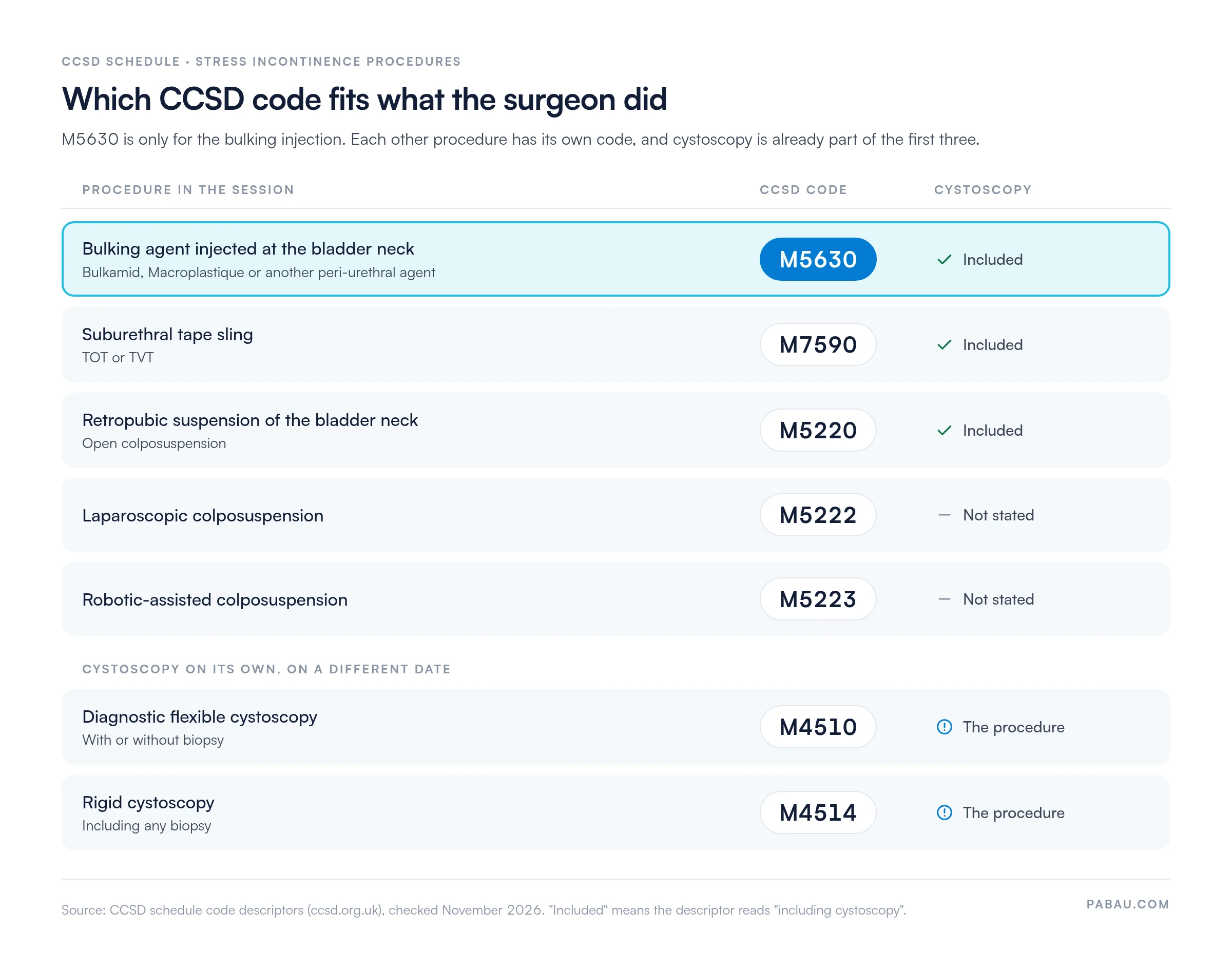
Before submitting an M5630 claim, run a quick check: Does the invoice include a separate cystoscopy code from the same session? If yes, remove it. The descriptor’s ‘including cystoscopy’ language means any secondary cystoscopy line will be automatically rejected by most PMI validation systems and flagged as unbundling.
A valid M5630 claim rests on two documents. The operative note captures the clinical specifics, and the invoice references the code, the diagnosis, and any prior authorization. Missing either one invites a denial or a clawback request.
In UK private practice, claims usually go through the Healthcode electronic billing platform, which checks CCSD codes against insurer requirements before submission. For Bupa-insured patients, the Bupa code search portal shows how Bupa lists a procedure code. Practices billing to multiple insurers should maintain a consistent operative note template that captures all the elements above regardless of the payer.
Clinical record templates in your practice management system keep the operative note fields structured and complete at the point of care. The surgeon fills them in during the episode instead of reconstructing them from memory, which lowers the risk of a documentation-based denial. Digital consent and pre-procedure forms add a time-stamped record you can produce the moment an insurer asks for it.
Most major UK private medical insurers require prior authorization before they reimburse M5630. Operating without a valid authorization reference number is an expensive mistake. The insurer can decline the whole claim because the procedure was not pre-approved, leaving the practice to collect payment from the patient.
Authorization requirements vary by insurer and policy type. Bupa, AXA Health, Aviva, and Vitality Health each maintain their own prior authorization processes, and the evidence they request differs. Check each insurer’s provider portal, or call its provider helpline, to confirm whether a patient’s policy needs authorization before you book the procedure date.
Once the authorization reference is issued, record it in the patient’s billing record straight away. Include it on every invoice and re-submission for this episode. Some insurers time-limit their authorizations. If the procedure date slips, confirm the authorization is still valid before proceeding.
M5630 denial patterns fall into a small number of recurring categories. Knowing them in advance is far cheaper than managing appeals. The table below maps the most common denial reasons to their root causes and resolution steps.
With error-checking claims management, a practice can validate CCSD code M5630 invoices before submission. The check flags a missing authorization reference, an absent ICD-10 code, or a duplicate cystoscopy line. Catching these at source is much faster than managing an appeal after a denial.
CCSD code M5630 is used for each individual peri-urethral bulking injection session, including repeat procedures. The same code applies whether this is the first, second, or subsequent injection for the same patient. There is no “repeat” modifier in the CCSD schedule that modifies M5630 for subsequent episodes.
What changes with a repeat procedure is the documentation and authorization, not the code itself. Each new injection episode requires its own prior authorization. Insurers will want clinical justification for a further injection. That means the degree of initial improvement, any symptom recurrence, the interval since the last injection, and why re-injection was chosen over surgery.
Treat every repeat injection as a new episode with its own complete documentation, authorization, and invoicing cycle.
In many urology practices, the operative note lives in one system and the invoice is typed up in another. The billing team then copies the agent, injection sites, and authorization reference across by hand. Each copy is another chance for an M5630 claim to come back.
Pabau keeps that information on one patient record. Its operative note templates can make the agent name, volume, injection site count, and cystoscopic findings mandatory fields. The note is then complete at the point of care. The Bupa CCSD billing guide covers the wider CCSD invoicing framework that M5630 sits within.

Pabau gives private urology and urogynecology practices CCSD code lookup, structured operative note templates, and Healthcode-compatible invoicing. Your M5630 claims leave the practice complete.

M5630 rewards a practice that settles the paperwork before the patient reaches the procedure room. Get the authorization reference first, record the agent and injection sites in the note, and leave cystoscopy off the invoice. Do that, and an insurer has little left to question.
The trade-off to remember is the device cost. Some insurers pay it as a consumable and others fold it into the fee, so confirm it policy by policy.
Pabau keeps the CCSD code, operative note, and authorization reference on one record, so a repeat injection starts from a complete history. Book a demo to see how it handles private billing for urology and urogynecology practices.

Need a full reference for Bupa CCSD billing? Bupa CCSD billing guide covers the complete Bupa procedure code framework, invoicing rules, and submission workflow for private UK practitioners.
Weighing surgery against a bulking injection? CCSD code M5220 covers retropubic suspension of the bladder neck, including colposuspension, and how to bill it.
Wanting to reduce CCSD claim denials across your practice? Private healthcare claims management in Pabau validates CCSD invoices before submission, reducing preventable denials for procedures including M5630.
CCSD code M5630 covers therapeutic injection of a peri-urethral bulking agent into the bladder neck to treat stress urinary incontinence. Cystoscopy is included as part of the procedure. The bundled cystoscopy cannot be billed as a separate code in the same episode.
No. The CCSD descriptor for M5630 explicitly states “including cystoscopy,” which means the cystoscopy performed during the injection session is bundled into the code. Billing a separate cystoscopy code from the same session is unbundling and will be rejected by most UK PMI validation systems.
Most major UK private medical insurers require prior authorization before reimbursing M5630. Bupa, AXA Health, Aviva, and Vitality Health each have their own authorization processes. Proceeding without a valid authorization reference number risks full claim denial, leaving the practice to collect from the patient directly.
N39.3 (Stress incontinence) is the most specific and appropriate ICD-10 code for the primary indication of M5630. R32 (Unspecified urinary incontinence) is a less specific alternative and may attract insurer scrutiny. Code to the highest specificity the documented clinical diagnosis supports.
M5630 is used for each individual injection session, including repeat procedures. A new prior authorization is required for each episode. The operative note for a repeat injection should record the previous outcome, the interval between sessions, and the clinical rationale for further treatment.
This depends on the specific insurer agreement and policy year. Some UK PMIs reimburse the device cost as a high-cost consumable add-on alongside M5630. Others expect the procedure fee to absorb it. Always confirm the insurer’s policy on consumable billing before the procedure date, and obtain separate approval if required.