

HCPCS Code L0472: Hyperextension TLSO billing guide
HCPCS code L0472: Official descriptor and device definition HCPCS code L0472 des...

Last Updated: Nov 5, 2026
M5520 is the CCSD code for implantation of an artificial urinary sphincter at the bladder neck, removal of one, or both in the same episode. Any cystoscopy performed during the operation is included in the code and is not billed separately.
The code sits in CCSD Chapter 12, sub-chapter 12.3.0 Bladder. UK private medical insurers such as Bupa, AXA Health and Aviva use it to identify the surgeon's procedure. The device itself is usually reimbursed on a separate route.
Let Pabau's smart automation suggest the right codes, reduce claim denials, and keep your practice compliant—effortlessly.
Automate repetitive tasks and focus on what matters most—your patients.
Reduce coding errors and ensure compliance with the latest regulations.
Clean claims, fewer denials, and faster reimbursements.
Powerful insights and reporting to help your practice thrive.
HIPAA compliant SOC 2 certified GDPR-compliant Trusted by 4,000+ clinics worldwide

M5520 covers implantation, removal, or removal with reimplantation of an artificial urinary sphincter at the bladder neck, all under one code.
Cystoscopy is bundled into M5520, and CCSD lists the cystoscopy codes M4510 and M4514 as unacceptable combinations with it.
Most avoidable claim queries come from a missing pre-authorisation, a separately billed cystoscopy, or an operative note that skips an AUS component.
The AUS device is reimbursed outside the M5520 surgical fee, so confirm each insurer’s implant route before surgery.
Pabau’s claims management software sends CCSD-coded claims to insurers through Healthcode and tracks each one until it is paid.
CCSD Code M5520 is the procedure code for implantation of artificial urinary sphincter at bladder neck and/or removal (including cystoscopy). It sits in Chapter 12 of the CCSD schedule, urinary system and male reproductive organs, under sub-chapter 12.3.0 Bladder. UK private medical insurers use the schedule to identify the procedure a consultant bills for.
Three parts of the descriptor decide how you code. The site is the bladder neck, not a more distal urethral position. The phrase “and/or removal” puts primary implantation, standalone removal, and removal with immediate reimplantation under the same code.
The parenthetical “(including cystoscopy)” is a bundling statement. Any cystoscopy in the same operative episode is part of M5520 and cannot attract a separate procedure fee.
The AMS 800, made by Boston Scientific, is the most widely used artificial urinary sphincter (AUS) in UK urology. It has three hydraulically connected components, all implanted during the M5520 procedure.
Implantation follows a perineal or penoscrotal approach. The surgeon positions the cuff, connects the tubing, fills the system, and confirms function before closing. Intraoperative cystoscopy is commonly performed to rule out urethral or bladder injury and is included within M5520.
Removal follows a similar exposure, with the surgeon disconnecting and explanting all three components. A cystoscopy after explantation to look for erosion or perforation is again included within M5520.
Post-prostatectomy incontinence is the main indication for AUS implantation in UK urology, usually after radical prostatectomy for prostate cancer. The International Consultation on Incontinence names the AUS as the preferred option for men with moderate to severe post-prostatectomy stress incontinence.
Accepted clinical indications for M5520 include the following.
The ICD-10 codes most often paired with M5520 are N39.3 (stress incontinence) and N32.8 (other specified disorders of bladder). UK insurers work from WHO ICD-10, so use the four-character codes rather than US ICD-10-CM extensions.
A pre-operative urodynamic study confirming sphincter deficiency is the standard supporting evidence. Make sure the operative note references those findings and that the same ICD-10 code appears on the invoice. The study itself is billed separately under M4780, usually in an earlier episode.
The inclusion and exclusion rules for M5520 decide what else can appear on the same invoice, and errors here cause many M5520 claim queries. The diagram sorts each item into what the code covers, what CCSD bars from the same claim, and what is billed on its own route.
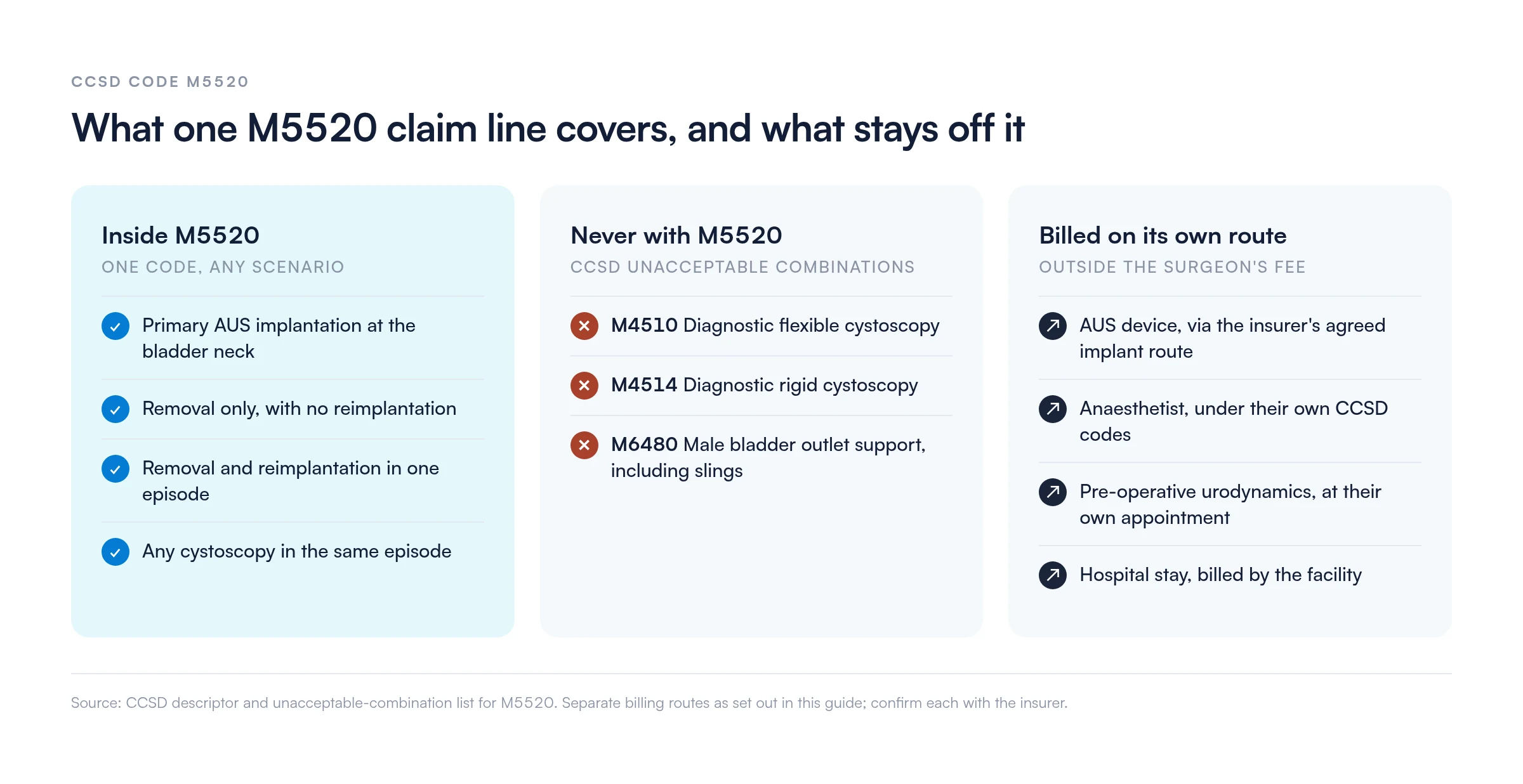
The device cost needs the most care. The AMS 800 carries a high list price, and insurers differ in how they reimburse it. Some cover the implant through a separate approved implant tariff, while others negotiate directly with the hospital.
Confirm the arrangement with each insurer before surgery and record it in the pre-authorisation request. Never put the device cost on the M5520 surgical fee line without explicit insurer agreement.
The “and/or removal” clause puts three clinical scenarios under one code. The scenario changes what the operative note must record, not which code you use.
Insurers sometimes ask whether removal-only episodes should attract a lower fee. CCSD does not set fees, so the code itself says nothing about the rate for removal. If an insurer pays removal-only episodes differently, settle it at pre-authorisation rather than by choosing another code.
M5520 sits beside several M-series codes for the bladder outlet, and picking the wrong neighbour is a common error. CCSD lists the three codes below as unacceptable combinations with M5520, so none of them belongs on the same claim. Every neighbouring urology code is in our full CCSD code library.
Consultants billing Bupa can check current values in our Bupa CCSD code guide.
Check adjacent M-series codes against the CCSD schedule version your insurer works from. Descriptors and unacceptable combinations change over time, so cross-reference the current schedule before you submit a claim.
Cuff erosion, device infection, and mechanical failure are the three main complications that send an AUS patient back to theatre. Each one needs its own detail in the operative note.
Where the revision removes or replaces the sphincter at the bladder neck, the M5520 descriptor covers it. How a revision is paid depends on each insurer’s policy, not on a CCSD rule. The note must state the indication clearly enough for the insurer’s clinical reviewer to confirm medical necessity.
A revision inside an insurer’s post-operative period may still need its own pre-authorisation, even when the policy covers revision. Do not assume the original authorisation extends to it. Contact the insurer before the revision theatre date.
A complete M5520 claim file usually holds five elements. A missing one gives the insurer’s clinical team grounds to return the claim or ask for more information, which can delay settlement by weeks.
Pre-authorisation requirements for AUS implantation vary between insurers. The table shows the evidence each major insurer typically asks for. Policies change, so confirm current requirements with each insurer’s provider helpline before you submit.
Pre-authorisation confirms that the procedure is covered under the patient’s policy. It does not guarantee that the device cost will be reimbursed too. Have that conversation with the patient before the consent appointment, so the hospital invoice holds no surprises.
Check for these five errors before you submit an M5520 claim.
Most urology practices still build CCSD invoices by hand, then key each claim into a separate insurer portal. Pabau, the practice software we build, opens each claim pre-filled from the invoice, so the M5520 line and its ICD-10 code are entered once.
Pabau’s Healthcode-connected claims management then sends private medical insurance claims through Healthcode to Bupa, AXA Health, Vitality and other insurers. Insurer pre-authorisations are stored against the patient as a case, and the reference carries through to the claim.

The claims dashboard tracks each claim from pending to paid, with days overdue shown on every row. When an insurer pays, you record the payment once and match it to every invoice it covers, so the surgical fee never sits unreconciled.

Pabau pre-fills each claim from the invoice, carries the pre-authorisation reference through, and sends it to Bupa, AXA Health or Vitality via Healthcode. Your team then tracks every claim from pending to paid in one dashboard.

Treat M5520 as one line for the whole sphincter episode, whether you implant, remove, or do both. The claim fails when something else rides along with it, like a cystoscopy code, a sling code, or the device cost.
Settle the device route and the pre-authorisation reference before the theatre date, and ask for an operative note that names every component. Do that, and an M5520 claim usually leaves the practice ready to pay. Fix them afterwards, and the same claim comes back for weeks of queries.
Book a demo to see how Pabau carries the pre-authorisation reference from booking to a paid urology claim.

Billing a Bupa patient? Bupa CCSD procedure codes guide covers the Bupa schedule structure, fee lookup, and common urology codes.
Coding endoscopic bladder work instead? CCSD Code M4230 explains the code for endoscopic destruction of a bladder lesion.
Working on the urethra rather than the bladder neck? CCSD Code M7280 walks through billing for urethral valve resection.
Choosing billing software for a UK practice? Best medical billing software in the UK compares the platforms that handle insurer claims and CCSD invoicing.
CCSD Code M5520 is the UK private healthcare code for implanting or removing an artificial urinary sphincter at the bladder neck. Any cystoscopy during the operation is included. Primary implantation, standalone removal, and removal with immediate reimplantation all use the same code.
No. The official CCSD descriptor includes cystoscopy, and CCSD lists the cystoscopy codes M4510 and M4514 as unacceptable combinations with M5520. Billing one alongside M5520 for the same operative episode is a bundling error, and the line will be rejected.
M5520 is the correct code for AUS removal at the bladder neck in UK private healthcare. The descriptor includes “and/or removal,” so standalone explantation uses the same code as primary implantation. A removal-only episode needs no different code.
The usual reasons are a separately billed cystoscopy code, a missing pre-authorisation reference, and an operative note that skips an AUS component. An ICD-10 code that does not match the pre-authorisation, or a device cost inside the surgical fee line, also causes rejections.



