CCSD code M5820 – Dilatation of outlet of female bladder
Code Definition
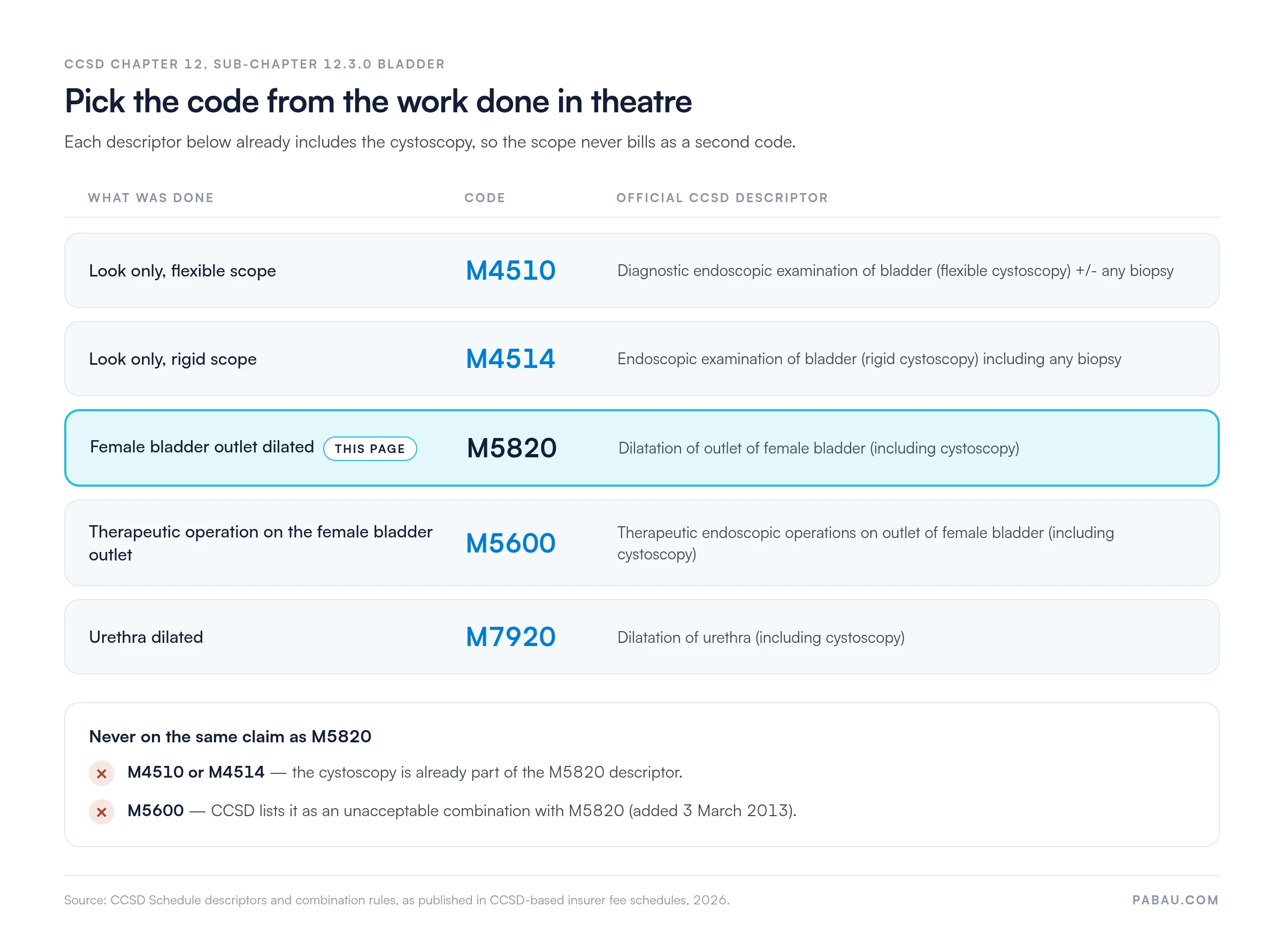
M5820 is the CCSD code for dilatation of outlet of female bladder (including cystoscopy). One code covers the cystoscopic inspection and the dilatation of the narrowed bladder outlet in the same sitting. The cystoscopy is never billed on top.
M5820 sits in CCSD Chapter 12, sub-chapter 12.3.0 Bladder, and applies to female patients only. Therapeutic endoscopic work on the female bladder outlet is coded as M5600 instead, and CCSD does not accept the two codes together.
M5820Dilatation of outlet of female bladderHigh match
Confidence score
98%
Why this code?
Matches patient diagnosis
Supported by clinical notes
Commonly used for this condition
Why practices choose Pabau
Save hours every week
Automate repetitive tasks and focus on what matters most—your patients.
Improve accuracy
Reduce coding errors and ensure compliance with the latest regulations.
Get paid faster
Clean claims, fewer denials, and faster reimbursements.
Grow with confidence
Powerful insights and reporting to help your practice thrive.
HIPAA compliant•SOC 2 certified•GDPR-compliant•Trusted by 4,000+ clinics worldwide
Key takeaways
CCSD Code M5820 covers dilatation of the female bladder outlet, and the cystoscopy is part of the same code.
Diagnostic cystoscopy codes M4510 (flexible) and M4514 (rigid) are not billed on top of M5820 for the same procedure.
CCSD lists M5600, therapeutic endoscopic operations on the female bladder outlet, as an unacceptable combination with M5820.
N32.0 (bladder-neck obstruction) and the N35 urethral stricture codes are the usual supporting ICD-10 diagnoses.
Most UK private insurers want pre-authorisation for theatre-based procedures, so check the insurer’s portal before the procedure date.
CCSD Code M5820: Definition and clinical scope
CCSD Code M5820 is the procedure code for dilatation of the outlet of the female bladder, with the cystoscopy included. The CCSD Group (Clinical Coding and Schedule Development) schedule defines the descriptor as: Dilatation of outlet of female bladder (including cystoscopy). Bupa, AXA Health, Aviva and Vitality sit on the group, and the CCSD Schedule holds the standard procedure codes for UK private healthcare.
The code sits in CCSD Chapter 12 (Urinary system and male reproductive organs), sub-chapter 12.3.0 Bladder. It captures one operative episode. The surgeon passes a cystoscope to inspect the lower urinary tract, then dilates the narrowed bladder outlet in the same sitting. It is one of the CCSD procedure codes insurers use to price a consultant’s fee.
M5820 applies to female patients only, and applying it to a male patient will see the claim rejected. Insurers generally require the operating consultant to hold recognised specialist status. Check the insurer’s rules for M5820 before you book the case.
Clinical indications: When M5820 is appropriate
M5820 fits a female patient with obstruction or functional narrowing at the bladder outlet that needs direct surgical treatment. Insurers usually expect conservative management to have been tried first before they authorise the procedure. Narrowing at the vaginal opening is a separate problem, and an incision to widen it is billed as CCSD code P1400.
The main clinical conditions that justify CCSD Code M5820 include:
Bladder outlet obstruction (BOO) in females: Voiding dysfunction from anatomical or functional narrowing of the vesical neck. It presents as incomplete emptying, a raised post-void residual, or recurrent urinary tract infections from stasis.
Urethral stricture or meatal stenosis: Scarring or stenosis of the urethra or urethral meatus that causes obstructive voiding symptoms.
Post-surgical or post-radiation scarring: Outlet narrowing after pelvic surgery, radiotherapy, or earlier instrumentation.
Refractory lower urinary tract symptoms (LUTS): Frequency, urgency, hesitancy, or poor stream where imaging and urodynamics have confirmed an outlet-level cause.
Recurrent urinary tract infections from incomplete voiding: Where urodynamic or ultrasound assessment links a raised residual volume to how often infections recur.
Record every earlier treatment attempt in the consultant letter. Insurers read that history when they judge the pre-authorisation request, and it supports the clinical case for surgery.
How the procedure is performed
The procedure follows a standard endoscopic sequence. Instrument choice varies by surgeon and local protocol, so the operative note should reflect the steps below as they were actually carried out.
Patient positioning and anaesthesia: The patient is placed in the dorsal lithotomy position. General anaesthesia (GA), spinal anaesthesia, or sedation with local anaesthetic may be used. Where GA is used, the anaesthetist bills separately under the relevant CCSD anaesthesia codes.
Urethral preparation: The urethra is cleansed and lubricated. A urethral catheter may be passed first to drain the bladder and confirm patency.
Cystoscopic inspection: A rigid or flexible cystoscope is introduced under direct vision. The surgeon inspects the urethra, bladder neck, trigone, and bladder mucosa and records the site and extent of the obstruction. This inspection is part of M5820 and is not billed on its own.
Dilatation: The outlet is dilated with a bougie-a-boule, graduated metal bougies, or a balloon dilator passed over a guidewire. The operative note must state the method and the final calibre achieved.
Post-procedure check: The cystoscope is reinserted to confirm mucosal integrity and adequate dilatation. Any bleeding is assessed, the bladder is drained, and the patient moves to recovery.
What CCSD Code M5820 includes and excludes
Most M5820 denials trace back to a component billed twice or a code billed alongside it. Check Bupa CCSD codes alongside the CCSD Technical Guide for insurer-specific interpretations.
The cystoscopy is part of the M5820 descriptor, so neither diagnostic cystoscopy code goes on the same claim.
Dilatation of bladder outlet
Included
The therapeutic element the code is built around. Document the technique and instrument size.
Urethral dilatation (M7920)
Check before billing
M7920 also includes cystoscopy. Check the insurer’s combination rules before billing it with M5820, and document a clinically distinct site.
Therapeutic endoscopic operations on the female bladder outlet (M5600)
Not billable with M5820
CCSD lists M5600 as an unacceptable combination with M5820. Code the episode to the one that describes the work done.
Anaesthesia
Not included. The anaesthetist bills separately
GA and sedation are billed by the anaesthetic team under separate CCSD anaesthesia codes.
Theatre facility fee
Not included. The hospital or facility bills separately
The consultant’s M5820 fee covers surgeon time only. Theatre, nursing, and consumables are billed by the facility.
Neighbouring CCSD codes and how to choose
Four codes in the same area of the schedule are easy to confuse with M5820. Diagnostic cystoscopy is M4510 with a flexible scope and M4514 with a rigid one. The same bundling applies to open removal of a bladder stone, M3900, where the cystoscopy is part of the code. Choosing the wrong code is a common cause of denial after the cystoscopy-bundling error.
Code
CCSD descriptor
Use when
Key distinction from M5820
M4510
Diagnostic endoscopic examination of bladder (flexible cystoscopy) +/- any biopsy
A flexible cystoscopy is the whole procedure
No outlet dilatation. Never billed alongside M5820.
M4514
Endoscopic examination of bladder (rigid cystoscopy) including any biopsy
A rigid cystoscopy is the whole procedure
No outlet dilatation. Never billed alongside M5820.
M5820
Dilatation of outlet of female bladder (including cystoscopy)
The female bladder outlet is dilated during cystoscopy
The correct code when cystoscopy and outlet dilatation are the operative steps.
M5600
Therapeutic endoscopic operations on outlet of female bladder (including cystoscopy)
A therapeutic endoscopic operation is performed on the female bladder outlet
CCSD lists M5600 as an unacceptable combination with M5820 (added 3 March 2013).
M7920
Dilatation of urethra (including cystoscopy)
The urethra, not the bladder outlet, is dilated
A different anatomical site. Check insurer rules before billing it with M5820.
Open surgery on the female bladder outlet, such as M5100, is a different operation from endoscopic dilatation. The table below sets out the endoscopic choices as a decision you can make from the operative note.
Read the operative note against the left column and the code follows, with the cystoscopy never billed twice. Descriptors and combination rules from the CCSD Schedule.
Supported ICD-10 diagnosis codes for M5820
UK private insurers check that the ICD-10 diagnosis code fits the CCSD procedure code before they pay. An M5820 claim paired with a diagnosis that does not describe an outlet obstruction or related voiding problem usually goes to manual review or resubmission.
ICD-10 code
Description
Relevance to M5820
N32.0
Bladder-neck obstruction
Primary supporting diagnosis for outlet dilatation. The most common pairing for M5820 claims.
N35.0
Post-traumatic urethral stricture
Appropriate when stricture follows catheterisation, instrumentation, or injury.
N35.1
Post-infective urethral stricture
Use when stricture aetiology is infective.
N35.8
Other urethral stricture
Covers idiopathic or post-surgical urethral stenosis not captured by N35.0 or N35.1.
R33.9
Retention of urine, unspecified
Secondary or supplementary code when urinary retention is the presenting complaint arising from the outlet obstruction.
N39.0
Urinary tract infection, site not specified
Supplementary code when recurrent UTI from incomplete voiding is a primary clinical driver. Pair with the outlet obstruction code.
Verify each pairing against the insurer’s own claim rules, since some insurers keep an approved-diagnosis list for each CCSD code. When in doubt, put the most specific obstruction code first and any symptom code (R33.9, N39.0) second.
Documentation requirements for M5820
An incomplete operative note is the most common documentation-related denial on M5820. The note must show that every part of the descriptor was carried out, not just name the procedure. Structured operative note templates cut missing-field denials and leave an audit trail that satisfies insurers and CQC inspectors alike.
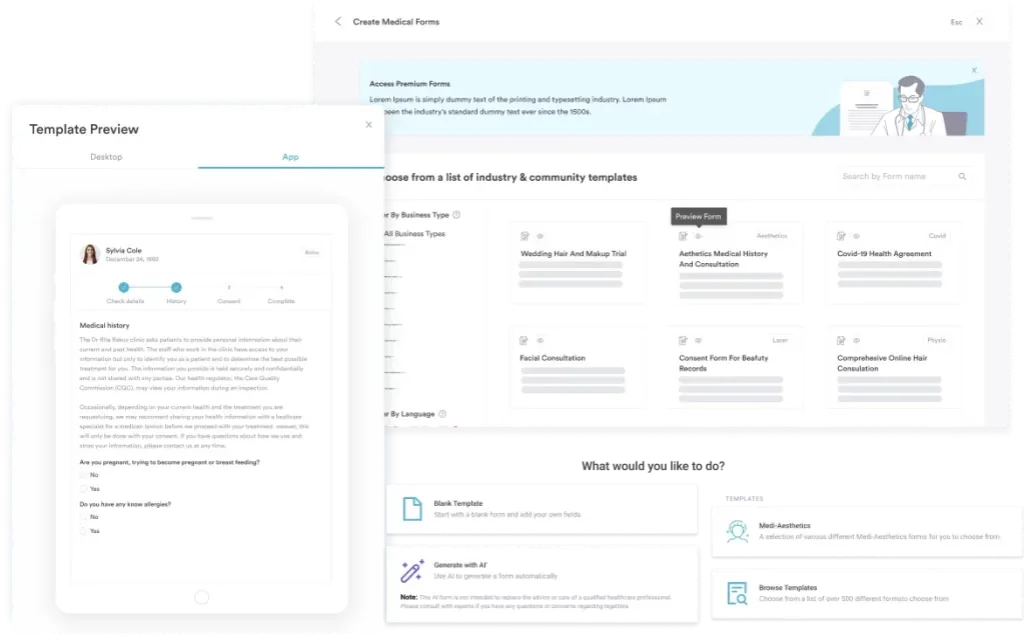
Pabau’s form builder starts an operative note from a blank template. Make scope type, calibre, and findings required fields for every M5820 case.
A compliant operative note for CCSD Code M5820 includes all of the following:
Confirmation that cystoscopy was performed: The instrument used (rigid or flexible), its size, and the findings in the urethra, bladder neck, trigone, and bladder mucosa.
Site and nature of the outlet obstruction: The location, circumferential extent, and appearance of the narrowing. A generic phrase such as “outlet obstruction noted” is not enough.
Dilatation technique and instruments used: The instrument (bougie-a-boule series, balloon catheter, or graduated bougies), the calibre before dilatation, and the final calibre achieved.
Clinical outcome and any complications: Ease of passage, any mucosal bleeding, and the state of the bladder on completion cystoscopy.
Indication documented by the referring clinician: The admission document or consultant letter should match the indication to the ICD-10 code on the claim.
Clinician name and GMC number: The operating surgeon’s details must appear on the claim, including the consultant’s insurer recognition number.
Pro Tip
Audit the last ten M5820 operative notes your practice submitted. If any lack the calibre, the pre-dilatation urethral size, or a clear cystoscopy statement, update the template before the next claim cycle.
Pre-authorisation requirements by insurer
Pre-authorisation rules for M5820 vary by policy type and change over time. The table shows the general approach of major UK private insurers at the time of writing. Always confirm the current rule on the insurer’s provider portal first. Where pre-authorisation was required and not obtained, check the insurer’s own appeal rules before you treat the denial as final.
Insurer
Pre-auth typically required?
Typical supporting evidence requested
Where to verify
Bupa
Yes, for most elective surgical procedures
Consultant referral letter, diagnosis code, evidence of conservative management
Bupa code search portal
AXA Health
Yes, for surgical procedures
GP or specialist referral, diagnosis code, clinical justification
AXA Health procedure code portal
Aviva
Yes, for surgical or theatre-based procedures
Consultant letter, CCSD code, proposed admission date
Aviva fee schedule
Vitality Health
Yes, for surgical interventions
Clinical referral, diagnosis code, previous treatment record
Vitality provider portal (verify current requirements directly)
Cigna
Typically required, depending on the policy
Consultant letter, CCSD code, clinical summary
Cigna provider portal (verify current requirements directly)
Pre-authorisation rules can change between policy years, so last year’s answer may not hold for the current policy. Record the authorisation number in the practice management system and include it on the Healthcode submission. A missing or expired number is an avoidable denial.
Common reasons M5820 claims are denied
M5820 denials follow predictable patterns, and most can be prevented at the point of coding rather than at appeal.
Cystoscopy billed separately on the same date: M4510 or M4514 submitted alongside M5820 bills the cystoscopy twice. Remove the cystoscopy code when M5820 is the procedure code.
M5600 billed with M5820: CCSD lists the pair as an unacceptable combination. Code the episode to whichever one describes the work in the operative note.
Missing or thin operative note: A note without the dilatation technique, instrument size, or cystoscopic findings gets the claim suspended. Attach the full note at first submission wherever the insurer portal allows it.
No pre-authorisation obtained: Where the insurer requires it, a missing authorisation usually stops payment. Check the insurer’s own resubmission window and appeal rules before you write the claim off.
Incorrect ICD-10 diagnosis pairing: A diagnosis that does not describe an outlet obstruction, stricture, or related voiding problem fails the insurer’s diagnosis check. Pair M5820 with N32.0, an N35 code, or the most accurate obstruction code.
Consultant not recognised by the insurer: Insurers generally require the operating consultant to hold recognised specialist status. Check the insurer’s rules for M5820 before the procedure date.
Anaesthesia and theatre coding alongside M5820
The consultant’s M5820 fee covers the surgical episode only. Anaesthesia and facility costs are billed separately by the providers who deliver them.
General anaesthesia: The anaesthetist bills under the relevant CCSD anaesthesia code on a separate claim and must hold their own insurer recognition. The two claims are adjudicated independently.
Sedation by an anaesthetist: Where IV sedation replaces GA, the anaesthetist still bills the sedation code independently.
Nurse-administered sedation: With no anaesthetist present, no separate anaesthesia code applies. The clinical and billing responsibility rests with the consultant.
Local anaesthetic only: No separate anaesthesia billing. The local anaesthetic is a consumable inside the facility fee.
Theatre and facility fees: The hospital or treatment centre bills theatre time, nursing, instruments, and consumables. None of these sit inside M5820.
Equivalent codes in other systems
Coders working across international private healthcare sometimes cross-reference CCSD codes against US CPT codes. The closest US equivalent to M5820 is CPT 52281, cystourethroscopy with calibration and/or dilation of urethral stricture or stenosis. The table below sets out the differences.
Feature
CCSD M5820
CPT 52281
Patient population
Female only (bladder outlet)
Male or female (urethral stricture or stenosis)
Anatomical site
Outlet of bladder (vesical neck)
Urethra (may include meatus)
Cystoscopy bundling
Included. M4510 and M4514 are not billed separately
Included within the CPT descriptor
Jurisdiction
UK private healthcare only
USA (Medicare, Medicaid, commercial payers)
Crosswalk validity
Reference only
Reference only
The American Medical Association maintains CPT codes, and they apply to US payers only. CPT 52281 is here for orientation and never replaces M5820 on a UK private insurer claim.
How to bill CCSD Code M5820 step by step
The steps below assume a CCSD-capable practice management system that submits electronically through Healthcode.
Record the operative note straight after the procedure: Enter the cystoscopy findings, the dilatation instrument and calibre, and the outcome while the case is fresh. This note is the base for the claim and any later audit request.
Select M5820 as the procedure code: Enter M5820 against the episode and confirm that neither M4510 nor M4514 is also entered for the same date.
Attach the supporting ICD-10 code: Choose the most specific code from N32.0, N35.0, N35.1, N35.8, R33.9, or N39.0. Make sure it matches the consultant letter and operative note.
Enter the pre-authorisation number: Record the insurer’s authorisation number against the episode so it travels with the claim.
Submit via Healthcode: Send the claim electronically and attach the operative note where the insurer allows. Keep the submission timestamp and claim reference in the patient record.
Track the claim and act on rejections: Work out whether a rejection is a bundling error, a documentation request, or a pre-authorisation query. Then resubmit within the insurer’s own resubmission window and appeal rules.
How Pabau keeps M5820 claims complete from theatre to Healthcode
Most M5820 rejections start before the claim is built. A note misses the calibre, a cystoscopy code slips onto the same date, or the authorisation number never reaches the submission.
Pabau, the practice management platform we build for private practices, keeps those pieces on one patient record. Its claims management software pulls the procedure code, diagnosis, and authorisation number from that record into the claim. It then submits and tracks the claim through Healthcode.
The outcome is fewer suspended claims and less time chasing insurers for the same missing detail. Your team sees the rejection reason against the episode and fixes it once.
Send complete M5820 claims to Healthcode
Pabau keeps the operative note, diagnosis, and authorisation number on one patient record, then submits and tracks the claim through Healthcode. Fewer M5820 claims come back for missing details.
Treat M5820 as one code for one episode. The cystoscopy is already inside it, and M5600 cannot travel with it. Code the outlet dilatation, pair it with the obstruction diagnosis, and leave the scope off the claim.
The work that protects the fee happens before the claim. A full operative note and a confirmed authorisation number turn most M5820 submissions into first-time payments. The trade-off is a few extra template fields in theatre against weeks of resubmission later.
Book a demo to see how Pabau carries the operative note and authorisation into every Healthcode claim.
Continue your research
Need a full reference for Bupa procedure codes?Bupa CCSD codes guide covers Bupa’s schedule of CCSD procedure codes and how claims reach Healthcode.
Billing a diagnostic cystoscopy on its own?CCSD code M4510 explains flexible cystoscopy coding and when a rigid scope moves the claim to M4514.
Is the patient having open bladder outlet surgery instead?CCSD code M5100 covers combined abdominal and vaginal bladder outlet surgery.
Working with a US payer on the same procedure?CPT code 52281 covers cystourethroscopy with urethral dilation under US billing rules.
Frequently asked questions
What does CCSD Code M5820 cover?
CCSD Code M5820 covers dilatation of the outlet of the female bladder, with the cystoscopy included in the same code. It applies to female patients only. Insurers generally require the operating consultant to hold recognised specialist status, so check the insurer’s rules for M5820.
What is the difference between M5820 and urethral dilatation codes?
M5820 describes dilatation at the outlet of the female bladder, the vesical neck. Urethral dilatation, M7920, treats a stricture or stenosis along the urethra below the bladder neck. If only the urethra is treated, M5820 is not the right code. If both sites are treated, check the insurer’s combination rules before billing both.
Which CCSD codes can be billed alongside M5820?
Anaesthesia codes, billed by the anaesthetist on a separate claim, and facility charges, billed by the hospital, sit alongside M5820. Diagnostic cystoscopy codes M4510 and M4514 are not billed on top, because the cystoscopy is part of M5820. CCSD also lists M5600 as an unacceptable combination with M5820.
Does M5820 require pre-authorisation from UK private insurers?
Usually, yes. Bupa, AXA Health, Aviva, and Vitality generally require pre-authorisation for theatre-based surgical procedures. Rules vary by policy and change over time, so confirm the requirement on the insurer’s provider portal before the procedure date. If authorisation was missed, check the insurer’s own appeal rules.
Can M5820 be billed with anaesthesia codes?
Yes, but anaesthesia codes are billed by the anaesthetist on a separate claim, not by the consulting surgeon alongside M5820. The consultant’s claim covers the surgical procedure only. The anaesthetist must hold independent insurer recognition and submit their claim independently under the applicable CCSD anaesthesia time-unit code.