

CPT Code 98981: RTM Treatment Management Billing Guide
CPT code 98981: Definition and official descriptor CPT code 98981 is an add-on c...

Last Updated: Nov 9, 2026
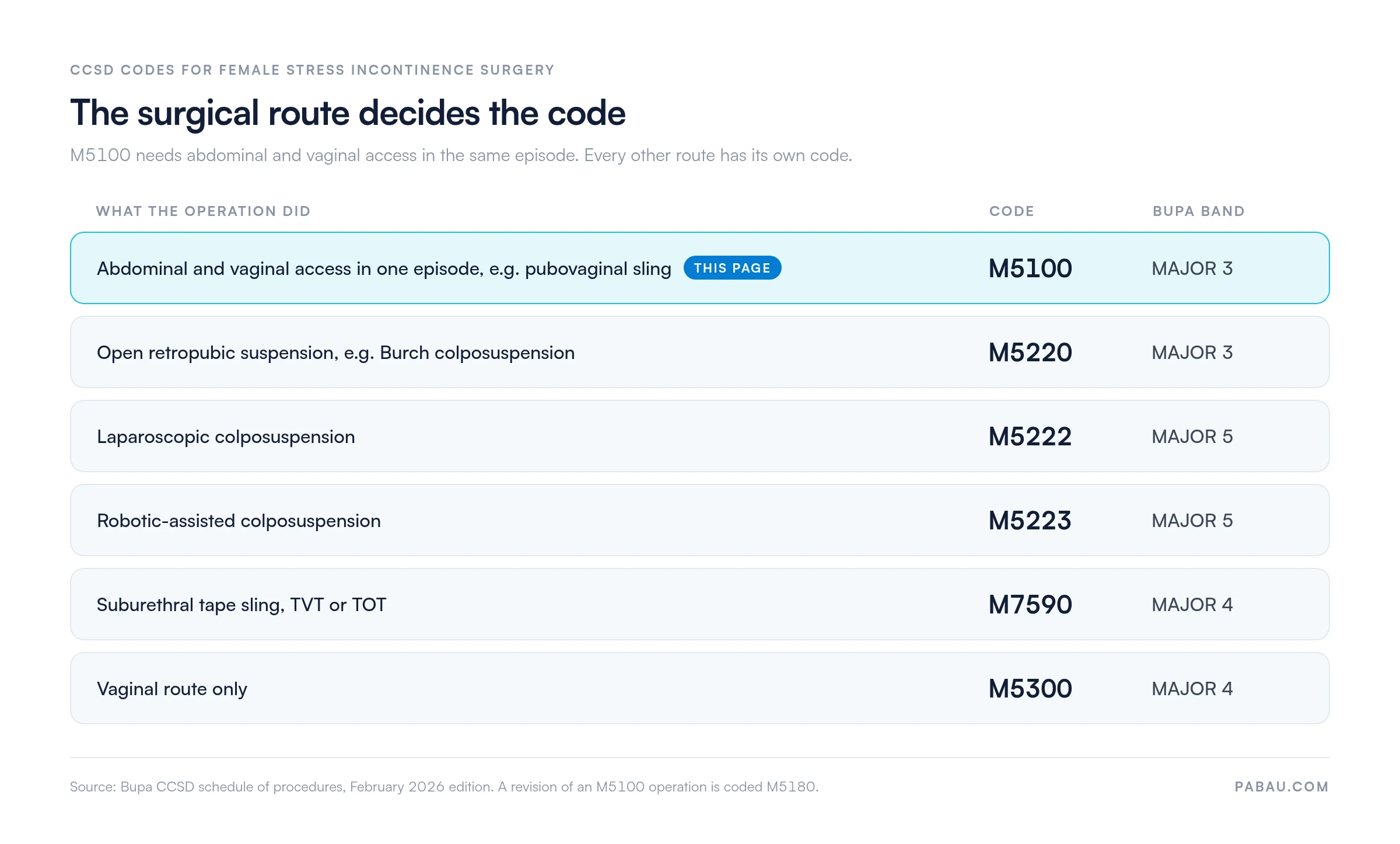
M5100 is the CCSD code for combined abdominal and vaginal operations to support outlet of female bladder (including sling procedures) (including cystoscopy). It applies only when the surgeon uses both routes in the same operative episode, as in a pubovaginal sling. Colposuspension, tape slings such as TVT and TOT, and vaginal-only repairs each carry their own codes.
Let Pabau's smart automation suggest the right codes, reduce claim denials, and keep your practice compliant—effortlessly.
Automate repetitive tasks and focus on what matters most—your patients.
Reduce coding errors and ensure compliance with the latest regulations.
Clean claims, fewer denials, and faster reimbursements.
Powerful insights and reporting to help your practice thrive.
HIPAA compliant SOC 2 certified GDPR-compliant Trusted by 4,000+ clinics worldwide

CCSD Code M5100 covers combined abdominal-vaginal procedures to support the bladder outlet, including sling operations, not purely vaginal repairs.
Colposuspension and tape slings have their own codes: M5220, M5222 or M5223 for colposuspension, and M7590 for TVT or TOT.
The operative note must confirm both abdominal and vaginal surgical access, the specific technique, and materials used to avoid downcoding.
All major UK private insurers, including Bupa and AXA Health, typically require pre-authorisation and urodynamic evidence before funding M5100 procedures.
Pabau stores each insurer pre-authorisation as a case and sends CCSD claims through Healthcode, with the authorisation code attached.
CCSD Code M5100 covers combined abdominal and vaginal operations to support the outlet of the female bladder, including sling procedures and cystoscopy. The defining feature of this code is dual surgical access.
The surgeon uses an abdominal approach (typically retropubic or laparoscopic) and a vaginal approach, together or in sequence, during the same operative episode.
Procedures that use only a vaginal route are coded M5300 and must not be billed under M5100. Colposuspension and tape slings have their own codes too. Bupa places M5100 in the MAJOR 3 complexity band.
The Bupa CCSD code schedule and the official CCSD schedule published at ccsd.org.uk are the primary references for current M5100 descriptors, fees and updates. When in doubt, verify against the live schedule rather than archived sources.
M5100 captures named procedures that need both abdominal and vaginal access to achieve bladder-neck or urethral support. The table below summarises the principal procedures within this code’s scope, alongside those that take a separate CCSD code.
The key coding principle is simple. If the operative note does not describe both an abdominal and a vaginal component in the same episode, M5100 is not the correct code. An M5100 claim for a vaginal-only operation gives UK private insurers grounds to deny or downcode it.
Several CCSD codes sit next to M5100 and are often confused with it during coding. Bupa gives each surgical route its own code and complexity band, and the chart below sets them side by side. Our CCSD reference for coders lists every other code in the schedule.
M5100 is appropriate when a surgeon performs a combined abdominal-vaginal operation to restore support to the bladder outlet in a female patient. The primary indication is genuine stress urinary incontinence (SUI) where conservative management has failed. It is caused by urethral hypermobility or intrinsic sphincter deficiency.
NICE guideline NG123 (urinary incontinence and pelvic organ prolapse in women) sets the clinical justification for surgical management of SUI in the UK. Insurers commonly check clinical necessity against NG123 before they fund an M5100 claim.
The ICD-10 diagnosis codes that most often accompany an M5100 claim are N39.3 (stress incontinence, female) and N32.8 (other specified disorders of the bladder). The treating clinician must confirm the diagnosis code, and coders should not assign one without clinical sign-off.
The surgical approach explains why the operative note for CCSD Code M5100 has to be specific about both access routes. The combined procedure uses two distinct surgical entry points during the same operative episode.
The abdominal component, open or laparoscopic, gives access to the retropubic space. There, sutures or sling material can be anchored to the rectus fascia or the anterior abdominal wall to elevate the bladder neck.
The vaginal component gives direct access to the bladder neck and proximal urethra. Through it, the surgeon mobilises and positions these structures before the sling is tensioned.
A pubovaginal sling shows the combined technique clearly. The surgeon harvests a strip of autologous fascia, usually from the rectus sheath, through a small abdominal incision. The strip is placed under the bladder neck through a vaginal incision, and its ends pass up through the retropubic space. They are then tied above the rectus fascia under appropriate tension.
A Burch colposuspension does not belong here. It uses abdominal access alone and is coded M5220.
Document the approach sequence explicitly in the operative note. State which incision was made first, what was achieved at each site, and how the two components came together. Vague notes that say only ‘stress incontinence repair performed’ give insurers grounds to downcode to a purely vaginal procedure code and reduce reimbursement.
Operative note quality decides whether an M5100 claim survives insurer review in UK private practice. The note must make it unambiguous that abdominal and vaginal access both took place during the same operative episode.
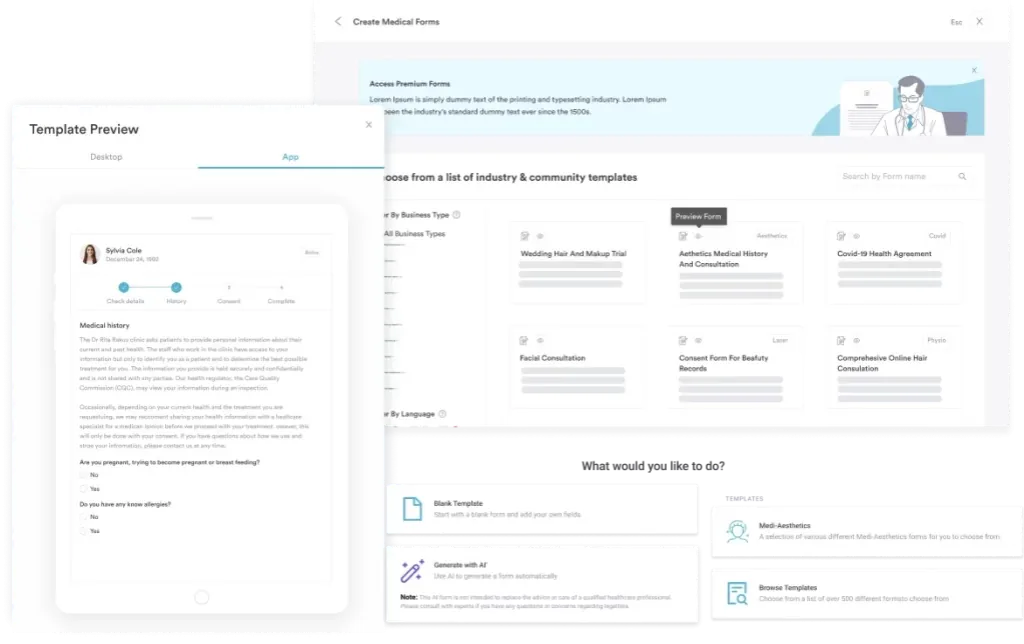
Digital forms in Pabau, the practice management platform we build, can turn these standards into one required template for the whole surgical team.
The following elements must be present in the operative note to support an M5100 claim:
Where synthetic mesh is used, record the product and its reference in the note. Confirm too that the case meets current NHS England and MHRA guidance on pelvic mesh for stress incontinence.
All major UK private insurers require pre-authorisation before they will fund an M5100 procedure. The authorisation must be obtained before the patient is listed for surgery, not retrospectively. Without a valid pre-authorisation reference number on the claim, the insurer will refuse payment regardless of documentation quality.
Pre-authorisation criteria differ between insurers and between individual policies. Always verify current requirements directly with the relevant insurer before listing the patient. The criteria above reflect typical requirements in the UK private market, not guaranteed policy terms for any specific patient.
M5100 claims in the UK private sector are denied or downcoded for a consistent set of reasons. Each one has a corrective action, set out in the table below, that avoids a second round of re-submission delays.
CCSD Code M5100 sits within a wider operative episode that may include other CCSD-coded procedures. The question for billers is: Which codes can legitimately be submitted alongside M5100, and which are bundled within it?
As a general principle, separately identifiable procedures that are not intrinsic to the bladder outlet operation can be co-billed under the CCSD multiple procedure rules. These rules typically charge the second and subsequent procedures at a reduced percentage of their standard fee.
The M5100 descriptor itself includes cystoscopy, so a check cystoscopy during the operation is not billed on top. Check the insurer’s rules before billing a diagnostic cystoscopy such as M4510 for a separate indication in the same episode.
Always cross-reference against individual insurer billing rules. Some insurers apply more restrictive co-billing policies than the standard CCSD multiple procedure guidance. The applicable policy is the one the patient holds, not a general rule.
Colposuspension is always coded separately from M5100, whether the surgeon works open, laparoscopically or with robotic assistance. Bupa’s February 2026 schedule lists open retropubic suspension as M5220 and laparoscopic colposuspension as M5222. Robotic-assisted colposuspension is M5223.
All three suspend the bladder neck through abdominal access alone, so none of them meets the combined-route test for M5100. A revised colposuspension is coded M5280, not M5180.
For M5100 itself, the access method still has to be on paper. The note must name the abdominal access (laparoscopic ports or an open incision) and the vaginal incision. It must also say how the two components came together. A laparoscopic abdominal stage does not change the code, provided the vaginal stage is documented in the same episode.
Run a quarterly coding audit across all M5100 claims submitted in your practice. Flag any claim where the operative note does not use the words ‘abdominal’ and ‘vaginal’ in describing the approach. If those words are absent, the note cannot support M5100 on review and the claim is at risk of recovery.
An M5100 claim passes through three hand-offs: the pre-authorisation before listing, the operative note in theatre, and the claim to the insurer. When each one lives in a separate system, the billing team re-keys the same details three times.
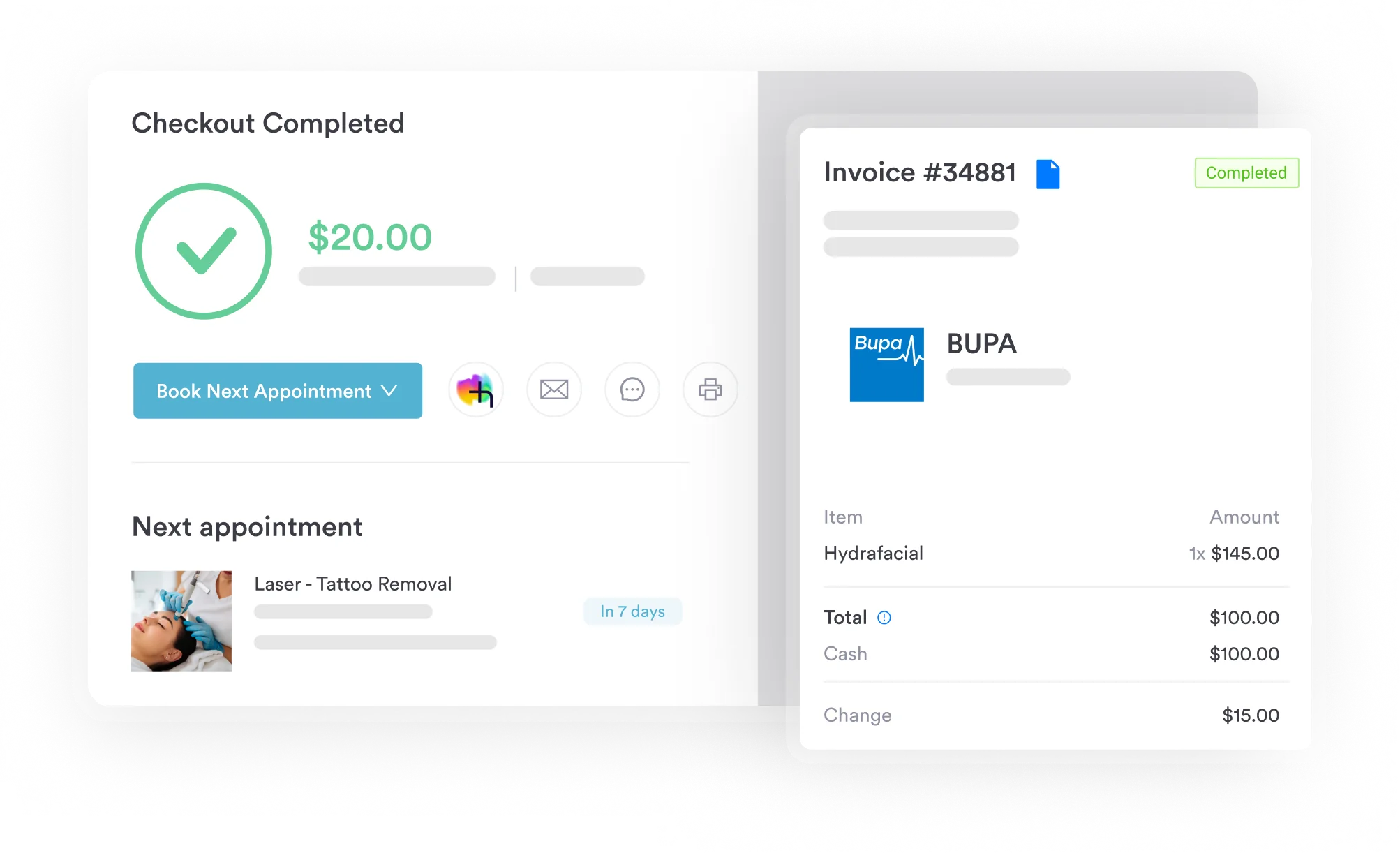
Pabau holds all three against one patient record. Its claims management software sends private medical insurance claims through Healthcode to Bupa, AXA Health, Vitality and other insurers.
For an M5100 workflow, that means:

Pabau stores each insurer pre-authorisation as a case and sends private medical insurance claims through Healthcode. Your M5100 claims leave with the authorisation code already attached.

M5100 is a narrow code, and that narrowness protects the practice. Bill it only when the operative note shows abdominal and vaginal access in one episode. Send colposuspension to M5220, M5222 or M5223, tape slings to M7590, and vaginal-only repairs to M5300.
Most M5100 denials are prevented before theatre rather than fixed after the remittance. A note template that asks for both routes, and a pre-authorisation logged before listing, remove two of the reasons insurers push back. Book a demo to see how Pabau ties the pre-authorisation, the operative note and the Healthcode claim to one patient record.

Need a broader CCSD coding reference for private practice? Bupa CCSD codes and fee schedule guide covers how the CCSD schedule is structured and how Bupa applies it across surgical specialties.
Coding a sphincter rather than a sling? CCSD code M5520 covers implantation of an artificial urinary sphincter at the bladder neck.
CCSD Code M5100 covers combined abdominal and vaginal operations to support the outlet of the female bladder, including sling procedures and cystoscopy. It covers techniques that use both routes in the same operative episode, such as a pubovaginal sling made from autologous fascia. Purely vaginal procedures are coded M5300, and colposuspension has its own codes.
Pubovaginal slings using autologous fascia are within M5100 scope, because they use both abdominal and vaginal access. Synthetic midurethral tapes, including TVT, TVT-O and TOT, are not. Their insertion is coded M7590, insertion of suburethral tape sling, in Bupa’s CCSD schedule.
No. Colposuspension is always coded separately from M5100, whatever the approach. Open retropubic suspension, including Burch colposuspension, is M5220. Laparoscopic colposuspension is M5222, and robotic-assisted colposuspension is M5223.
Yes, all major UK private insurers, including Bupa, AXA Health, Vitality, and Aviva, typically require pre-authorisation before an M5100 procedure will be funded. Authorisation must be obtained before listing the patient for surgery. Supporting evidence usually includes urodynamic confirmation of stress urinary incontinence and documentation that conservative management has failed. Verify current criteria directly with the relevant insurer.
Most denials come from four problems. The first is M5100 billed when only a vaginal procedure was performed, and the second is a missing pre-authorisation reference. The third is an operative note that does not document both abdominal and vaginal access. The fourth is a diagnosis code that does not support stress incontinence surgery.
The operative note must confirm both abdominal and vaginal access and name the technique, such as a pubovaginal sling. It also records the materials used and any concurrent procedures. Insurers expect the pre-authorisation reference number, the urodynamic study confirming stress incontinence, and the specialist referral letter on file before the claim is submitted.




