

ICD-10 code S61.201A: Open wound of left index finger without nail damage
ICD-10 code S61.201A covers a left index finger wound of unstated type ICD-10 co...

Last Updated: Oct 16, 2026
Billable Code Specific Code
N23 is the billable ICD-10-CM code for unspecified renal colic.
N23 carries no excludes notes and needs no laterality character, which makes it easy to assign and easy to over-assign. Overall, what follows sets out its billable status, the specificity test against N20-N22, documentation requirements, CPT pairings, and the ICD-9 crosswalk.
Let Pabau's smart automation suggest the right codes, reduce claim denials, and keep your practice compliant—effortlessly.
Automate repetitive tasks and focus on what matters most—your patients.
Reduce coding errors and ensure compliance with the latest regulations.
Clean claims, fewer denials, and faster reimbursements.
Powerful insights and reporting to help your practice thrive.
HIPAA compliant SOC 2 certified GDPR-compliant Trusted by 4,000+ clinics worldwide

ICD-10 Code N23 is the billable diagnosis code for unspecified renal colic, valid for HIPAA-covered claims under the FY2026 edition.
Use N23 only when clinical documentation does not confirm the specific cause, stone location, or laterality. When a kidney stone is confirmed, N20.0 (nephrolithiasis) is instead the more precise choice.
The most common coding error is submitting N23 when imaging has already confirmed a calculus. As a result, payers may deny claims where documentation supports a more specific code.
Pabau’s claims management tools and the Claim.MD integration handle claim scrubbing for format and code validity, eligibility checks, and ERA reconciliation.
N23 sits in ICD-10-CM, the U.S. Clinical Modification of the ICD-10 code set. The Centers for Medicare and Medicaid Services (CMS) and the National Center for Health Statistics maintain it jointly. Notably, it is a billable, specific code valid for submission on HIPAA-covered transactions. The FY2026 edition took effect on October 1, 2025, and remains current through September 30, 2026.
This code sits within Chapter XIV (Diseases of the genitourinary system, N00-N99), under the N20-N23 urolithiasis block. CMS’s ICD-10-CM coding resources show no type 1 or type 2 excludes notes on N23. Adjacent diagnosis codes can therefore be reported on the same claim.
Renal colic is acute, severe pain that originates in the flank and may radiate toward the groin or lower abdomen. Specifically, it results from a calculus (kidney stone) or other obstruction moving through the urinary collecting system, creating sudden increases in pressure proximal to the blockage. The pain typically arrives in waves, is disproportionately severe relative to what patients expect, and does not reliably resolve with position changes.
The presentation that coders and clinicians need to see in the note comes down to five findings.
When imaging confirms a calculus, a more specific code than N23 becomes available and may be required. Otherwise, when imaging is inconclusive, pending, or not performed, N23 remains the appropriate choice if the clinical presentation is consistent with renal colic.
Coders assign from the chart note, not from the textbook definition of renal colic. The choice between N23 and a more specific N20-N23 code depends on what the chart note confirms. Instead, clinical probability of a stone does not decide it. This is where the majority of audit findings and claim denials originate.
The table below is organized around what the documentation contains rather than the code hierarchy. Indeed, that matches how the work runs in practice, starting from the note rather than the codebook.
The AAPC ICD-10-CM coding guidance confirms this hierarchy. N23 is appropriate only when the documentation does not support a more specific code. For example, if a CT scan performed the same day confirms a 4mm left ureteral stone, the coder must use N20.1. Overall, the decision flow below runs the same test in the order a coder meets it.
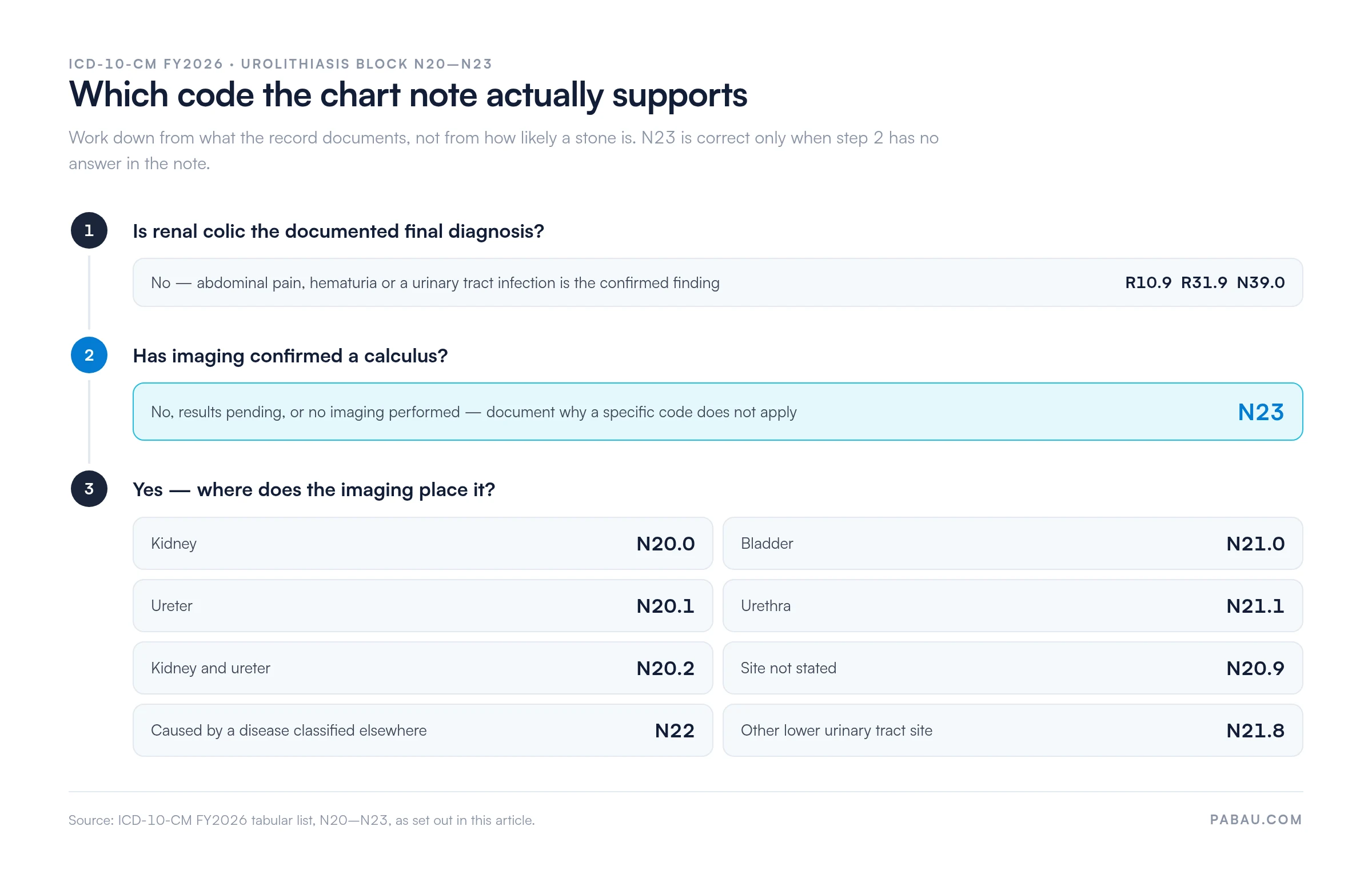
The full N20-N23 block covers all urolithiasis diagnoses under the genitourinary chapter. Coders working with renal colic presentations should know every code in this group. Notably, payers may flag repeated N23 use on a patient whose prior imaging already confirmed a specific calculus.
Renal colic shares its symptom profile with several other acute conditions. When the working diagnosis remains uncertain and the final documented diagnosis is not confirmed renal colic, these codes from adjacent ICD-10 chapters apply. Consequently, coders should never assign N23 for a differential diagnosis that was not confirmed as the final diagnosis by the treating clinician.
When hematuria accompanies a confirmed renal colic episode, R31 codes may be reported alongside N23 as additional diagnoses, provided both are documented. Indeed, the CDC/NCHS ICD-10-CM official coding tool and the WHO ICD-10 browser both support verification of valid code combinations for concurrent diagnoses.
A claim submitted with N23 must be supported by a chart note that clearly documents the clinical basis for the renal colic diagnosis. Inadequate documentation is the single most common reason payers request medical records for ICD-10 Code N23 claims. Specifically, the note should address each of the following.
Capturing this at the point of care, rather than during claim review, is what keeps an N23 claim defensible. A note written after the fact rarely recovers the imaging status a payer wants to see. Instead, build the imaging line into the template and the retrospective query burden drops on its own.
Document whether imaging was performed and what it showed before submitting N23. If CT urogram results were pending at discharge, note ‘stone not confirmed at time of visit’ in the assessment. Consequently, this single sentence prevents payers from downgrading the claim to a symptom code (R10.9) during review.
Three patterns account for most ICD-10 Code N23 claim problems. Nonetheless, each one is preventable with the right documentation workflow in place.
Practices with recurring N23 denials usually find the cause in their EHR’s code suggestion logic rather than in individual coder decisions. When the system autopopulates N23 for any “flank pain” chief complaint, specificity errors compound across the claim volume. Therefore, reviewing that at the practice management level, rather than case by case, is far quicker. Mapping the resulting rejections to their denial codes in billing shows how often specificity, rather than eligibility, is the cause.
The procedure codes billed alongside ICD-10 Code N23 depend on the clinical setting and the level of workup performed. Emergency department presentations typically pair N23 with a high-acuity E&M code. In contrast, urology outpatient visits pair it with a standard E&M, plus imaging or procedural codes where intervention follows. Verify current CPT codes against the AMA’s CPT code set before billing. The table below reflects commonly paired codes, not an exhaustive list.
Linking N23 to the correct CPT code on each claim line is what carries medical necessity. Pairing it with an imaging CPT requires that the imaging results are at least pending in the note. Specifically, 74178 is the pairing that draws the most payer attention, because a completed CT is the record that would have supported a specific code.
For EHR data migrations, historical record review, or legacy billing reconciliation, ICD-10 Code N23 maps to ICD-9-CM code 788.0 (Renal colic). Specifically, this crosswalk comes from the General Equivalence Mappings (GEMs) published by CMS. The backward mapping from N23 to 788.0 is one-to-one. Going the other way, 788.0 can open onto the more specific N20 codes as well, so the direction of the migration matters. Pull the current GEM files from CMS before applying either direction in a production billing system.
Practices migrating from older EHR systems often encounter 788.0 in historical problem lists. Map 788.0 to N23 by default, then review the original imaging reports. Where a report placed the stone, the converted problem list should carry the N20-range code instead.
The documentation errors that produce N23 claim problems rarely come from coders not knowing the rules. Instead, three workflow habits cause most of them.
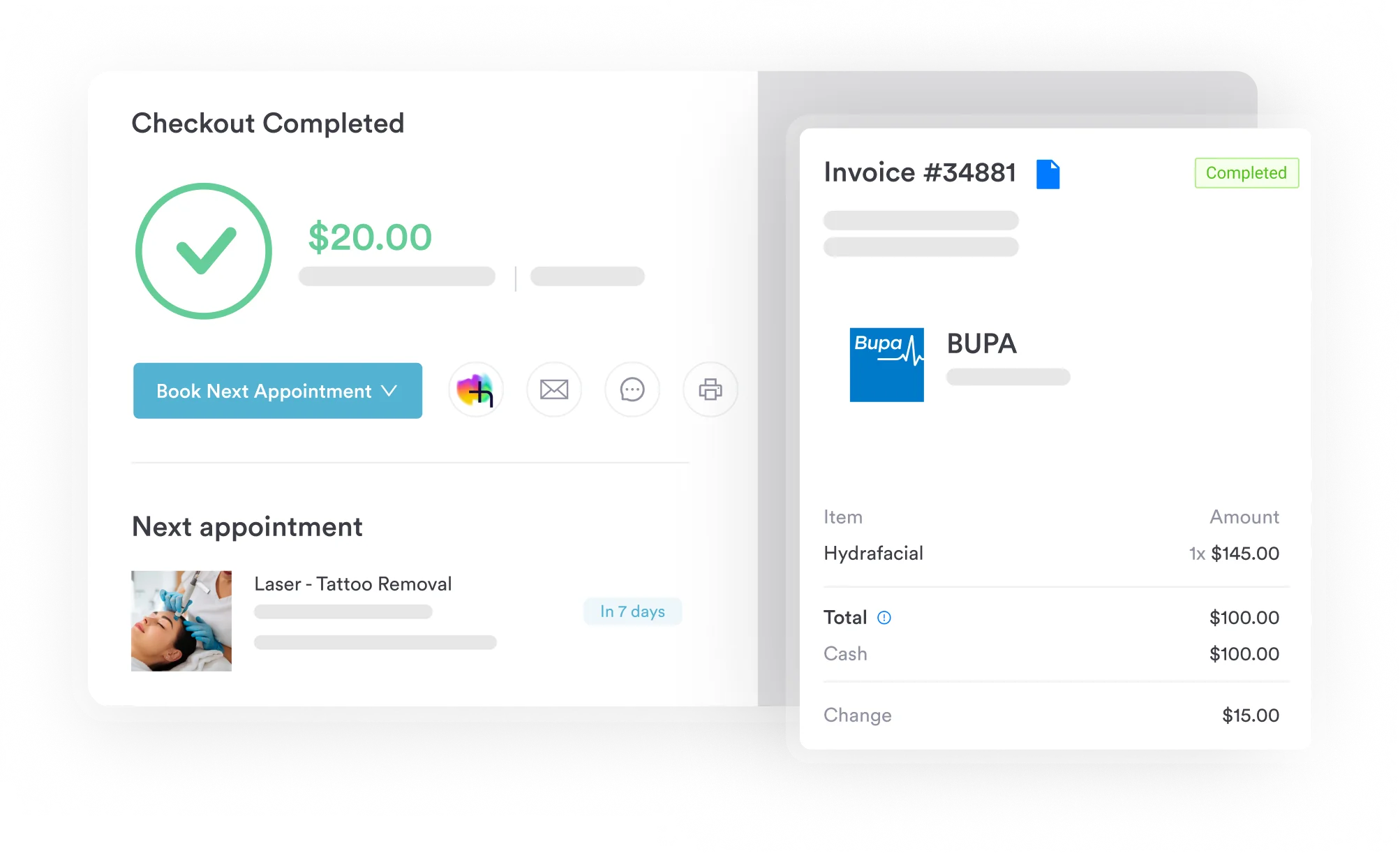
Practice management software like Pabau connects the note to the claim, so coding happens while the imaging status is still on screen. Pabau’s claims management software submits through the Claim.MD clearinghouse, which scrubs each claim for format and code validity. It also runs real-time eligibility checks and posts ERAs back against the invoice. Those checks confirm that the codes you submitted are valid and payable. However, whether N23 was the right code for that chart is still a documentation decision, and it belongs upstream of the clearinghouse.
In addition, records that carry prior imaging findings forward matter just as much. When a patient’s problem list already documents a confirmed N20.0 calculus, that history should surface during coding. Otherwise, discovering it while answering a denial is the expensive version.
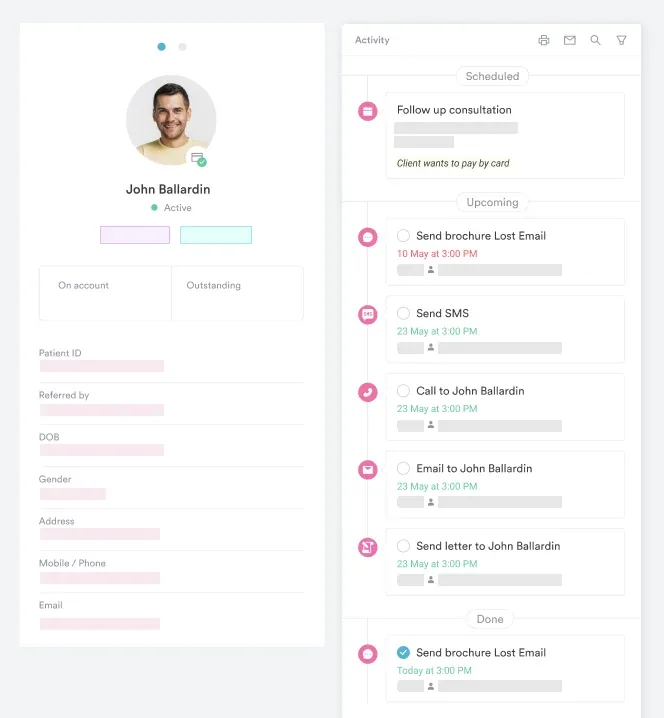

Pabau’s claims management tools connect the chart note to the claim, so coding happens while the documentation is in front of you. Submission runs through the Claim.MD clearinghouse with eligibility checks and ERA reconciliation built in.

ICD-10 Code N23 is a straightforward code when the documentation supports it. However, the trouble starts when it becomes the default for any flank pain presentation, whatever the imaging shows. Every N23 claim should survive one question. Why was a more specific code not used?
The fix sits upstream, in the note itself. Specifically, prompt for imaging status at the point of care and the specificity question answers itself before a coder ever sees the chart. Book a demo to see how Pabau connects charting, coding, and claim submission for urology and primary care practices.

Chasing rejected renal colic claims? Denial management in healthcare covers how to find and fix the root causes behind diagnosis code rejections.
Submitting claims electronically? Claim.MD clearinghouse guide explains what a clearinghouse checks before a claim reaches the payer.
Wondering where coding sits in the wider process? Revenue cycle management overview traces a claim from documentation through to payment.
Building documentation habits that hold up in an audit? Medical billing compliance sets out the standards a payer expects to see in the record.
Want fewer resubmissions? What is a clean claim defines what has to be right on the first pass.
ICD-10 Code N23 is the billable ICD-10-CM diagnosis code for unspecified renal colic. It is valid for HIPAA-covered claims under the FY2026 edition, effective October 1, 2025. Specifically, it is used when the clinical documentation establishes a renal colic presentation but does not confirm the specific cause, calculus location, or laterality.
Yes. In fact, N23 is a specific, billable ICD-10-CM code valid for submission on all HIPAA-covered transactions for the FY2026 code year. It does not require additional specificity beyond what the code description already provides, unlike non-billable parent codes such as N20.
Nephrolithiasis (kidney stones confirmed on imaging) is coded N20.0 (Calculus of kidney), not N23. N20.0 is the appropriate code when the clinical documentation or imaging report confirms a renal calculus. Instead, N23 is reserved for renal colic presentations where a specific calculus has not been confirmed in the record.
Common CPT codes paired with N23 include emergency department E&M codes (99283-99285) and CT abdomen and pelvis (74178). In addition, abdomen X-ray, one view (74018) and urinalysis with microscopy (81001) are frequent. When a stone is later confirmed and treated, procedure codes such as 52353 (ureteroscopy with lithotripsy) or 50590 (ESWL) are added. The specific N20-range code then replaces N23.



