CCSD Code M2510: Ureterocele excision billing guide
CCSD Code M2510: Definition and clinical scope CCSD Code M2510 is the Clinical C...

Last Updated: Nov 3, 2026
M2930 is the CCSD code for removal of prosthesis from ureter (including cystoscopy). It covers taking out a ureteric stent, such as a double-J stent, through a cystoscope.
Other stent work has its own codes. A removal and new stent in one session is M2680, and a transplant stent removal is M2932. Bupa grades M2930 as MINOR 4.
Let Pabau's smart automation suggest the right codes, reduce claim denials, and keep your practice compliant—effortlessly.
Automate repetitive tasks and focus on what matters most—your patients.
Reduce coding errors and ensure compliance with the latest regulations.
Clean claims, fewer denials, and faster reimbursements.
Powerful insights and reporting to help your practice thrive.
HIPAA compliant SOC 2 certified GDPR-compliant Trusted by 4,000+ clinics worldwide

CCSD code M2930 covers cystoscopic removal of a ureteric stent or other prosthesis, and the cystoscopy is included in the code.
Bupa grades M2930 as MINOR 4, with a schedule fee of £166 in its February 2026 schedule.
A removal and new stent in one session is M2680, not M2930 plus an insertion code.
UK private insurers such as Bupa, AXA Health, Aviva, Vitality and WPA expect a pre-authorisation number on the claim.
Pabau, the practice management software we build, keeps the CCSD code, diagnosis and pre-auth number on one claim record and sends it through Healthcode.
CCSD code M2930 is the code for removal of prosthesis from ureter (including cystoscopy). The prosthesis is usually a double-J (JJ) or pigtail stent, placed earlier to keep urine draining from the kidney to the bladder.
The code belongs to the CCSD schedule, maintained by the Clinical Coding and Schedule Development Group. CCSD is the UK standard for coding procedures in private healthcare. Insurers such as Bupa, AXA Health, Aviva, Vitality and WPA use it to price and assess claims. Our index of CCSD codes for specialists lists the other codes in the schedule.
M2930 sits in chapter 12 of the schedule, Urinary system and male reproductive organs, under the ureter codes. Cystoscopy is part of the descriptor, because the bladder is the route to the stent. It is not billed as a separate line. Our guide to Bupa CCSD codes explains how the wider schedule is organised.
Ureteric stent removal is a short cystoscopic procedure. It is often done under local anaesthetic gel with a flexible cystoscope, or under sedation or general anaesthetic with a rigid scope. The choice depends on the patient and the stent.
Once the lower curl of the stent is visible in the bladder, the urologist grips it with a grasper passed through the scope. The stent is then withdrawn through the urethra. Fluoroscopy may be used to confirm complete removal when the stent is encrusted.
A stent left with a retrieval string can be pulled out without a cystoscope. That removal does not match the M2930 descriptor, so check the note before you code it. Hospital and anaesthetist fees are billed separately by the facility and the anaesthetist.
M2930 is used when a stent has reached its planned removal date, or when a complication brings removal forward. The indication must be clear in the note, because it drives the ICD-10 code on the claim.
If a new stent goes in during the same session, the episode is an exchange and takes M2680 instead. The next section sets out the neighbouring codes.
Several ureter codes in chapter 12 mention stents, and the descriptor decides which one fits. The bands and fees below come from Bupa’s February 2026 schedule, as reproduced in Pabau’s Bupa CCSD codes reference 2026.
A ureteroscopy done at the same visit changes the code, and so do a new stent and a stone operation. Our guide to CCSD code M3000 covers the ureteroscopy case. The chart below puts every scenario in the order a coder should check it.
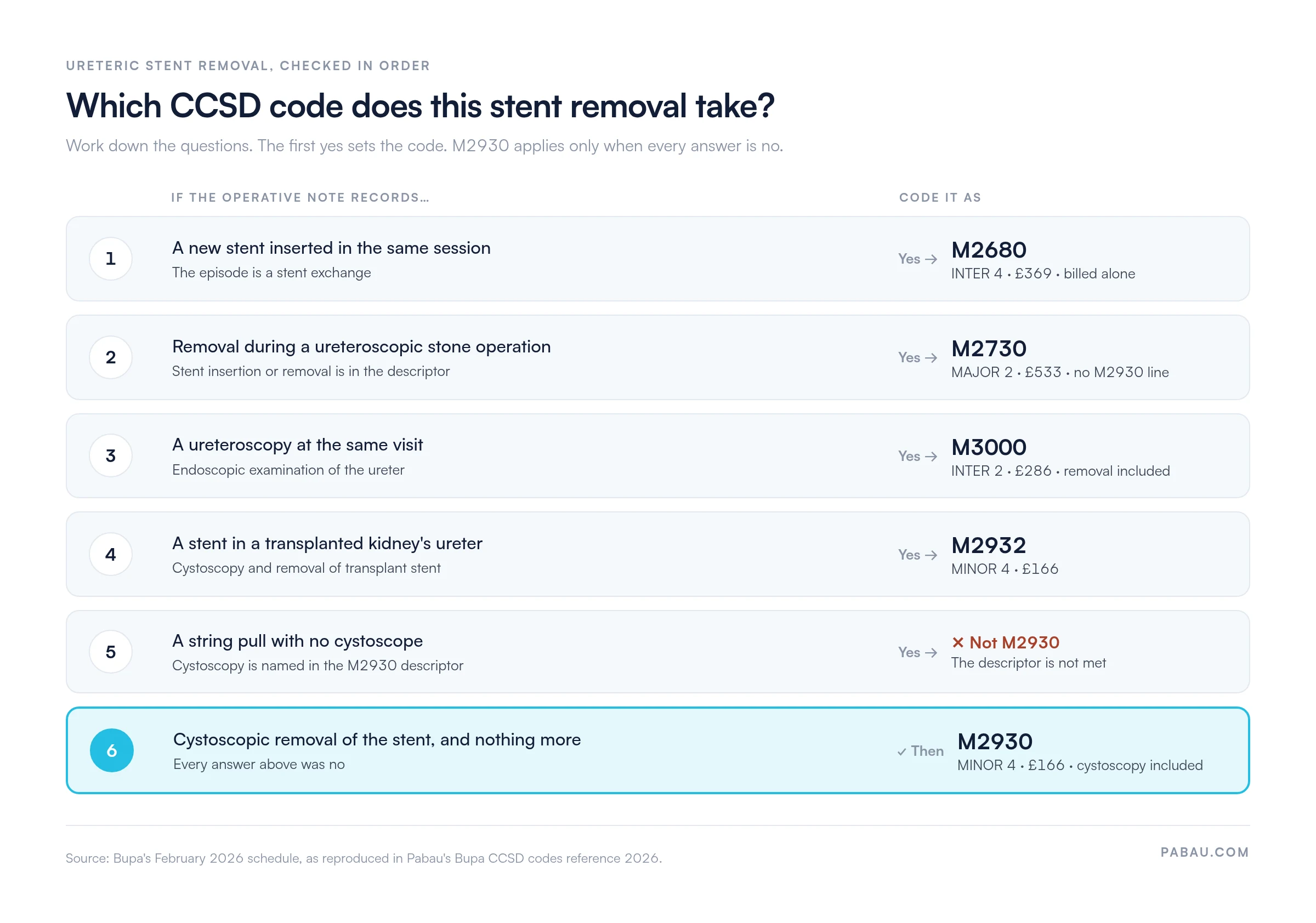
Under Bupa, M2930 pays £166 and a diagnostic flexible cystoscopy pays £245. Swapping in M4510, or adding it as a second line, can look tempting for that reason. Code only what the note records, because insurers audit stent codes against the operative note.
Every M2930 claim needs an ICD-10 diagnosis code that explains why the stent came out. Insurers check the diagnosis against the procedure code, and a vague code invites a query. Check definitions in the WHO ICD-10 browser before submission.
Avoid an unspecified symptom code, such as R39.8, when a precise code applies. Match the diagnosis to the one given at pre-authorisation, too. A mismatch between the two is a common reason insurers hold a claim.
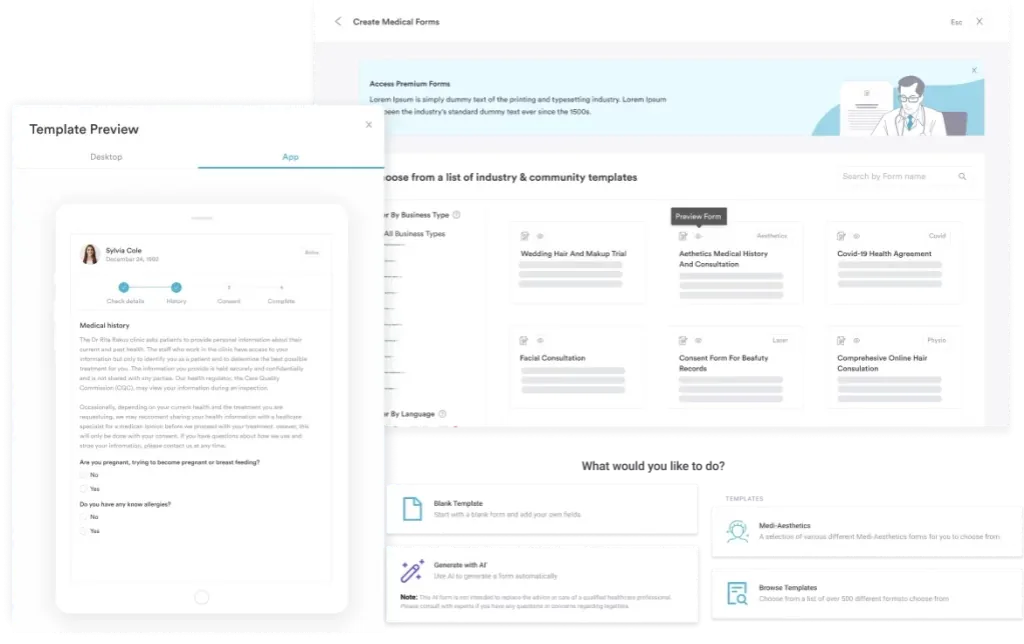
The operative note is the document that supports an M2930 claim. Cystoscopy is named in the descriptor, so the note must confirm it. A note that records a string pull alone does not support the code. Digital forms for operative documentation help capture every required field at the time of the procedure.
Bilateral removal needs care. The M2930 descriptor does not mention both sides, while M2920 includes bilateral work. Ask the insurer how it wants a bilateral removal billed before you submit.
Most UK private medical insurers expect the patient to have pre-authorisation before treatment. The patient usually calls the insurer and receives an authorisation number. Treating without one is a common reason claims are rejected.
The table below is a general guide to what each insurer asks for. Policy rules change, so confirm them with each insurer directly.
Get the authorisation number before the procedure date. Record it in the billing file and put it on the invoice. An authorisation for an exchange does not cover a removal-only claim, so update it if the plan changes.
UK insurers do not use relative value units. Each insurer publishes its own fee schedule, and Bupa groups codes into complexity bands with a fee for each band. Bupa grades M2930 as MINOR 4, which carries a fee of £166.
Bupa’s fee is the most it pays for the code. If your charge is higher, the patient pays the difference as a shortfall, so tell them before the procedure. Our Bupa procedure codes and fee schedule guide explains how shortfalls work.
AXA Health, Aviva, Vitality and WPA set their own fees for M2930. Check each one in the insurer’s fee finder before you quote the patient.
Denials for M2930 come from a small set of avoidable errors. For claims that still come back, our guide to denial management in healthcare covers tracking and resubmission.
Run a three-point check before an M2930 claim leaves the practice. Is the authorisation number on the invoice? Does the note confirm cystoscopy? Did a new stent go in, which would make it M2680?
Each UK insurer runs its own review process for recognised specialists. Most queries are settled by resubmitting with the right code or documents.
The ombudsman handles complaints from policyholders, not fee disputes between a consultant and an insurer. The patient has 6 months from the insurer’s final response to refer a complaint.
The CCSD schedule decides which steps are part of M2930 and which carry their own code. Confirm any unusual pairing with the insurer before you submit.
In many urology practices, the operative note, the authorisation number and the invoice sit in different places. The billing team then pieces them together after the session. That is where an exchange gets coded as a removal, or an authorisation number goes missing.
Pabau’s claims software for specialists keeps the CCSD code, the ICD-10 diagnosis and the authorisation number on one claim record. You send the claim through Healthcode to insurers such as Bupa, AXA Health and Vitality. You then track its status in the same place.
Pabau does not choose the code, so the M2680 and M3000 checks above still apply. What it does is keep the note and the claim together, so the checks take seconds. Pabau can also check a patient’s Bupa cover before the procedure date.

Pabau helps UK private urology practices record CCSD codes, attach authorisation numbers and send claims through Healthcode to Bupa, AXA Health and other insurers.

M2930 is one of the simplest codes in the ureter section, and one of the easiest to get wrong. The procedure rarely changes, but what happens around it does.
A new stent turns it into M2680. A ureteroscopy turns it into M3000. A stone operation already includes it. The note decides which applies, so make cystoscopy, laterality and any new stent required fields.
Book a demo to see how Pabau links operative notes, authorisation numbers and Healthcode claims for UK urology practices.

Treating the kidney endoscopically? CCSD code M1000 covers therapeutic endoscopic operations on the kidney.
Checking what Bupa pays for other urology codes? The Bupa procedure codes and fee schedule guide explains bands, fees and shortfalls.
Choosing software to bill UK insurers? Our roundup of the best medical billing software in the UK compares tools for insurer claims and payment tracking.
CCSD code M2930 covers removal of a prosthesis from the ureter, including the cystoscopy used to reach it. The prosthesis is usually a double-J or pigtail stent. The cystoscopy is not billed separately.
Bupa grades M2930 as MINOR 4, with a schedule fee of £166 in its February 2026 schedule. If your charge is higher, the patient pays the shortfall. Other insurers set their own fees.
Use M2680, endoscopic removal and insertion of prosthesis into ureter. Bupa grades it INTER 4 at £369. Do not bill M2930 with an insertion code for the same session.
No. Cystoscopy is named in the M2930 descriptor, so it is included. Billing a diagnostic cystoscopy code such as M4510 for the same scope is unbundling, and the insurer will reject it.
Not in the same operation. M2730 already includes insertion or removal of a stent. Bill M2930 when the stent comes out at a later cystoscopy.
Usually, yes. Bupa, AXA Health, Aviva and Vitality expect an authorisation number for most procedures. Check the patient’s policy, and put the number on the invoice.
The patient first complains to the insurer. After the final response, or after 8 weeks without one, they can go to the Financial Ombudsman Service within 6 months.