CPT Code 99465: Newborn resuscitation in the delivery room
CPT Code 99465: Definition and clinical description CPT Code 99465 is the AMA pr...

Last Updated: Nov 2, 2026
M1400 is the CCSD code for extracorporeal fragmentation of calculus of kidney (lithotripsy) – single treatment. It covers one session of extracorporeal shock wave lithotripsy (ESWL), where shock waves generated outside the body break up a stone in the kidney.
Each further session is billed as M1400 again, and UK private medical insurers expect a pre-authorisation number before it goes ahead. ESWL of a stone in the ureter is coded M3110 instead.
Let Pabau's smart automation suggest the right codes, reduce claim denials, and keep your practice compliant—effortlessly.
Automate repetitive tasks and focus on what matters most—your patients.
Reduce coding errors and ensure compliance with the latest regulations.
Clean claims, fewer denials, and faster reimbursements.
Powerful insights and reporting to help your practice thrive.
HIPAA compliant SOC 2 certified GDPR-compliant Trusted by 4,000+ clinics worldwide

CCSD code M1400 covers extracorporeal shock wave lithotripsy (ESWL) of a kidney stone, billed as one unit per treatment session.
The CCSD schedule has no separate repeat-session code, so every further ESWL session is another M1400 that needs the insurer’s authorisation first.
ESWL of a ureteric stone is M3110, and endoscopic or percutaneous kidney stone surgery takes M0910 or M0940.
UK private insurers such as Bupa, AXA Health, Aviva and Vitality expect a pre-authorisation number before the session goes ahead.
N20.0 (calculus of kidney) is the cleanest ICD-10 pairing, with N20.2 used when a ureteric stone is also present.
CCSD code M1400 is the UK private-sector procedure code for extracorporeal fragmentation of calculus of kidney (lithotripsy), billed per single treatment. It covers extracorporeal shock wave lithotripsy (ESWL) of a renal stone, where the shock waves are generated outside the body.
CCSD stands for Clinical Coding and Schedule Development, the group that maintains the procedure and diagnostic test schedule used across UK private healthcare. Bupa, AXA Health, Aviva and Vitality back the schedule, and insurers such as WPA, Cigna, Allianz Care and Healix use it too.
Within the full set of CCSD codes, M1400 sits in Chapter 12, which covers the urinary system and male reproductive organs.
The word “extracorporeal” is what separates M1400 from ureteroscopic and percutaneous stone surgery, which carry their own CCSD codes. The words “single treatment” set the billing unit: one M1400 equals one ESWL session on one date.
ESWL focuses acoustic shock waves on a kidney stone from outside the body, breaking it into fragments small enough to pass in the urine. Insurers audit M1400 claims against the procedure note, so each stage below should appear in it.
M1400 applies when the consultant urologist chooses ESWL as the treatment for a stone in the renal pelvis or calyces. Typical candidates have stones under about 20 mm whose CT density suggests they will fragment.
The code is site-specific. A stone treated by ESWL in the ureter is coded M3110, and bladder stones have their own codes. Where both a kidney and a ureteric stone are treated in one sitting, check the insurer’s multiple-procedure rules before billing both codes.
UK insurers ask for the diagnosis when they authorise and pay a claim, and recording it as an ICD-10 code keeps it unambiguous. The pairings below come from the WHO ICD-10 classification, which UK coders look up in the NHS Classifications Browser.
When in doubt, N20.0 is the most defensible primary diagnosis for a straightforward renal stone treated by ESWL. The diagnosis on the claim should match the one given at authorisation.
The access route and the stone’s location decide the code, as the chart below shows. The table after it sets M1400 against the stone codes it is most often mixed up with, using the descriptors in the current CCSD schedule.
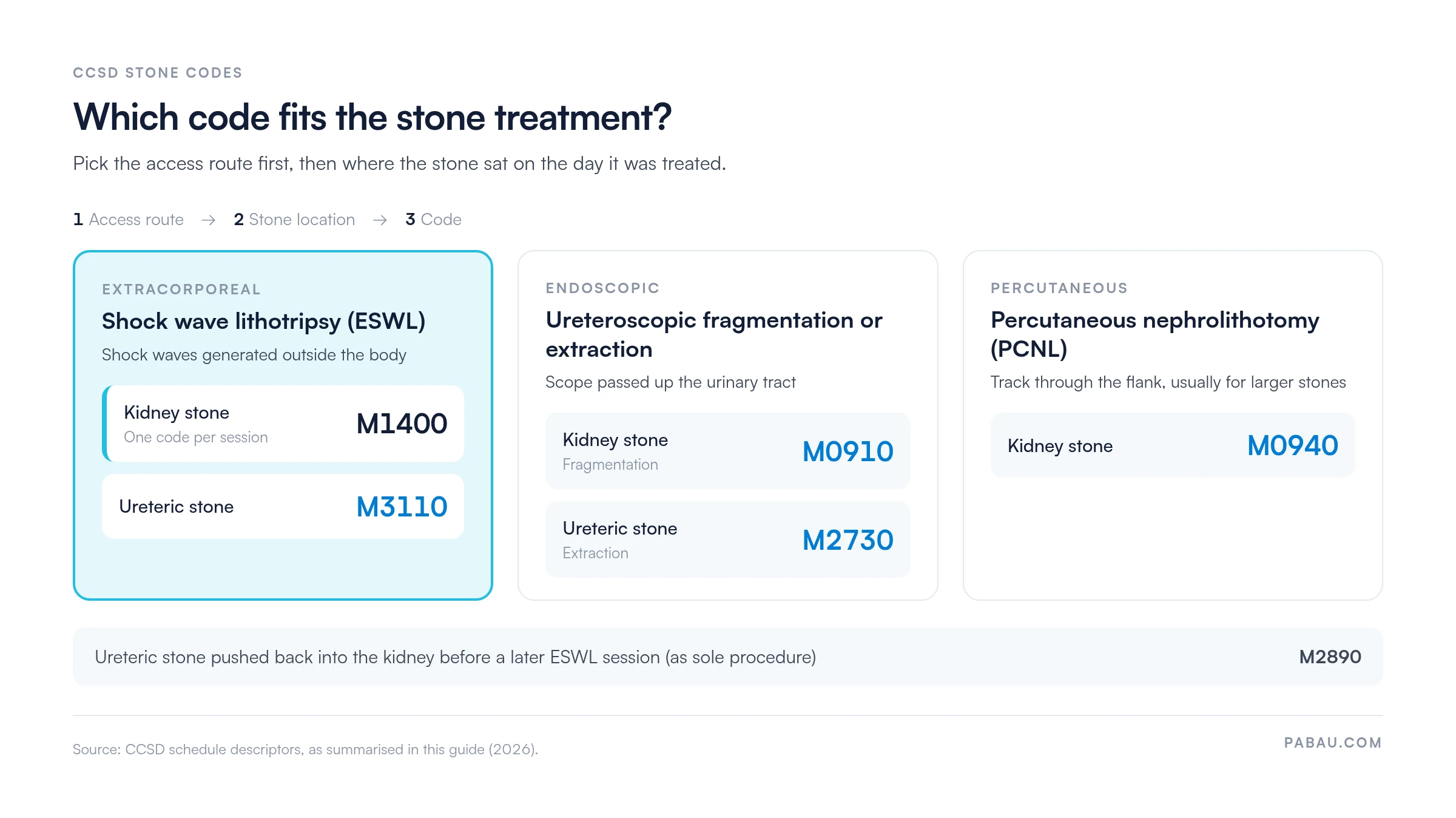
Our guide to CCSD code M0910 covers the endoscopic route in detail. Check descriptors against the current schedule each year, because CCSD revises codes in regular updates.
One M1400 covers one ESWL session on one date of service. The CCSD schedule has no add-on code for repeat kidney ESWL, so the rule plays out as follows.
UK private medical insurers generally expect a pre-authorisation number before ESWL goes ahead. The patient usually calls the insurer with their referral to get it, though many consultants’ secretaries help. Treatment without authorisation risks the insurer declining the claim, leaving the patient to pay.
Put the authorisation number on the invoice when you raise it, not as a follow-up. Insurers match it to the consultant, the CCSD code and the date of service, and a mismatch on any one can stop payment.
An authorisation request for M1400 typically covers the following details.
Our Bupa CCSD codes guide walks through Bupa’s authorisation and submission steps. Other insurers follow a similar pattern, but confirm the details with each one.
A valid M1400 claim rests on records that show the session happened as billed and was clinically indicated. Practices using claims management software can keep these documents on the patient record next to the claim.
Imaging guidance during the session is part of M1400 and is not billed as a separate code. A diagnostic scan done before the treatment day, such as a CT KUB, is a separate investigation billed by whoever performed it.
Anaesthesia needs a check per insurer. H3 Insurance’s fee schedule, for example, marks M1400 as a procedure whose fee already includes any local anaesthesia or sedation. Where an anaesthetist gives a general anaesthetic, they invoice the insurer on their own claim.
The hospital or lithotripsy unit invoices the insurer separately for the facility, equipment and consumables. The consultant’s M1400 invoice covers only the professional fee, and folding facility charges into it will be rejected.
Most M1400 rejections from UK insurers trace back to authorisation, policy cover or coding. The causes below are the ones to check before an invoice goes out.
A rejected M1400 claim can usually be put right, and the route depends on why it was declined. Work through these steps in order.
Lithotripsy billing goes wrong when the code, the diagnosis and the authorisation number live in different places. Pabau keeps them on one patient record from booking to invoice.
Your team records M1400 with its ICD-10 diagnosis and the insurer’s authorisation number on the appointment. The invoice then goes to Bupa, AXA Health and other insurers through Healthcode, so the details the insurer checks arrive together.
Each ESWL session sits on its own dated appointment, so a repeat session is easy to match against the number of sessions authorised. That makes it harder to bill a session the insurer has not agreed to pay.

Pabau helps UK private urology practices record CCSD codes, ICD-10 diagnoses and authorisation numbers. Claims then go through Healthcode to Bupa, AXA Health and other insurers.

Every M1400 claim turns on two facts. The ESWL session treated a stone in the kidney, and the insurer authorised that session first. Get both right and most rejections disappear.
Repeat sessions are where practices lose money, because each one is a fresh M1400 that needs cover in place. Track sessions against the authorisation, not from memory. Book a demo to see how Pabau links each lithotripsy session to its CCSD code and authorisation.

Need the full picture of Bupa CCSD billing? Pabau’s Bupa CCSD codes guide covers code structure, authorisation and submission for UK private practice.
Coding other endoscopic kidney work? CCSD code M1000 covers therapeutic endoscopic operations on the kidney other than stone work.
Want to reduce claim errors across your practice? Pabau claims management provides electronic claim submission and invoice tracking for UK private practices.
CCSD code M1400 covers extracorporeal shock wave lithotripsy of a kidney stone, billed per single treatment session. The shock waves are generated outside the body and focused on a renal calculus. ESWL of a ureteric stone is M3110, and endoscopic or percutaneous stone surgery has its own codes.
No. The CCSD schedule has no repeat-session code for kidney ESWL, so each further session is billed as M1400 again. Check that the insurer’s authorisation covers the extra session before it goes ahead.
Yes, UK private insurers such as Bupa, AXA Health, Aviva and Vitality generally expect an authorisation number before treatment. The insurer usually asks for the CCSD code, the diagnosis, the consultant’s details and the hospital.
N20.0 (calculus of kidney) is the primary pairing. N20.2 applies when a ureteric stone is also present and the kidney stone is the ESWL target. Avoid N20.9 once imaging confirms a renal stone, and add N13.2 when obstruction is documented.
ESWL of a stone in the ureter is coded M3110, extracorporeal shockwave lithotripsy of calculus of ureter. M1400 is reserved for stones in the kidney at the time of treatment.
Keep a dated pre-treatment imaging report, the insurer’s authorisation number and a procedure note confirming extracorporeal delivery. Add the imaging guidance record and a post-treatment note on fragmentation and follow-up. An anaesthetic record is needed when an anaesthetist was involved.
ESWL is usually a day-case or outpatient procedure in a hospital lithotripsy unit. The consultant bills M1400 for the professional fee, and the hospital invoices the insurer separately for the facility.
The patient complains to the insurer first. If the final response does not resolve it, or eight weeks pass without one, the Financial Ombudsman Service can take the complaint.