CPT Code 98981: RTM Treatment Management Billing Guide
CPT code 98981: Definition and official descriptor CPT code 98981 is an add-on c...

Last Updated: Nov 9, 2026
M2012 is the CCSD code for replantation of ureter into bowel (including bilateral), surgery that reconnects the ureter to the intestine instead of the bladder. It sits in Chapter 12 of the CCSD schedule, Urinary system and male reproductive, under the Ureter sub-chapter. One code covers the operation whether the surgeon replants one ureter or both.
The destination of the ureter decides the code. Replantation into the bladder is billed as M2080 for one side or M2030 for both. The schedule lists M2100, other connection of ureter, as an unacceptable combination with M2012.
Let Pabau's smart automation suggest the right codes, reduce claim denials, and keep your practice compliant—effortlessly.
Automate repetitive tasks and focus on what matters most—your patients.
Reduce coding errors and ensure compliance with the latest regulations.
Clean claims, fewer denials, and faster reimbursements.
Powerful insights and reporting to help your practice thrive.
HIPAA compliant SOC 2 certified GDPR-compliant Trusted by 4,000+ clinics worldwide

M2012 is the CCSD code for replantation of ureter into bowel, billed as one line whether the surgeon replants one ureter or both.
The ureter’s destination decides the code. Bowel is M2012, while bladder replantation is M2080 for one side and M2030 for both.
The CCSD schedule lists M2100, other connection of ureter, as an unacceptable combination with M2012, so never bill the two together.
Most UK private medical insurers expect preauthorization for planned surgery, so quote the reference number on the M2012 claim.
Pabau’s claims management software sends CCSD claims through Healthcode from the patient record and checks required fields before submission.
CCSD code M2012 is the code UK private medical insurers use for replantation of ureter into bowel (including bilateral). The surgeon divides the ureter and implants it into a segment of intestine, so urine drains through the bowel instead of the bladder.
The code sits in Chapter 12 of the schedule, Urinary system and male reproductive, under the Ureter sub-chapter. Its neighbors sit in our library of CCSD codes. Insurers such as Bupa work from the same schedule, which our guide to Bupa CCSD codes covers in full.
The bracketed words carry the billing rule. “Including bilateral” means one M2012 line covers the operation, whether one ureter or both are replanted. Billing the code twice for a bilateral case duplicates the claim.
Fees and complexity grades are set by each insurer, so check the insurer’s own fee schedule before you quote the patient.
Replanting a ureter into bowel is a form of urinary diversion. Surgeons use it when the bladder can no longer store urine safely, or has been removed.
The best-known version is ureterosigmoidostomy, where the ureters are joined to the sigmoid colon. Urine mixes with stool and leaves through the anus, so the patient doesn’t need an external stoma bag.
That advantage comes with long-term costs. Patients face a higher risk of kidney infection, metabolic acidosis and cancer where the ureter meets the colon. They need lifelong colonoscopy surveillance as a result.
Many surgeons now prefer an ileal conduit or a reconstructed bladder. Those operations involve more than a ureter-to-bowel join. An ileal conduit has its own code, M1910, which already includes the ureteric implantation. For a reconstructed bladder, check the schedule for a separate code before you settle on M2012.
With the clinical picture in place, coding comes down to one question: where did the ureter go? The replantation descriptors look alike, which is why coders slip between them. The table lists the neighbors confirmed on the CCSD schedule.
If the ureter went back into the bladder, see our guides to CCSD code M2080 and CCSD code M2030. When the note leaves the destination unclear, query the surgeon before you code. A wrong destination code gets the claim returned, and resubmitting delays payment.
Insurers read the operative note against the descriptor, so the note has to support every word of it. Before you code, make sure it states:
A note that only says “urinary diversion” leaves the coder choosing between several codes. One line naming the destination and the side saves a query later.
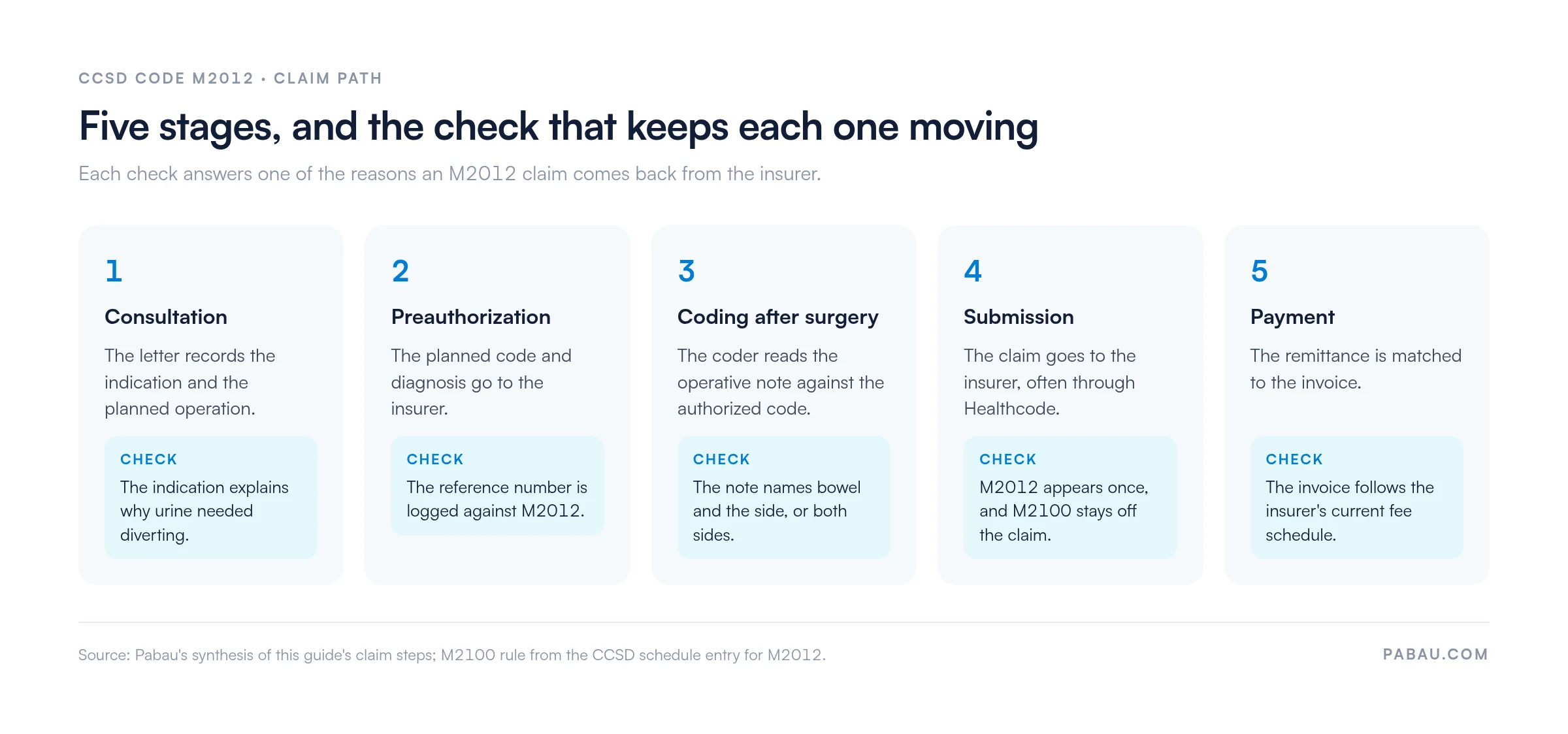
Once the note is right, the claim follows a predictable path. The overview pairs each stage with the check that keeps it moving, and the steps below fill in the detail.
If the plan changes during surgery, for example from a bladder replantation to a bowel one, call the insurer before you submit. Record who you spoke to and when, then ask them to update the authorization to M2012.
Even with the check done, a few errors come up again and again. Each one has a simple fix.
Take an illustrative case. The consultant plans a ureterosigmoidostomy for both ureters, and the practice requests authorization for M2012.
During surgery, both ureters are implanted into the sigmoid colon. The operative note names the segment and states that both sides were done.
The coder bills M2012 once, with the authorization reference and the diagnosis. M2100 stays off the claim, because M2012 already describes the join. Had the surgeon re-joined one ureter to the bladder instead, the code would be M2080, and the practice would update the authorization before billing.
Major urology claims stall on paperwork more often than on coding. The authorization reference sits in an email, the operative note in another system, and someone retypes the claim by hand.
Pabau, the practice management platform we build, keeps those pieces on the patient record. Its claims management software submits CCSD claims to UK insurers through Healthcode, straight from that record.
Before a claim leaves, Pabau checks that required fields such as membership numbers and authorization codes are complete. You can then track each claim’s status and reconcile payments without chasing the insurer by phone.
The same claims tools work with Claim.MD in the US, and with Medicare and DVA claims in Australia through Tyro. That helps groups that bill in more than one region.
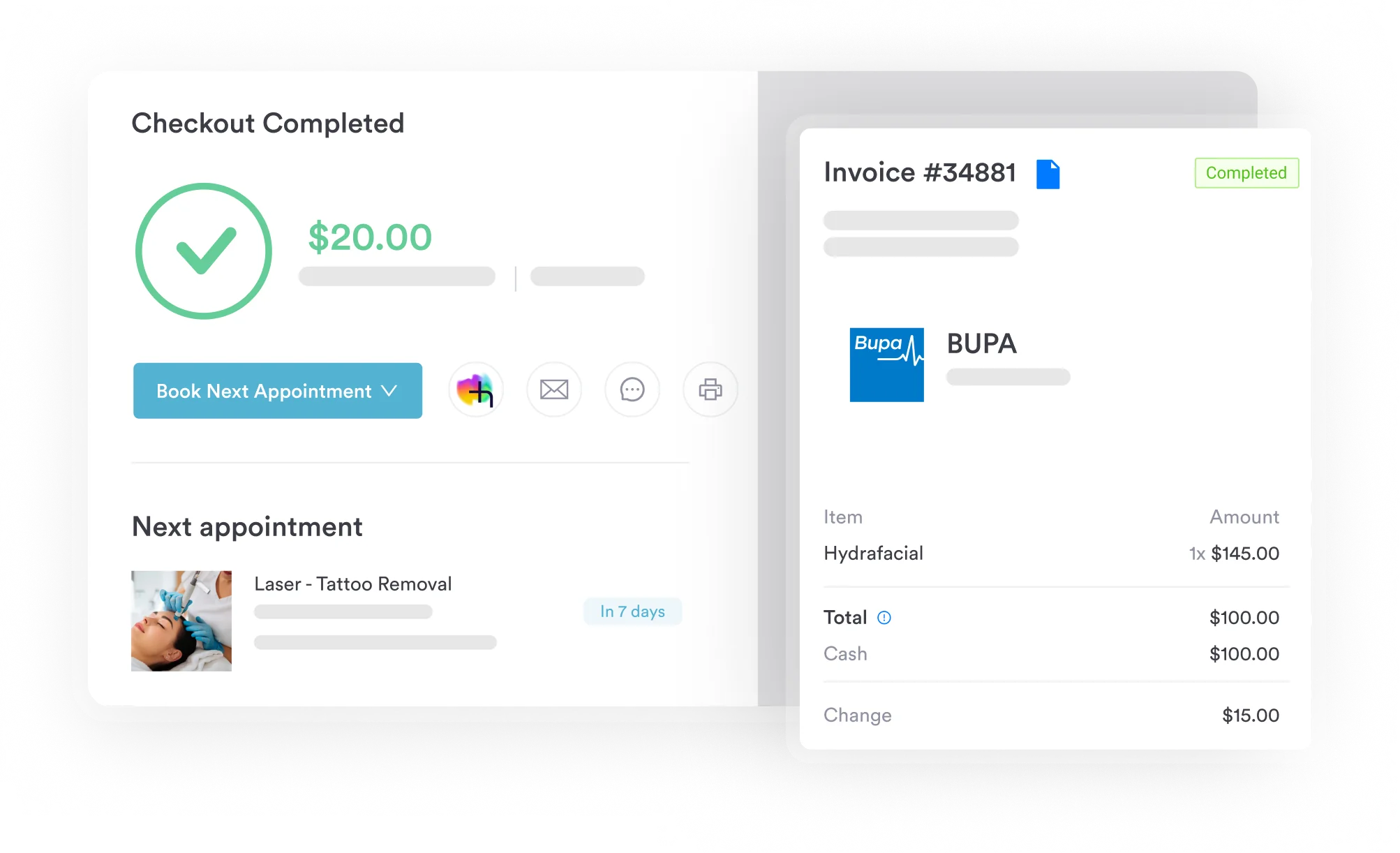

Pabau keeps the authorization reference, signed forms and claim on one record, then submits through Healthcode. Your team spends less time chasing returned claims.

M2012 comes with one clear rule. If the ureter goes into bowel, on one side or both, the claim carries one M2012 line.
Most returned claims trace back to three slips: the wrong destination, a double-billed bilateral case, or M2100 added on top. Settle those before submission, and you remove the most common reasons for an insurer query.
Want to see a CCSD claim move from the patient record to Healthcode? Book a demo and we’ll walk you through it with your own codes.

Did the ureter go into the bladder on one side? CCSD code M2080 covers unilateral replantation into the bladder, with cystoscopy included.
Were both ureters replanted into the bladder? CCSD code M2030 covers bilateral replantation into the bladder on a single line.
Did the surgeon build an ileal conduit instead? CCSD code M1910 covers construction of the conduit, with ureteric implantation included.
Working on a transplant ureter? CCSD code M2160 covers reconstruction of the transplant ureter.
Correcting reflux rather than diverting urine? CCSD code M2210 covers open correction of unilateral vesicoureteric reflux.
No. M2012 is a CCSD code, which UK private medical insurers use to process claims. OPCS-4 is the classification the NHS uses to record procedures, so an NHS episode is coded differently.
The Clinical Coding and Schedule Development Group maintains it. The group is made up of representatives from the major UK private insurers. It sets codes and descriptors, while each insurer sets its own fees.
M2012 was added on 20 January 2010. Check the live schedule before you code, because descriptors and combination rules can change between publication cycles.
Use the CCSD website at ccsd.org.uk. Searching the full schedule requires an account on the site. Check each insurer’s own fee schedule for what it pays.