HCPCS code K0552: Infusion pump supplies billing guide
HCPCS code K0552: Official description and code category HCPCS code K0552 belong...

Last Updated: Nov 23, 2026
X1420 is the CCSD code for anterior exenteration of pelvis, a major cancer operation. It removes the bladder, urethra, lower ureters and reproductive organs, and it leaves the rectum in place. Consultant surgeons bill it to UK private medical insurers.
The extent of the resection decides the code. Removing the rectum as well makes it a total pelvic exenteration, X1410. A robotic-assisted anterior exenteration has its own code, X1421.
Let Pabau's smart automation suggest the right codes, reduce claim denials, and keep your practice compliant—effortlessly.
Automate repetitive tasks and focus on what matters most—your patients.
Reduce coding errors and ensure compliance with the latest regulations.
Clean claims, fewer denials, and faster reimbursements.
Powerful insights and reporting to help your practice thrive.
HIPAA compliant SOC 2 certified GDPR-compliant Trusted by 4,000+ clinics worldwide

CCSD code X1420 is anterior exenteration of pelvis, a major cancer operation billed by the consultant surgeon to UK private medical insurers.
The extent of the resection picks the code: X1410 covers a total exenteration, and X1421 covers the robotic-assisted anterior operation.
The CCSD lists X1420 and X1423 as an unacceptable combination, so one exenteration gets one exenteration code.
Pre-authorization is normal for major cancer surgery, so get the insurer’s reference before the operation and quote it on the claim.
The operative note should name each organ removed, confirm the rectum stayed and record whether the approach was open or robotic.
CCSD code X1420 is the UK private insurance code for anterior exenteration of pelvis, a major cancer operation. It removes the bladder, urethra, lower ureters and reproductive organs, and it leaves the rectum in place. The Canadian Cancer Society’s guide to pelvic exenteration notes the anterior operation is used when no cancer sits in or close to the rectum.
The code sits in Chapter 14 of the CCSD schedule, under sub-chapter 14.1.0 with the uterus and adnexa procedures. NHS hospitals record the same operation with OPCS-4 code X14.2. So the surgeon who bills X1420 is usually a gynecological oncologist working with a wider pelvic surgery team.
X1420 pays for the consultant’s surgical work. The hospital bills its own operating room, bed and critical care charges under its contract with the insurer. The anesthetist bills separately, under their own fee arrangement.
Exenteration codes split on two questions. How much came out, and was the operation robotic? Get either one wrong and the claim describes a different operation from the one in the notes. The grid below maps each pair of answers to its code.
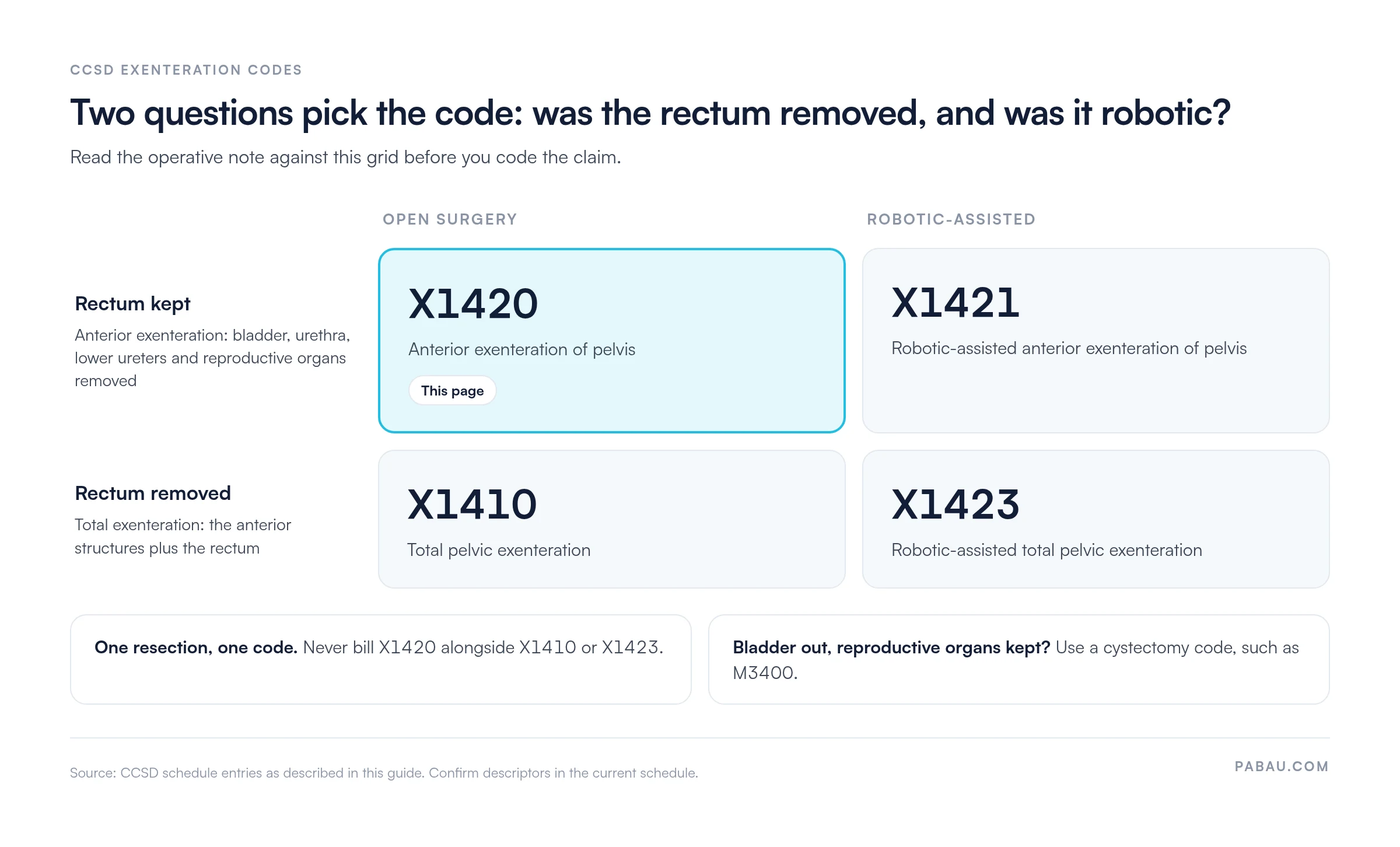
Two exenteration codes for one resection is the pattern that gets queried. A total exenteration already includes the anterior structures, so X1410 and X1420 describe overlapping work. The CCSD treats its coding principles as guidelines, and each insurer decides whether to adopt them.
Watch the lower boundary too. When the bladder comes out but the reproductive organs stay, use a cystectomy code, such as CCSD code M3400.
Major cancer surgery runs on a longer billing timeline than a day-case procedure. This is the usual path for a privately insured patient.
Insurers check an exenteration claim by reading the code against the operative note. A good note lets a reviewer confirm X1420 without writing back to you.
Most queries on this code come back to one of five errors. Each has a simple fix if you catch it before submission.
Take an illustrative case. A patient with recurrent cervical cancer is pre-authorized for an anterior exenteration under X1420.
During the operation, the surgeon finds disease close to the rectum and removes it too. The operation is now a total exenteration, which X1410 describes.
The consultant’s office sends the insurer the operative note and asks for the authorization to be amended. The claim then goes in under X1410 alone, never as X1420 plus X1410.
The CCSD Group, made up of Aviva, AXA Health, Bupa and Vitality, sets the codes and their descriptions. It does not set fees. Our CCSD billing guides cover the neighboring codes one by one. Each insurer decides its own benefit for X1420, its pre-authorization process and which coding principles it adopts.
Before surgery, confirm three points with the patient’s insurer. Check that the policy covers the code, get the authorization reference, and note the benefit you will be paid. For Bupa patients, our Bupa CCSD codes guide and Bupa fee schedule explainer show where to look.
In many consultant offices, the authorization email, the operative note and the insurance claim live in three places. When an insurer queries an exenteration claim, someone rebuilds the episode by hand.
Pabau keeps those pieces on one patient record. You store the authorization reference against the episode, and the native Healthcode integration pre-fills the claim from that record.
Pabau checks the required claim fields before submission, then tracks the claim’s status and reconciles the payment. You get a cleaner first submission on a high-value claim, and a quicker answer when the insurer asks a question. See how it works in Pabau’s claims management software.

Pabau stores the pre-authorization reference against the patient record, pre-fills the Healthcode claim from it and checks required fields before submission. Your team answers insurer queries without rebuilding the episode.

X1420 is a narrow code for a very large operation. The billing risk sits in two decisions: how much was removed, and how it was done. Settle both in the operative note, and the right code follows.
When the plan changes during surgery, fix the authorization before the claim goes in, not after it comes back. Book a demo to see how Pabau keeps the authorization, the operative note and the Healthcode claim for each operation on one record.

Coding a bladder removal without exenteration? CCSD code M3400 covers open total cystectomy with urinary diversion.
Billing a Bupa-insured patient? Bupa CCSD codes explains how to look up and submit procedures under Bupa’s schedule.
Checking what Bupa pays for a procedure? Bupa procedure codes fee schedule explains how Bupa sets benefits for CCSD-coded treatments.
No. CCSD codes are for private insurance claims. NHS hospitals record the same operation with OPCS-4 code X14.2, anterior exenteration of pelvis.
An anterior exenteration removes the bladder and keeps the rectum. A posterior exenteration removes the rectum and keeps the bladder. A total exenteration removes both.
Use the code for the cancer being treated, supported by histology. Recurrent cervical cancer, for example, is coded under C53, malignant neoplasm of cervix uteri.
Policies with cancer cover usually include major cancer surgery, but benefits and limits vary. Check the patient’s cover and get pre-authorization before booking the operation.
Full recovery can take six months or longer, according to the Canadian Cancer Society. Adjusting to the changes to your body can take a year or more.