

HCPCS Code Q4185: Cellesta flowable amnion billing guide
HCPCS Code Q4185: definition and official descriptor HCPCS Code Q4185 is the Lev...

Last Updated: Nov 20, 2026
M3400 is the CCSD code for open total cystectomy with construction of an intestinal conduit or bladder. It covers removing the whole bladder through an open incision and building a new route for urine from bowel in the same operation.
The code sits in the bladder section of chapter 12 of the CCSD schedule used by UK private medical insurers. Robotic cystectomy is billed as M3410 or M3411, and laparoscopic cystectomy as M3420.
Let Pabau's smart automation suggest the right codes, reduce claim denials, and keep your practice compliant—effortlessly.
Automate repetitive tasks and focus on what matters most—your patients.
Reduce coding errors and ensure compliance with the latest regulations.
Clean claims, fewer denials, and faster reimbursements.
Powerful insights and reporting to help your practice thrive.
HIPAA compliant SOC 2 certified GDPR-compliant Trusted by 4,000+ clinics worldwide

CCSD code M3400 covers open total cystectomy with construction of an intestinal conduit or bladder, so removal and diversion share one code.
The approach decides the code. Robotic cystectomy is M3410 or M3411, laparoscopic cystectomy is M3420, and partial cystectomy is M3500.
CCSD-based insurer schedules band M3400 as a Complex Major procedure, but each insurer sets its own fee.
UK insurers usually expect pre-authorization for planned bladder surgery, so get the reference number before the operation date.
Claims go electronically through Healthcode or direct to the insurer, and the insurer’s provider manual sets the appeal rules.
CCSD code M3400 is the code UK private medical insurers use for open total cystectomy with construction of an intestinal conduit or bladder. National Friendly’s CCSD-based fee schedule lists it under that narrative as a Complex Major procedure.
The surgeon removes the whole bladder through an open abdominal incision. In the same operation, a segment of bowel is used to build a new route for urine. Both steps sit inside the one code.
The schedule is maintained by the CCSD Group, the Clinical Coding & Schedule Development Group. Major UK private health insurers run it, and its codes are used by Bupa, AXA Health and others.
Watch the wording on older lists. The CCSD record notes that the narrative once read “Total cystectomy (with construction of intestinal conduit or bladder)”. The current wording adds “Open”, which separates it from the robotic and laparoscopic codes.
The CCSD Group updates its schedule over time, so check the edition your insurer works from. Our index of CCSD codes lists the other procedure codes we cover.
Total cystectomy removes the whole urinary bladder. It is most often done for muscle-invasive bladder cancer. Less often, it treats a non-cancer condition that other treatment has not controlled, such as radiation damage to the bladder.
Because the bladder stores urine, the surgeon has to build a new drainage route in the same operation. That diversion is what the bracket in the M3400 narrative describes. The operation runs in three phases.
It is a long operation under general anesthesia, and the anesthetist bills separately. That fee is covered further down.
No, not for the two diversions the narrative names. M3400 covers construction of an intestinal conduit or a bladder, so an ileal conduit and an orthotopic neobladder both fall inside it. A diversion outside that wording needs a check with the insurer.
Code from the operation the surgeon finished, not the one that was planned. If the diversion changed during surgery, the note should say so, and the claim should match it.
The approach decides the code as much as the organ does. Insurer schedules list separate codes for robotic and laparoscopic cystectomy, all in the same Complex Major band. The decision path below shows the two questions that pick the code, and the table adds the neighboring codes.
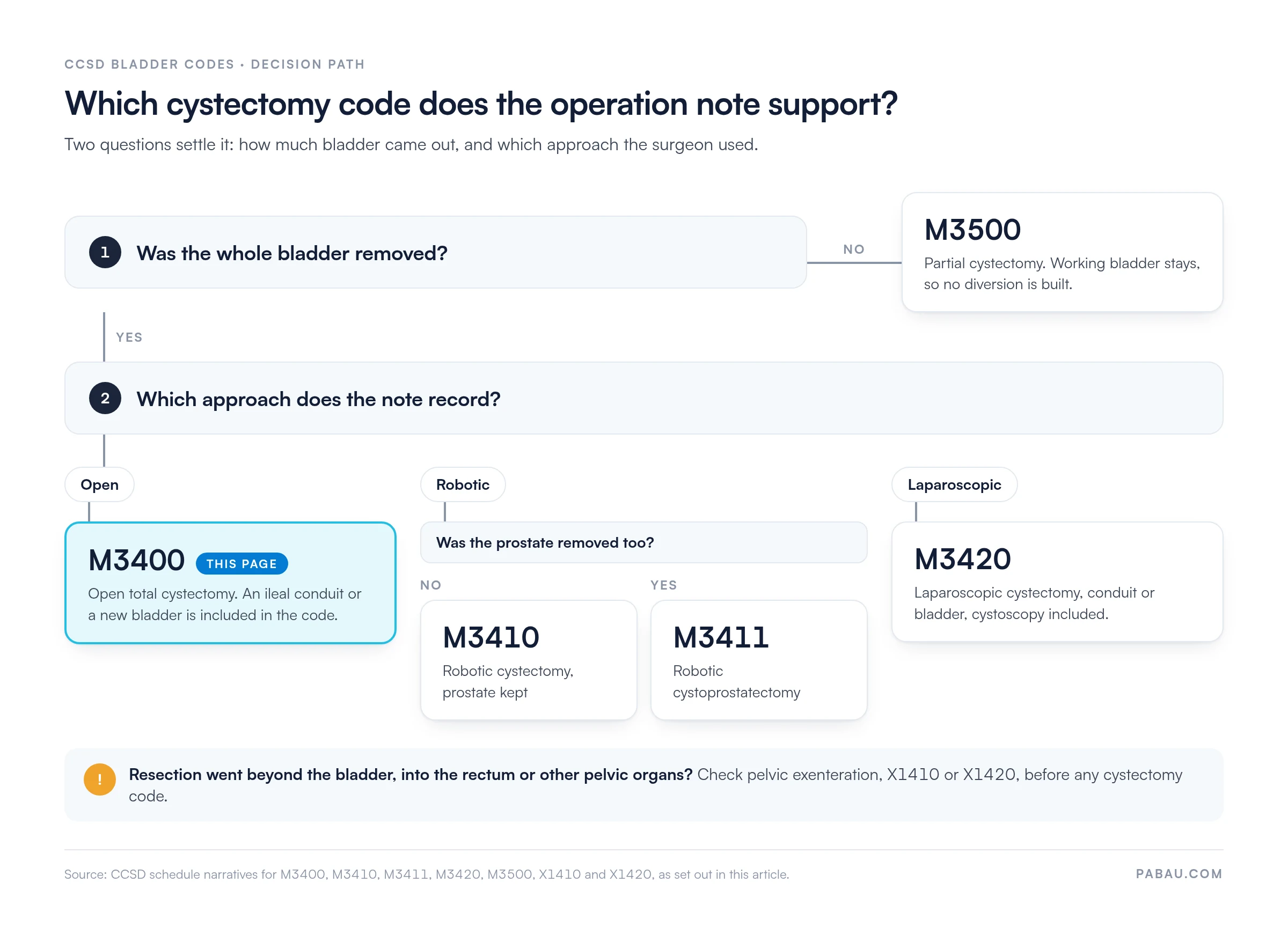
Partial and total cystectomy are easy to confuse on a vague note. Partial cystectomy under M3500 leaves working bladder in place, so it carries no diversion. If any bladder was preserved, M3400 is the wrong code. Opening the bladder only to take out stones is a different operation again, billed as M3900.
Removing the urethra is billed under its own CCSD code, M7200. A same-session urethrectomy therefore needs a combination check before it joins the M3400 claim.
The narrative tells you what is in the code. Beyond that, each insurer applies its own combination rules, so check the current schedule before a second line goes on the claim.
Before an M3400 claim goes out, ask the surgeon to confirm in writing what else was done in the session. Lymph node dissection and urethrectomy are the two extras to ask about first.
When a UK insurer asks for a diagnosis, the claim uses WHO ICD-10 codes. For M3400, the diagnosis should explain why the whole bladder was removed. The WHO ICD-10 browser lists the full C67 category.
When pathology confirms muscle invasion, put the T stage in the referral letter or clinical summary. It shows the insurer why the whole bladder had to come out.
Most UK private insurers want planned bladder surgery approved before it happens, and the patient’s policy decides what is covered. The table below is a starting point, so confirm each detail with the payer before the operation date.
An authorization request for M3400 is easier to approve when it carries these documents:
Emergency surgery, such as for bleeding that can’t be controlled, can’t wait for approval. Tell the insurer as soon as you can, and follow its provider manual for retrospective requests.
A claim for M3400 is only as strong as the operation note behind it. The note has to show more than the fact that the bladder came out. A digital operation-note form turns each element into a field the surgeon fills in.
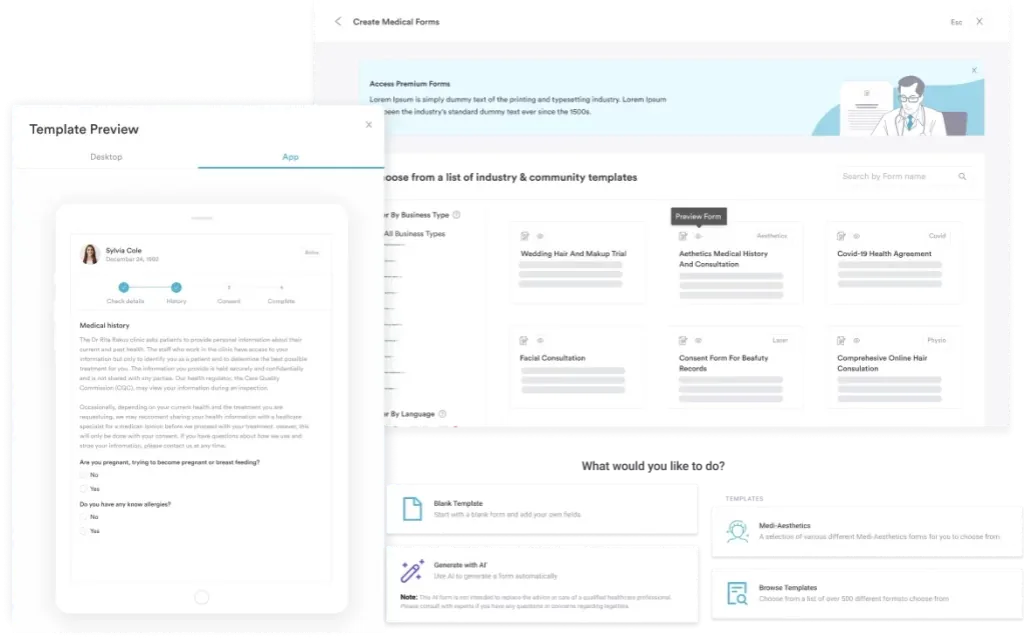
A complete M3400 operation note records:
Keep the histopathology report, the anesthetic record and the authorization reference with the claim. Some insurers ask for them before they pay.
M3400 is a Complex Major operation with several possible second codes, so there is more to check than on a minor procedure. Claims management software can flag a missing field before submission, but coders still need to know what insurers look for.
If a claim is still refused, ask the insurer for its reason in writing. Then follow the appeal process in its current provider manual, and only commit to a deadline you have confirmed there.
The anesthetist bills separately from the surgeon for the same operation, against the same procedure code. Insurers set the anesthetist’s fee in their own schedules, so check it there rather than in the CCSD narrative.
The rest of the team bills in different ways:
Agree with the team who sends which claim before the operation. That way no claim goes out late against the authorization.
In many urology practices, the authorization lives in an email and the operation note sits in another system. The claim then gets keyed in by hand, and each handoff can lose the reference or the right code.
Pabau keeps those steps together on one patient record. Its claims management software sends claims electronically through Healthcode and to Bupa. The authorization code, dates and sessions sit on the patient’s case, with a warning when one is missing.
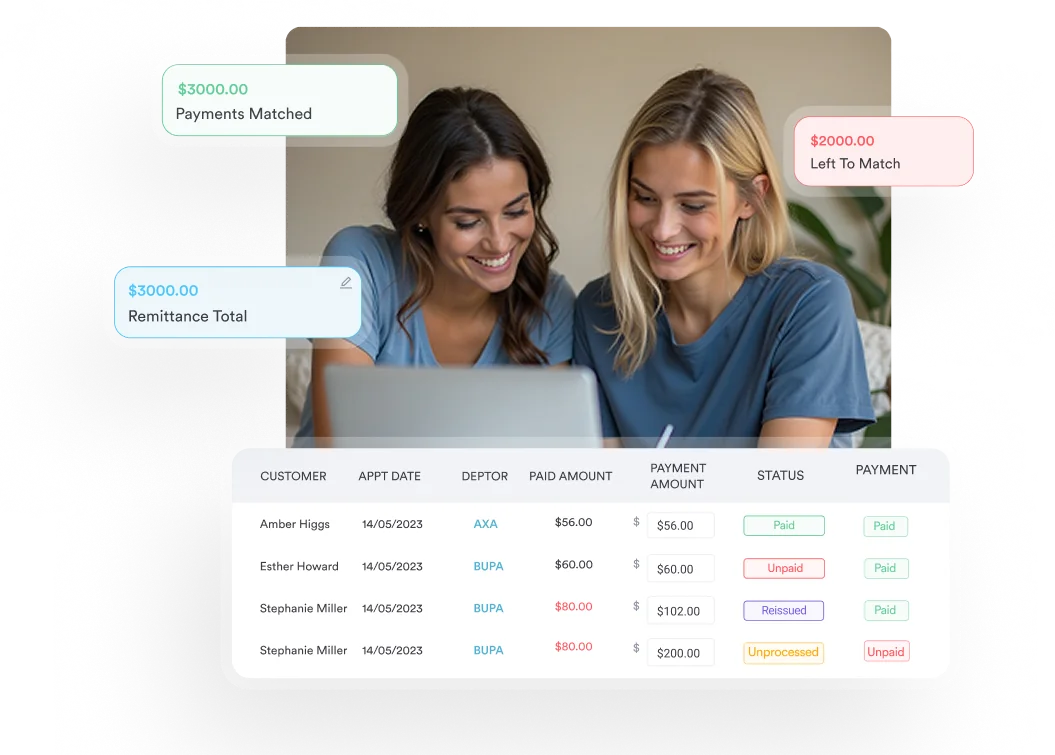
The result is fewer claims bounced for a missing reference, and a clear view of which cystectomy claims still need chasing. Your team spends less time on rework and more on patients.

Pabau tracks authorization codes on the patient’s case and sends claims electronically through Healthcode and to Bupa. You see each claim’s status without phoning the insurer.

M3400 is a clear code once the note says open, total, and which diversion was built. Most trouble comes from the wrong approach code, a vague diagnosis or a missing authorization. You can catch all three before the claim leaves.
Agree a standard procedure title with your surgeons, and check each insurer’s current schedule and combination rules. Those two habits head off the queries that slow cystectomy payments. Book a demo to see how Pabau tracks authorizations and sends your Healthcode claims from one patient record.

Billing a partial cystectomy instead? CCSD code M3500 covers partial cystectomy, where only part of the bladder wall is removed.
Coding a same-session urethrectomy? CCSD code M7200 covers removal of the urethra.
Need a full Bupa CCSD billing reference? Bupa CCSD codes covers Bupa’s procedure list and how its claims work.
Checking Bupa fees before you invoice? Bupa procedure codes and fee schedule walks through Bupa’s recognized codes and fee tiers.
CCSD code M3400 covers open total cystectomy with construction of an intestinal conduit or bladder. The whole bladder is removed, and a urinary diversion is built from bowel in the same operation. It sits in the bladder section of chapter 12 of the CCSD schedule.
It is included. The narrative covers construction of an intestinal conduit or a bladder, so an orthotopic neobladder falls inside M3400. Don’t add a second line for the diversion.
No. M3400 is the open operation. Robotic cystectomy is M3410 without the prostate or M3411 with it, and laparoscopic cystectomy is M3420.
When an insurer asks for a diagnosis, UK claims use WHO ICD-10 codes. Bladder cancer takes a C67 code, such as C67.0 for the trigone or C67.5 for the bladder neck. Non-cancer indications include N30.1, N30.4 and N32.1.
Urethrectomy has its own CCSD code, M7200, and the M3400 narrative doesn’t mention it. If the urethra was removed in the same session, record it in the note. Then check the insurer’s combination rules before you add M7200.
The closest CPT codes are 51590, complete cystectomy with an ileal conduit or sigmoid bladder, and 51596, complete cystectomy with continent diversion. CPT 51570 covers complete cystectomy alone. CCSD and CPT are not equivalent systems, so treat these as reference points only.
The usual reasons are a missing pre-authorization, the wrong approach code, a vague diagnosis and an unchecked second code. Ask the insurer for its reason in writing. Then appeal through its provider manual, with the operation note, histopathology and clinical summary attached.





