CPT Code 99465: Newborn resuscitation in the delivery room
CPT Code 99465: Definition and clinical description CPT Code 99465 is the AMA pr...

Last Updated: Nov 2, 2026
M1910 is the CCSD code for construction of an ileal conduit, including implantation of both ureters into it. It covers isolating a segment of ileum, joining the ureters to it and bringing it out as a urostomy stoma.
Bowel re-anastomosis and stoma formation sit inside the code and are not billed separately. When the conduit is built during a total cystectomy, Bupa's cystectomy codes such as M3400 already include it, so M1910 is not added.
Let Pabau's smart automation suggest the right codes, reduce claim denials, and keep your practice compliant—effortlessly.
Automate repetitive tasks and focus on what matters most—your patients.
Reduce coding errors and ensure compliance with the latest regulations.
Clean claims, fewer denials, and faster reimbursements.
Powerful insights and reporting to help your practice thrive.
HIPAA compliant SOC 2 certified GDPR-compliant Trusted by 4,000+ clinics worldwide

CCSD Code M1910 covers construction of an ileal conduit with ureteric implantation, not continent diversions such as a neobladder.
Bowel segment isolation, re-anastomosis and stoma formation are part of the procedure. Ureteric stenting and pre-operative stoma siting may need separate coding.
On Bupa’s schedule, total cystectomy codes such as M3400 already include the conduit, so M1910 is billed only when the conduit is the main procedure.
Operative notes must confirm bilateral ureteric implantation, ileal segment length, stoma site and restored bowel continuity to satisfy insurer requirements.
Pabau’s claims management software stores each pre-authorisation and validates claims before they reach Healthcode.
CCSD Code M1910 is defined by the Clinical Coding and Schedule Development (CCSD) schedule with the official descriptor: Construction of ileal conduit including ureteric implantation.
It covers the complete surgical creation of an incontinent urinary diversion from a segment of ileum. Both ureters are joined directly to that segment, and its distal end is brought to the abdominal wall as a urostomy stoma.
M1910 sits in chapter 12 of the CCSD schedule, urinary system and male reproductive organs, in the ureter section. The operating consultant urologist bills it for the primary surgical episode.
Anaesthetist fees are billed separately using the applicable CCSD anaesthesia schedule. Histopathology, post-operative stoma nurse follow-up and stoma appliance supplies fall outside this code entirely.
The ileal conduit is also known as the Bricker conduit or ileal loop urinary diversion. It involves four surgical steps that coders and billing teams should recognise in an operative note.
The operative note should reflect all four components. A report that describes only the stoma formation, without documenting bilateral ureteric implantation, is a common trigger for a claim query from UK private insurers.
Clinically, most ileal conduits are built as the urinary diversion after radical cystectomy for muscle-invasive bladder cancer (MIBC).
British Association of Urological Surgeons (BAUS) guidance treats the ileal conduit as the standard incontinent diversion. It suits patients who are not suitable for, or do not choose, a continent reconstruction.
When the conduit is built during a total cystectomy, Bupa bills the whole operation under the cystectomy code, as the next sections explain. M1910 is billed when the conduit is the main procedure, for indications such as these:
The billing team should confirm the primary diagnosis in the clerk-in notes and the oncology MDT letter. The indication directly informs the insurer’s medical necessity assessment.
When coding M1910 after pelvic exenteration, confirm with the operating consultant which procedure is the principal code. Depending on the CCSD schedule edition, the exenteration code may already cover the diversion. Never assume M1910 is the primary surgical code in a multi-organ resection.
Knowing the bundling boundaries of CCSD Code M1910 prevents under-coding. It also prevents duplicate-billing denials, which arise when integral sub-procedures are submitted as separate line items.
The bundling status of intraoperative JJ stents is the most common grey area. Some insurers treat stents placed to support the ureteroileal anastomosis as integral, while others accept a separate stenting code. Check the current CCSD schedule edition and the insurer’s unbundling policy before submitting a stenting line item alongside M1910.
Correct code selection depends on knowing which CCSD codes sit closest to M1910 and when each applies. The table below covers the codes most often confused with M1910 in urology billing, with descriptors from the Bupa schedule.
Always cross-reference against the current CCSD schedule before submitting. Code descriptors and bundling rules are subject to annual revision and individual insurer schedule amendments.
The quickest way to choose between these codes is to follow where the ureters end up in the operative note, as the chart below shows.
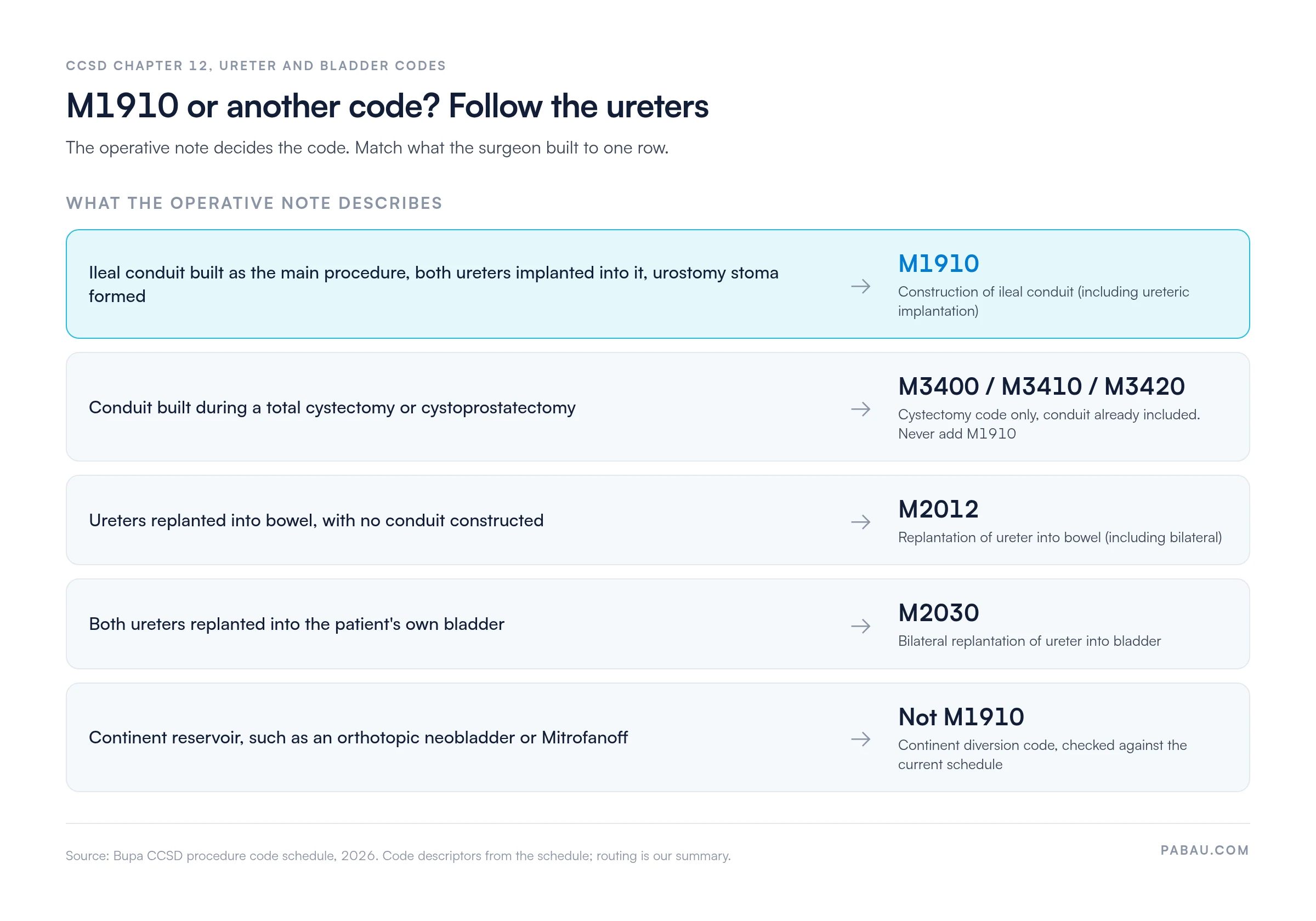
Our CCSD code library covers the neighbouring ureter codes in more depth. If the surgeon reimplants both ureters into the bladder instead, the page on M2030 sets out its documentation.
The clinical distinction between an ileal conduit and a neobladder maps directly onto different CCSD codes. Getting this wrong is the most common miscoding error in urinary diversion billing.
The operative report is the definitive guide to code selection. If it describes a continent reservoir anastomosed to the urethra, M1910 does not apply. Insurers will spot a continent diversion billed under M1910 on clinical review.
Every total cystectomy code on Bupa’s schedule includes the conduit. Open total cystectomy (M3400), robotic assisted cystectomy (M3410) and laparoscopic cystectomy (M3420) all read “with construction of intestinal conduit or bladder”. The cystoprostatectomy codes M3411 and M3412 carry the same wording.
Adding M1910 to one of those claims bills the conduit twice, so the insurer will query it as unbundling. Three checks keep the claim clean.
Pabau, the practice management platform we build, opens each claim pre-filled from the invoice. Its claims management software then validates the claim and flags missing details before it reaches Healthcode.
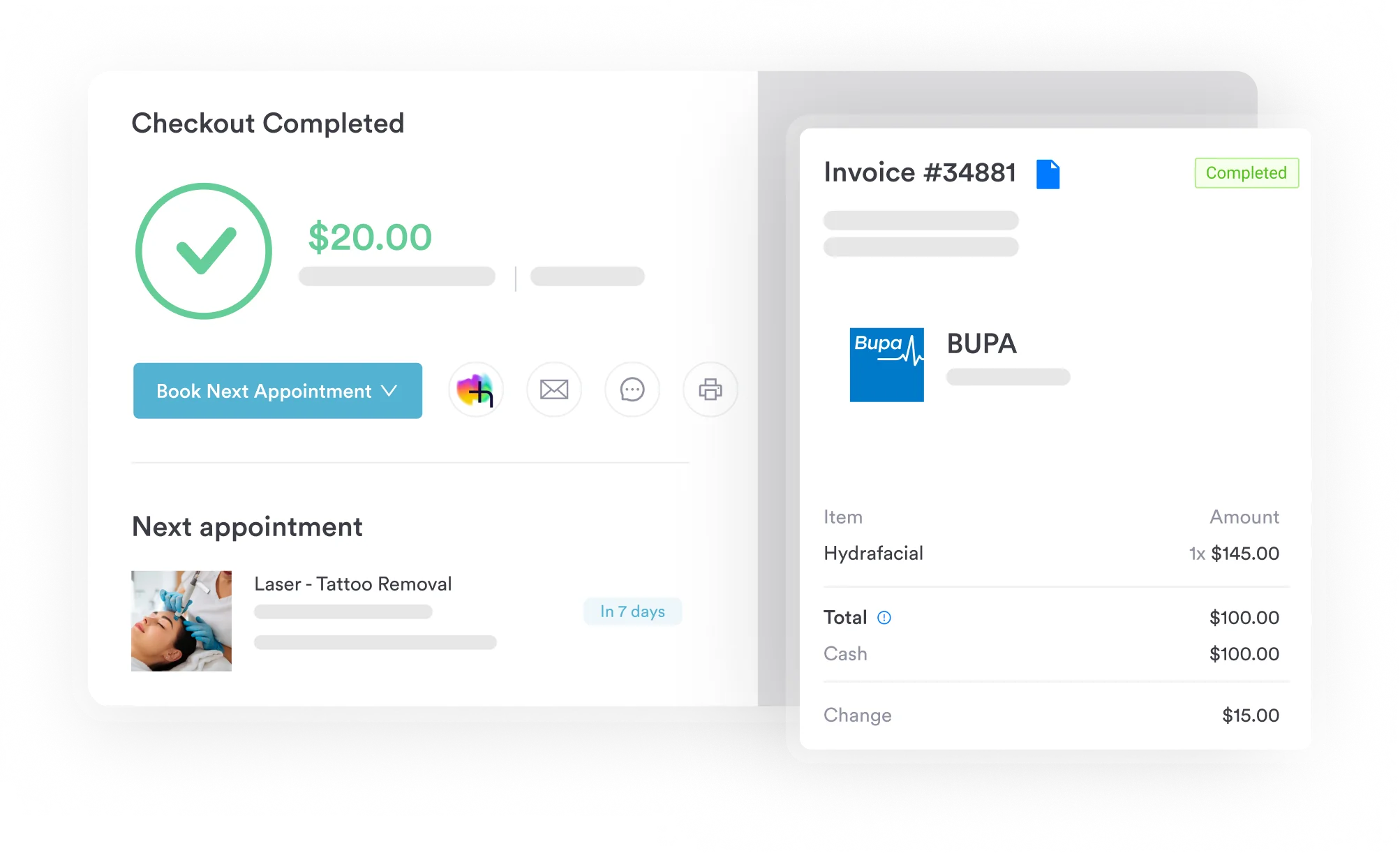
UK private insurers assess M1910 claims against the operative note. A well-structured report removes ambiguity and the most common grounds for a query or denial.
The operative note should include each of these items:
A digital operative note template with a field for each item keeps the note complete. It also makes the note quick to retrieve when an insurer asks for supporting records.
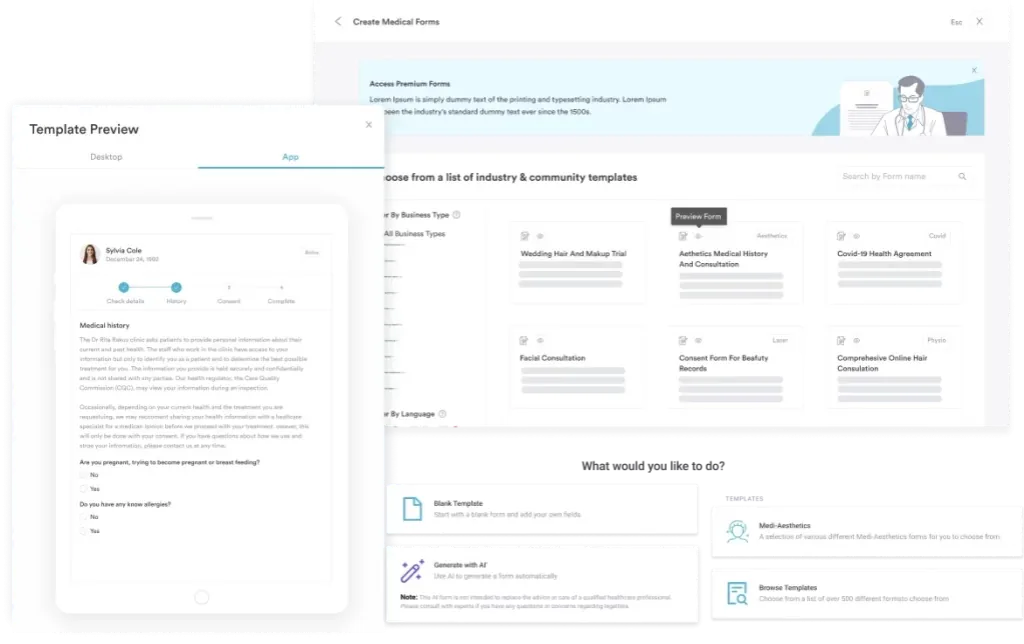
All major UK private medical insurers require preauthorisation before elective urological surgery of this complexity. Submit the request before the procedure, because retrospective requests are routinely declined or reviewed under stricter criteria.
The preauthorisation request should name the CCSD code you will bill and any planned companion codes. Add the consultant’s name and GMC number, the clinical indication with staging information, and the planned hospital and admission date.
Insurers may take 3-10 working days to authorise complex oncological cases, so factor this into surgical booking timelines.
Denials for M1910 cluster around four recurring issues. Each has a straightforward fix when caught before submission.
Keep authorisation references, operative notes and every submitted claim version together. An appeal needs all three, and assembling them after a denial costs days.
Run a monthly review of M1910 claim outcomes, split by insurer. If one payer produces most of the denials, check its bundling rules and claim form fields before you suspect the coding. Ask the insurer’s provider relations team for its M1910 claim requirements in writing.
In many urology practices, someone checks each M1910 claim by hand. They compare the authorisation letter, the operative note and the insurer’s schedule, often in three different places.
Pabau holds those pieces against one patient record. Each pre-authorisation is stored as a case and attached when the surgery is booked. The invoice is raised to the patient’s insurer at its contract rate, and the claim opens pre-filled from it.
Claim validation flags missing or invalid details before the claim goes to Healthcode, and the claims dashboard shows every claim that needs action. A missing authorisation reference gets fixed before Bupa can query it. For descriptors across the schedule, our guide to Bupa CCSD codes explains how it is structured.

Pabau stores each pre-authorisation, raises the claim from the invoice and validates it before it reaches Healthcode, so fewer M1910 claims come back.

Before you submit M1910, settle one question. Was the conduit the main procedure, or part of a total cystectomy? On Bupa’s schedule the cystectomy code already covers the conduit, so M1910 belongs only on standalone diversions.
Once the code is right, the remaining denial risks are paperwork. An authorisation that names the code you bill, and an operative note that records all four steps, remove the usual grounds for a query.
Book a demo to see how Pabau tracks pre-authorisations and validates CCSD claims before they reach Healthcode.

Coding a ureteroscopy in the same section? CCSD code M3000 sets out what the endoscopic examination of the ureter includes and what replaces it.
Need to tighten your claims submission process? Private healthcare claims management explains how Pabau structures and validates CCSD claims before they reach the insurer.
CCSD Code M1910 covers construction of an ileal conduit including bilateral ureteric implantation. That means isolating an ileal segment, joining both ureters to it, forming the urostomy stoma and re-joining the small bowel. Anaesthetist fees and post-operative stoma supplies are billed separately, and stenting depends on the insurer.
M1910 builds an ileal conduit, implants both ureters into it and brings it out as a urostomy stoma. M2012 covers replantation of the ureter into bowel, including bilateral, where no conduit is built. M2030 covers bilateral replantation of the ureter into the bladder, so urine still drains through the bladder.
Not on Bupa’s schedule. Its total cystectomy codes, such as M3400, M3410 and M3420, include construction of an intestinal conduit or bladder. Adding M1910 to one of those claims bills the conduit twice. Check each insurer’s own schedule, since descriptors can differ.
Yes. Urostomy stoma formation is integral to the construction of an ileal conduit and is included within M1910. Submitting it as a separate code alongside M1910 is likely to trigger a duplicate billing query from the insurer.
Four reasons come up again and again. The claim lacks a valid preauthorisation, or the operative note doesn’t confirm bilateral ureteric implantation. Or M1910 was used for a continent diversion, or added to a cystectomy code that already includes the conduit. The fourth is billing bundled steps, such as bowel anastomosis, as separate lines.
Yes. Bupa, AXA Health, Vitality, Aviva and WPA all require preauthorisation before ileal conduit construction. Submit the request before the procedure. It must name every planned CCSD code, the clinical indication and the operating consultant’s GMC number.