CPT Code 99465: Newborn resuscitation in the delivery room
CPT Code 99465: Definition and clinical description CPT Code 99465 is the AMA pr...

Last Updated: Nov 2, 2026
M2210 is the CCSD code for open correction of vesico-ureteric reflux on one side. It covers open reimplantation of a single ureter into the bladder, whichever open technique the surgeon uses, including Cohen, Politano-Leadbetter and Lich-Gregoir.
Open correction of both sides is coded M2280. Laparoscopic and robotic reimplantations fall outside M2210, and endoscopic anti-reflux injection is coded M2981. The code sits in Chapter 12 of the CCSD schedule, Urinary system and male reproductive organs.
Let Pabau's smart automation suggest the right codes, reduce claim denials, and keep your practice compliant—effortlessly.
Automate repetitive tasks and focus on what matters most—your patients.
Reduce coding errors and ensure compliance with the latest regulations.
Clean claims, fewer denials, and faster reimbursements.
Powerful insights and reporting to help your practice thrive.
HIPAA compliant SOC 2 certified GDPR-compliant Trusted by 4,000+ clinics worldwide

CCSD Code M2210 covers open correction of vesico-ureteric reflux on one side only, and bilateral open correction is coded M2280.
The code names no technique, so Cohen cross-trigonal, Politano-Leadbetter and Lich-Gregoir reimplantations all fall within M2210.
Laparoscopic and robotic reimplantations of one ureter are coded M2080 and M2090, and endoscopic anti-reflux injection is coded M2981.
Missing pre-authorisation and wrong laterality are the two most common reasons M2210 claims are denied.
Pabau, the practice management platform we build, keeps pre-authorisation references, operative notes and CCSD-coded claims in one patient record.
CCSD Code M2210 is the Clinical Coding and Schedule Development (CCSD) code for open correction of vesico-ureteric reflux on one side. It sits in Chapter 12 of the CCSD schedule, “Urinary system and male reproductive organs”. The code applies only when all three of these hold:
CCSD is the code set used for billing in UK private practice. Every major private medical insurer accepts CCSD codes, including Bupa, AXA Health, Aviva Health, VitalityHealth and WPA. NHS coding uses OPCS-4 instead, and CCSD claims are submitted through Healthcode, the UK private healthcare clearinghouse.
Open correction of unilateral vesico-ureteric reflux is a ureteric reimplantation. The surgeon detaches the affected ureter from the bladder wall and repositions it through a longer submucosal tunnel.
That tunnel stops urine flowing back from the bladder into the ureter and kidney. M2210 doesn’t name a surgical technique, so three main open approaches fall within its scope.
All three techniques build a submucosal tunnel long enough to act as a one-way valve. The operative note must state which technique was performed. Insurers use the note to confirm the approach was open rather than laparoscopic or endoscopic.
The surgical team usually includes the operating consultant urologist and an anaesthetist giving general anaesthesia. Some centres add an assistant surgeon. Each of those roles is billed separately, as the ancillary fees section below explains.
Open surgical correction of VUR is warranted when conservative management has failed or the reflux grade poses ongoing renal risk. UK private medical insurers (PMIs) follow NICE guidance (NG224) and British Association of Paediatric Urologists (BAPU) standards when assessing medical necessity for M2210 claims.
The voiding cystourethrogram (VCUG), also called a micturating cystourethrogram (MCUG), is the gold-standard investigation. It confirms both the grade of reflux and the side affected. The VCUG report goes in the pre-authorisation request and stays in the operative notes bundle.
Insurers reject claims where the grade is missing or falls below the threshold the payer applies for open surgery. At grade III, the strongest supporting evidence is breakthrough febrile urinary tract infections despite antibiotic prophylaxis. New renal scarring on a DMSA scan carries the same weight.
M2210 covers open correction of unilateral VUR, whether the approach is intravesical or extravesical, and whichever named technique the surgeon uses. Two facts from the operative note decide whether it applies, the approach and the side, as the grid below shows.
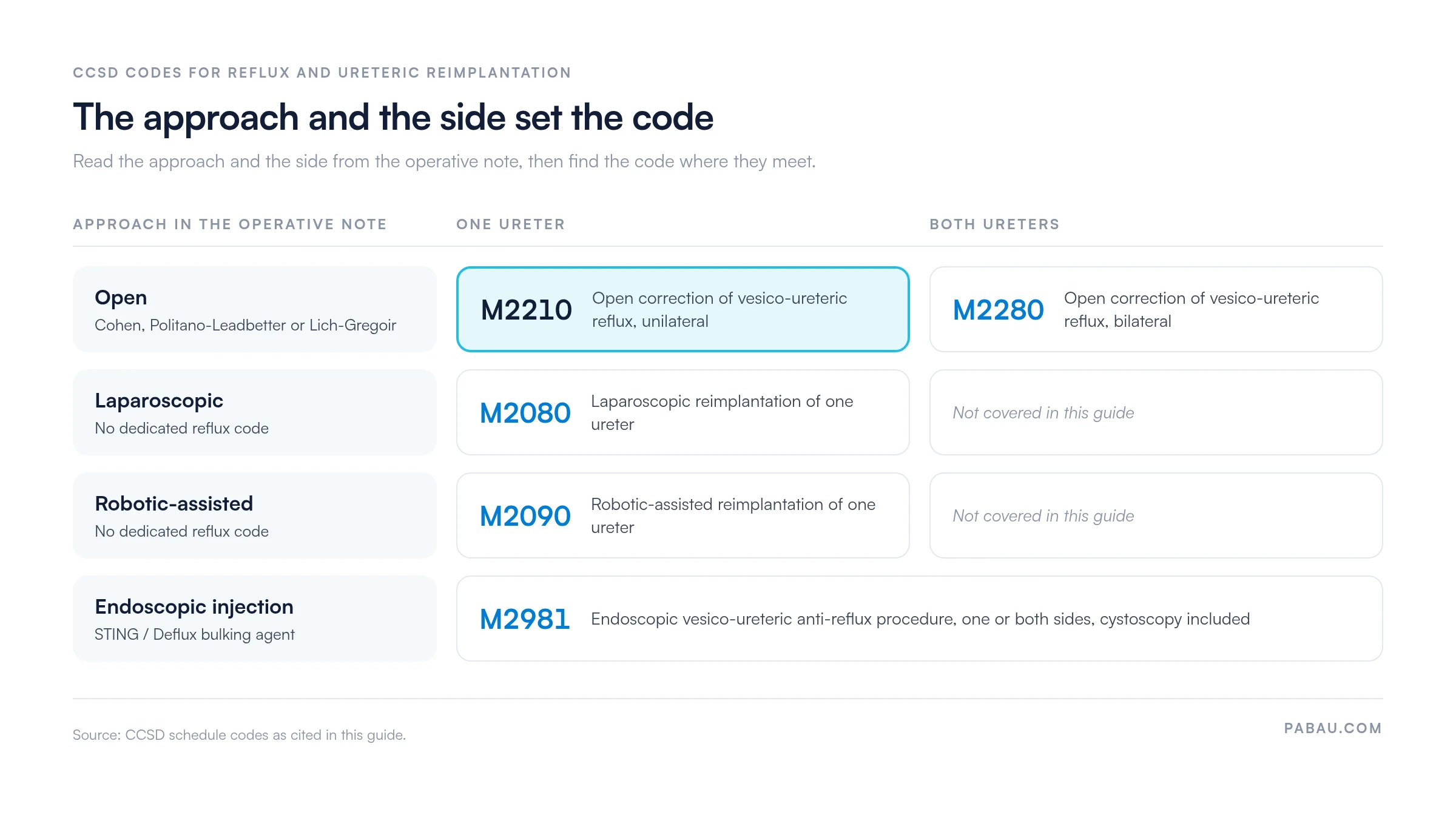
The laparoscopic exclusion is the most compliance-critical boundary. Billing a laparoscopic reimplantation under M2210, an open code, is a material billing error. Insurers check operative notes to verify the approach. A mismatch triggers an audit query at minimum, and repeat cases can lead to a fraud referral.
Coders in paediatric urology need a clear map of the codes around M2210. The table below covers the codes most often used alongside or instead of CCSD Code M2210.
Cystoscopy done only to gain access during the open reimplantation is generally treated as part of the operative approach. It shouldn’t be billed separately under M2210. Check payer-specific bundling rules before submitting a cystoscopy code alongside M2210 for the same session.
A clean M2210 claim needs documentation at three stages: pre-authorisation before surgery, the operative note during it, and follow-up imaging after it.
Claims management software that stores pre-auth references and operative notes in the same patient record sends the claim out with its evidence attached. The clinical forms behind each decision also need to be retrievable when the payer reviews the claim.
Document the affected side (left or right ureter) explicitly in both the operative note heading and the body of the note. Insurers match the laterality stated on the claim against what appears in the operative note. A note that reads ‘the refluxing ureter was reimplanted’ without naming the side creates an immediate query and delays payment.
All major UK PMIs require pre-authorisation before elective paediatric urological surgery. Pre-authorisation for M2210 isn’t automatic.
The payer reviews the clinical referral to confirm the procedure is medically necessary before the operation takes place. A claim without a valid pre-authorisation number is the fastest route to a flat denial.
Claims are submitted through Healthcode, the UK private healthcare clearinghouse. The Healthcode claim record must include these six items:
Bupa adds its own requirements for urological procedures, and Pabau’s Bupa CCSD code guide walks through them.
M2210 claims fail for a predictable set of reasons, and most denials are preventable with checks before submission. The table below maps each common denial trigger to its root cause and the action that prevents it.
Approach mismatch carries the highest compliance risk of the six. Billing an open code for a laparoscopic procedure misrepresents the operation performed. Insurers who spot a pattern of approach mismatches may refer the consultant to their recognised provider review process.
The consultant urologist’s M2210 fee covers the surgeon’s time only. Anaesthesia, surgical assistance and inpatient facilities are billed separately by their own providers. Knowing how insurers handle each fee prevents co-billing disputes and underpayment.
The anaesthetist and assistant surgeon often use different billing platforms from the consultant. Before any claim goes in, the consultant’s practice manager should confirm the whole team is quoting the same pre-authorisation reference.
The evidence for an M2210 claim usually lives in three places. The VCUG report sits in the imaging system, the authorisation number in an email, and the operative note in the hospital record. When an insurer queries the claim, someone has to rebuild that bundle by hand.
In Pabau, the pre-authorisation reference, clinical letters and operative note are stored against the patient record. The claim goes to Healthcode with its CCSD code and authorisation number drawn from that same record. So when Bupa or AXA Health asks for the operative note, your team can send it straight from the patient file.

Pabau keeps pre-auth references, operative notes and CCSD-coded claims in one patient record, so UK private consultants can submit through Healthcode with the evidence attached.

Coding M2210 correctly turns on two facts the surgeon already records: the approach and the side. Check both in the operative note before the code is chosen, and the most damaging denial, an approach mismatch, never reaches the payer.
Pre-authorisation is the other lever. Secure it before the operation is booked, with the VCUG grade and side stated, and share the reference with the anaesthetist and any assistant. A claim prepared this way rarely needs defending later.
Book a demo to see how Pabau keeps pre-authorisation, operative notes and CCSD claims together for UK private consultants.

Looking up another procedure? CCSD codes brings Pabau’s CCSD billing guides together in one library, organised by code.
Comparing billing systems for a UK private practice? Best medical billing software in the UK compares the options for practices that bill private medical insurers.
CCSD Code M2210 is the billing code for open correction of vesico-ureteric reflux on one side. It covers any open ureteric reimplantation technique (Cohen cross-trigonal, Politano-Leadbetter or Lich-Gregoir) on a single ureter. It does not cover bilateral correction, laparoscopic or robotic procedures, or endoscopic injection.
M2210 is a unilateral code only. Open correction of both ureters in the same operative session is coded M2280. A bilateral correction billed under M2210 misstates the procedure and will be queried when the payer reviews the operative note.
No dedicated laparoscopic reflux code exists in the CCSD schedule. Laparoscopic reimplantation of one ureter is coded M2080, and robotic-assisted reimplantation of one ureter is coded M2090. M2210 specifies an open approach, so the approach in the operative note and the code submitted must match.
Open surgical correction is typically indicated for grade IV or V reflux. Grade III can qualify when conservative management has failed, shown by breakthrough febrile UTIs or new renal scarring on a DMSA scan. UK PMIs generally follow NICE and BAPU guidance, and the VCUG report confirming grade and side goes with the pre-authorisation request.
Bupa, AXA Health, and Aviva Health all require pre-authorisation before elective paediatric urological surgery, including M2210 procedures. The pre-authorisation number must appear on the Healthcode claim submission. Claims submitted without a valid authorisation number are denied regardless of clinical merit.
Yes. The anaesthetist and assistant surgeon each submit separate CCSD-coded claims referencing the same pre-authorisation number as the surgeon’s M2210 claim. PMI policies on assistant surgeon reimbursement vary, so confirm entitlement during the pre-authorisation process rather than assuming it will be reimbursed automatically.