HCPCS Code J1558: Billing guide for Xembify immune globulin
HCPCS Code J1558: Definition, descriptor, and drug identity HCPCS Code J1558 is ...

Last Updated: Nov 3, 2026
M2160 is the CCSD code for reconstruction of transplant ureter, the surgical repair of the ureter that drains a transplanted kidney. It covers ureteroneocystostomy, Boari flap reconstruction and ureteroureterostomy when endoscopic or radiological treatment has not resolved the problem.
The code applies only to a renal allograft recipient. Surgery on the patient's native ureter takes a non-transplant ureter code instead. Major UK private insurers typically require pre-authorisation before the procedure.
Let Pabau's smart automation suggest the right codes, reduce claim denials, and keep your practice compliant—effortlessly.
Automate repetitive tasks and focus on what matters most—your patients.
Reduce coding errors and ensure compliance with the latest regulations.
Clean claims, fewer denials, and faster reimbursements.
Powerful insights and reporting to help your practice thrive.
HIPAA compliant SOC 2 certified GDPR-compliant Trusted by 4,000+ clinics worldwide

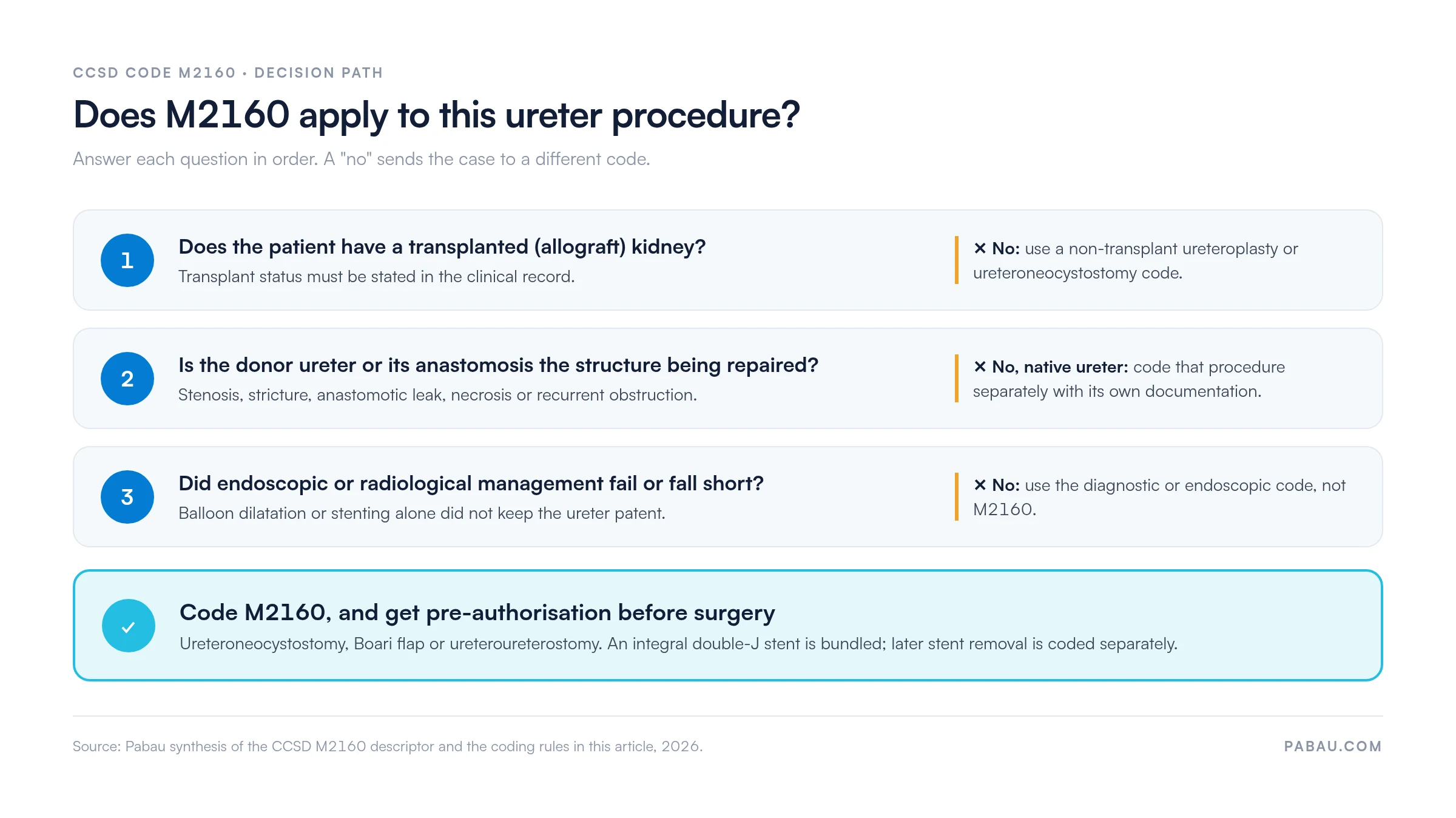
CCSD code M2160 covers reconstruction of transplant ureter and applies only when the patient has a transplanted (allograft) kidney, never to native ureteric repair.
Covered techniques include ureteroneocystostomy, Boari flap and direct ureteroureterostomy, and the operative note must name the technique used.
Major UK private insurers, including Bupa, AXA Health and Aviva, typically require pre-authorisation for M2160 before the procedure goes ahead.
Pabau’s claims management software keeps the CCSD code, the clinical note and the Healthcode claim together for UK private practice.
CCSD code M2160 is the billing code for reconstruction of transplant ureter. It belongs to the CCSD schedule, the standardised procedure code set used across UK private medical insurance. Within it, M2160 sits in Chapter 12, Urinary system and male reproductive organs, under the ureter sub-chapter.
The transplant context is part of the code’s definition, which is what separates M2160 from its neighbours. Our CCSD code library lists the other codes in that chapter.
The code applies when a consultant surgeon performs open (or minimally invasive) surgical reconstruction of the ureter serving a transplanted kidney. It does not apply to procedures on the patient’s native, non-transplanted ureter, even during the same operative episode. Payers verify transplant status through the clinical record before settling M2160 claims.
Reconstruction of transplant ureter addresses structural failure of the ureteric anastomosis or the donor ureter itself after renal transplantation.
The transplanted ureter is typically shorter than a native ureter and depends on a more tenuous blood supply. It is also exposed to the immunological stresses of the transplant environment. These factors make it vulnerable to complications that may need surgical reconstruction.
The procedure is performed under general anaesthesia in an operating theatre equipped for urological and transplant surgery. The operative approach varies with the site and extent of ureteric pathology, but all accepted techniques fall within M2160’s scope.
The Lich-Gregoir extravesical technique is widely favoured for ureteroneocystostomy in transplant patients. It avoids opening the bladder, which reduces operative time and infection risk. A double-J ureteric stent is routinely placed at reconstruction and removed endoscopically at a later date. Stent placement integral to the reconstruction is part of M2160 and is not billed separately.
M2160 is indicated when post-transplant ureteric pathology cannot be managed by endoscopic or radiological means alone and needs surgical reconstruction, open or minimally invasive. Common clinical scenarios include the following.
The indication must be documented in the clinical record and operative note. Coders should confirm that the clinical picture supports M2160 rather than a diagnostic or endoscopic code. If the consultant tries endoscopic management first and converts to surgical reconstruction in the same session, M2160 covers the reconstructive component.
Understanding the bundling rules for M2160 prevents both under-coding and claim rejections from unbundling violations. The CCSD technical guide sets the framework. Verify current bundling rules with the treating insurer before submission, as individual payer schedules may differ.
The most common coding error with M2160 is using a non-transplant ureteroplasty or ureteroneocystostomy code for a patient who has received a kidney transplant. The CCSD schedule treats the transplant context as a distinct clinical entity. Operating on a transplanted organ brings its own complexity, specialist setting and risk profile.
If a transplant patient also has work on their native ureter in the same session, each distinct procedure is coded separately. The documentation has to justify both codes. A native-ureter reimplantation takes a non-transplant code instead, such as M2030 for bilateral replantation into the bladder.
Three questions settle whether a case belongs under M2160, and each “no” points to a different code.
UK private insurers will not settle M2160 without a complete operative note that demonstrates the transplant context, the clinical indication, and the technique employed. Incomplete documentation is a common cause of first-pass claim failure for this code.
The operative note must contain all of the following elements.
Pre-operative imaging reports (ultrasound, CT urogram, or nuclear renogram demonstrating obstruction or leak) should be appended to the claim or referenced in the operative note. They corroborate medical necessity and accelerate payer adjudication.
Document the transplant date and referring nephrologist in the operative note header. Insurer case handlers use these details to cross-reference the patient’s transplant episode when validating M2160 claims. Including them upfront avoids a common back-and-forth query that delays settlement.
Reconstruction of transplant ureter is a high-cost, specialist surgical intervention. Major UK private insurers typically require pre-authorisation before it is performed. Operating without pre-authorisation creates a significant risk of non-payment, regardless of the clinical urgency.
Sometimes an urgent case cannot wait for pre-authorisation. Notify the insurer as soon as practicable after surgery, and document the clinical urgency in the operative note. Most insurers have a retrospective approval pathway for genuine emergencies, but this must be initiated promptly.
Several codes are commonly billed alongside M2160 or considered as alternatives when the clinical picture does not meet the M2160 threshold. Our guide to Bupa CCSD codes covers insurer-specific rules on code submission and bundling.
M2160 claims fail at a higher rate than routine urology codes because payers apply heightened scrutiny to transplant-related procedures. Understanding the most frequent rejection triggers helps practice administrators catch problems before submission rather than after. A pre-submission review stage in the billing workflow lets the team check each trigger below before the claim goes out.
When a claim is rejected, request the denial reason in writing before resubmitting. Correcting the specific identified deficiency and resubmitting with a covering letter referencing the insurer’s stated reason gives the best chance of reversal at first appeal.
Private urology and transplant practices billing M2160 alongside a mixed-payer caseload need pre-authorisation status, operative notes and claim submission in one place. Pabau, the practice management platform we build, links the CCSD code, the clinical note and the claim from the point of documentation. Its claims management software then sends the claim to UK insurers through Healthcode.
The practice team can keep pre-authorisation status and notes alongside the patient episode, which lowers the risk of surgery going ahead without valid approval. Digital clinical forms let consultants write operative notes in a structured format. That format captures the fields insurers expect for M2160: transplant history, intraoperative findings, technique and materials.

For practices billing several UK private insurers, submitting and tracking claims without switching between insurer portals cuts administrative time per episode. Pabau does not automate insurer approval decisions. It supports the tracking and documentation that produce a clean, complete first-pass submission.
To see how Pabau supports CCSD billing workflows for UK private practice, book a demo.

Pabau keeps CCSD codes, operative notes and pre-authorisation status on the patient record, then submits the claim through Healthcode. Fewer M2160 claims come back for missing detail.

Treat M2160 as a decision made when the surgery is planned, before the theatre date is set. Confirm the patient’s allograft status, secure pre-authorisation and agree the likely technique with the consultant at that point.
Then hold the operative note to the insurer’s standard on the day. A note that names the technique and the intraoperative findings leaves the case handler little to query. The trade-off is a few minutes of structured documentation against a rejected claim and a formal appeal.
Book a demo to see how Pabau keeps CCSD codes, operative notes and pre-authorisation status together for your urology or transplant practice.

Need guidance on Bupa’s CCSD code requirements? Bupa CCSD codes guide covers how Bupa maps CCSD codes to fee schedules and what the provider portal requires for claim submission.
Want to reduce claim rejection across your private practice? Claims management software shows how Pabau keeps CCSD codes, clinical notes and Healthcode submission in one workflow.
Coding ureter reimplantation for a patient with native kidneys? CCSD code M2030 covers bilateral replantation of the ureter into the bladder, the non-transplant counterpart to M2160.
CCSD code M2160 covers surgical reconstruction of the ureter serving a transplanted kidney. That includes ureteroneocystostomy (with or without a Boari flap), direct ureteroureterostomy, and any stent placement integral to the reconstruction. It applies only where the patient has a renal allograft and does not cover native ureteric pathology.
The difference is the transplant context. M2160 is specific to reconstruction of the donor ureter in a renal allograft recipient. Standard ureteroneocystostomy codes in CCSD Chapter 12 apply to patients with native kidneys. Using a non-transplant code for a transplant patient is a coding error that triggers denials.
Yes, in most cases. Major UK private insurers, including Bupa, AXA Health and Aviva, typically require pre-authorisation for M2160 given the procedure’s complexity and cost. Requirements vary by insurer and policy year, so verify them on the insurer’s provider portal before the procedure.
Four reasons lead the list. Either no pre-authorisation was obtained before surgery, or the clinical record does not confirm renal transplant status. Otherwise, a non-transplant code was submitted, or the operative note lacks detail on technique, findings or materials. A pre-submission documentation review catches each of these before the claim is raised.
A double-J stent placed during the reconstruction is integral to M2160 and is not billed separately. Endoscopic stent removal happens later, in a separate session after the transplant ureter has healed. It is coded at that time, using the appropriate CCSD cystoscopy or stent removal code.