CPT Code 25210: Excision of a single carpal bone
CPT Code 25210: Official descriptor and quick-reference data CPT Code 25210 is a...

Last Updated: Nov 26, 2026
M2200 is the CCSD code for ureterostomy – closure, the operation that takes down a ureterostomy stoma. UK private medical insurers use CCSD codes to identify the procedure on pre-authorization requests and invoices.
Let Pabau's smart automation suggest the right codes, reduce claim denials, and keep your practice compliant—effortlessly.
Automate repetitive tasks and focus on what matters most—your patients.
Reduce coding errors and ensure compliance with the latest regulations.
Clean claims, fewer denials, and faster reimbursements.
Powerful insights and reporting to help your practice thrive.
HIPAA compliant SOC 2 certified GDPR-compliant Trusted by 4,000+ clinics worldwide

CCSD code M2200 covers ureterostomy closure, the operation that takes down a ureterostomy stoma and restores urine flow through the ureter.
CCSD is the UK schedule of procedure codes used by private medical insurers such as Bupa, AXA Health, Aviva and Vitality.
Every M2200 invoice needs a WHO ICD-10 diagnosis code, not a US ICD-10-CM code, and Z43.6 covers the closure encounter.
Insurers expect pre-authorization before a planned closure, and each insurer sets its own fee for the code.
Pabau, a practice management platform, records the authorization reference against the case and sends UK insurer claims through Healthcode and Bupa.
CCSD code M2200 covers the surgical closure of a ureterostomy, described in the schedule as “Ureterostomy – closure.” The Clinical Coding and Schedule Development Group publishes the CCSD Schedules, the standard procedure codes for UK private healthcare. Private medical insurers use them to identify treatment on pre-authorizations and invoices.
M2200 sits in the urinary tract section of the schedule, alongside other codes for surgery on the ureter. Our CCSD codes guide explains how the schedule is organized and where to look up each code.
The official descriptor names the closure only. Insurers generally expect these operative steps within the M2200 fee:
Confirm bundling rules with the insurer before you bill any of these steps separately. The table below shows how insurers generally treat each part of the operation.
A ureterostomy is a surgical opening that diverts urine from the ureter to the skin surface, bypassing the bladder. Surgeons create one when bladder function is compromised, to protect a ureteral anastomosis during healing, or as a temporary measure after trauma or malignancy. Closure becomes appropriate once the original indication has resolved and the ureter and bladder are ready to work together again.
The closure typically runs through four operative phases:
If the closure was done laparoscopically, check the current CCSD schedule for a separate laparoscopic code before you invoice M2200. Then confirm the fee with the insurer, since each insurer prices codes in its own schedule.
M2200 is one of several CCSD codes for ureteral and urinary diversion surgery. Picking the wrong one is an easy error here, partly because the descriptors for formation and closure procedures are worded alike. Check the operative report against these distinctions first:
Look up the exact code for each of these in the current CCSD schedule, which requires a CCSD login. The operative report is the deciding document, so confirm the procedure performed against the descriptor before coding. Was a cystoscopy or nephrostomy procedure done on the same date? Check the insurer’s rules for multiple procedures in one session before you send the invoice.
When you plan more than one procedure in the same session, ask the insurer whether one authorization covers every code. Bupa, AXA Health, Aviva and Vitality each set their own rules. Get the authorized codes in writing before the procedure date to avoid disputes after the claim.
Every M2200 invoice to a UK private medical insurer needs at least one diagnosis code. UK insurers use the WHO ICD-10 classification, not the US ICD-10-CM edition. The WHO ICD-10 browser is the reference standard for ICD-10 structure and hierarchy. For M2200, the principal diagnosis should reflect the reason for the original ureterostomy or the closure encounter itself.
Sequence the principal diagnosis as the condition chiefly responsible for the admission or encounter. Z43.6 leads when the closure is the primary reason for the encounter and the original pathology is resolved or in remission. If the underlying condition (malignancy, obstruction, trauma) remains active, sequence that condition first and add Z43.6 as a secondary code. The whole decision turns on one question, mapped below.
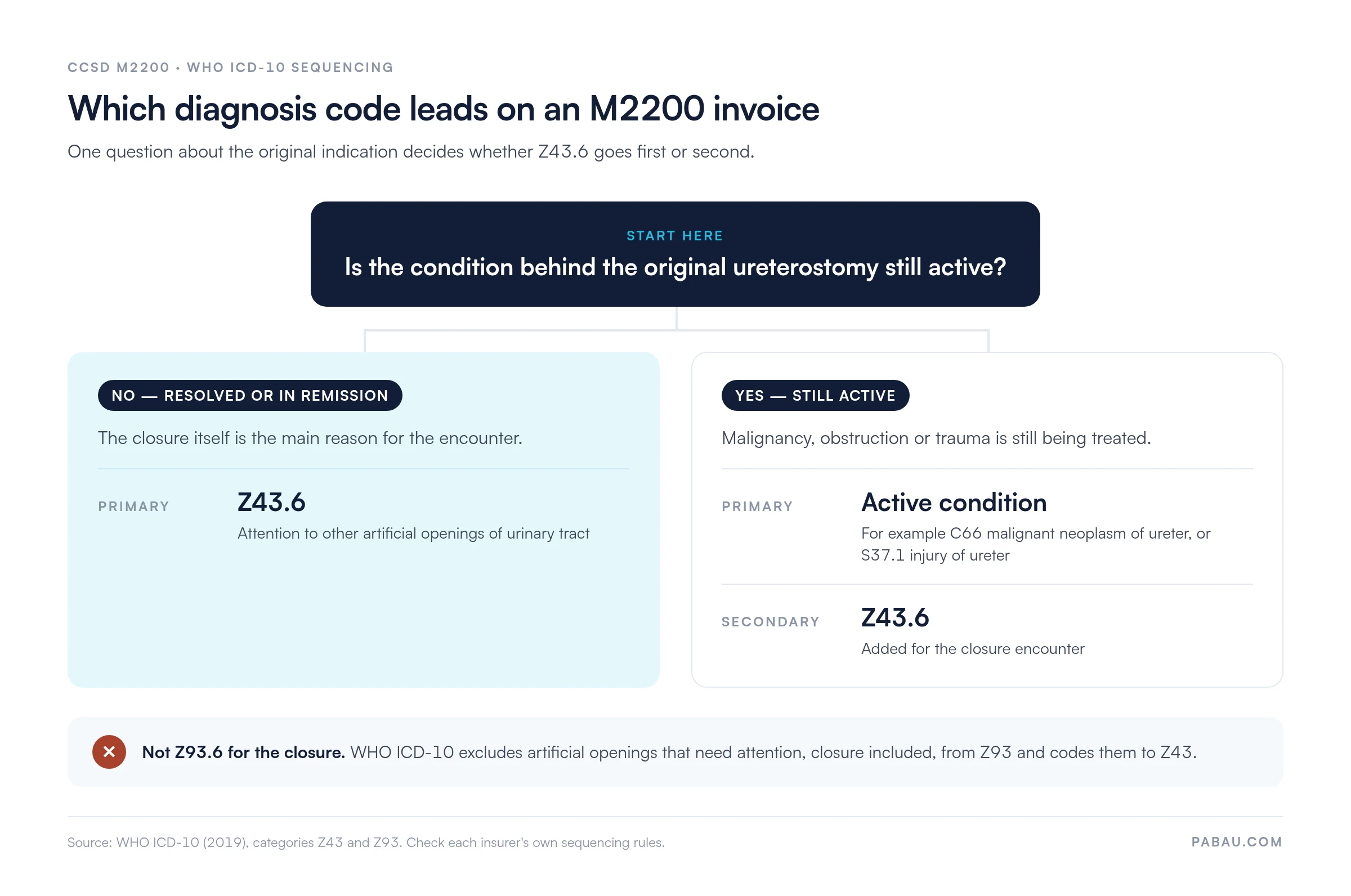
Z93.6, the status code for other artificial openings of the urinary tract, does not belong on the closure invoice. WHO ICD-10 excludes artificial openings that need attention or management from Z93 and codes them to Z43 instead. Some insurers also have their own sequencing rules, so check their billing guidance before you send the invoice. The same Z43 rule covers bowel stomas, so an ileostomy closure billed under G7530 pairs with Z43.2, attention to ileostomy.
UK private medical insurers assess an M2200 claim on three documents: the operative report, the pre-authorization, and the invoice. A missing or inconsistent detail in any one of them commonly triggers a query or a rejection.
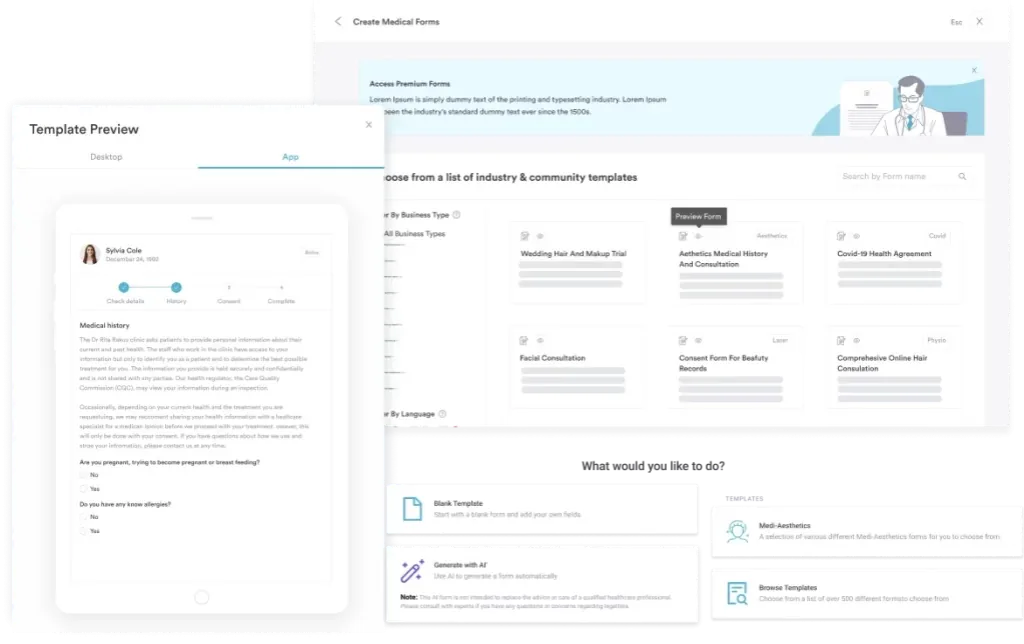
The operative report must include the original indication for the ureterostomy and the approach used, open or laparoscopic. It should also record the relevant findings, the re-anastomosis or reimplantation technique, and confirmation of wound closure. Vague or templated reports that do not confirm the specific steps performed give the insurer grounds to query the claim. Digital forms for operative documentation help practices capture these elements consistently at the point of dictation.
Alongside the operative report, insurers check the following before they pay:
CCSD sets the codes, and each insurer sets its own fees against them. Bupa, AXA Health, Aviva and Vitality each publish separate fee schedules and benefit limits, in pounds sterling. The same M2200 closure can therefore pay a different amount from one insurer to the next. Our overview of Bupa CCSD codes shows how codes match one insurer’s fee schedule.
Insurers also set their own rules when more than one procedure is done in the same session. Check the current schedule before you quote the patient. If the consultant charges more than the insurer pays, explain the shortfall to the patient in writing first.
CCSD does not use modifier codes in the same way as CPT. Supporting notes go to the insurer with the authorization request or the invoice. If both ureterostomies are closed in one operation, the operative report must say so clearly. Contact the insurer before you invoice to confirm how it pays for a bilateral closure.
The anesthetist invoices the insurer separately from the surgeon. Insurers generally set an anesthetic fee against the same CCSD procedure code, so check the anesthetist’s fee in the insurer’s schedule. The insurer links the two invoices by patient and date, and the surgeon’s M2200 invoice carries no anesthetic charge.
When M2200 is performed with a cystoscopy, get written confirmation from the insurer that both codes are authorized before the procedure. An insurer may authorize M2200 but decline the cystoscopy unless a separate reason for it is documented in the operative report and the authorization request.
Rejections for CCSD code M2200 follow predictable patterns. Knowing them in advance lets billing teams build prevention into the submission workflow rather than resolving rejections after the fact. Good medical billing compliance processes catch most of these before they reach the insurer.
When a claim is rejected, ask the insurer for the reason in writing. The exact reason tells you which document or code to correct, so you never resubmit the same invoice unchanged. If the claim is declined on clinical grounds, escalate with a formal appeal. Include supporting clinical notes and a letter from the treating urologist.
Urology billing teams invoicing M2200 repeat three tasks on every case: tracking pre-authorization, choosing the right ICD-10 code, and sending invoices to several insurers. Each one done by hand adds time to the revenue cycle and raises the risk of a preventable rejection.
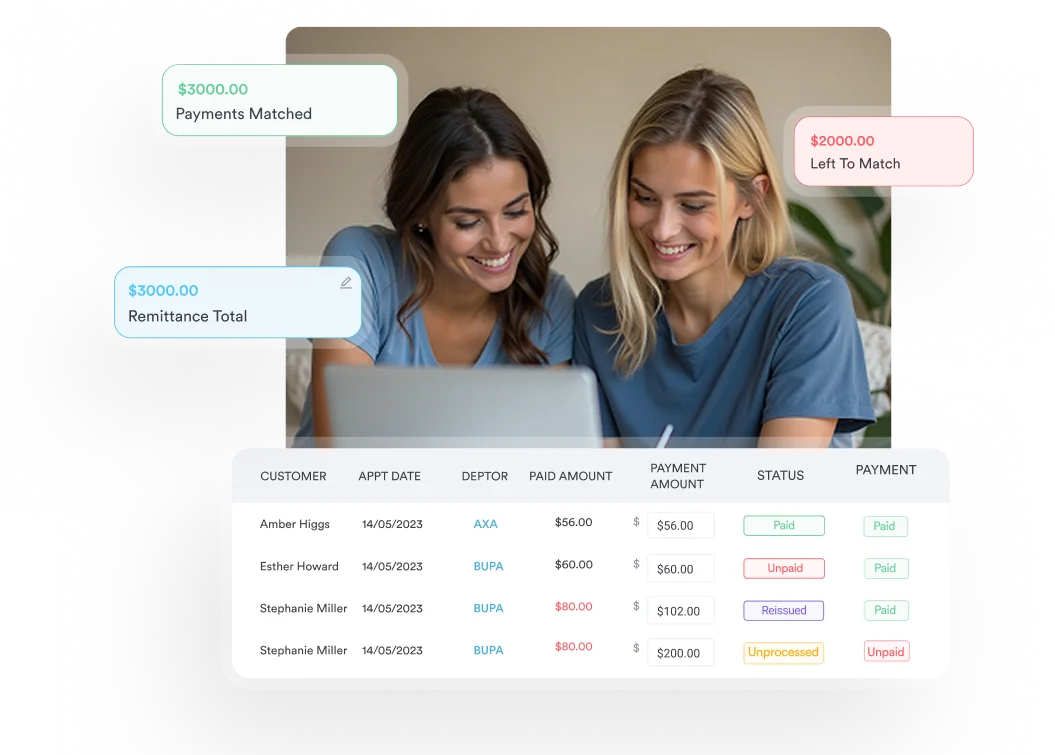
In Pabau’s claims software for urologists, billing staff can record the authorization reference against the case before the procedure date. Pabau warns the team when a case has no authorization, so the claim is complete before it leaves the practice. Claims then go to UK insurers electronically through Healthcode and Bupa.
Pabau’s digital forms also let the practice build an operative note template. Every M2200 report then records the approach, the reconstruction technique and the wound closure in the same order, which is the detail insurers query most.

Pabau helps urology practices record authorization references against each case. Insurer claims then go out through Healthcode and Bupa.

M2200 itself is rarely the hard part, since one descriptor covers the closure. Rejections come from the paperwork around it: an authorization that does not match the invoice, or a diagnosis sequenced the wrong way round.
So settle those details on the case before surgery. Confirm the authorization, decide whether Z43.6 leads or follows, and agree the operative note template with the surgeon. A practice that does this on every case spends its billing time on new claims instead of appeals.
Book a demo to see how Pabau tracks authorizations and sends CCSD claims through Healthcode for UK urology practices.

Looking for a broader CCSD billing reference? Bupa CCSD codes overview explains how the CCSD schedule works and how codes match insurer fee schedules.
Looking up another CCSD code? The CCSD codes guide explains how the UK schedule is organized and where to find each code.
Billing a reimplantation with no stoma to close? CCSD code M2080 covers unilateral replantation of the ureter.
Correcting reflux on one side? CCSD code M2210 covers open correction of unilateral vesicoureteric reflux.
Comparing billing platforms for a UK private practice? The best medical billing software in the UK reviews the leading options for insurer invoicing.
CCSD code M2200 is the code UK private medical insurers use for ureterostomy closure. Insurers generally expect ureteral mobilization, stoma excision, re-anastomosis or reimplantation, and wound closure within the M2200 fee. Confirm bundling rules with the insurer.
Z43.6 (Attention to other artificial openings of urinary tract) is a common primary code for the closure encounter. When the original indication is still active, that condition’s code is sequenced as primary instead. Examples are C65 for renal pelvis malignancy or S37.1 for ureteral injury, with Z43.6 added as a secondary code.
Common reasons are missing or expired pre-authorization and an ICD-10 code that does not justify the closure. Others are unbundling component steps and an operative report that lacks detail about the closure technique. Each of these is preventable with a check before the invoice goes to the insurer.
No. The anesthetist invoices the insurer separately, and insurers set their own anesthetic fee for the procedure. The insurer links the two invoices by patient and date, so the surgeon’s M2200 invoice carries no anesthetic charge.
Ureterostomy formation creates a stoma that diverts the ureter to the skin. Ureterostomy closure (M2200) takes that stoma down and restores normal ureteral continuity. They are opposite procedures with different CCSD codes. Using the formation code for a closure is a coding error that insurers can pick up on clinical review.
Four common errors are unbundling component steps, using the formation code instead of M2200, missing a valid ICD-10 code, and invoicing without pre-authorization. A structured pre-submission checklist reviewed against the operative report catches all four before the claim leaves the practice.