HCPCS Code E0272: Foam rubber mattress billing guide
HCPCS Code E0272: official descriptor and code overview HCPCS Code E0272 is the ...

Last Updated: Nov 6, 2026
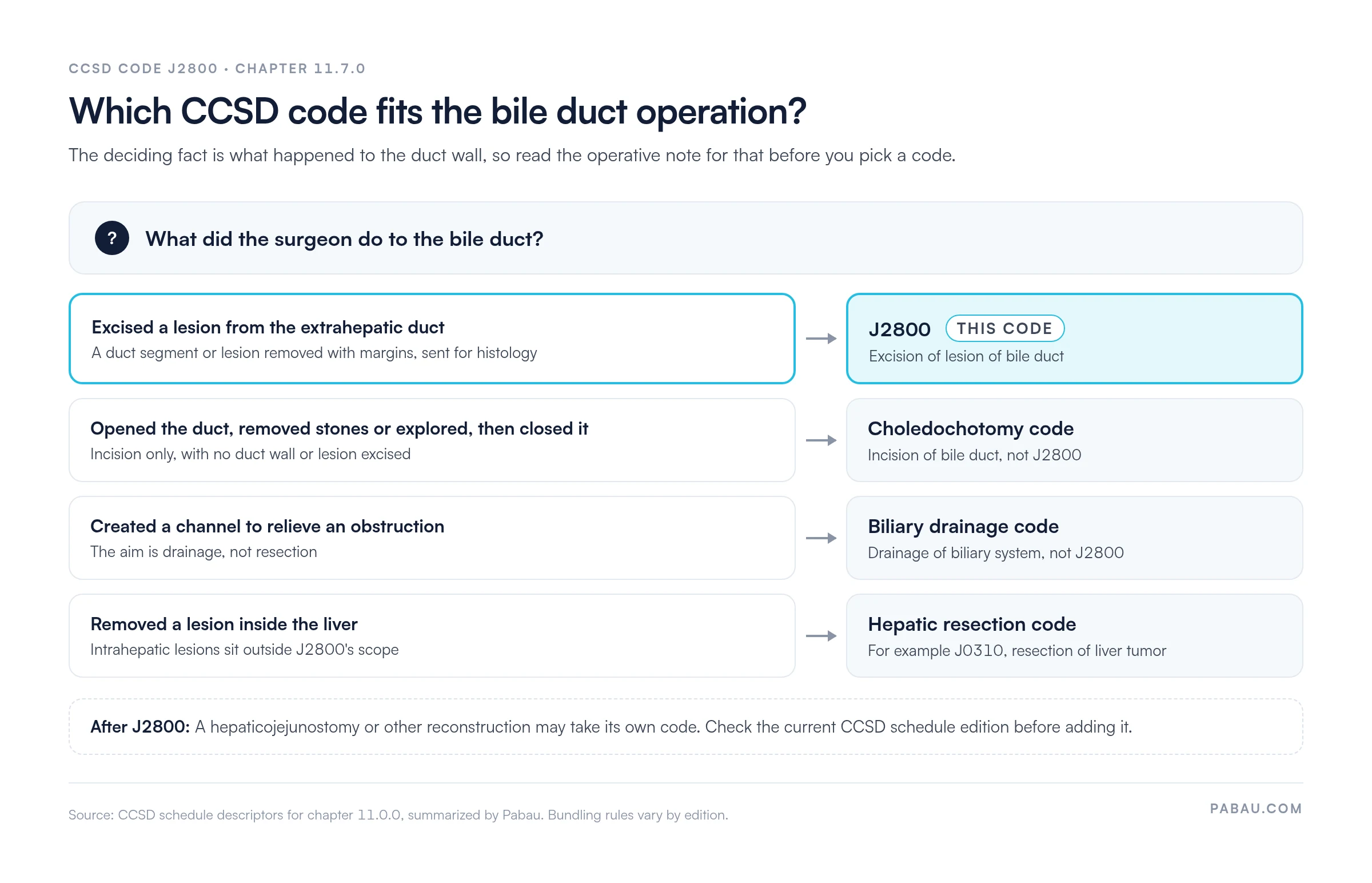
J2800 is the CCSD code for excision of lesion of bile duct. It covers surgical removal of a lesion from the extrahepatic bile duct, with the affected segment resected to clear margins. The scope includes the common bile duct, common hepatic duct and cystic duct.
J2800 sits in CCSD chapter 11.0.0 Abdomen, under 11.7.0 Other Organs (Mainly Digestive). It applies only when tissue is excised. An incision to remove stones is a choledochotomy, and an intrahepatic lesion takes a hepatic resection code.
Let Pabau's smart automation suggest the right codes, reduce claim denials, and keep your practice compliant—effortlessly.
Automate repetitive tasks and focus on what matters most—your patients.
Reduce coding errors and ensure compliance with the latest regulations.
Clean claims, fewer denials, and faster reimbursements.
Powerful insights and reporting to help your practice thrive.
HIPAA compliant SOC 2 certified GDPR-compliant Trusted by 4,000+ clinics worldwide

CCSD code J2800 covers surgical excision of a lesion from the extrahepatic bile duct, which sets it apart from incision (choledochotomy) and drainage procedures.
Common indications include cholangiocarcinoma, choledochal cyst, benign polypoid lesions and iatrogenic biliary strictures that need resection.
Major UK private insurers require pre-authorization before J2800, and a claim without a valid reference is the most common reason for denial.
Pabau, the practice management platform we build, supports CCSD billing with pre-authorization reference capture and Healthcode claim submission.
CCSD code J2800 is defined in the CCSD official schedule as “Excision of lesion of bile duct.” The code sits in the Abdomen chapter of the schedule, under 11.7.0 Other Organs (Mainly Digestive). Open distal pancreatectomy, CCSD code J5700, sits in the same sub-chapter.
UK private health insurers use the CCSD schedule for procedure coding, and claims reach them through the Healthcode billing network. The neighboring hepatobiliary codes sit in the same section of our CCSD codes library.
The procedure involves surgical access to the extrahepatic biliary tree and isolation of the lesion on or within the duct wall. The surgeon resects it with adequate margins and assesses the result intraoperatively. The scope covers the common bile duct, common hepatic duct and cystic duct. Intrahepatic lesions fall outside it and take hepatic resection codes such as J0310.
J2800 describes the excision itself. Associated procedures in the same operative episode, such as hepaticojejunostomy for biliary reconstruction, follow separate coding rules, covered in the adjacent-codes section.
Bile duct lesion excision is performed when a lesion on the extrahepatic bile duct cannot be managed endoscopically or percutaneously. Endoscopic management at ERCP, such as biliary stent insertion, is billed under CCSD code J3900. It is also the route when the lesion needs histological resection margins. Four categories of diagnosis most commonly support a J2800 claim.
Insurers cross-reference the procedure code against the diagnosis to validate clinical necessity. Pairing J2800 with a non-operative diagnosis is a common and avoidable denial trigger.
The operative approach varies by lesion site, extent and surgeon preference, but the core steps are consistent. The operative note must capture each step clearly. Payers use it to confirm that J2800 was performed rather than a lesser procedure.
Section 11.7.0 of the Abdomen chapter contains several codes for related but distinct procedures. Coders most often confuse J2800 with choledochotomy (incision only) and with biliary drainage procedures. The table shows which code applies when.
The critical distinction between J2800 and choledochotomy is what happens to the duct wall. If the surgeon incises the duct, extracts stones and closes it again, that is a choledochotomy, and J2800 does not apply. If the surgeon excises a segment of duct bearing a lesion, J2800 is correct.
Billing J2800 for an incision-only exploration is a miscoding error that payers audit, and it can trigger recovery action.
Each branch of that choice starts from the same question about the duct.
The procedures below are typically separately billable alongside J2800. Bundling rules change between CCSD schedule editions, so verify each one against the current edition before submission.
Do not add ancillary codes to a J2800 claim on the assumption that they are separately billable. Billing separately for components the schedule bundles within J2800 is a frequent denial and audit trigger across major UK private payers. A duct-to-duct repair, for instance, may suggest J3000 for the anastomosis, but confirm the schedule does not bundle it first.
Before submitting any ancillary code alongside J2800, check the CCSD technical guide for the current schedule edition. Bundling rules are edition-specific and change annually. When in doubt, ask the insurer’s provider liaison team for written guidance before the claim goes out. A written steer protects the practice if the claim is later queried.
A J2800 claim will not pay without supporting documentation. UK private insurers routinely review documentation for major surgical claims. A vague operative note and a missing pre-authorization reference are the two most common reasons for delay or denial. Each document below has its own content and timing requirements.
The operative note is the most scrutinized document. It must state plainly that a lesion was excised from the bile duct, not merely incised, drained or biopsied. Where the note is vague about whether tissue was removed, insurers often downcode the claim to a lesser procedure. Some ask for a written consultant explanation instead, and either response delays payment.
Major UK private insurers treat J2800 as a major surgical procedure that needs pre-authorization before the operative date. Without a valid authorization reference, the claim is denied regardless of documentation quality. The Bupa CCSD billing guide covers Bupa’s requirements in detail. The table summarizes the key pre-authorization requirements across the four main UK private insurers.
Each insurer updates its pre-authorization requirements independently, and they may change between policy years. Check the current requirements in each insurer’s provider manual before the procedure date. If an emergency prevented pre-authorization, contact the insurer immediately after the procedure. Most have a retrospective authorization process, though approval is not guaranteed.
J2800 claim denials follow predictable patterns. Knowing the frequent causes lets the billing team fix them before submission and build a targeted appeal when a claim comes back.
Submit every appeal in writing to the insurer’s clinical review team rather than the standard claims department. Include the original claim reference, the specific denial reason and the supporting clinical documentation. State the basis for the appeal clearly, and keep copies of all correspondence.
Run a five-point check before every J2800 claim leaves the practice. Confirm the pre-authorization reference, and that the signed operative note describes an excision. Attach the pathology report, cross-check the ICD-10 code against the operative finding, and verify ancillary codes against the current CCSD schedule. The check takes about ten minutes, while a denial appeal can take weeks.
When the pre-authorization reference sits in an email and the operative note in the hospital system, the billing team rebuilds each J2800 claim by hand. That is where a reference goes missing or the code drifts away from the note.
Pabau’s claims management software keeps those pieces on the patient’s episode instead. Whichever system you use for hepatobiliary billing, it should handle each step of the J2800 workflow in one place:
Pabau covers that sequence with CCSD code selection, authorization reference capture, Healthcode submission and claim tracking. The result is a J2800 claim that matches the operative note and carries its authorization reference on the first submission.

Pabau supports UK private practice billing, including CCSD code capture, pre-authorization reference linking and Healthcode submission. See how it works for hepatobiliary practices.

J2800 pays when the operative note shows a lesion excised from the extrahepatic duct. It fails when the same note reads like an exploration, however complex the operation was.
So read the note for that one fact before you submit. Then confirm the pre-authorization reference matches the procedure performed. Hold any ancillary code until the current schedule edition confirms it is not bundled.
Those checks take minutes, and an appeal takes weeks. Book a demo to see how Pabau keeps the CCSD code, authorization reference and operative note together for every hepatobiliary claim.

Billing other procedures for Bupa patients? Bupa CCSD billing guide covers the full range of Bupa CCSD procedure codes and fee schedule guidance for UK private practitioners.
Need a view of how fees are set? Bupa procedure codes fee schedule explains how Bupa fees are structured across CCSD surgical chapters.
Reconstructing the duct after excision? CCSD code J3000 covers anastomosis of the common bile duct and how to bill it.
Billing gallbladder surgery too? CCSD code J1830 explains coding and documentation for laparoscopic cholecystectomy.
Working up a liver lesion before surgery? CCSD code J1300 covers percutaneous biopsy of a liver lesion.
CCSD code J2800 is the UK private healthcare procedure code for excision of lesion of bile duct. It covers surgical removal of a lesion from the extrahepatic biliary system. It sits in the Abdomen chapter, under 11.7.0 Other Organs (Mainly Digestive). Major UK private insurers use it, including Bupa, AXA Health, Aviva and Vitality.
J2800 describes excision of bile duct tissue, while a choledochotomy code covers incision and exploration only, with no tissue removed. If the surgeon opened the duct, removed stones and closed it without excising a lesion, the choledochotomy code is correct. Billing J2800 for a choledochotomy is a miscoding error that payers audit.
Bupa, AXA Health, Aviva and Vitality all require pre-authorization before J2800 is performed. Each insurer has its own authorization portal and clinical information requirements. A J2800 claim without a valid reference is the most common cause of outright denial for this code.
Intraoperative cholangiography (IOC) is generally treated as a separately billable radiological service rather than bundled within J2800, though bundling rules are edition-specific. Confirm the current CCSD schedule edition and the insurer’s policy before adding an IOC code to a J2800 claim. Unbundling errors are a frequent denial trigger.
Reconstruction or hepaticojejunostomy after the excision may warrant a separate CCSD code, depending on the current schedule edition. A separate code is more likely where reconstruction goes well beyond primary duct closure. Verify against the current CCSD technical guide before adding a reconstruction code to a J2800 claim.
The most common reason is a missing or invalid pre-authorization reference. Next come an operative note that does not confirm excision, which leads to a downcode, and a diagnosis code that does not match. Unbundled ancillary codes and late submission complete the list, and each has its own appeal route.