HCPCS Code E0272: Foam rubber mattress billing guide
HCPCS Code E0272: official descriptor and code overview HCPCS Code E0272 is the ...

Last Updated: Nov 6, 2026
Billable Code
J5700 is the CCSD code for distal pancreatectomy, the removal of the body and tail of the pancreas. UK private medical insurers such as Bupa, AXA Health and Aviva use it to identify and pay the operation.
The schedule codes the minimally invasive routes separately. A laparoscopic distal pancreatectomy is J5750 and a robotic-assisted one is J5712, which leaves J5700 for open surgery.
Let Pabau's smart automation suggest the right codes, reduce claim denials, and keep your practice compliant—effortlessly.
Automate repetitive tasks and focus on what matters most—your patients.
Reduce coding errors and ensure compliance with the latest regulations.
Clean claims, fewer denials, and faster reimbursements.
Powerful insights and reporting to help your practice thrive.
HIPAA compliant SOC 2 certified GDPR-compliant Trusted by 4,000+ clinics worldwide

CCSD code J5700 is the UK private insurance code for distal pancreatectomy, the removal of the body and tail of the pancreas.
The schedule codes distal pancreatectomy by approach. A laparoscopic resection takes J5750 and a robotic-assisted one takes J5712, which leaves J5700 for open surgery.
Insurers such as Bupa, AXA Health and Aviva expect a pre-authorization number before surgery, and the J5700 claim must quote it.
The operative note must state the approach, the extent of resection and whether the spleen was removed or preserved.
Pabau, the practice management platform we build, carries the pre-authorization code from the booking through to the Healthcode claim.
CCSD code J5700 is the CCSD procedure code for distal pancreatectomy, the removal of the body and tail of the pancreas. The Clinical Coding & Schedule Development Group (CCSD) publishes it in the schedule UK private medical insurers use to identify surgical procedures.
Bupa, AXA Health, Aviva and Vitality all identify a consultant’s surgical fee by its CCSD code. Our guide to Bupa CCSD codes shows how one insurer applies the schedule.
The code applies whatever the diagnosis. It covers surgery for pancreatic adenocarcinoma, chronic pancreatitis, a pancreatic neuroendocrine tumor (PNET), an intraductal papillary mucinous neoplasm (IPMN) or a symptomatic pseudocyst. Code selection depends on the extent of resection and the surgical approach.
J5700 belongs to the pancreatic block of sub-chapter 11.7.0, alongside total pancreatectomy, Whipple’s procedure and excision of a pancreatic lesion. The schedule splits distal pancreatectomy by approach, so three codes describe one resection.
Look J5700 up on ccsd.org.uk and the record shows an inactive date of 1 January 2006. That is a legacy field carried by most codes loaded into the schedule in 2010, and it does not mean J5700 was withdrawn. Check the live CCSD schedule for the edition in force on the date of service.
Distal pancreatectomy removes the body and tail of the pancreas, the portion that lies to the left of the superior mesenteric vein. The head and uncinate process stay in place. That distinguishes it from Whipple’s procedure (pancreatoduodenectomy) and from total pancreatectomy.
The operative report should state which segments were resected. A note that says “distal pancreatectomy” with no segmental detail still supports J5700. A note that implies a resection margin into the pancreatic head invites a query from the insurer.
Postoperative pancreatic fistula is the most common complication of distal pancreatectomy, and it starts at the closed pancreatic stump. A fistula does not change the procedure code, but managing it may add charges to the admission.
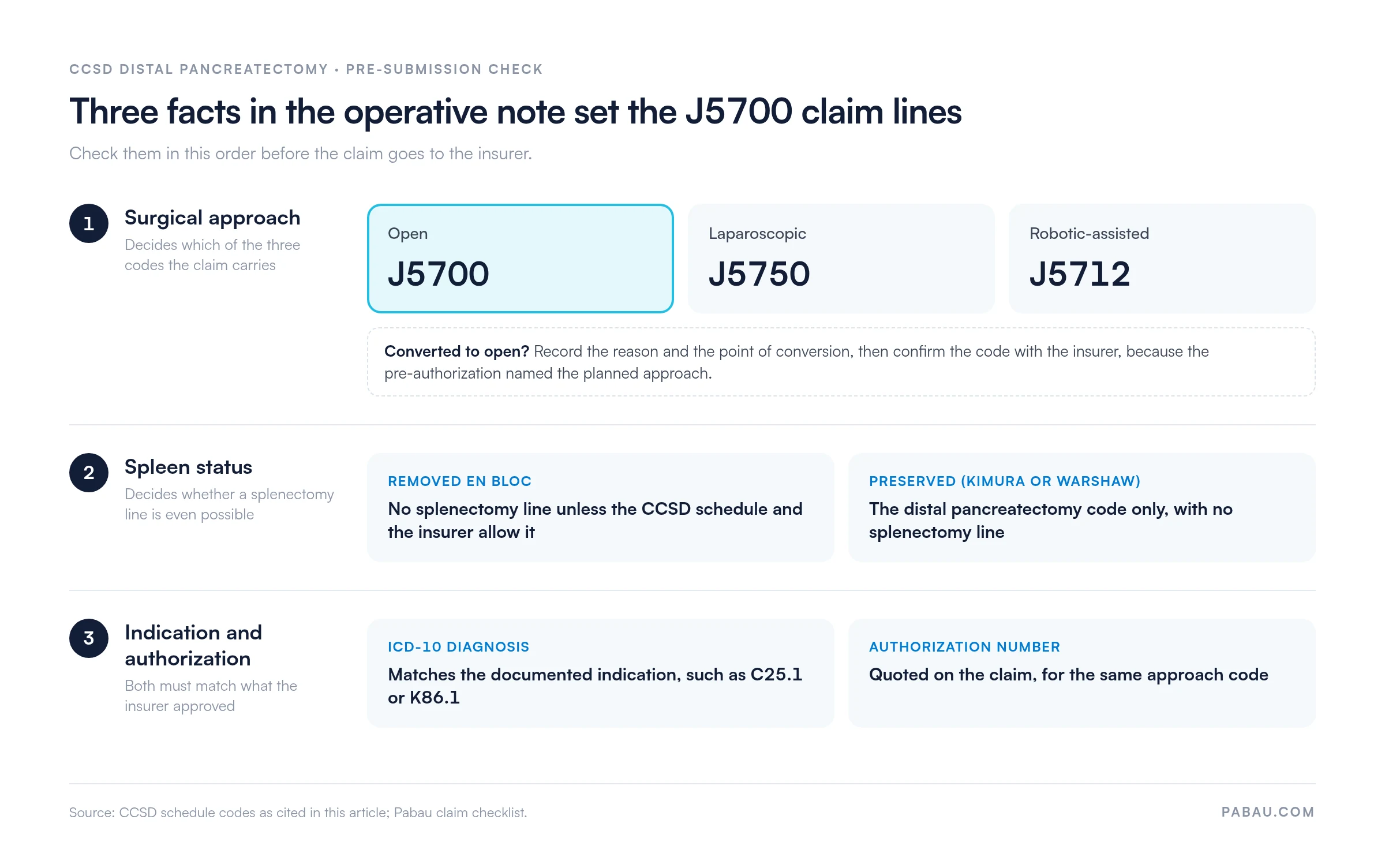
J5700 names no approach in its descriptor, but the CCSD schedule gives the minimally invasive routes their own codes. Laparoscopic distal pancreatectomy is J5750, and robotic-assisted distal pancreatectomy is J5712. That leaves J5700 for the open operation. Practices that also bill US payers report the open distal resection without a pancreaticojejunostomy as CPT 48140.
Conversion is where approach coding goes wrong. When a laparoscopic resection converts to open, record the reason and the point of conversion in the note. Then confirm with the insurer which code the completed operation takes, because the pre-authorization named the planned approach.
The approaches differ in recovery more than in coding effort. The Dutch LEOPARD randomized trial found that laparoscopic distal pancreatectomy shortened time to functional recovery compared with open surgery. It measured recovery, not long-term cancer outcomes.
The J5700 descriptor does not mention the spleen, so a same-operation splenectomy goes on the claim only where the CCSD schedule allows a second line. Check the schedule’s guidance and the insurer before adding one.
The question comes up on most cancer cases. Distal pancreatectomy for cancer usually removes the spleen with the pancreas, because the splenic vessels run along the back of the gland.
A splenectomy line the schedule doesn’t allow is a common audit finding and gets the claim queried. Missing one that is allowed leaves a fee unbilled. A current schedule and a clear operative note prevent both.
Coders working on pancreatic claims meet several codes near J5700 in sub-chapter 11.7.0. Billing a distal resection as Whipple’s procedure or total pancreatectomy is one of the costliest errors in this chapter. Every code below comes from the CCSD schedule.
The schedule is revised over time, so confirm each neighboring code against the current edition before billing. Never copy a code number from a secondary source.
Some services in the same admission go on their own claim lines, and some are part of J5700. Each separate line needs its own entry in the operative record.
Never bill a step that is integral to the resection as a separate code. Insurers treat unbundled lines as an audit risk and decline them.
Every J5700 claim needs an ICD-10 diagnosis that justifies the operation. UK claims use ICD-10 as published by the WHO, the same classification the NHS uses. The diagnosis must match the indication in the consent form, the clinical notes and the histopathology request.
Cancer cover depends on the patient’s policy, so check it before surgery. Some policies limit cancer treatment or exclude conditions the patient had before joining, especially under moratorium underwriting. The insurer confirms cover for the diagnosis when it issues the pre-authorization.
Insurers audit surgical claims against the operative record, so the note must support every code billed. A vague operative note is one of the most common reasons a J5700 claim gets queried. Three facts in the note decide the claim lines, and the path below shows the order to check them in.
UK private medical insurers expect pre-authorization before a planned distal pancreatectomy. The patient usually calls the insurer with the CCSD code and the diagnosis, and the insurer issues an authorization number. The claim then quotes that number.
A J5700 claim without a valid authorization number is likely to be declined, however strong the clinical case. Each insurer runs its own process, so confirm the current requirements with Bupa, AXA Health, Aviva, Vitality or WPA before surgery. Have these details ready for the request:
There is no national tariff for private surgery in the UK. Each insurer sets its own fee schedule for consultant surgeons and anesthetists, with a fee limit for each CCSD code.
The hospital bills separately for the operating room, the bed and drugs, often at a price agreed with the insurer. The consultant’s invoice covers only the professional fee.
If the consultant charges more than the insurer’s limit, the patient usually pays the shortfall. Agree the fee with the patient in writing before surgery, so the shortfall does not arrive as a surprise.
Fee limits change, and laparoscopic and robotic codes may carry different limits from J5700. Check the insurer’s current schedule for the date of service rather than a figure from a secondary source.
Insurers look closely at pancreatic surgery claims. Most declined J5700 claims trace back to the authorization, the coding or the operative note, and a structured denial management process recovers more of them.
A declined J5700 claim can often be recovered. Read the rejection or remittance message first, because the reason decides the response.
Run a five-point check before submitting a J5700 claim. Confirm the authorization number, the approach code, the diagnosis against the operative indication, the spleen status and note support for every extra line. Five minutes here saves weeks of appeal.
In many surgical practices, the authorization number arrives by phone or email and the operative note sits in another system. Someone at the billing desk joins them up days after surgery. That is where an approach code goes wrong or an authorization number goes missing.
Pabau’s claims management software stores each insurer pre-authorization as a case attached to the booking. The authorization code follows the appointment through to the claim, and any claim still missing one is flagged with “Assign case”. Claim validation catches missing or invalid details before the claim goes to Healthcode.
When an insurer rejects a claim, Pabau shows the reason so you can correct it and resubmit. Each insurer payment is recorded once and matched to every invoice it covers, so you can see which J5700 claims are still outstanding.

Pabau carries the pre-authorization code from the booking to the claim and sends surgical claims to Bupa, AXA Health, Vitality and other insurers through Healthcode. Missing details are flagged before you submit.

J5700 is one of three distal pancreatectomy codes, and the approach decides which one the claim needs. Before billing, read the operative note for the approach, the extent of resection and the spleen. Then check that all three match the authorization.
That review catches the approach mismatch, the missing authorization number and the disallowed splenectomy line before the insurer does. A query caught at the billing desk costs minutes, while one the insurer raises can hold payment for weeks.
Book a demo to see how Pabau carries the authorization from booking to Healthcode claim for your surgical practice.

Billing CCSD codes for Bupa patients? Bupa CCSD codes explains how Bupa applies the CCSD schedule and what it expects on a claim.
Coding other operations in sub-chapter 11.7.0? CCSD code J2800 covers excision of a lesion of the bile duct.
Choosing billing software for a UK private practice? The best medical billing software in the UK compares the options for insurer claims.
Keeping surgical billing audit-ready? Medical billing compliance sets out the checks that keep claims defensible.
CCSD code J5700 covers distal pancreatectomy, the removal of the body and tail of the pancreas. UK private medical insurers use it to identify and pay the operation. It applies whatever the diagnosis, from cancer to chronic pancreatitis. Laparoscopic and robotic-assisted resections take their own codes, J5750 and J5712.
The J5700 descriptor does not mention the spleen, so check the CCSD schedule before adding a splenectomy line. When the spleen is preserved with the Kimura or Warshaw technique, no splenectomy line applies. A splenectomy line the schedule doesn’t allow is a common audit finding.
Laparoscopic distal pancreatectomy is CCSD code J5750, and robotic-assisted distal pancreatectomy is J5712. That leaves J5700 for the open operation. The operative note must name the approach so the claim carries the matching code.
The most common are C25.1 (malignant neoplasm of body of pancreas), C25.2 (tail of pancreas) and C25.4 (endocrine pancreas). K86.1 (other chronic pancreatitis), K86.3 (pseudocyst of pancreas) and D13.6 (benign neoplasm of pancreas) are also used. The code must match the documented indication and the pre-authorization.
Yes. UK private medical insurers such as Bupa, AXA Health and Aviva expect pre-authorization before a planned distal pancreatectomy. The patient usually gets an authorization number from the insurer, and the claim must quote it. A claim without one is likely to be declined.
Each UK insurer sets its own fee limit for J5700 in its consultant fee schedule, and the limits change over time. The hospital bills separately for its own charges. Check the insurer’s current schedule for the date of service before quoting a fee to the patient.
Fk.148 is the CCSD reference number for J5700 in the schedule. The code sits in chapter 11.0.0 Abdomen (Excl. Urinary & Reproductive Organs), sub-chapter 11.7.0 Other Organs (Mainly Digestive). The claim itself quotes the code J5700.