HCPCS code T2043: Hospice continuous home care billing guide
HCPCS code T2043 pays for hospice crisis care by the hour HCPCS code T2043 is th...

Last Updated: Oct 7, 2026
J0310 is the CCSD code for resection of liver tumour(s), the open surgical removal of one or more tumors from the liver. UK private medical insurers use it for excising primary liver cancers and liver metastases.
The code sits in CCSD section 11.7.0, Other Organs (Mainly Digestive). Laparoscopic and robotic excisions take J0313 and J0311, and formal hepatectomies have their own codes, such as J0200 and J0210.
Let Pabau's smart automation suggest the right codes, reduce claim denials, and keep your practice compliant—effortlessly.
Automate repetitive tasks and focus on what matters most—your patients.
Reduce coding errors and ensure compliance with the latest regulations.
Clean claims, fewer denials, and faster reimbursements.
Powerful insights and reporting to help your practice thrive.
HIPAA compliant SOC 2 certified GDPR-compliant Trusted by 4,000+ clinics worldwide

CCSD code J0310 is the code for resection of liver tumour(s) performed as an open operation.
Laparoscopic and robotic tumor excisions take J0313 and J0311, and formal hepatectomies take J0200, J0210 or their minimally invasive versions.
The code usually pairs with ICD-10 C22.0 (hepatocellular carcinoma), C78.7 (secondary malignant neoplasm of liver) or C22.1 (intrahepatic cholangiocarcinoma).
UK private medical insurers expect prior authorization for J0310, and a missing authorization reference is a common cause of outright rejection.
Pabau, the practice management platform we build, stores the authorization reference, operative note and histopathology report on one patient record.
CCSD code J0310 is the code for open resection of a liver tumor in UK private medical insurance billing. Its official descriptor, set by the Clinical Coding & Schedule Development (CCSD) Group, reads “Resection of liver tumour(s)”. The code sits in section 11.7.0 of the CCSD schedule, Other Organs (Mainly Digestive).
It covers surgical excision of tumor-bearing liver tissue, whether the lesion is a primary cancer or a secondary deposit. Hepatocellular carcinoma and colorectal liver metastases are the typical examples. CCSD’s own history note records that the descriptor previously read “Removal of liver tumour”.
The defining feature is that tissue is physically removed. Radiofrequency or microwave ablation destroys the tumor in place without excision, so it takes its own CCSD codes, XR964 and J0312. Miscoding an ablation as a resection is one of the most common errors on hepatic claims.
J0310 is also narrower than many billers assume. CCSD codes laparoscopic and robotic tumor excision separately, as J0313 and J0311. Formal anatomical resections have their own codes too. J0200 covers a partial hepatectomy of up to three segments, and J0210 a hemihepatectomy of four or more.
J0310 applies when a consultant surgeon excises a liver tumor for any of the following diagnoses. The primary indication matters because it decides which ICD-10 diagnosis code accompanies the CCSD claim.
An MDT (multidisciplinary team) decision supporting surgical resection is standard clinical practice, and insurers increasingly ask for it at pre-authorization. Billing teams should request a copy of the MDT outcome before submitting the J0310 claim.
The CCSD schedule splits liver surgery two ways: by surgical approach and by how much liver is removed. J0310 covers one cell of that grid, an open excision of a tumor without a formal segment-based hepatectomy. The operative note decides which cell applies, as the grid below shows.
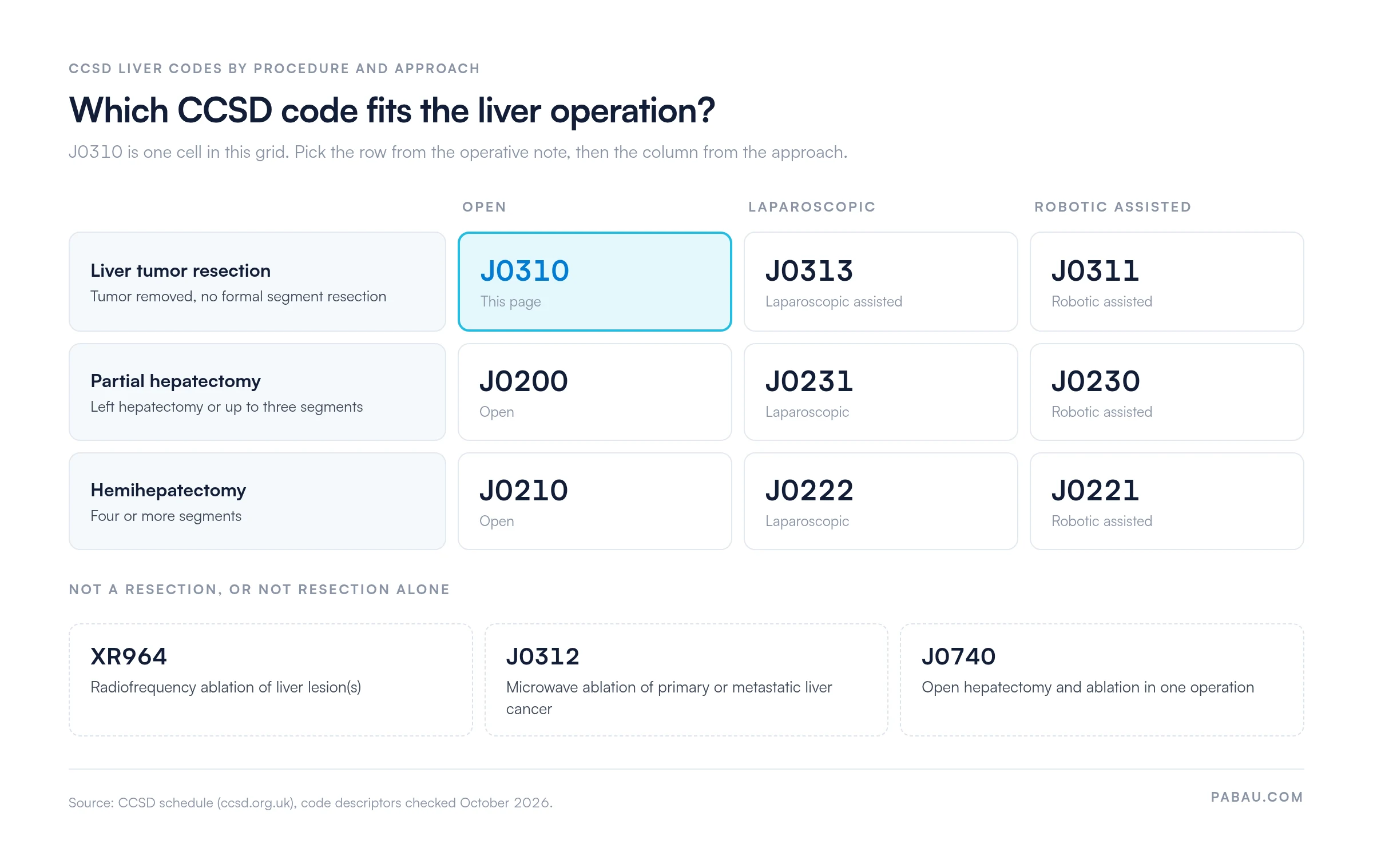
The table sets out the same split by resection type, with the CCSD code for each approach.
The surgical margin status (R0 for clear margins, R1 for microscopic involvement) should appear in both the operative note and the histopathology report. So should the Couinaud segment numbers resected. Insurers use these details to check that the code claimed matches the operation performed.
The scope of J0310 is confined to open excision of tumor-bearing liver tissue. Billers often field questions about other procedures performed in the same operation. The table below shows what J0310 includes, what needs a different or additional code, and what CCSD bars from billing alongside it.
J0310 sits among several liver codes in CCSD section 11.7.0. Picking the wrong neighbor leads to rejection or underpayment, especially when the approach or extent differs from the operative note. The table below lists the codes billers confuse most often, with their official descriptors.
When resection and ablation happen in the same open operation, check J0740 (open hepatectomy and ablation) before coding them separately. CCSD lists XR964 and J1300 among the codes that cannot be billed with J0310. Confirm each insurer’s bundling rules before submitting more than one procedure code. Pabau’s index of CCSD codes collects our guides to the rest of the schedule.
Before submitting a J0310 claim, check the operative note for ‘excision’ or ‘resection’ of liver tissue. If the note describes only ‘ablation’, ‘coagulation’ or ‘destruction’, J0310 is not the correct code. Check the approach too, because a laparoscopic or robotic excision takes J0313 or J0311.
CCSD codes are specific to UK private medical insurance billing. The NHS uses the OPCS-4 classification, maintained by NHS England, for procedure coding in NHS settings. The crosswalk below helps practices that treat both NHS and private patients, or that turn an NHS operative record into a CCSD claim.
The OPCS-4 mappings above are for reference and should be checked against the current NHS England OPCS-4 edition before use. CCSD J0310 is for private billing only and is never submitted to NHS commissioners.
Every major UK private medical insurer requires prior authorization for J0310 before the operation takes place. A J0310 claim submitted without a valid authorization reference is usually rejected outright rather than downgraded. The table below summarizes the general requirements.
Always check the insurer’s current provider portal, because lead times and evidence requirements change without notice. Our guide to Bupa CCSD codes covers Bupa-specific billing rules in more depth.
Insurers scrutinize J0310 claims closely because liver resections sit at the high-complexity end of the CCSD schedule. The documents below should be ready before submission. Retention follows your insurer contracts and the NHS Records Management Code of Practice. The Code typically sets 8 years for adult records.
J0310 claims are submitted electronically through Healthcode, the main UK clearinghouse for private medical insurance billing. These steps reflect best practice for liver surgery claims specifically.
J0310 denial patterns are well established in UK PMI billing. Most rejections fall into six categories, and each one is preventable with the right documentation and coding process.
A downgrade is when the insurer pays a lesser liver code instead of rejecting the claim. It is especially common when the operative note omits the Couinaud segments removed or the margin status. The resulting underpayment can be significant on a procedure of this complexity.
Appealing a downgrade requires the original operative note and histopathology report. Filing both before submission keeps the claim from being downgraded in the first place.
Practices billing J0310 juggle pre-authorization across several insurers, detailed operative documentation, and the risk of a downgrade when the claim file is incomplete. Pabau’s claims management software keeps those pieces together, so the claim goes out complete the first time.
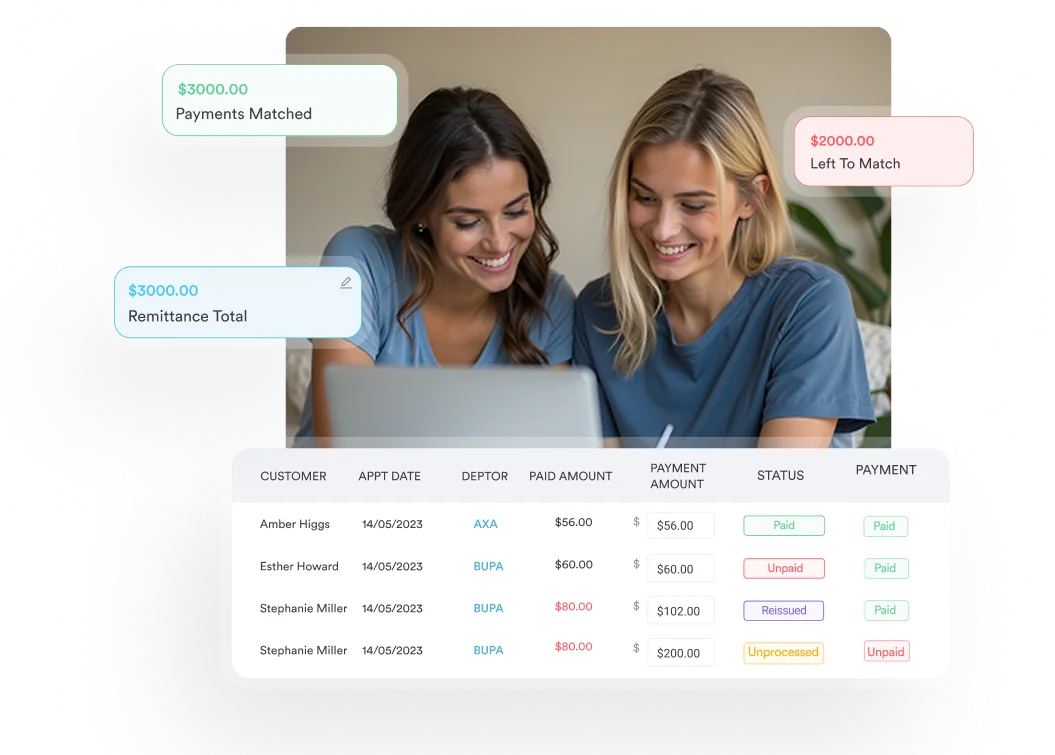
Billing teams enter CCSD codes such as J0310 directly and attach pre-authorization references to individual appointments. Operative notes and histopathology reports are stored on the same patient record. When the claim is ready, the supporting documents are in one place, which cuts the risk of sending an incomplete package to Healthcode.
Pabau’s audit trail shows billing administrators every claim’s status, from pre-authorization through to payment posting. That matters most on high-value codes like J0310, where one missing document can turn a full payment into a downgrade.
Set up a pre-submission checklist in your practice management system for every J0310 case. Confirm the insurer’s pre-auth reference and check that the CCSD code matches the approach and extent in the operative note. Then confirm the ICD-10 code against pathology and make sure the histopathology report is filed.

Pabau helps surgical practices manage CCSD code entry, pre-authorization tracking and audit-ready documentation in one place. Fewer rejected claims means less administrative rework.

Treat J0310 as a narrow code. It fits an open excision of liver tumors, and the operative note’s approach and extent decide whether a neighboring CCSD code applies instead.
The fix sits upstream of billing. Agree with your surgeons that every operative note states the approach, the segments removed, and the margin status. Then hold submission until histopathology is filed, and the downgrades and rejections above become rare.
Book a demo to see how Pabau keeps pre-authorization, operative notes and histopathology together for every CCSD claim.

Need a full reference for Bupa CCSD codes? Bupa CCSD codes guide covers the procedure codes Bupa accepts and how to submit them correctly.
Looking up another code in the CCSD schedule? CCSD codes index collects our guides to individual CCSD procedure codes.
Managing claims across several UK insurers? Pabau claims management supports CCSD code entry, pre-auth tracking, and audit-ready documentation in a single workflow.
CCSD code J0310 covers open resection of liver tumour(s), where the surgeon excises the tumor without a formal segment-based hepatectomy. Laparoscopic and robotic excisions take J0313 and J0311. Ablation, biopsy, formal hepatectomy and liver transplant are coded separately.
The three main pairings are C22.0 (hepatocellular carcinoma), C78.7 (secondary malignant neoplasm of liver, including colorectal liver metastases), and C22.1 (intrahepatic cholangiocarcinoma). The confirmed pathological diagnosis decides which one applies.
No. CCSD codes laparoscopic tumor excision as J0313 and robotic excision as J0311, so J0310 is the open-surgery code. State the approach in the operative note and claim narrative, because insurers check it against the code.
All major UK private medical insurers, including Bupa, AXA Health, Aviva Health, Cigna Global, and WPA, require prior authorization before liver resection. Claims without a valid authorization reference are typically rejected without clinical review rather than sent for appeal.
The usual causes are a missing pre-authorization reference, ablation language in the operative note, and a mismatched ICD-10 code. Claims also fail when histopathology is missing or the operative note lacks segment numbers and margin status. Billing a laparoscopic or robotic excision as J0310 is another avoidable error.
Anesthesia and surgical assistant fees are not bundled within J0310 and are billed separately by the relevant clinicians. Whether each is reimbursable depends on individual insurer policy. Confirm with the specific insurer before adding these codes to the claim.