HCPCS Code J1110: Dihydroergotamine mesylate injection billing guide
HCPCS Code J1110: Official descriptor and drug overview HCPCS Code J1110 is the ...

Last Updated: Oct 29, 2026
Billable Code
J1300 is the CCSD code for percutaneous biopsy of lesion of liver. It covers a needle biopsy of a focal liver lesion through the skin, by core needle or fine needle aspiration, under ultrasound or CT guidance.
J1300 sits in the CCSD Abdomen chapter, in the Other Organs (Mainly Digestive) section. Histopathology is billed separately, and imaging guidance is billed on its own line where the insurer allows it.
Let Pabau's smart automation suggest the right codes, reduce claim denials, and keep your practice compliant—effortlessly.
Automate repetitive tasks and focus on what matters most—your patients.
Reduce coding errors and ensure compliance with the latest regulations.
Clean claims, fewer denials, and faster reimbursements.
Powerful insights and reporting to help your practice thrive.
HIPAA compliant SOC 2 certified GDPR-compliant Trusted by 4,000+ clinics worldwide

CCSD code J1300 covers a needle biopsy of a focal liver lesion through the skin, by core needle or fine needle aspiration.
Histopathology is always billed separately, and imaging guidance is billed on its own line only where the insurer doesn’t bundle it into J1300.
Bupa, AXA Health, Aviva and Vitality Health typically require pre-authorization. A missing authorization number is the most common reason a J1300 claim is declined.
ICD-10 codes such as R93.2, C22.x, C78.7 and K74.x establish medical necessity, and the more specific code supports the claim better.
Pabau, the practice management platform we build, stores each insurer’s J1300 fee and pre-authorization and sends the claim through Healthcode.
CCSD code J1300 is the UK private healthcare procedure code for percutaneous biopsy of lesion of liver. A practitioner passes a needle through the abdominal wall, under real-time imaging, to take tissue from a focal liver lesion. The code covers core needle biopsy, which retrieves a tissue core for histopathology, and fine needle aspiration (FNA), which yields cells for cytology.
The Clinical Coding & Schedule Development (CCSD) group maintains the procedure schedule that UK private insurers use. J1300 sits in chapter 11.0.0, Abdomen (Excl. Urinary & Reproductive Organs), within section 11.7.0, Other Organs (Mainly Digestive). Each insurer sets its own fee against the code, as the Bupa CCSD codes schedule shows.
Hepatology, gastroenterology and interventional radiology practices bill it most often. The code doesn’t distinguish between a primary liver tumor, a metastatic deposit or a lesion in chronic liver disease. Code selection turns on the approach alone. A laparoscopic, open or transjugular biopsy is billed under a different CCSD code.
A percutaneous liver biopsy begins before the patient reaches the procedure room. A coagulation screen (INR, platelet count and PT) confirms the patient can safely tolerate needle puncture. The British Society of Gastroenterology recommends INR and platelet thresholds before proceeding, and the procedure note must record these results.
The procedure itself runs in seven steps.
The biopsy diagnoses a focal liver lesion seen on earlier ultrasound, CT or MRI, or stages a known liver cancer. It also grades chronic liver disease when noninvasive fibrosis markers are inconclusive. Typical examples are non-alcoholic fatty liver disease (NAFLD), non-alcoholic steatohepatitis (NASH) and viral hepatitis. The pathology lab, not the proceduralist, bills the histopathology report on the specimen.
Knowing the scope of CCSD code J1300 prevents the two most common claim errors. One is billing extra for services J1300 already covers. The other is missing a separate charge for services outside it.
Grouped by who bills them, those services turn one biopsy into as many as four claim lines.
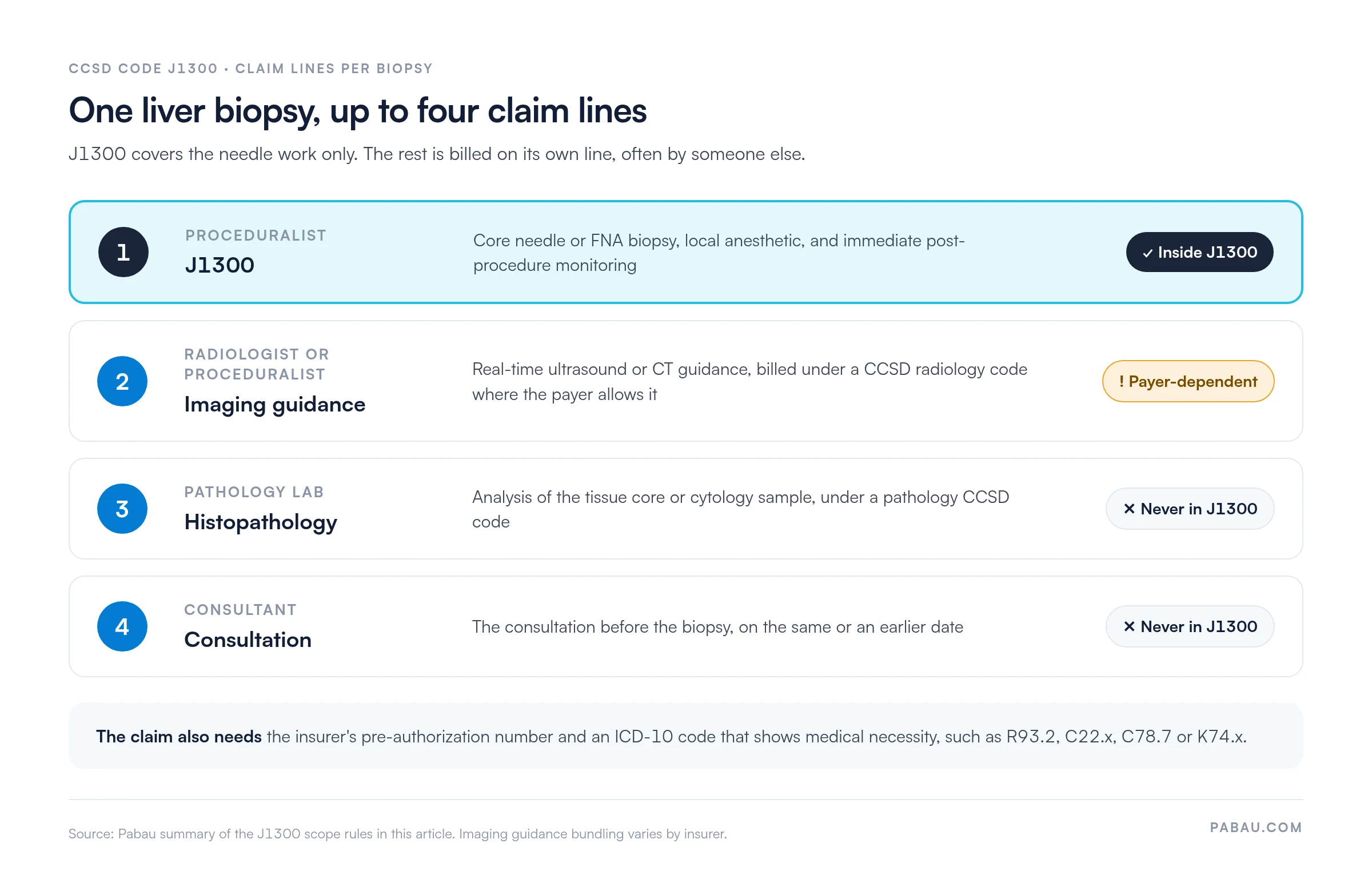
Ultrasound guides the vast majority of percutaneous liver biopsies in UK private practice. CT guidance is used for deep lesions or when ultrasound gives a poor view. Whether guidance is billed separately alongside CCSD code J1300 depends on the payer, not on a universal CCSD rule.
Under most insurer schedules, real-time guidance during a percutaneous biopsy is a separately codable radiology service. The CCSD radiology chapter carries codes for ultrasound and CT guidance of interventional procedures. Some payers bundle guidance into the J1300 fee, though, and won’t pay a separate radiology line. Check the insurer’s provider handbook or the Healix fee schedule before adding a guidance code.
When guidance is billed separately, the procedure note must document three details.
If one clinician performs both the guidance and the biopsy, most CCSD schedules still allow both codes. That remains payer-dependent, so check before you bill.
Choosing CCSD code J1300 correctly means knowing when a different liver code applies. The approach is the main selection criterion.
Laparoscopic, open and transjugular liver biopsies are billed under other CCSD codes in the abdomen chapter. Confirm the exact code against the CCSD schedule or browse the CCSD codes library before you bill. The approach descriptor is the reliable selection criterion.
If the biopsy confirms a resectable tumor, the liver resection is billed under J0310. In the US, the same needle biopsy is reported under CPT code 47000.
A J1300 claim needs an ICD-10 diagnosis code that establishes medical necessity. UK private insurers use the WHO edition of ICD-10, not the US ICD-10-CM. A vague or unspecified code without clinical context in the notes is a common denial trigger. These are the codes used most often.
Some payers ask for extra justification when R93.2 is used alone, without context in the referral letter or pre-procedure notes. Where cancer is suspected, C22.x or C78.7 usually supports the claim more strongly than R93.2.
Most major UK private medical insurance (PMI) payers require pre-authorization before a percutaneous liver biopsy. Billing CCSD code J1300 without a valid authorization number is the most common reason a claim is declined at first review. The table summarizes each major payer’s approach. Policies change, so confirm against each provider handbook before submission.
Record the authorization number in the patient record and on the invoice as soon as you receive it. Practitioners new to private work rarely met this step in the NHS, so build it into the booking routine from the start.
Request pre-authorization before the patient is booked onto the procedure list, not on the day. Most UK PMI payers won’t retrospectively authorize a J1300 biopsy that has already been performed, even with a clear clinical indication. Build a pre-auth checkpoint into your booking workflow for every private liver procedure.
Incomplete documentation is the second most common cause of J1300 denials, after missing pre-authorization. A complete procedure note for a percutaneous liver biopsy contains these eight elements.
A structured procedure note template in your digital documentation tool captures every required field before the patient leaves recovery. A note written more than 24 to 48 hours after the procedure is harder to defend if a payer requests it during a claim review.
Standardized templates also reduce audit risk when a practice writes a high volume of private procedure notes.
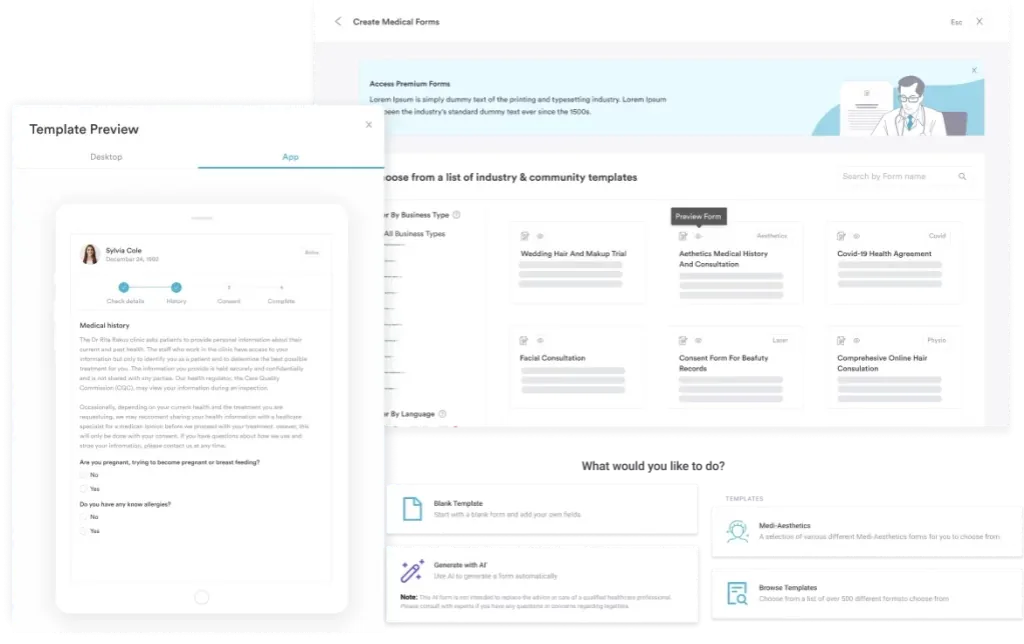
Most J1300 denials fall into a handful of repeating causes. Fixing the root cause before resubmission is faster than disputing a denial without addressing it.
Percutaneous liver biopsy has a well-documented complication profile. Clinical literature, including the BSG liver biopsy guidelines, names hemorrhage as the most common serious complication. Bile leak, hematoma and pneumothorax are the other significant risks. When a complication arises, the coding extends beyond J1300 itself.
Treat the approach below as illustrative. Verify complication codes with a qualified clinical coder or the payer’s handbook before submission, because incorrect complication coding carries compliance risk.
When a complication extends the episode, such as an overnight admission after hemorrhage, the admission codes and daily fees are billed separately from J1300. The biopsy’s procedure note must document the complication clearly so the extra codes stand up on audit.
Submitting CCSD code J1300 cleanly takes a system that covers the whole workflow. That means fee schedule setup, ICD-10 attachment, authorization tracking and claim submission to the insurer. Practices running this through spreadsheets and email risk submission errors and late payment.
Pabau’s claims management software handles that workflow for UK private practices. For J1300, it runs in six steps.
Practitioners moving from the NHS into private work meet pre-authorization and insurer invoicing for the first time. Setting up CCSD billing early prevents the ad hoc invoicing behind most claim errors.
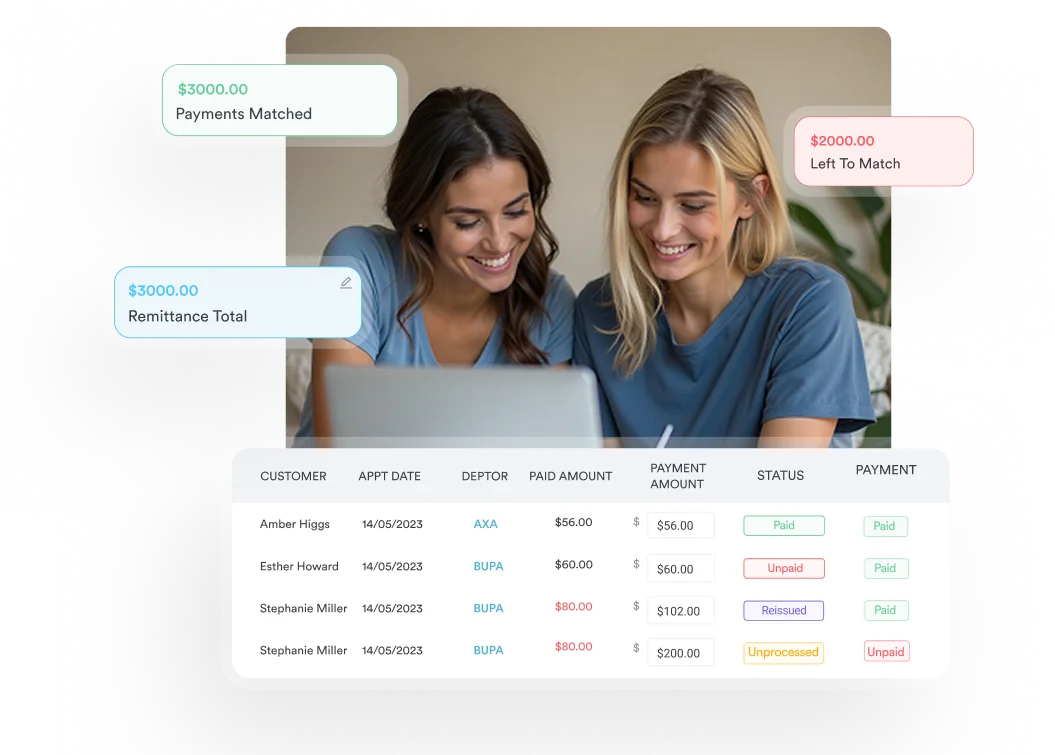

Pabau helps UK private practices manage CCSD claims, pre-authorization tracking and insurer invoicing in one place. See how it handles J1300 and the rest of your procedure fee schedule.

J1300 is a narrow code, and that narrowness makes it easy to bill well. Put the needle work under J1300, and give guidance, pathology and the consultation their own lines.
Most of the revenue risk sits before the needle goes in. Get the pre-authorization number at booking, pick the most specific ICD-10 code, and finish the procedure note before discharge. Those three habits prevent the most common J1300 denials.
Want J1300 claims that reach the insurer complete the first time? Book a demo to see how Pabau tracks pre-authorizations and sends claims through Healthcode.

Managing the full CCSD billing cycle? Bupa CCSD codes and fee schedule covers how Bupa procedure codes are structured and submitted through private practice billing systems.
Moving from biopsy to surgery? CCSD code J0310 covers billing a liver tumor resection once the biopsy confirms the diagnosis.
Billing the same procedure in the US? CPT code 47000 explains how a percutaneous needle biopsy of the liver is coded under CPT.
Taking tissue through the gut wall instead? CCSD code J6730 covers endoscopic upper GI ultrasound, including transmucosal biopsy.
CCSD code J1300 covers percutaneous biopsy of lesion of liver: A needle biopsy of a focal liver lesion through the skin. It’s usually done under ultrasound or CT guidance. Histopathology is always billed separately. Imaging guidance is billed separately where the insurer doesn’t bundle it into the J1300 fee.
Imaging guidance is usually coded separately, under a CCSD radiology code, but some payers bundle it into the J1300 fee. Check each insurer’s current provider handbook before adding a guidance code to the claim.
Bupa, AXA Health, Aviva and Vitality Health all typically require pre-authorization before a percutaneous liver biopsy. A J1300 claim without a valid authorization number is the most common cause of first-pass denial. Confirm the requirement in each payer’s current provider handbook, because policies are reviewed regularly.
Yes. The pathology lab bills histopathology of the biopsy specimen separately, under the appropriate pathology CCSD code. The two codes cover distinct services and aren’t bundled. J1300 covers the procedure, and the histopathology code covers the lab analysis.
J1300 covers the percutaneous approach only: A needle biopsy through the skin, without surgical access. An open liver biopsy, where the abdomen is surgically opened, is billed under another CCSD code in the abdomen chapter. A laparoscopic biopsy through a port has its own code too. The approach, not the indication, decides which code applies.
For a suspected tumor, the usual codes are R93.2 for abnormal liver imaging, C22.0 or C22.9 for primary liver cancer, and C78.7 for metastases. For chronic liver disease, K74.6 (cirrhosis), K76.0 (NAFLD) and B18.2 (chronic hepatitis C) are common. More specific codes support claims better than unspecified ones.