HCPCS Code J1110: Dihydroergotamine mesylate injection billing guide
HCPCS Code J1110: Official descriptor and drug overview HCPCS Code J1110 is the ...

Last Updated: Oct 29, 2026
J1830 is the CCSD code for laparoscopic cholecystectomy, the keyhole removal of the gallbladder. It applies only when the surgeon performs no intraoperative cholangiogram and does not explore the common bile duct.
A cholangiogram during the case moves the claim to J1880, and bile duct exploration moves it to J1820. J1830 sits in CCSD chapter 11.0.0 (Abdomen) under subchapter 11.7.0. In the NHS, the same operation is coded OPCS-4 J18.3, with Y75.2 for the laparoscopic approach.
Let Pabau's smart automation suggest the right codes, reduce claim denials, and keep your practice compliant—effortlessly.
Automate repetitive tasks and focus on what matters most—your patients.
Reduce coding errors and ensure compliance with the latest regulations.
Clean claims, fewer denials, and faster reimbursements.
Powerful insights and reporting to help your practice thrive.
HIPAA compliant SOC 2 certified GDPR-compliant Trusted by 4,000+ clinics worldwide

CCSD code J1830 covers laparoscopic cholecystectomy only when no intraoperative cholangiogram or bile duct exploration is performed.
If a cholangiogram is obtained during the procedure, J1880 applies instead. Bile duct exploration maps to J1820.
All major UK private medical insurers (Bupa, AXA Health, Aviva, Vitality, Freedom Health) require pre-authorization before J1830 can be claimed.
The operative note must confirm the laparoscopic approach, cystic duct and artery management, and specimen disposition to support the claim.
Pabau, the practice management platform we build, lets billing staff find J1830, attach the diagnosis code, log the pre-auth number, and submit in one workflow.
CCSD code J1830 is the procedure code for laparoscopic cholecystectomy in UK private healthcare billing. It describes the minimally invasive removal of the gallbladder through small abdominal port sites, with no cholangiogram and no bile duct exploration. The code is maintained in the CCSD Technical Guide and is recognized across UK private medical insurers’ fee schedules.
For practitioners moving between NHS and private settings, the NHS equivalent is OPCS-4 code J18.3, with Y75.2 for the laparoscopic approach. The two systems run in parallel but serve different billing environments. Surgeons moving from NHS to private practice should treat CCSD J1830 as the code their billing team uses for every standard laparoscopic cholecystectomy.
J1830 sits in CCSD chapter 11.0.0, which covers the abdomen excluding urinary and reproductive organs. Its subchapter is 11.7.0, other organs (mainly digestive). Within the CCSD procedure codes, cholecystectomy codes group together by technique and by any extra operative step performed:
An operative note supports a J1830 claim, rather than a J1820 or J1880 claim, when it describes this operative sequence:
Intraoperative cholangiography is not part of this sequence. If a cholangiogram is obtained at any point during the procedure, the code changes from J1830 to J1880. The operative note must make clear whether a cholangiogram was or was not performed.
The most common miscoding error on cholecystectomy claims is using J1830 when a cholangiogram was performed, or J1880 when it was not. Once the operative technique is confirmed, two questions settle the code, asked in the order shown below.
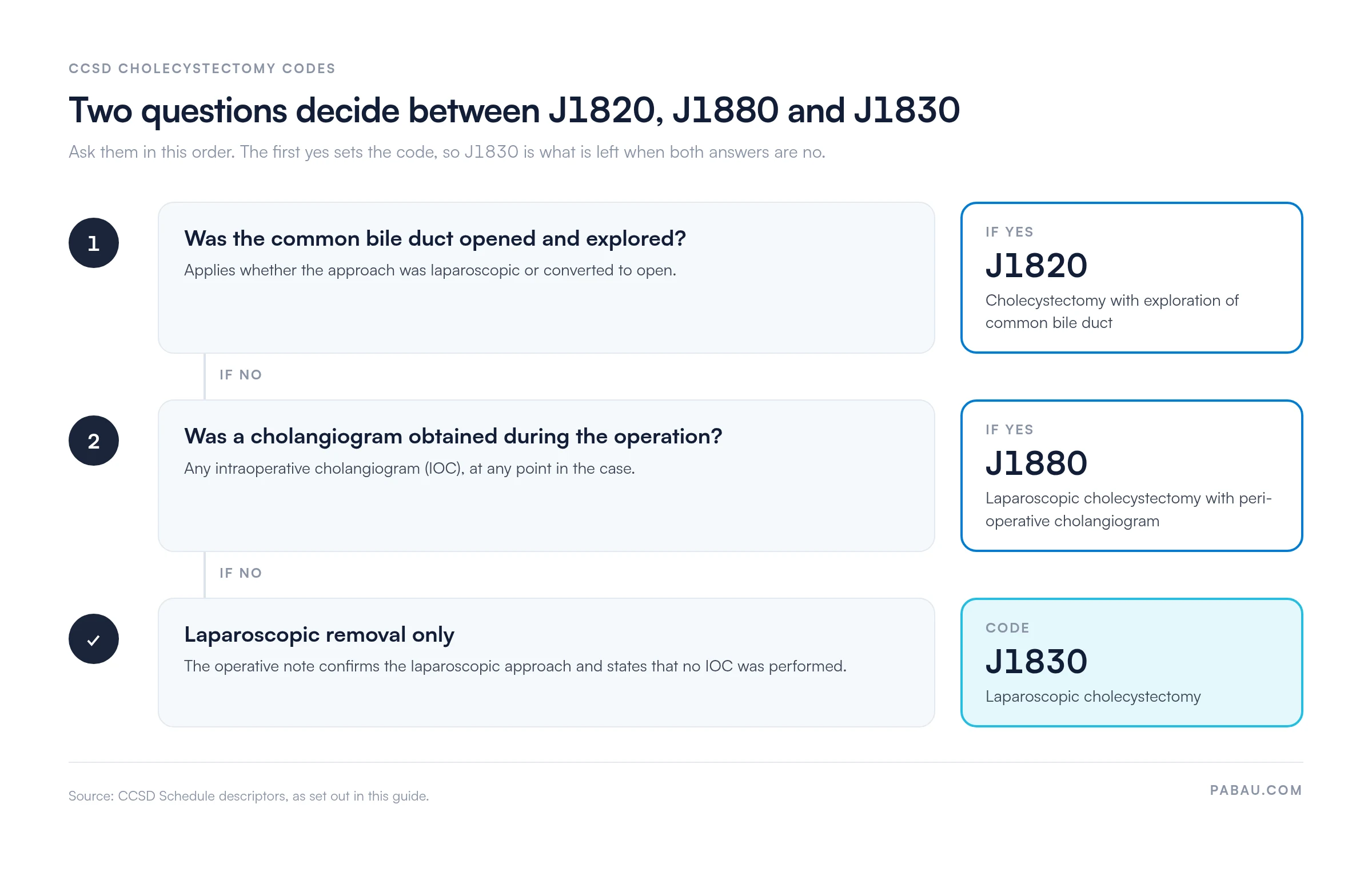
No. J1830 excludes intraoperative cholangiography. If an intraoperative cholangiogram (IOC) is performed at any point, J1880 applies instead of J1830.
The two codes exist to separate procedures with fluoroscopic bile duct imaging from procedures without it, so there is no room for interpretation. Coding J1830 when the operative note documents an IOC is a miscoding. Insurers may treat it as understating procedure complexity and query or deny the claim.
Similarly, if the bile duct is opened and explored, J1820 is the correct code regardless of whether the initial approach was laparoscopic. The table below maps the three codes to the clinical decision that routes to each:
A J1830 claim must include an ICD-10 diagnosis code that reflects the clinical indication for surgery. The diagnosis must align with the insurer’s definition of medical necessity. Common indications include:
The operative note and the claim form must use consistent ICD-10 diagnosis coding. Mismatches between the stated indication and the diagnosis code are a denial trigger across all major insurers.
Check that the ICD-10 diagnosis code on the claim form matches the primary indication documented in the operative note exactly. A claim citing acute cholecystitis (K81.0) when the note records symptomatic cholelithiasis (K80.20) will flag for manual review at adjudication.
Conversion from laparoscopic to open cholecystectomy during the same operative episode is a recognized complication. It creates a billing decision point that varies by insurer convention. The code should reflect the operative work completed and the approach under which the main procedure was accomplished.
Sometimes the laparoscopic phase was the main operative work, and conversion was needed only for hemostasis or specimen retrieval. Some insurers then accept J1830, provided it represents the bulk of the procedure. Where the open phase made up the substantive operative work, the open cholecystectomy code applies.
Insurer conventions differ here, so billing teams should confirm the code with the insurer before submitting. The operative note must record the reason for conversion, the point at which it occurred, and the findings that prompted it. Without that record, both J1830 and any open equivalent are at risk of denial for insufficient documentation.
A complete operative note is the foundation of any successful J1830 claim. Insurers review documentation to verify that the procedure claimed matches the procedure performed and that medical necessity is established. Under UK GDPR data-handling obligations, this documentation must also be stored securely and accessibly for the period professional regulators require.
The operative note must include all of the following to support a J1830 claim:
All major UK private medical insurers require pre-authorization before a J1830 claim can be paid. The Bupa CCSD code schedule and equivalent guides from other insurers set out the fee band for J1830 and the documentation they expect at submission. Requirements vary by insurer, and the table below summarizes the general framework:
Fee amounts differ by insurer and are updated annually. Never rely on a prior-year schedule, and verify the current J1830 fee in the relevant insurer portal before invoicing. Private billing teams keep a current list of insurer portal logins and check fee schedules at the start of each year.
Denial patterns on CCSD J1830 claims are well established. Most rejections fall into one of six categories:
Keep a copy of the pre-authorization confirmation (with number and expiry date) in the patient billing record before the procedure date. If the claim is queried months later, this confirmation is the fastest way to resolve a missing pre-auth denial without reopening the case.
J1830 covers the laparoscopic cholecystectomy itself. It does not include the anesthetist’s fee, any assistant surgeon fee, or post-operative outpatient consultations. These are billed under separate codes by the relevant practitioners.
Administrative staff submitting a J1830 claim should follow a consistent workflow to avoid the most common denial triggers. The steps below apply regardless of which portal or practice management system the practice uses:
Many billing teams assemble a J1830 claim from three places. The operative note sits in one system, the pre-auth letter in an inbox, and the fee schedule in an insurer portal. Each handoff is a chance for the wrong code or a missing number to slip through.
Pabau keeps the operative note, the pre-auth confirmation, and the submitted claim together in the patient record. Staff pick J1830 from the CCSD code library, attach the diagnosis code, and log the pre-auth number before the claim goes out.
When an insurer queries the claim months later, the full documentation package is already in that record. The team can answer the query without switching systems or reopening the case.

Pabau includes a built-in CCSD code library, pre-authorization tracking, and electronic claim submission. Your team can submit J1830 and related claims without leaving the patient record.

Treat J1830 as the code only after the operative note rules out the other two. Ask whether the bile duct was explored, then whether a cholangiogram was taken. Two no answers make J1830 correct, and the note should state both in plain words.
The cost is a few extra lines of documentation on every case. That small effort keeps pre-authorized claims from coming back as queries or denials months later.
Pabau’s CCSD code library and claim workflow keep the code, the diagnosis, and the pre-auth number in one record. Book a demo to see how your team can get J1830 claims right the first time.

Billing other CCSD codes for the same insurer? Bupa CCSD code schedule covers the full range of Bupa-recognized procedure codes and fee bands.
Need to tighten up your claims workflow? Claims management software for private practices explains how Pabau tracks submissions, monitors status, and flags outstanding claims.
Billing the same operation in the US? CPT code 47562: Laparoscopic cholecystectomy billing guide covers the US counterpart to J1830.
Coding other procedures in subchapter 11.7.0? CCSD code J1300: Percutaneous biopsy of lesion of liver walks through a neighboring code in the same CCSD subchapter.
Draining the gallbladder instead of removing it? CCSD code XR580: Percutaneous cholecystostomy covers the code for image-guided gallbladder drainage.
CCSD code J1830 covers laparoscopic cholecystectomy performed without intraoperative cholangiography and without bile duct exploration. It is the standard code for minimally invasive gallbladder removal through trocar ports. No cholangiographic or bile duct work is done in the same session.
J1830 applies when no intraoperative cholangiogram is performed, and J1880 applies when a cholangiogram is obtained during the procedure. The two codes are mutually exclusive. If the operative note documents an IOC, J1880 must be used, however straightforward the case was otherwise. Using J1830 on a claim where an IOC took place is a miscoding that commonly triggers denial.
J1820 applies when the common bile duct is opened and explored during the same operative episode. This may occur laparoscopically or via open conversion. If the bile duct is only visualized, not opened or probed, J1830 (or J1880 if an IOC is obtained) remains the correct code. Verify with the insurer if the operative note records any instrumentation of the bile duct.
The operative note must confirm the laparoscopic approach, the clinical indication, and cystic duct and artery clipping and division. It must also record that no intraoperative cholangiography or conversion to open took place, and how the specimen was retrieved. The claim form must carry a matching ICD-10 diagnosis code and the insurer’s pre-authorization number, obtained before the procedure date.
The most frequent trigger is the wrong code, such as J1830 submitted when a cholangiogram or bile duct exploration occurred. A missing pre-authorization number and an operative note that does not confirm the laparoscopic approach are close behind. An ICD-10 code that does not match the documented indication also triggers denials. So does submission after the insurer’s claim window, typically 90 days from the date of service.
Yes. The anesthetist’s fee is billed under a separate CCSD anesthesia code on the same claim form and does not constitute unbundling. The surgical J1830 line and the anesthetic line are distinct and are assessed independently by the insurer. Check individual insurer schedules for any policy restrictions on assistant surgeon fees billed concurrently with J1830.