CCSD Code D1010: Radical mastoidectomy including meatoplasty
CCSD Code D1010: Definition and clinical scope CCSD Code D1010 is the UK private...

Last Updated: Nov 25, 2026
J3500 is the CCSD code for sphincterotomy of bile duct and pancreatic duct using duodenal approach. It covers the endoscopic cut of the sphincter of Oddi at ERCP, on the bile duct, the pancreatic duct or both.
UK private insurers such as Bupa, AXA Health, Aviva and Vitality use the code on claims. Stent insertion and stone extraction are separate procedures, and J3500 can't be billed with J3800 for the same episode.
Let Pabau's smart automation suggest the right codes, reduce claim denials, and keep your practice compliant—effortlessly.
Automate repetitive tasks and focus on what matters most—your patients.
Reduce coding errors and ensure compliance with the latest regulations.
Clean claims, fewer denials, and faster reimbursements.
Powerful insights and reporting to help your practice thrive.
HIPAA compliant SOC 2 certified GDPR-compliant Trusted by 4,000+ clinics worldwide

CCSD Code J3500 covers endoscopic sphincterotomy of the bile duct and pancreatic duct using the duodenal approach, the standard ERCP route through a side-viewing duodenoscope.
J3500 belongs to the CCSD Schedule used by UK private insurers such as Bupa, AXA Health, Aviva and Vitality. The schedule doesn’t set fees, so each insurer decides what it pays.
J3500 can’t be billed with J3800 (therapeutic ERCP without stent), J3300, J3100 or J3200. Name the duct or ducts cut in the operative notes, and pair the code with a bile duct or pancreatic diagnosis.
Pabau, a practice management platform, records insurance policies, authorization numbers and claims on the patient’s record. UK claims go out through Healthcode and BUPA.
CCSD Code J3500 is the UK private healthcare code for sphincterotomy of the bile duct and pancreatic duct using the duodenal approach. It belongs to the CCSD Schedule, the standard set of procedure codes for UK private healthcare.
The Clinical Coding and Schedule Development (CCSD) Group maintains the schedule. J3500 was added on January 20, 2010. It sits in chapter 11, Abdomen (excluding urinary and reproductive organs), within the 11.7.0 Other Organs (Mainly Digestive) group.
The open bile duct operation coded J2720 sits in the same group. UK private insurers such as Bupa, AXA Health, Aviva and Vitality use the schedule to identify procedures on claims.
The duodenal approach qualifier matters. It describes the endoscopic route, with a side-viewing duodenoscope passed through the mouth to the second part of the duodenum. Open or laparoscopic operations on the sphincter of Oddi are coded elsewhere in the schedule. US practices bill the same endoscopic procedure under CPT 43262.
The CCSD Group doesn’t set fees or reimbursement. Each insurer decides its own benefit maximum for J3500. The CCSD procedure codes guide explains how the schedule’s chapters and code structure work across specialties.
Endoscopic sphincterotomy is performed under fluoroscopic guidance, with the patient under conscious sedation or general anesthesia. A therapeutic duodenoscope reaches the ampulla of Vater, where the common bile duct and main pancreatic duct empty into the duodenum. The gastroenterologist cannulates the target duct and uses a sphincterotome to cut the sphincter of Oddi with controlled electrosurgical energy.
The two sphincterotomies are anatomically distinct. A biliary sphincterotomy widens the common bile duct orifice. A pancreatic sphincterotomy widens the main pancreatic duct orifice. The J3500 descriptor names both ducts, so the operative notes must state which sphincter or sphincters were cut.
Step 8 is the billing-critical step. When both sphincters are cut in the same session, the operative report must name both explicitly. A generic “sphincterotomy performed” leaves the insurer unable to match the notes to the code.
UK insurers review J3500 against the ICD-10 diagnosis code on the claim. A diagnosis that doesn’t call for sphincterotomy is one of the most common reasons a claim gets queried. The accepted indications follow international ERCP guidelines.
Knowing the scope of J3500 prevents two errors. One is billing separately for steps the code already covers. The other is missing a separate procedure that was performed and documented.
Billing a stent or balloon dilation alongside J3500 depends on the schedule’s compatibility rules for that pair of codes. Check those rules before you submit both. Splitting J3500 into separately billed steps is an unbundling error that insurers flag during review. The map below sorts each item into one of four billing outcomes.
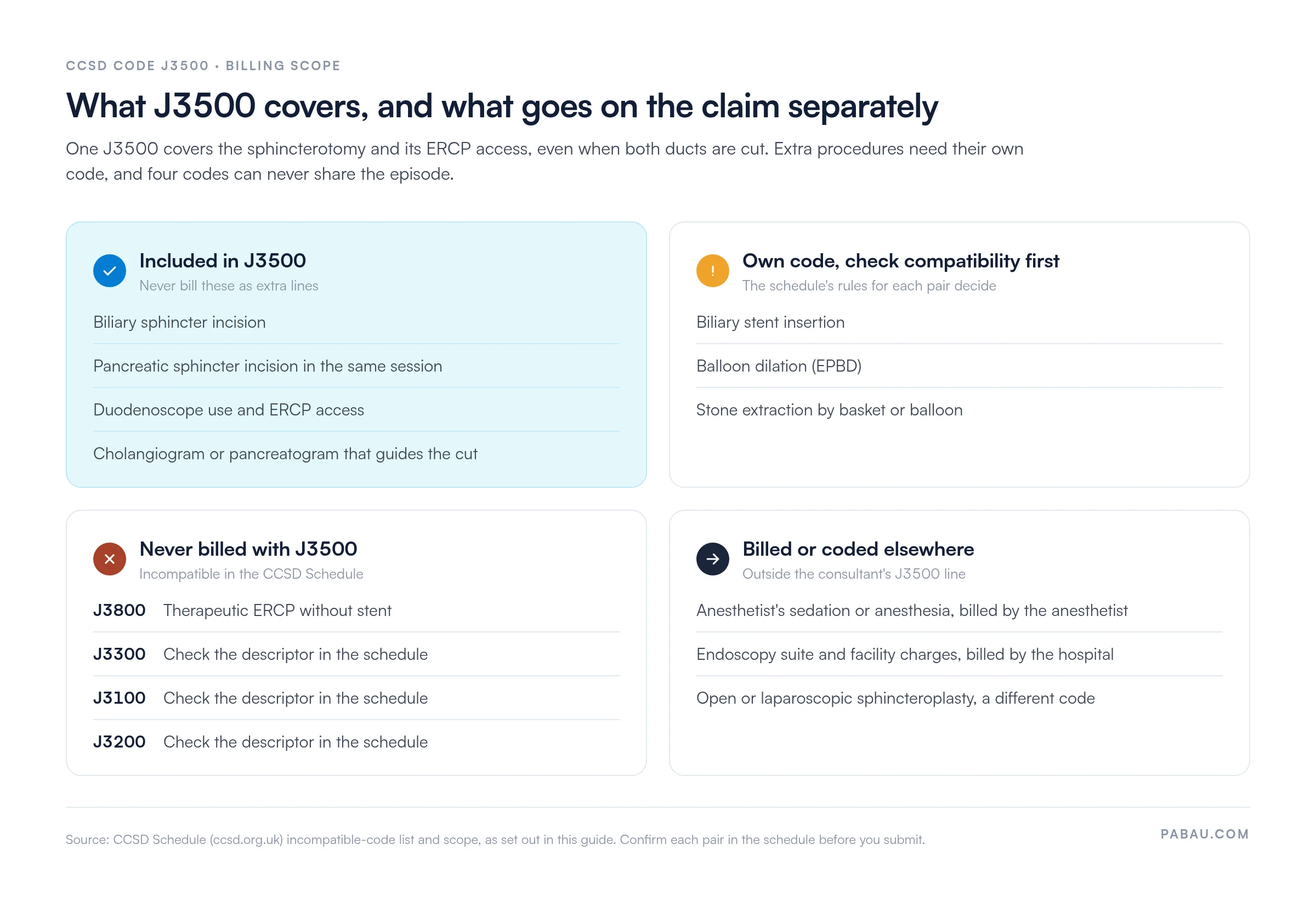
The CCSD Schedule lists J3500 as incompatible with four codes. An incompatible pair can’t be billed for the same episode. The schedule itself sits behind a login, so confirm each descriptor there before you submit. Pabau’s CCSD codes library covers other procedures from the schedule, one code per page.
The J3800 pairing causes the most rejections. An ERCP that includes a sphincterotomy is itself a therapeutic ERCP, so coders sometimes add J3800 on top of J3500. Choose the single code that matches the operative notes.
A J3500 claim stands or falls on the endoscopy report. Insurers can check these elements when they review the claim. Missing one of them is enough to trigger a query or a rejection.
UK private claims carry ICD-10 diagnosis codes alongside the CCSD procedure code. The codes below cover the conditions that most often lead to J3500. Check each one in the WHO ICD-10 browser before submission.
Match the code to the duct that was treated. A gallbladder stone code such as K80.0 or K80.1 doesn’t support a bile duct procedure, even when the patient also has gallstones.
Requirements for J3500 vary by insurer and by policy. Bupa, AXA Health, Aviva, Vitality and WPA each set their own rules, so confirm them directly. The points below are general principles, not insurer-specific rules.
J3500 claims are rejected for a predictable set of reasons. Checking each one before submission saves the time a resubmission takes.
The CCSD Schedule doesn’t use CPT-style modifiers. A combined biliary and pancreatic sphincterotomy is still one J3500 code, not two. Each insurer sets its own rules for assistant fees, so check its terms before the procedure.
When an anesthetist provides sedation or general anesthesia, they bill the insurer separately, quoting the same CCSD procedure code. Endoscopy suite and facility charges are billed by the hospital on its own account.
Audit your J3500 claims from the past 12 months and filter for reports that don’t name the duct. Each report that says only ‘sphincterotomy performed’ gives the insurer grounds to query the claim. Add duct identity as a required field in your ERCP report template before the next list.
The CCSD Schedule identifies the procedure but doesn’t put a price on it. Each insurer sets its own benefit maximum for J3500, so the same procedure can pay different amounts under Bupa, AXA Health or Aviva.
Bupa publishes the benefit maximum it pays for each CCSD code, and Pabau’s guide to Bupa procedure codes explains how to read it. If the consultant charges more than the insurer pays, the patient may owe the difference.
Confirm the fee with the patient’s insurer before you quote it. Insurer fee schedules change, so a figure from last year may no longer apply.
A J3500 claim depends on several pieces arriving together: the policy number, the authorization number, the endoscopy report and the right ICD-10 code. When those sit in email threads, insurer portals and spreadsheets, one missing piece holds up the consultant’s fee.
In Pabau, claims management software keeps the patient’s insurance policy, authorization number and claim status on their record. UK claims go out through Healthcode and BUPA, so your team can see which claims are paid and which need a resubmission.
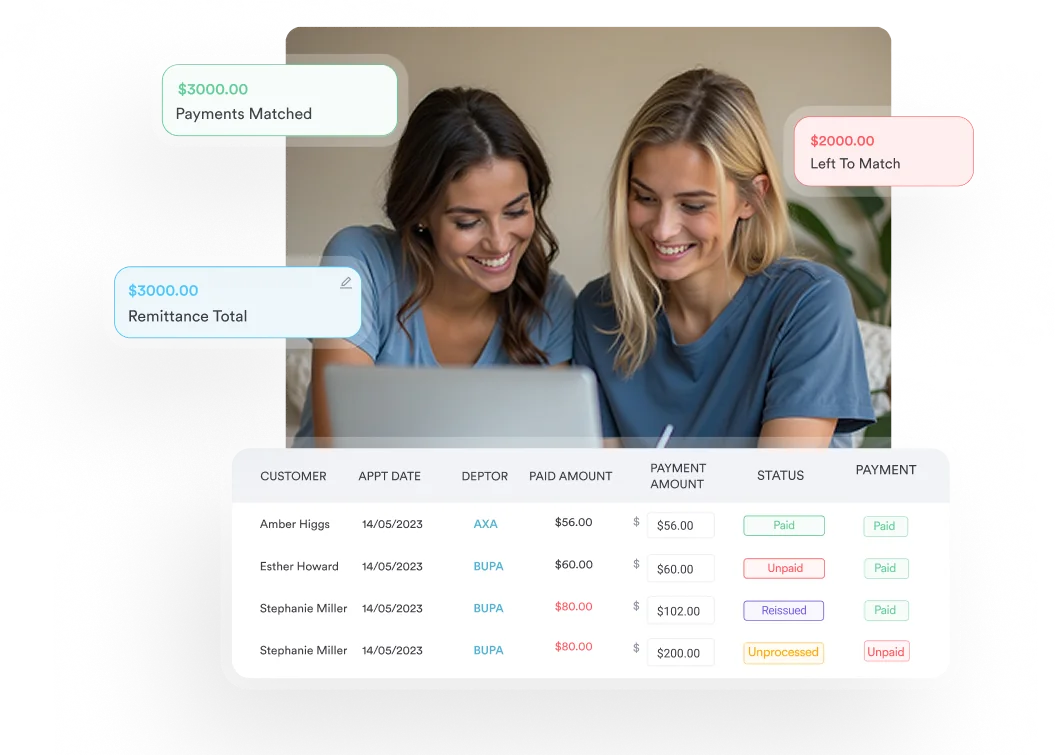
Your billing team catches a missing authorization number before the claim goes out, so fewer claims come back from the insurer for correction.

Pabau supports insurance billing and claims management, with UK claims sent through Healthcode and BUPA. See how gastroenterology practices record policies, authorization numbers and claim status in one place.

CCSD Code J3500 is specific about approach, anatomy and scope. It covers the endoscopic sphincterotomy itself, through the duodenal route, on the bile duct and pancreatic duct. When a J3500 claim fails, the usual cause is a report that leaves the approach or the duct unnamed.
Build the approach and duct identity into your ERCP report template, and secure the insurer’s authorization before the list. Never pair J3500 with J3800 or the other incompatible codes, and match the ICD-10 code to the duct treated.
Pabau sends UK insurance claims through Healthcode and BUPA and keeps every claim’s status in view. Book a demo to see how it fits your billing workflow for endoscopic procedures.

Looking for a broader CCSD procedure code reference? Pabau’s CCSD procedure codes guide covers CCSD code structure, billing rules and UK insurer fee schedules for private practices.
Checking what Bupa pays for a CCSD code? Pabau’s Bupa procedure codes and fee schedule guide explains how Bupa sets its benefit maximums for CCSD procedure codes.
Need help managing claims across multiple insurers? Pabau’s claims management software supports claim tracking, authorization records and resubmission of rejected claims.
Coding bile duct surgery after a failed ERCP? Pabau’s CCSD Code J2720 guide covers partial excision of the bile duct with anastomosis to the duodenum or jejunum.
Billing a full therapeutic ERCP? Pabau’s CCSD Code J3900 guide covers therapeutic ERCP coding for UK private insurance claims.
CCSD Code J3500 covers sphincterotomy of the bile duct and pancreatic duct using the duodenal approach. In this endoscopic procedure, performed at ERCP, the sphincter of Oddi is cut. That widens the biliary orifice, the pancreatic orifice or both. Stent insertion and stone extraction are separate procedures with their own codes.
No. The CCSD Schedule lists J3500 as incompatible with J3800 (therapeutic ERCP without stent), so the two can’t be billed for the same episode. J3500 is also incompatible with J3300, J3100 and J3200. Bill the single code that matches the operative notes.
Requirements vary by insurer and policy, so confirm them with Bupa, AXA Health, Aviva, Vitality or the patient’s insurer. For a planned procedure, the patient usually gets an authorization number before the date. For emergency cases such as acute cholangitis, contact the insurer as soon as possible afterward.
An ICD-10 code that doesn’t support sphincterotomy is one of the most common reasons. Others include a missing authorization number, notes that don’t name the approach or the duct, and J3500 billed with an incompatible code such as J3800. Adding approach and duct identity to the ERCP report template prevents the most avoidable rejections.
A stent insertion is a separate procedure from the sphincterotomy, so it isn’t part of J3500. Whether the two codes can be billed together depends on the CCSD Schedule’s compatibility rules for that stent code. Check the schedule before you submit both, and document each procedure and its indication in the notes.
For bile duct stones, the usual codes are K80.5 (calculus of bile duct without cholangitis) and K80.3 (calculus of bile duct with cholangitis). K83.1 (obstruction of bile duct) covers non-stone blockages. K83.4 (spasm of sphincter of Oddi) and K86.1 (other chronic pancreatitis) also support the code. The diagnosis code must match the documented indication. A gallbladder code such as K80.0 or K80.1 in place of a bile duct code is a common mismatch.