CCSD Code D1010: Radical mastoidectomy including meatoplasty
CCSD Code D1010: Definition and clinical scope CCSD Code D1010 is the UK private...

Last Updated: Nov 25, 2026
J2900 is the CCSD code for anastomosis of the hepatic duct, the operation that joins the hepatic duct to bowel to restore bile drainage. It is most often billed for a hepaticojejunostomy after a bile duct injury or stricture.
UK private insurers such as Bupa, AXA Health, Aviva and Vitality use CCSD codes to authorize and pay for planned surgery.
Let Pabau's smart automation suggest the right codes, reduce claim denials, and keep your practice compliant—effortlessly.
Automate repetitive tasks and focus on what matters most—your patients.
Reduce coding errors and ensure compliance with the latest regulations.
Clean claims, fewer denials, and faster reimbursements.
Powerful insights and reporting to help your practice thrive.
HIPAA compliant SOC 2 certified GDPR-compliant Trusted by 4,000+ clinics worldwide

CCSD Code J2900 is the UK private-sector code for anastomosis of the hepatic duct, most often a hepaticojejunostomy.
It covers joins to the hepatic duct. A join from the common bile duct to bowel needs a different CCSD code, J3000.
UK insurers such as Bupa, AXA Health, Aviva and Vitality expect pre-authorization before planned J2900 surgery.
Every J2900 claim needs a matching ICD-10 diagnosis, such as K83.1, K91.5 or C24.0.
CCSD sets no fees, so each insurer’s own fee schedule decides what J2900 pays.
CCSD Code J2900 carries the official descriptor “Anastomosis of hepatic duct.” It sits in the J section of the CCSD procedure code schedule, the section for other abdominal organs, mainly digestive. The Clinical Coding and Schedule Development (CCSD) group publishes the CCSD Schedules, the standard procedure codes for the UK private healthcare sector.
Bupa, AXA Health, Aviva and Vitality are the four private insurers that make up the CCSD group. CCSD itself sets no fees. Each insurer decides its own reimbursement and procedure grade for J2900.
The code applies specifically to the hepatic duct — the duct draining bile from the liver before it reaches the common bile duct. This anatomical detail matters, because procedures on the common bile duct itself take different codes. Coders who conflate the two risk the wrong code, a clinical query from the insurer or a rejected claim.
Anastomosis of the hepatic duct means surgically joining the hepatic duct to another structure, most commonly a Roux-en-Y loop of jejunum. The join restores or bypasses normal bile drainage. The procedure re-routes bile around an obstruction, injury, or stricture that has interrupted flow through the native biliary tree.
The two most common techniques are hepaticojejunostomy and choledochojejunostomy. Hepaticojejunostomy joins the hepatic duct directly to a jejunal limb. It is the preferred repair for high bile duct injuries or strictures at the hepatic confluence. Choledochojejunostomy joins the common bile duct to the jejunum and is used when the injury or obstruction is at a lower level.
When J2900 is billed for a Roux-en-Y hepaticojejunostomy, the anastomosis itself is the index procedure. Drain placement and standard wound closure are bundled. The CCSD schedule and the insurer’s rules decide whether the jejunal division takes its own code.
Biliary stricture and iatrogenic bile duct injury are the two most frequent reasons a surgeon performs hepatic duct anastomosis and submits J2900. The ICD-10 diagnosis code on the claim must match the documented indication exactly.
Knowing the scope of J2900 prevents unbundling errors and duplicate billing, both common triggers for insurer audits.
CCSD publishes code combinations that should not be billed together, and insurers add their own rules. Check both before billing a second procedure alongside J2900. Omental excision is one example, since CCSD code T3600 applies only when it is the sole procedure. A separately coded Roux limb construction that the schedule treats as part of J2900 is a frequent audit finding.
Several codes in the CCSD code library cover biliary anastomosis procedures that share clinical territory with J2900. The anatomical level of the anastomosis determines code selection. When a segment of bile duct is removed before the join to the duodenum or jejunum, the claim moves to J2720. Before billing J2900 with another biliary code, check the CCSD combinations list for the current pairings.
J2900 is the correct code when the operative report places the join at the right or left hepatic duct, or at the confluence. Two questions about the operation, answered from the report, settle which biliary code applies.
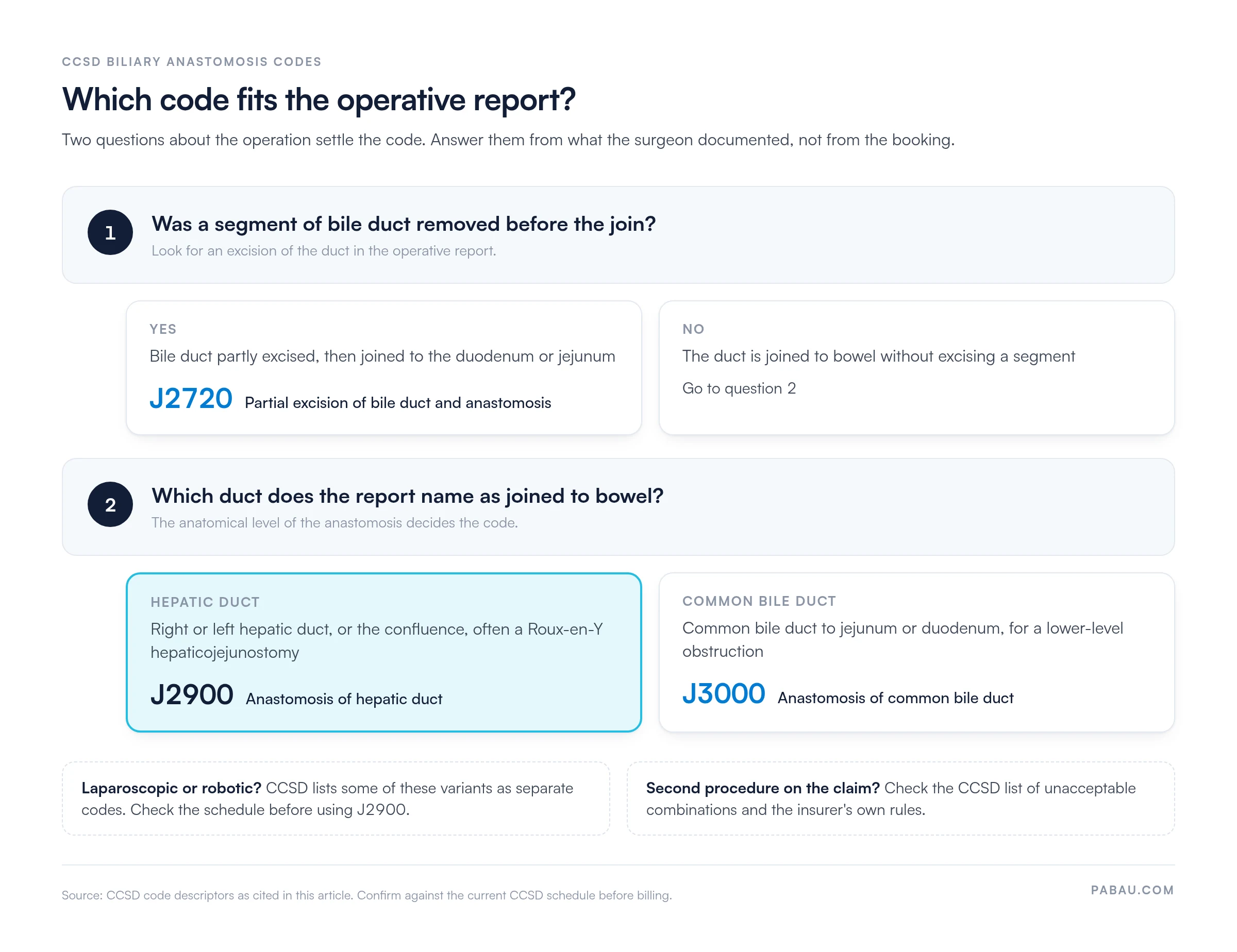
When the common bile duct is joined to bowel, J3000 applies instead. Check the current CCSD schedule before submitting either code.
Before billing J2900, read the operative report and identify the proximal ductal structure named in the anastomosis. If the report says ‘common bile duct to jejunum’, J2900 is likely wrong. Flag it for the surgeon to clarify before submission.
UK private insurers expect a valid ICD-10 diagnosis code on every J2900 claim. The code must reflect the documented clinical indication, not the procedure itself. A non-specific code where the notes support a more specific one often prompts a clinical query. The WHO ICD-10 browser lists the codes below for the biliary conditions treated by hepatic duct anastomosis.
Check the code against the WHO browser before submission, since UK insurers work from WHO ICD-10 rather than the US ICD-10-CM edition. For iatrogenic injury (T81.2), add an external cause code from the Y60–Y84 range that records the original operation.
A complete operative report is the most important document for a J2900 claim. Insurer clinical teams check it against the submitted code to confirm the procedure matches. A report that does not name the hepatic duct as the joined structure is the fastest route to a clinical query or a rejected claim.
UK private medical insurers expect pre-authorization before planned inpatient surgery, and hepatic duct anastomosis is no exception. The patient usually calls the insurer, which checks the policy and issues an authorization number for the planned procedure. A missing number is one of the most common reasons J2900 claims fail. It is an administrative failure, and it is hard to fix after the operation.
Private medical insurance generally covers planned treatment of acute conditions. Emergency admissions usually go through the NHS, and policies can exclude pre-existing or chronic conditions. Check the patient’s cover before admission, not after the claim comes back.
Bupa, AXA Health, Aviva, Vitality and WPA set their own authorization rules, and those rules change. Check them with the patient’s insurer before every admission. Tracking authorization numbers against booked operations stops a claim reaching submission without one.
Hepatic duct anastomosis rarely happens alone. Other clinicians and the hospital bill alongside it, and the insurer’s multiple-procedure rules can reduce what a second procedure pays.
J2900 is usually the principal procedure on the claim. How much a second procedure pays depends on the insurer, not on CCSD. Check each insurer’s published rules before adding a second code.
Before submitting a J2900 claim with a second procedure, check it against the CCSD list of unacceptable combinations. If the pair is listed, drop the secondary code rather than wait for the insurer to reject the claim.
Rejections of CCSD Code J2900 claims follow a predictable pattern. Missing pre-authorization leads the list, followed by operative reports that don’t name the duct and the wrong code choice.
A rejected J2900 claim is not always final. Insurers review corrected claims and clinical evidence, and the patient can escalate a dispute about their cover. Check the insurer’s time limit for a review as soon as the rejection arrives.
For ICD-10 rejections, confirm in the WHO browser that the resubmitted code is current. It must also match what is documented in the clinical record.
Surgical practices often track J2900 authorizations in emails and spreadsheets, then rebuild each claim by hand. That is where missing authorization numbers and mismatched codes slip through.
Pabau, a practice management platform, keeps the CCSD code, the ICD-10 diagnosis and the insurer’s authorization details on the patient’s case. Its private practice claims software records the authorization code, dates and approved sessions, and warns you when one is missing. Claims then go to Bupa directly or to other insurers through Healthcode.
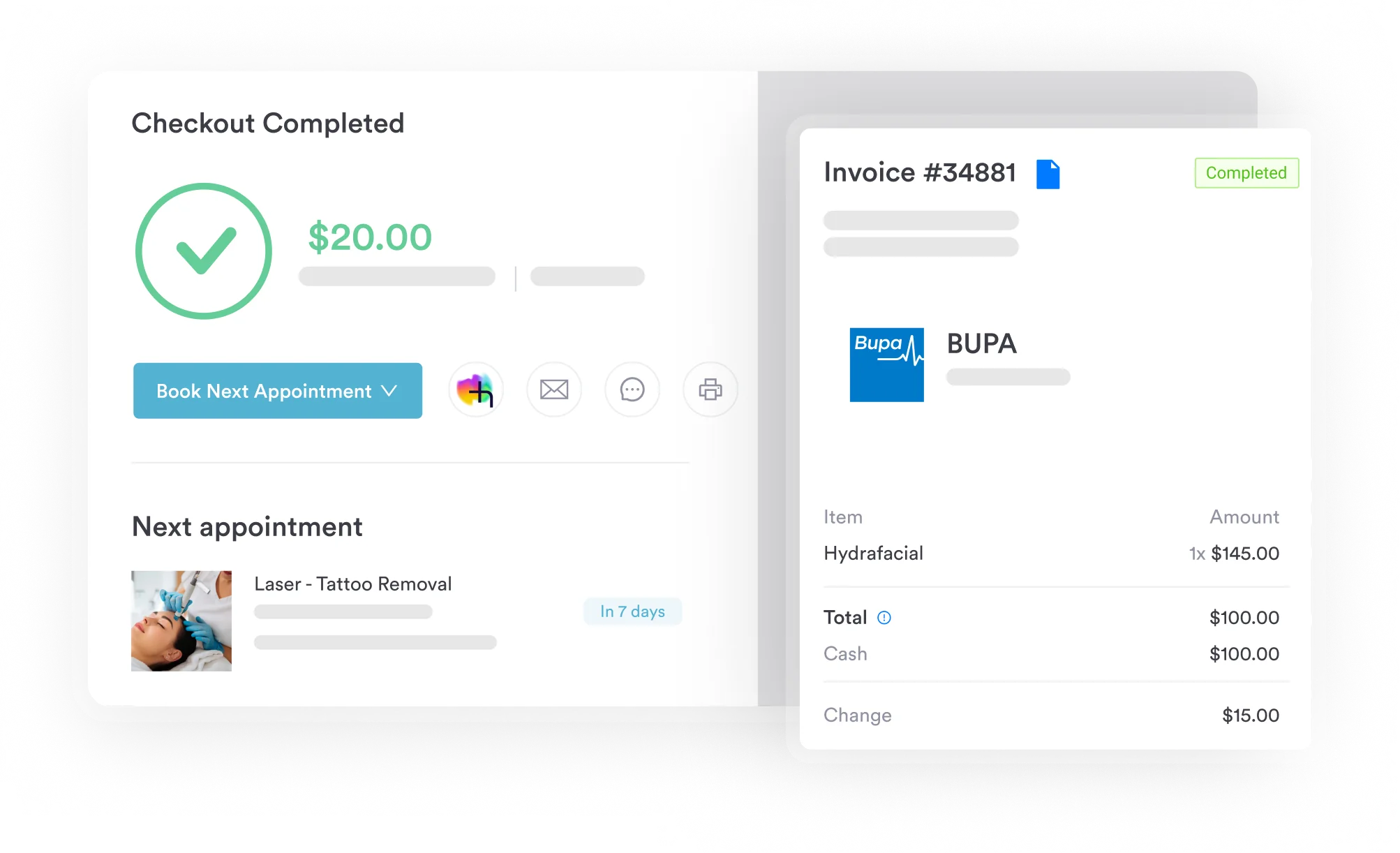
Teams that record surgical documentation on Pabau’s digital forms also capture operative details in the fields insurers check. The result is fewer rejections and a shorter wait for payment.

Pabau keeps CCSD codes, ICD-10 diagnoses and insurer authorization details on each case, then sends claims through Healthcode or to Bupa. See how it works for your surgical practice.

CCSD Code J2900 covers a demanding operation with an equally demanding billing path. The two most preventable failures are a missing authorization number and an operative report that does not name the hepatic duct. Both are fixable before the claim leaves your practice.
If rejected J2900 claims eat your team’s week, book a demo to see how Pabau flags a missing authorization number before submission.

Looking for a full CCSD code reference? Bupa CCSD codes covers how CCSD-coded procedures map to insurer billing requirements.
Need a claims submission workflow? Claims management software from Pabau keeps CCSD codes, ICD-10 diagnoses and authorization details together on each claim.
Joining the common bile duct instead? CCSD code J3000 covers anastomosis of the common bile duct and how to bill it.
Comparing UK billing platforms? The best medical billing software in the UK compares the tools private practices use for insurer claims.
Removing a bile duct lesion? CCSD code J2800 covers excision of a lesion of the bile duct.
CCSD Code J2900 covers anastomosis of the hepatic duct. The surgeon joins the hepatic duct to bowel, most commonly a Roux-en-Y loop of jejunum, to restore or bypass bile drainage. It is used for biliary stricture, iatrogenic bile duct injury and biliary bypass for malignancy.
J2900 applies specifically to the hepatic duct. Neighboring codes cover joins from the common bile duct (J3000) and partial excision of the bile duct with anastomosis (J2720). The anatomical level of the anastomosis, documented in the operative report, decides which code is correct.
Yes, for planned surgery. Bupa, AXA Health, Aviva, Vitality and WPA all expect the patient to get pre-authorization before inpatient treatment. Quote the authorization number on the claim, and tell the insurer if the planned procedure changes.
The most frequent reasons are missing pre-authorization, an operative report that does not confirm the hepatic duct was joined and a mismatched ICD-10 code. Billing a code that CCSD lists as an unacceptable combination with J2900 is another. Each has a resolution path in the denials section above.
The anesthetist bills separately under the insurer’s anesthetist fee schedule. Not every insurer pays a separate surgical assistant fee. Confirm both with the patient’s insurer before the operation.
CCSD lists some laparoscopic and robotic variants as separate codes. Check the current CCSD schedule for a specific code before applying J2900 to a minimally invasive operation.