

CCSD Code D1010: Radical mastoidectomy including meatoplasty
CCSD Code D1010: Definition and clinical scope CCSD Code D1010 is the UK private...

Last Updated: Nov 25, 2026
J2720 is the CCSD code for partial excision of bile duct and anastomosis of bile duct to duodenum/jejunum. It covers removing a segment of the common bile duct and joining the remaining duct to the duodenum or a jejunal loop in one operation.
UK private insurers, including Bupa, AXA Health and Aviva, use the code to authorize and pay the surgeon's fee. A robotic-assisted operation takes J2721 instead, and an anastomosis to the hepatic duct takes a hepatic duct code.
Let Pabau's smart automation suggest the right codes, reduce claim denials, and keep your practice compliant—effortlessly.
Automate repetitive tasks and focus on what matters most—your patients.
Reduce coding errors and ensure compliance with the latest regulations.
Clean claims, fewer denials, and faster reimbursements.
Powerful insights and reporting to help your practice thrive.
HIPAA compliant SOC 2 certified GDPR-compliant Trusted by 4,000+ clinics worldwide

CCSD Code J2720 covers partial bile duct excision plus anastomosis to the duodenum or jejunum. Both components are required, so the code doesn’t apply to an anastomosis alone.
Choledochoduodenostomy (duct to duodenum) and choledochojejunostomy (duct to jejunum, usually Roux-en-Y) are both covered. Hepaticojejunostomy joins the hepatic duct and is coded separately, under hepatic duct codes such as J2900.
UK private insurers such as Bupa, AXA Health and Aviva often query or reject J2720 claims for two reasons. The authorization number is missing, or the operative notes skip the excision or the anastomosis.
Pabau, a practice management platform, sends UK insurance claims through Healthcode and BUPA. Practices can track each J2720 claim from submission to payment.
CCSD Code J2720 is the UK private healthcare code for partial excision of the bile duct with anastomosis to the duodenum or jejunum. It belongs to the CCSD Schedule, the standard set of procedure codes for UK private healthcare.
The surgeon removes a segment of the common bile duct, then joins the remaining duct to the bowel to restore bile drainage. The code covers the whole surgical episode. That includes duct mobilization, the resection, building the anastomosis and routine closure.
Two elements are inseparable under this code. CCSD Code J2720 doesn’t apply to an anastomosis without excision of a bile duct segment. Nor does it apply to an excision without reconstruction. Coders must confirm both steps are documented in the operative notes before submitting this code.
The Clinical Coding and Schedule Development (CCSD) Group maintains the procedure schedule that UK private insurers use, including Bupa, AXA Health, Aviva, Vitality and WPA. J2720 sits with the bile duct codes in its Other Organs (Mainly Digestive) section, next to J2721, the robotic-assisted version.
The CCSD Group doesn’t set fees, so each insurer decides its own benefit maximum for the code. A J2720 claim carries the CCSD code, the ICD-10 diagnosis code, the patient’s policy or membership number, and the insurer’s pre-authorization number. Consultants submit it electronically through Healthcode or through the insurer’s own portal.
The surgery coded under CCSD Code J2720 follows a consistent sequence, though the specific technique varies by indication and the surgeon’s preferred approach.
A robotic-assisted operation takes its own code, J2721, rather than J2720. For a laparoscopic approach, confirm with the insurer before surgery that it will accept J2720 at the benefit set for open surgery.
The principal diagnoses that lead to partial bile duct excision with anastomosis include the following conditions. Each maps to supporting ICD-10 codes covered in the section below.
The indication must be clearly stated in the clinical notes and reflected in the ICD-10 code submitted with the claim. A generic “biliary obstruction” code without specificity is a frequent denial trigger.
CCSD Code J2720 covers both anastomotic routes. The choice of route is a clinical decision recorded in the operative notes. It doesn’t change the code, but it confirms the scope of the procedure.
The line between choledochojejunostomy and hepaticojejunostomy decides the code. Sometimes the operative notes describe anastomosis to the hepatic duct rather than the common bile duct. That claim should carry a hepatic duct code such as J2900, not J2720. Billing J2720 when the anatomy involved the hepatic duct is a miscoding error that insurers pick up at audit.
Three questions answered from the operative notes settle which bile duct code the claim carries.
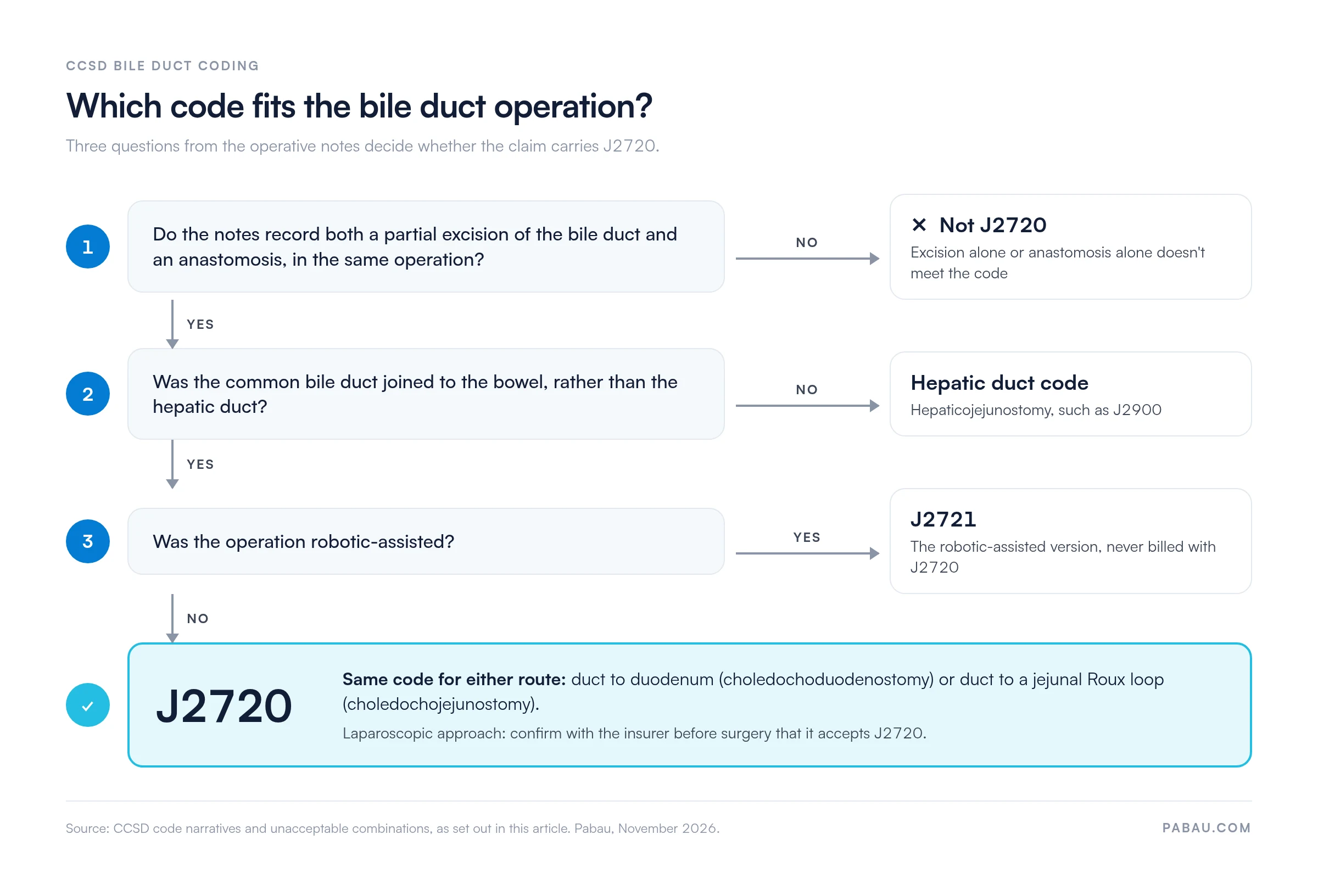
Several bile duct codes sit next to J2720 in the CCSD schedule, and each has an entry in Pabau’s CCSD code library. Knowing which ones can be billed together helps you avoid unbundling disputes with insurers. The CCSD Group lists J2720 as an unacceptable combination with J3300 (incision of bile duct) and with J2721, its robotic-assisted version. Sphincterotomy of bile duct and pancreatic duct using duodenal approach sits nearby as CCSD code J3500.
Scope of “partial excision” under J2720: The code applies when a segment of the common bile duct is removed, not the entire duct. Total choledochectomy requires a different code.
Lymphadenectomy performed alongside J2720 for oncological staging is not included in J2720 and may need a separate code with clinical justification. Omentum removed in the same operation is different, because code T3600 is billable only when omental excision is the sole procedure. Confirm the current CCSD rules for oncological coding with the insurer before submitting. The Bupa CCSD codes guide explains how the schedule is structured.
UK private insurers expect a specific ICD-10 diagnosis code on every J2720 claim. A non-specific or mismatched code is one of the most common denial triggers. The WHO ICD-10 browser provides authoritative definitions for each code listed below.
UK insurers work from the WHO edition of ICD-10, so check each code there rather than in a US ICD-10-CM lookup, which differs in places. Insurers audit diagnosis specificity. An obstruction code (K83.1) on a claim that should carry C24.0 can prompt a clinical review or a reduced payment.
Always use the most specific ICD-10 code available for the underlying diagnosis. If the histology report confirms cholangiocarcinoma, replace the generic obstruction code (K83.1) with C24.0 before final claim submission. Insurers compare the submitted diagnosis code against the operative and histology findings during post-payment audit.
A J2720 claim stands or falls on the operative notes. The documentation must confirm both the partial bile duct excision and the anastomosis were performed in the same operative episode. If either component is missing from the notes, the insurer can query the claim or pay it at a lower-value biliary code.
Operative note essentials for J2720 claims:
Pre-authorization: J2720 is a major bile duct operation, and UK private insurers expect it to be authorized before surgery. The patient usually contacts their insurer, such as Bupa, AXA Health, Aviva, Vitality or WPA, with the CCSD code and the diagnosis. The insurer then issues an authorization or claim number.
Keep the imaging reports, referral letter and planned procedure description ready, because the insurer may ask for them. Requirements differ by insurer and policy, so confirm them directly. A claim without a valid authorization number is likely to be rejected.
Additional supporting documents:
The CCSD schedule doesn’t use CPT-style modifiers. Each insurer sets its own rules for assistant fees, emergency surgery and repeat operations, so check the insurer’s terms before surgery.
Anesthesia billing: The anesthetist bills the insurer separately, quoting the same CCSD procedure code. Each insurer sets the anesthetist’s fee under its own categories, so the amount differs between Bupa, AXA Health and others. Operating room, nursing and facility charges are billed by the hospital on its own account and are not part of J2720.
When a surgical assistant scrubs in, check the insurer’s fee schedule before you bill. Bupa publishes its schedule at codes.bupa.co.uk, and other insurers set their own rules. Confirm the terms before surgery so the assistant’s claim isn’t rejected.
Common J2720 claim rejections and how to resolve them:
Bupa publishes the benefit maximum it pays for each CCSD code, and the Bupa procedure codes and fee schedule guide explains how to read it. Logging each rejection against its root cause shortens the time between a rejection and a corrected resubmission.
A J2720 claim depends on several documents arriving together: the authorization number, the operative notes, the histology report and the right ICD-10 code. When those sit in email threads, insurer portals and spreadsheets, one missing piece holds up the surgeon’s fee.
In Pabau, claims tracking for private surgeons keeps the authorization number, diagnosis code and claim status on the patient’s record. UK claims go out through Healthcode and BUPA, so your team can see which claims are paid and which need a resubmission.
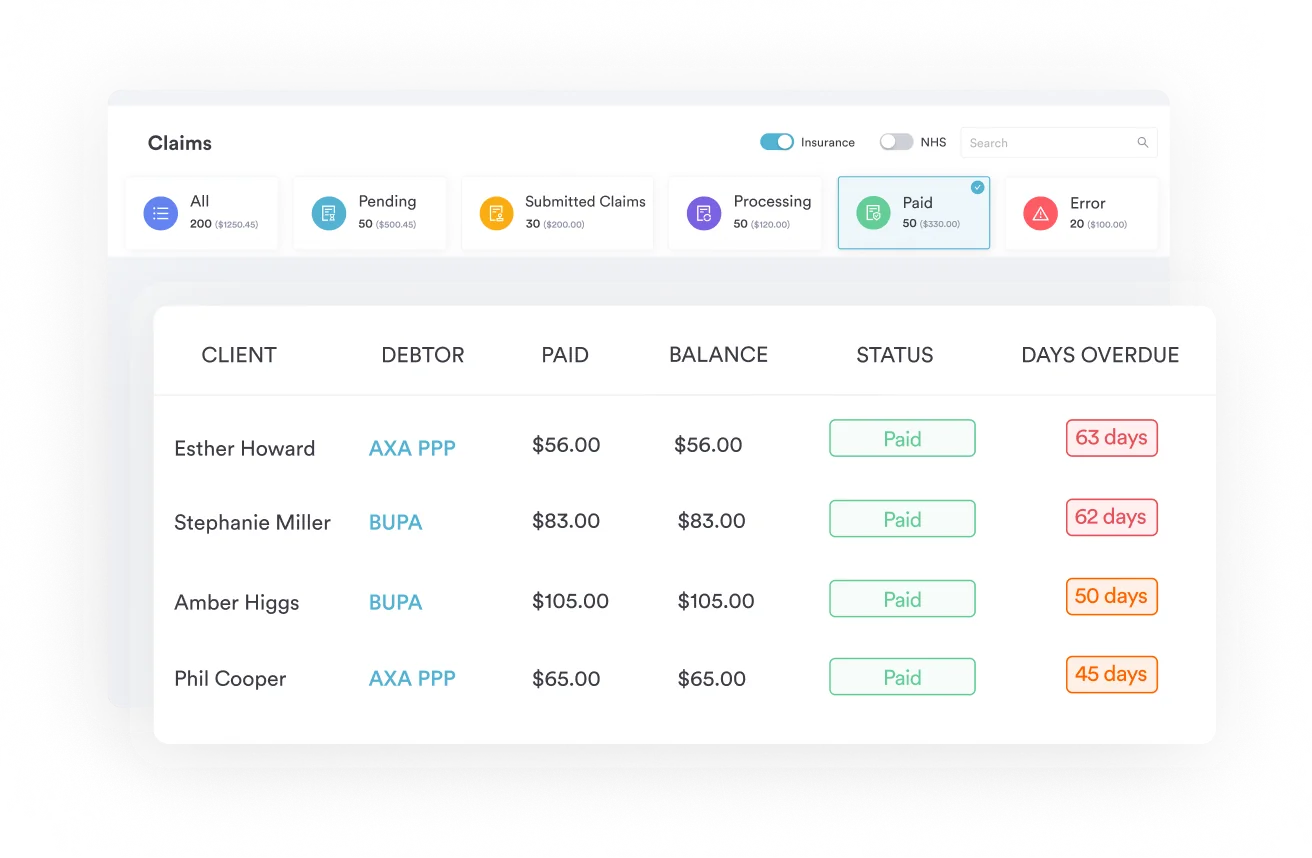
Your billing team spots a missing document before the claim goes out, so fewer claims come back from the insurer for correction.

Pabau supports insurance billing and claims management, with UK claims sent through Healthcode and BUPA. See how surgical practices track authorization numbers and claim status in one place.

CCSD Code J2720 only holds up when the operative notes confirm both the partial bile duct excision and the biliary-enteric anastomosis. Leave either out, and a UK insurer can query the claim or pay it at a lower-value code.
Secure pre-authorization from the patient’s insurer before surgery. Afterward, pair J2720 with the most specific ICD-10 code and name the anastomotic route in the notes.
Pabau sends UK insurance claims through Healthcode and BUPA and keeps every claim’s status in view. Book a demo to see how it fits your billing workflow for major bile duct surgery.

Looking for a broader CCSD procedure code reference? Pabau’s CCSD procedure codes guide covers CCSD code structure, billing rules, and UK insurer fee schedules for private healthcare practices.
Need help managing surgical claims across multiple insurers? Pabau’s claims management software supports end-to-end claim tracking, authorization records, and resubmission of rejected claims.
Checking what Bupa pays for a CCSD code? Pabau’s Bupa procedure codes and fee schedule guide explains how Bupa sets its benefit maximums for CCSD procedure codes.
Coding a bile duct anastomosis without an excision? Pabau’s CCSD Code J3000 guide covers the code for anastomosis of the common bile duct.
CCSD Code J2720 describes partial excision of the bile duct and anastomosis of the bile duct to either the duodenum (choledochoduodenostomy) or the jejunum (choledochojejunostomy). Both the excision and the anastomosis must be performed in the same operative episode for the code to apply. Neither component alone triggers J2720.
Choledochoduodenostomy joins the common bile duct directly to the duodenum. Choledochojejunostomy joins it to a loop of jejunum, usually built as a Roux-en-Y to prevent intestinal reflux. Both routes are covered under CCSD Code J2720. Choledochojejunostomy is generally preferred for most biliary reconstructions because it avoids sump syndrome, which can complicate the duodenal route over time.
The most common reasons are a missing pre-authorization number, a non-specific ICD-10 diagnosis code, and operative notes that describe the excision but not the anastomosis. Billing a hepaticojejunostomy as J2720 also gets the claim rejected. So does billing the excision and the anastomosis as two codes instead of J2720.
No. The CCSD schedule doesn’t use CPT-style modifiers. A robotic-assisted operation takes its own code, J2721, and each insurer sets its own rules for assistant fees, emergency surgery and repeat operations. Check the insurer’s terms before surgery.
The anesthetist bills the insurer separately, quoting the same CCSD procedure code. That claim doesn’t affect the surgeon’s J2720 fee. Operating room and facility charges are billed by the hospital on its own account and are not part of J2720.
The most common ICD-10 pairings for J2720 are K83.1 (obstruction of bile duct), C24.0 (cholangiocarcinoma of the extrahepatic bile duct) and Q44.4 (choledochal cyst). K86.1 (chronic pancreatitis with CBD obstruction), K83.0 (cholangitis) and K91.5 (postcholecystectomy syndrome) also support the code. Use the most specific code available for the confirmed diagnosis. UK insurers audit ICD-10 specificity during post-payment review.




