


CPT Code 30801: Superficial turbinate ablation billing guide
CPT Code 30801: Official descriptor and procedure overview The American Medical ...

Last Updated: Nov 27, 2026
CCSD code XR576 covers biliary drainage with an occluded stent in place, an interventional radiology procedure filed under sub-chapter 17.11 (Liver). Use it only when an existing biliary stent has blocked and the radiologist drains the obstructed system under imaging.
AXA Health’s specialist procedure schedule lists XR576 as a Major procedure. It also names three codes that can’t share its claim: J3200, J3900 and J5000.

CCSD code XR576 is “Biliary drainage with occluded stent in place,” an interventional radiology code in sub-chapter 17.11 (Liver).
Use it only when a biliary stent is already in place and blocked, and the report says so.
CCSD lists J3200 (Repair of bile duct), J3900 (Therapeutic ERCP) and J5000 (Percutaneous examination of bile duct) as unacceptable combinations with XR576.
The full includes and excludes sit behind the CCSD login, so confirm them in the codebook before you bill.
Record the insurer’s pre-authorization reference on the claim, and check each payer’s rules for urgent cases.
The official descriptor for XR576 is “Biliary drainage with occluded stent in place.” It belongs to the XR series of radiology codes in the CCSD schedule. CCSD files it under Chapter 17 (Interventional radiology), sub-chapter 17.11.0 (Liver).
In plain terms, the code fits a patient whose existing biliary stent has stopped draining. The interventional radiologist then drains the obstructed biliary system.
A first drainage with no stent in place doesn’t match this descriptor. In that case, look for the code that names the procedure performed.
The full CCSD entry for XR576 sits behind a login. The public record confirms the descriptor, the chapter and three combination rules. It doesn’t show the full includes and excludes.
So confirm these points in the current CCSD codebook before you bill:
Insurer schedules can add rules of their own. AXA Health, for example, states that every Chapter 17 code includes imaging guidance by X-ray, CT/MRI, fluoroscopy or ultrasound. Check each payer’s schedule alongside the CCSD entry.
Your report has to show why XR576 fits. An assessor reading it should see the stent, the blockage and the drainage. Include these points:
Keep the consent form and the report on the same patient record. An audit request then becomes a quick retrieval job.
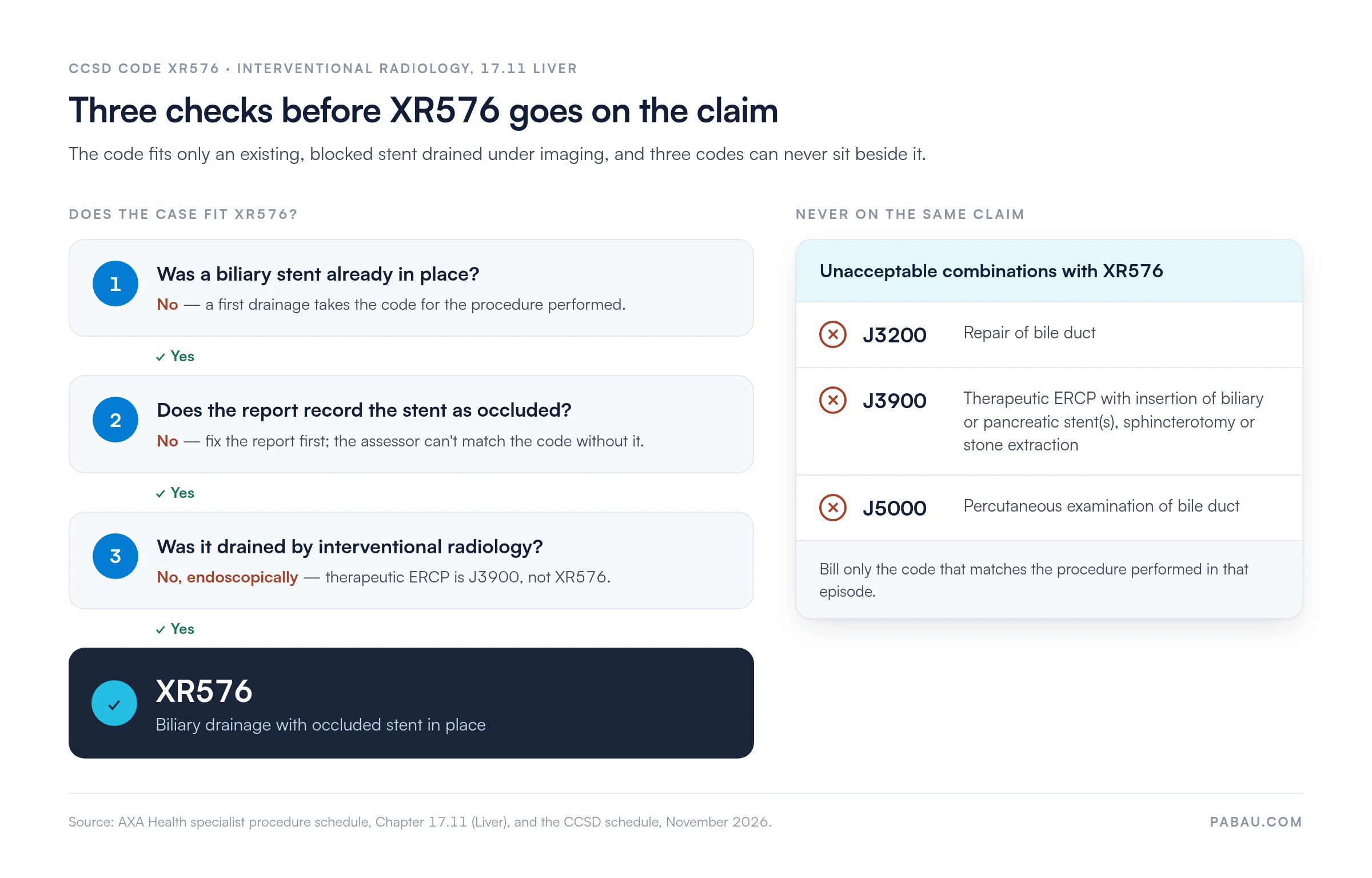
CCSD lists three unacceptable combinations with XR576: J3200 (Repair of bile duct), J3900 (Therapeutic ERCP) and J5000 (Percutaneous examination of bile duct). Don’t bill any of them alongside XR576 for the same episode.
J3900 matters most in practice, because a blocked stent is often cleared or replaced endoscopically instead. When that happens, the episode is billed as J3900 and XR576 drops off the claim.
The chart below puts the three fit checks and the barred codes side by side.
Other codes in sub-chapter 17.11.0 may sit close to XR576. Their exact boundaries are in the login-gated codebook, so check there before you choose between them. Our CCSD code library lists the neighbouring codes by chapter.
Most UK private medical insurers expect pre-authorisation for interventional procedures. Some patients present urgently, though. Ask each payer how it handles urgent or retrospective approval. Bupa’s procedure code lookup shows how Bupa lists a code.
Then follow these steps to send the claim through Healthcode:
For insurer-specific rules, our Bupa CCSD codes guide walks through how Bupa handles codes and invoices.
Most problems with this code come from a mismatch between the claim and the report. These are the ones to watch:
CCSD doesn’t set fees for XR576. Each insurer publishes its own schedule, and contracted rates can differ from it.
Check the Aviva fee schedule or the Healix fee schedule. AXA Health’s schedule lists XR576 at £750, plus £142 for general anaesthesia. For Bupa, use its provider portal. Quote patients a figure only after their insurer confirms it.
Urgent biliary cases leave little time for admin. Authorization references, reports and claims can easily drift apart across systems.
Pabau’s billing software keeps the appointment, the report and the claim on one patient record. With claims management linked to Healthcode, you send insurer claims and track their status in one place.
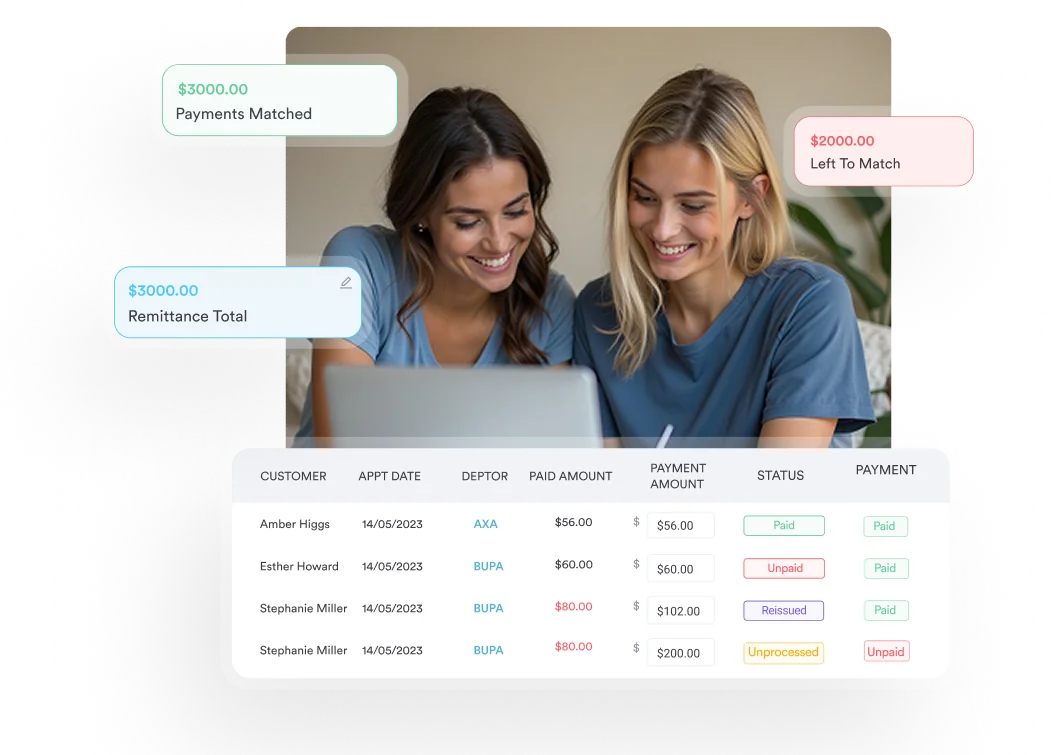

Pabau links each appointment, report and insurer claim on the patient record, and tracks claim status after you submit.

XR576 is narrow by design. It fits biliary drainage when a stent is already in place and blocked.
Get that match right, and keep J3200, J3900 and J5000 off the same claim. Then confirm the full includes and excludes in the CCSD codebook. Work done before the procedure saves appeals later.
Book a demo to see how Pabau keeps insurer claims and their paperwork together.

Dilating a biliary stricture instead? CCSD code XR565 covers billing for biliary stricture dilatation.
Managing the stent endoscopically? CCSD code J3900 explains billing for therapeutic ERCP.
Draining the gallbladder rather than the ducts? CCSD code XR580 covers percutaneous cholecystostomy billing.
Billing Bupa for interventional work? Bupa CCSD codes guide covers code recognition, pre-authorization and invoicing.
It’s a biliary stent that has become blocked and no longer drains bile well. Sludge, debris or tissue growth can cause the blockage. Patients may then develop jaundice or infection.
CCSD lists J3200 (Repair of bile duct), J3900 (Therapeutic ERCP) and J5000 (Percutaneous examination of bile duct) as unacceptable combinations. Bill only the code that matches the procedure performed in that episode.
XR codes are the radiology codes in the CCSD schedule. They cover diagnostic imaging, such as plain films, and interventional procedures like XR576.
XR576 is an interventional radiology code. An endoscopic stent procedure takes its own code, such as J3900 for therapeutic ERCP. Check the codebook for the exact match.
Log in to the CCSD website to search the full schedule. Some insurers, such as Bupa, also offer public code lookups showing how they list each code.
Most UK private medical insurers use CCSD codes. Each one still decides what it covers and pays, so check the payer’s schedule before the procedure.




