CCSD Code M2510: Ureterocele excision billing guide
CCSD Code M2510: Definition and clinical scope CCSD Code M2510 is the Clinical C...

Last Updated: Nov 3, 2026
J3900 is the CCSD code for therapeutic ERCP with insertion of a biliary or pancreatic stent, sphincterotomy or stone extraction. The endoscopist reaches the bile and pancreatic ducts through a duodenoscope and performs at least one of those interventions in the same session.
CCSD also lists J3800 for therapeutic ERCP without stent insertion and J4300 for diagnostic ERCP, including forceps biopsy. Insurers apply the CCSD Schedule through their own schedules, so check the payer's version before you bill.
Let Pabau's smart automation suggest the right codes, reduce claim denials, and keep your practice compliant—effortlessly.
Automate repetitive tasks and focus on what matters most—your patients.
Reduce coding errors and ensure compliance with the latest regulations.
Clean claims, fewer denials, and faster reimbursements.
Powerful insights and reporting to help your practice thrive.
HIPAA compliant SOC 2 certified GDPR-compliant Trusted by 4,000+ clinics worldwide

CCSD Code J3900 covers therapeutic ERCP with stent insertion, sphincterotomy or stone extraction in one session.
A therapeutic ERCP differs from a diagnostic one because a physical intervention is performed, not imaging alone. Using the wrong code risks denial.
Complete operative reports must document each intervention performed, the technique, and the clinical indication. Vague notes are a common cause of J3900 denials.
Digital procedure forms in Pabau, our practice management software, help private practices structure the documentation behind J3900 claims.
CCSD Code J3900 describes therapeutic ERCP, in which an endoscopist passes a side-viewing duodenoscope to the ampulla of Vater under fluoroscopic guidance. In the same session, they insert a biliary or pancreatic stent, perform an endoscopic sphincterotomy, or extract stones from the bile or pancreatic duct.
The code comes from the CCSD Group, which maintains the CCSD Schedule of procedure and diagnostic-test codes for UK private healthcare. J3900 is the therapeutic ERCP code that includes stent insertion, sphincterotomy and stone extraction. Therefore, do not add extra lines for components already included, and check each insurer’s schedule for its own bundling rules.
The four steps named in the J3900 descriptor can occur alone or together during one ERCP session. When several happen together, they stay on the J3900 line, and each one still needs its own entry in the operative report.
A sphincterotomy performed to help stone extraction or stent placement in the same session is part of the J3900 ERCP. Therefore, do not add it as an extra line on the same date of service. However, where a sphincterotomy is the only step, check the insurer’s schedule for the code it expects.
Therapeutic and diagnostic ERCP are not interchangeable for billing purposes. Rather, the difference is whether a hands-on step is performed during the endoscopy.
For this reason, insurers check this difference closely. A note that describes contrast injection and imaging, but names no therapeutic step, invites the insurer to reclassify the claim as diagnostic ERCP. That can lead to a reduced payment or a recoupment request, so anchor every J3900 claim in a record of the specific therapeutic act.
The ICD-10 diagnosis code submitted with J3900 must match the clinical reason recorded in the ERCP note. Specificity matters, because an unspecified code where a more specific one applies is a common cause of authorisation delays and retrospective denials. The table below covers common pairings.
ICD-10 codes are updated periodically, so confirm the codes above against the current UK edition before you submit. For example, a code that was deleted or revised in the latest update can trigger an automatic rejection.
Selecting the correct code depends on what was performed. The J-series contains distinct codes for related but other ERCP types. Using J3900 when a narrower or broader code is appropriate is an error that auditors find quickly.
Check the current CCSD Schedule at ccsd.org.uk for the full J-series descriptor list. Although searching the schedule requires a CCSD login, it remains the definitive reference as descriptors change.
Pabau’s CCSD codes library covers the rest of the schedule, with other biliary and upper GI cases.
Every J3900 claim stands or falls on the operative report. So, insurers expect the ERCP note to confirm the reason for each therapeutic step and manoeuvre. For instance, a report that calls the ERCP “successful” without detailing what was done is insufficient.
Structured digital ERCP forms prompt clinicians to record each required field before the note is finalised. For example, a form built around the J3900 descriptor makes it harder to sign off a note missing the stent size or stone count.
The following elements must appear in the ERCP records:
Complete clinical records also support your record-keeping duties as a UK private provider, such as the accuracy principle in UK GDPR. A missing detail in the operative note is a billing risk and a record-keeping risk at once.
Before submitting a J3900 claim, run a pre-billing check against the operative report. Confirm the therapeutic intervention is named, stent specifications or stone count are recorded, and fluoroscopy findings are documented. A two-minute check at the point of coding prevents weeks of denial management.
Major UK private insurers commonly require pre-authorisation before therapeutic ERCP, and each insurer sets its own rules. Proceeding without an authorisation reference number can lead to a denied claim, however well the ERCP is recorded. Confirm the rule with each payer before booking.
A pre-authorisation request for therapeutic ERCP should include:
In fact, incomplete submissions are a common cause of authorisation delays for therapeutic ERCP.
ERCP claim denials follow predictable patterns, and each has a checkpoint that stops it before submission. The five checkpoints below map each stage of a J3900 claim to the denial it prevents.
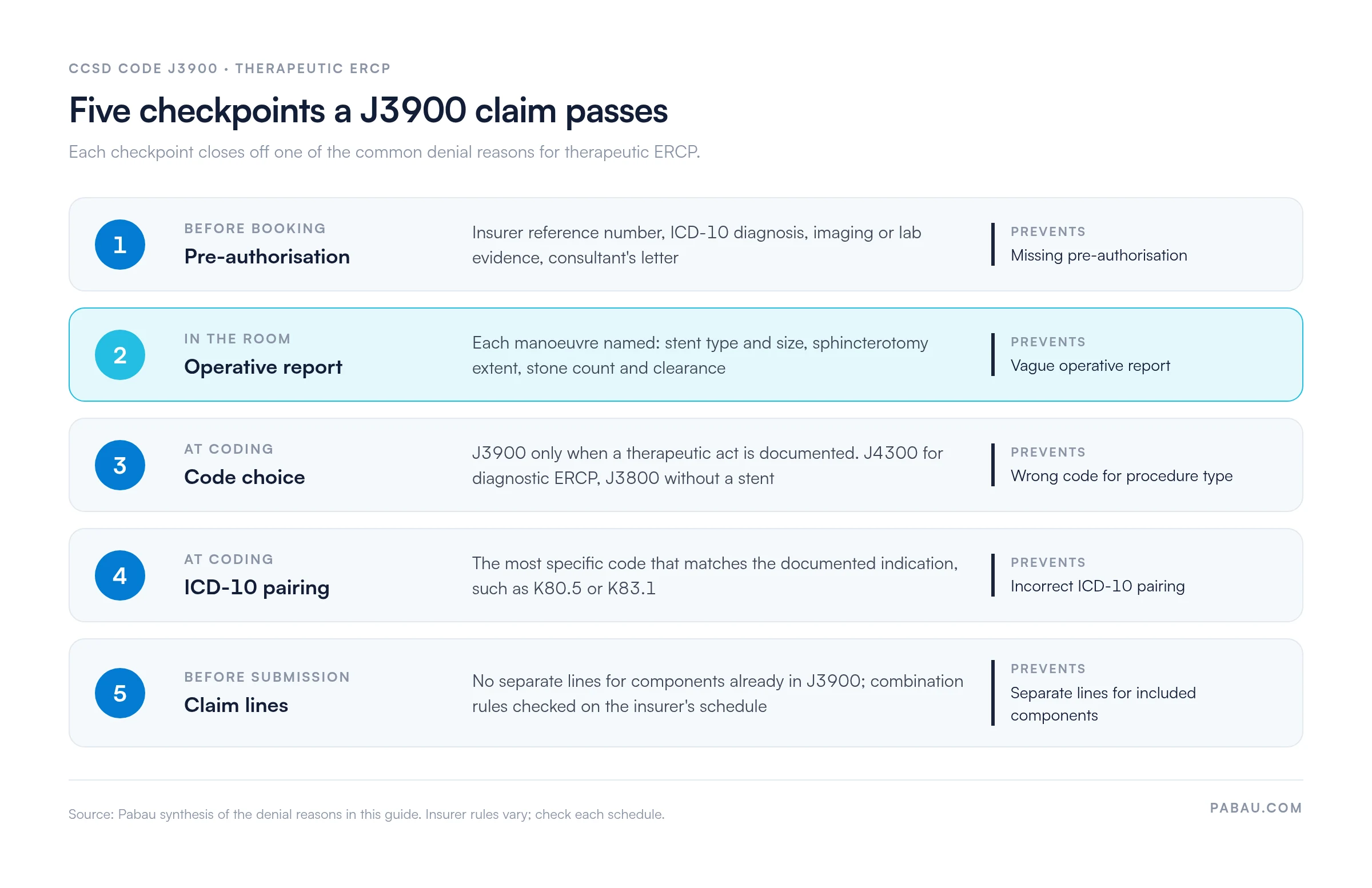
Claims management software that flags incomplete records before a claim leaves the practice guards against the patterns above. Catching a missing authorisation number at billing beats managing an appeal weeks later.
Fluoroscopy and sedation are the two ancillary services that raise the most billing questions about CCSD Code J3900.
Fluoroscopy is used during ERCP to guide scope positioning, confirm cannulation, and show the ductal system under contrast. However, whether it is bundled into J3900 or billed separately depends on the individual insurer’s fee schedule and billing rules.
For example, some insurers treat fluoroscopy as integral to the ERCP and will not reimburse it as an add-on. Others permit an extra radiology code when a radiologist provides live guidance distinct from the endoscopist’s use of the C-arm. Confirm the insurer’s position before submitting an extra fluoroscopy line.
When an anaesthetist gives propofol sedation or a general anaesthetic for ERCP, the anaesthetist usually submits their own claim. They use the code and fee their insurer’s schedule sets for anaesthetic services on that case.
When the endoscopist gives moderate sedation (e.g. midazolam and fentanyl), the billing position varies by insurer. Endoscopist-administered sedation is generally not reimbursed separately from J3900 unless the insurer’s schedule includes an add-on code for it.
Post-procedural complications arising from a J3900 ERCP require secondary ICD-10 coding to support any subsequent care claims. The table below maps the most clinically significant complications to their coding.
When a patient requires readmission or further treatment because of a post-ERCP complication, the complication code supports the medical necessity of those subsequent claims. Otherwise, follow-up admissions may appear clinically unmotivated.
Many private endoscopy practices still keep the ERCP note in free text and the pre-authorisation number in an email thread. The claim then goes out from another billing tool. As a result, each hand-off is a chance to lose the stent size, the stone count or the insurer reference.
Pabau holds those pieces on one patient record. Digital ERCP forms can require an entry for each step before the note is signed, and the authorisation reference sits on the same record. Finally, at checkout, the claim goes to the insurer through Healthcode with the details your team already recorded.
The result is a J3900 claim that matches its operative report, with fewer queries coming back from insurers after submission.

Pabau helps gastroenterology and surgical practices structure procedure documentation, manage CCSD billing workflows, and reduce claim errors. See how it fits your practice.

Treat the operative report as the claim. If it names each therapeutic act, the stent specification and the stone count, a J3900 claim holds up at review. It also shows clearly when J4300 or J3800 fits the case better.
Overall, the trade-off is a few extra minutes of structured note-taking per case against weeks of correspondence over a reclassified claim. Confirm pre-authorisation and the insurer’s own schedule before the list date, because CCSD codes and payer rules change independently.
Book a demo to see how Pabau helps your endoscopy team turn each ERCP note into a claim-ready record.

Need a complete Bupa CCSD billing reference? Bupa CCSD codes guide covers the full Bupa procedure code schedule and billing rules for UK private practice.
Billing a diagnostic ERCP instead? CCSD code J4300 covers diagnostic ERCP, including forceps biopsy, and when it applies.
Is a cholecystectomy next for this patient? CCSD code J1830 explains how to bill laparoscopic cholecystectomy.
Coding an endoscopic ultrasound before ERCP? CCSD code J6730 walks through endoscopic upper GI ultrasound billing.
Looking to improve your private practice billing process? Claims management software streamlines CCSD claim submission and tracks denial patterns across your caseload.
CCSD Code J3900 covers therapeutic ERCP with insertion of a biliary or pancreatic stent, endoscopic sphincterotomy, or stone extraction in the same session. It is the therapeutic ERCP code that includes those components, so do not add separate lines for them. Check each insurer’s schedule for its own rules.
Diagnostic ERCP involves contrast injection and ductal imaging with no physical intervention. Therapeutic ERCP involves at least one intervention: stent insertion, sphincterotomy, or stone removal. They are billed under different CCSD codes. Billing J3900 when only diagnostic imaging was performed is upcoding and can be reclassified on review.
It depends on the insurer. Some treat fluoroscopy as integral to ERCP and will not pay a separate radiology code. Others permit an add-on when a radiologist provides distinct live guidance. Confirm each insurer’s billing rules before including a fluoroscopy line on a J3900 claim.
Code post-ERCP pancreatitis with the most specific acute pancreatitis code in K85, plus K91.8 for a postprocedural disorder of the digestive system. Document the onset relative to the procedure date. The complication codes support medical necessity for any later admissions or treatment arising from the episode.