HCPCS code G0143: Thin-layer Pap screening with rescreening
HCPCS code G0143 means two manual reads of one liquid-based slide HCPCS code G01...

Last Updated: Oct 19, 2026
H5520 is the CCSD code for laying open of high anal fistula (fistulotomy) including sigmoidoscopy. It covers fistulotomy of a high fistula-in-ano, where the tract runs through or above a significant part of the anal sphincter. Sigmoidoscopy in the same operation is bundled into the code and is never billed separately.
The code sits in Chapter 11 of the CCSD schedule, under 11.6 Rectum/Anus. A low fistula laid open the same way bills under H5510, and closing a fistula with a plug bills under H5530.
Let Pabau's smart automation suggest the right codes, reduce claim denials, and keep your practice compliant—effortlessly.
Automate repetitive tasks and focus on what matters most—your patients.
Reduce coding errors and ensure compliance with the latest regulations.
Clean claims, fewer denials, and faster reimbursements.
Powerful insights and reporting to help your practice thrive.
HIPAA compliant SOC 2 certified GDPR-compliant Trusted by 4,000+ clinics worldwide

CCSD Code H5520 covers laying open a high anal fistula, with sigmoidoscopy bundled into the same code.
Never bill sigmoidoscopy as a separate line alongside H5520, because the descriptor already includes it.
High fistulas involve significant sphincter muscle, while low fistulas bill under H5510, which also bundles sigmoidoscopy.
H5530 covers closing a fistula with a plug, so it never stands in for H5520 on a tract that was laid open.
Pabau, the practice management platform we build, links the operative note, preauthorisation number and CCSD code on each claim.
CCSD Code H5520 is defined by the Clinical Coding and Schedule Development (CCSD) group as laying open of high anal fistula (fistulotomy) including sigmoidoscopy.
The sigmoidoscopy wording is part of the descriptor, and it sets the billing rule. Sigmoidoscopy performed during this procedure is included in the code and cannot be claimed as an additional item.
H5520 sits within CCSD Chapter 11, Abdomen (excluding urinary and reproductive organs), Rectum/Anus category. Its neighbours are H5510, for a low fistula laid open the same way, and H5530, for closing a fistula with a plug. The rest of the chapter sits in our CCSD codes library.
The “high” classification refers to fistulas whose tract passes through or above the external anal sphincter, typically described as suprasphincteric or extrasphincteric. High fistulas carry more procedural complexity and stricter documentation requirements than low fistulas. They also sit higher in insurer fee schedules.
Laying open a high anal fistula is performed under general anaesthesia by a consultant colorectal surgeon. The operative note should reflect five core steps to support the H5520 claim.
Anaesthesia is billed separately. The anaesthetist submits their own CCSD codes, which are not bundled into H5520. Check the current CCSD Technical Guide (October 2025) for the unbundling rules that apply to your insurer contracts.
H5520 is appropriate when the operative findings and documentation confirm a high fistula-in-ano meeting the criteria below. The code should not be used if the fistula is classified as low on operative assessment.
H5520 is not appropriate for low or intersphincteric fistulas, which bill under H5510. Sphincter-sparing repairs need other codes too. Closing the tract with a suturable bioprosthetic or synthetic plug bills under H5530.
An advancement flap or a ligation of the intersphincteric fistula tract (LIFT) procedure falls under different CCSD codes again.
The single most common billing error on H5520 claims is a separate sigmoidoscopy code submitted alongside the procedure. The CCSD descriptor includes sigmoidoscopy within H5520, so it is a bundled element rather than an additional billable item.
This applies whether the sigmoidoscopy is rigid or flexible, as the descriptor covers both. A separate sigmoidoscopy code gets the secondary item denied, or the whole claim queried for duplicate billing.
The clinical rationale for the bundle is straightforward. Sigmoidoscopy during a high fistulotomy is a standard intraoperative step to assess the internal opening in relation to the rectal wall. Insurers and the CCSD schedule treat it as part of the operative assessment rather than a standalone diagnostic episode.
If the patient also needs a full diagnostic colonoscopy as a separate episode before or after surgery, code it under the appropriate endoscopy code. The H5520 bundle applies only to sigmoidoscopy performed within the same operative episode as the fistulotomy.
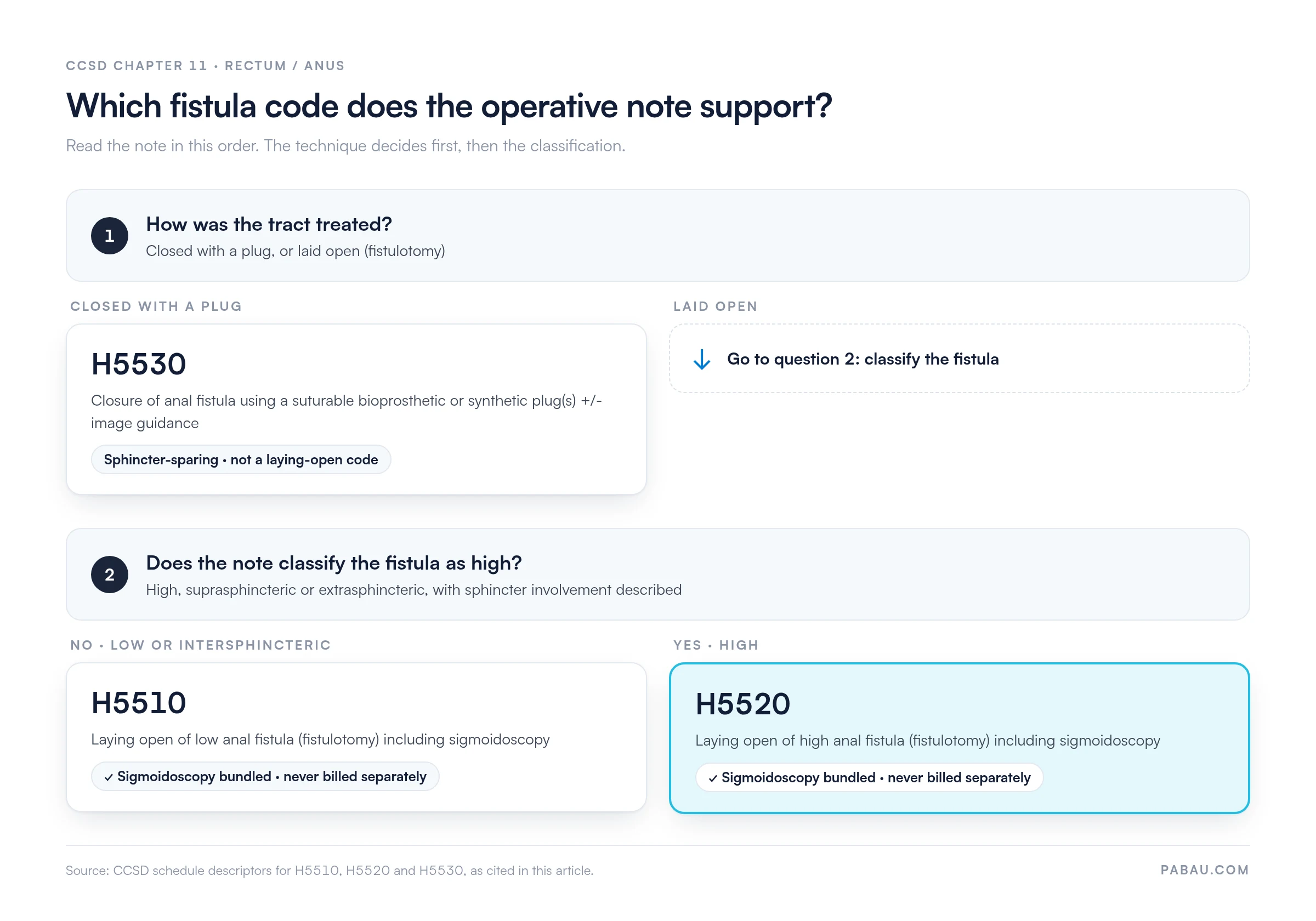
Choosing between H5510, H5520 and H5530 depends on the operative findings documented in the surgeon’s note. Billing H5510 for a high fistula, or H5520 for a plug closure, is a leading cause of claim denial and audit risk.
The operative note is the coding document. If the note does not use the word “high” or describe sphincter-complex involvement, it cannot support H5520, and H5510 is the safer default.
Upcoding from H5510 to H5520 without documented operative findings is an audit risk under all major insurer contracts. The decision path below follows the order a coder should read the note in.
Insurers reviewing CCSD Code H5520 claims check the operative note for specific elements. A note that confirms surgery took place without documenting the fistula classification is insufficient. The following elements must be present before you submit the claim.
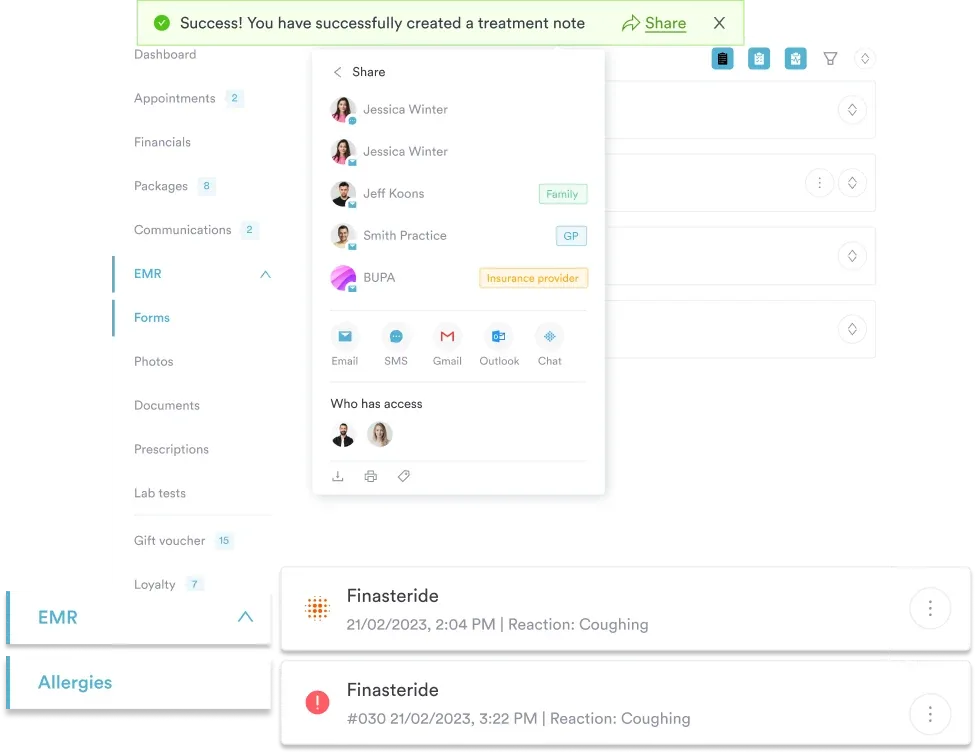
When the operative note and the claim live on the same patient record, these checkpoints can become part of the pre-billing workflow. An incomplete note then gets caught before it reaches the insurer.
Most UK private insurers require preauthorisation before H5520 is performed. As an inpatient procedure under general anaesthesia, it triggers mandatory prior approval under standard Bupa, AXA Health, Aviva and Vitality policies. A missing preauthorisation is the leading cause of post-operative denial, and the loss is typically non-recoverable.
A preauthorisation request for H5520 must include the following information. Requirements vary by insurer and are updated periodically, so confirm current terms with each one before submission.
Aviva’s fee schedule guidance and Vitality’s fee finder both list H5520-category procedures under inpatient surgical bands that need preauthorisation. AXA Health’s portal allows a code-specific preauthorisation lookup.
If you bill several insurers, track each authorisation number against its procedure code so no claim goes out without one.
H5520 claim denials follow predictable patterns. Knowing the common reasons lets the billing team catch errors before submission rather than after rejection.
Run a pre-submission checklist on every H5520 claim. Confirm the preauthorisation number is attached and the operative note uses the word ‘high’. Check that sigmoidoscopy is documented but not separately coded, and that the ICD-10 code is K60.3, K60.4 or K60.5.
Every H5520 claim submitted to a UK private insurer must carry a supporting ICD-10 diagnosis code. The right code depends on the anatomical classification of the fistula documented in the clinical record.
Insurers accept these pairings as standard, though not across every policy type. Each diagnosis code should match what the clinical notes record, so never pick the ICD-10 code independently of the documented diagnosis.
Where the anatomical classification is ambiguous, review the operative note with the surgeon before submitting. Our guide to Bupa CCSD codes explains how Bupa processes diagnosis-to-procedure pairings for colorectal procedures.
Accurate H5520 billing rests on three things. You need the right code backed by documentation, a valid preauthorisation number, and an operative note with every element insurers expect. Pabau, the practice management platform we build for private practices, keeps all three on the same patient record.
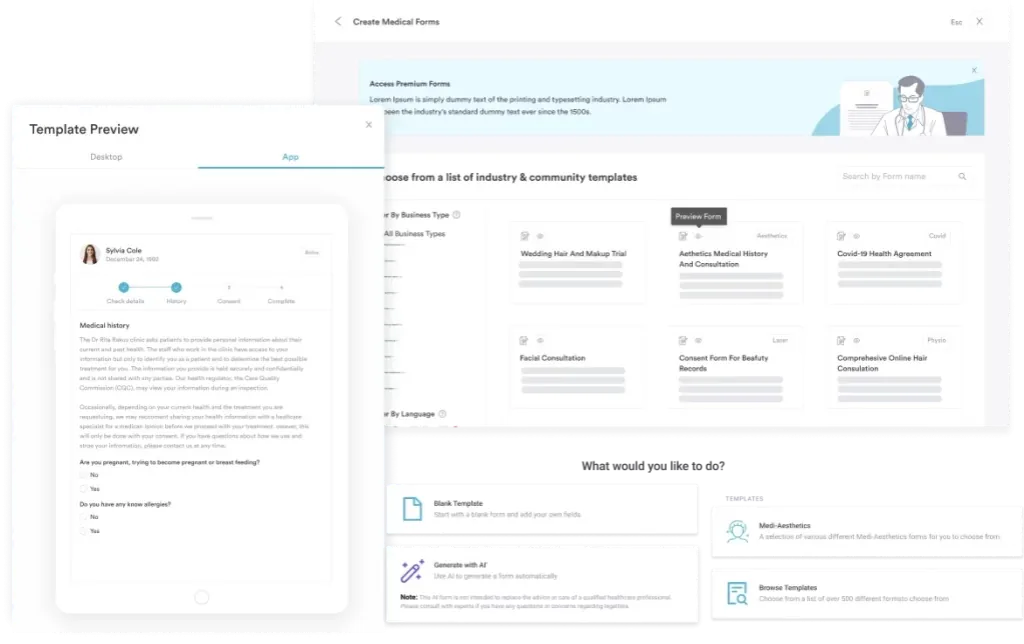
In Pabau’s claims management software, your billing team searches the CCSD code library and attaches procedure and diagnosis codes at the point of billing. The preauthorisation number is linked to the patient record, so a claim heading out without one is easy to spot. That heads off the most common H5520 denial before the claim leaves the practice.
On the documentation side, Pabau’s digital forms let surgical teams capture operative note elements, sphincter classification and sigmoidoscopy confirmation in structured fields.
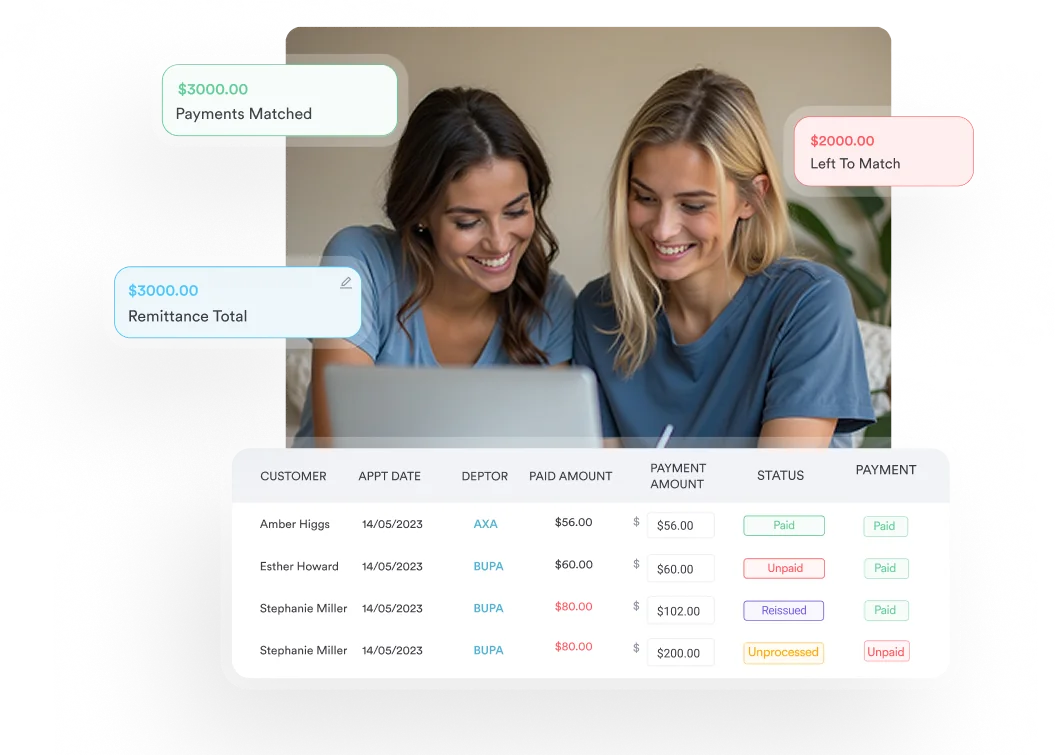
Those fields link to the patient record and the claim, which gives you an audit trail when an insurer queries the code. Pabau’s reporting then shows H5520 acceptance rates by insurer, so recurring denial patterns surface early.

Pabau helps colorectal and surgical teams submit accurate CCSD claims with preauthorisation tracking, insurer-specific rules, and complete operative documentation linked to every claim.

H5520 rewards coders who read the operative note before they pick a code. If the note says high and confirms the sigmoidoscopy, H5520 stands, and the sigmoidoscopy stays off the claim. If either element is missing, query the surgeon before you submit instead of defaulting to the higher code.
A few minutes of checking costs far less than a denied claim, and a missing preauthorisation can make that denial unrecoverable. Book a demo to see how Pabau keeps the operative note, preauthorisation and CCSD code together on every fistula claim.

Billing another rectum and anus procedure? CCSD Code H4200: Perineal repair of prolapse of rectum walks through a neighbouring Chapter 11 code and how insurers handle it.
Coding the same surgery for a US payer? CPT Code 46280: Anal fistula surgery billing guide explains how complex anal fistula surgery is reported with CPT codes.
Want to reduce claim errors across all your CCSD procedures? Pabau’s claims management software supports CCSD code submission with insurer-specific rule tracking and preauthorisation management.
CCSD Code H5520 is the UK private healthcare procedure code for laying open a high anal fistula, with sigmoidoscopy bundled into the same code. It applies to suprasphincteric or extrasphincteric fistulas, operated on under general anaesthesia by a consultant colorectal surgeon.
No. Sigmoidoscopy is explicitly included in the H5520 descriptor. Billing a separate sigmoidoscopy code alongside H5520 for the same operative episode is incorrect. It is one of the most common causes of denial on this code.
H5510 and H5520 both lay open an anal fistula, and both include sigmoidoscopy. H5510 is for a low fistula with minimal sphincter involvement, while H5520 is for a high fistula involving the sphincter complex. H5530 covers closing a fistula with a suturable bioprosthetic or synthetic plug, which is a sphincter-sparing technique rather than a laying-open procedure.
The most common pairings are K60.3 (anal fistula), K60.4 (rectal fistula) and K60.5 (anorectal fistula). The correct code depends on the anatomical classification in the clinical notes. A diagnosis code that does not relate to a fistula will trigger a procedure-to-diagnosis mismatch denial.
The most common reasons are duplicate billing of sigmoidoscopy, H5510 submitted for a high fistula, and missing preauthorisation. An operative note that does not classify the fistula as high, or does not confirm the sigmoidoscopy, also gets claims denied.
Bupa, AXA Health, Aviva and Vitality all recognise H5520 within their CCSD-based fee schedules. WPA, Healix, Allianz Care and Cigna UK also use the CCSD schedule. Each insurer sets its own fee level and preauthorisation requirements, so confirm current terms directly before submitting.