CCSD code H1300: Bypass of colon billing guide
What CCSD code H1300 covers, and what it doesn’t CCSD code H1300 is the sc...

Last Updated: Oct 20, 2026
H4430 is the CCSD code for examination of rectum under anaesthetic, billed when the examination is the sole procedure. Surgeons list it when pain, spasm or a suspected abscess, fistula or tumor makes an awake examination impossible. With the patient anesthetized, the anal canal and lower rectum can be assessed properly.
The claim turns on three words: as sole procedure. Once a biopsy, prolapse repair or resection follows in the same session, H4430 drops out and the other code carries the claim. Pair it with a matching ICD-10 diagnosis, confirm pre-authorization before the list date, and keep the operation note consistent with both.
Let Pabau's smart automation suggest the right codes, reduce claim denials, and keep your practice compliant—effortlessly.
Automate repetitive tasks and focus on what matters most—your patients.
Reduce coding errors and ensure compliance with the latest regulations.
Clean claims, fewer denials, and faster reimbursements.
Powerful insights and reporting to help your practice thrive.
HIPAA compliant SOC 2 certified GDPR-compliant Trusted by 4,000+ clinics worldwide

CCSD code H4430 covers examination of the rectum under anaesthetic, billed only when no other procedure happens in the same session.
The CCSD schedule lists unacceptable combinations with H4430, including H4200, H3320, H4680 and H5640.
Pair H4430 with the ICD-10 diagnosis that prompted the examination, such as K61.0 anal abscess or K62.5 rectal bleeding.
Pre-authorization rules vary by insurer and policy, so confirm them with Bupa, AXA Health, Aviva, Vitality or Freedom Health first.
CCSD code H4430 is the UK private medical insurance code for examination of rectum under anaesthetic, as sole procedure. It sits in Chapter 11 of the CCSD schedule, in sub-chapter 11.6.0 Rectum / Anus. The code was added to the schedule on 3 June 2013.
The surgeon examines the anal canal and rectum while the patient is anesthetized. Usually, pain or spasm makes a proper examination impossible at an outpatient appointment. Suspected abscesses, fistulas, strictures and unexplained bleeding are common reasons for listing one.
The CCSD Group maintains the schedule that Bupa, AXA Health, Aviva, Vitality and other insurers use. Its code detail sits behind a login, so check the current descriptor before you bill. The NHS uses OPCS-4 codes instead, and the two systems are not interchangeable.
Three words decide most H4430 claims: as sole procedure. If the surgeon only examines, H4430 is the right code. If a billable procedure follows in the same session, that procedure carries the claim instead, as the diagram below shows.
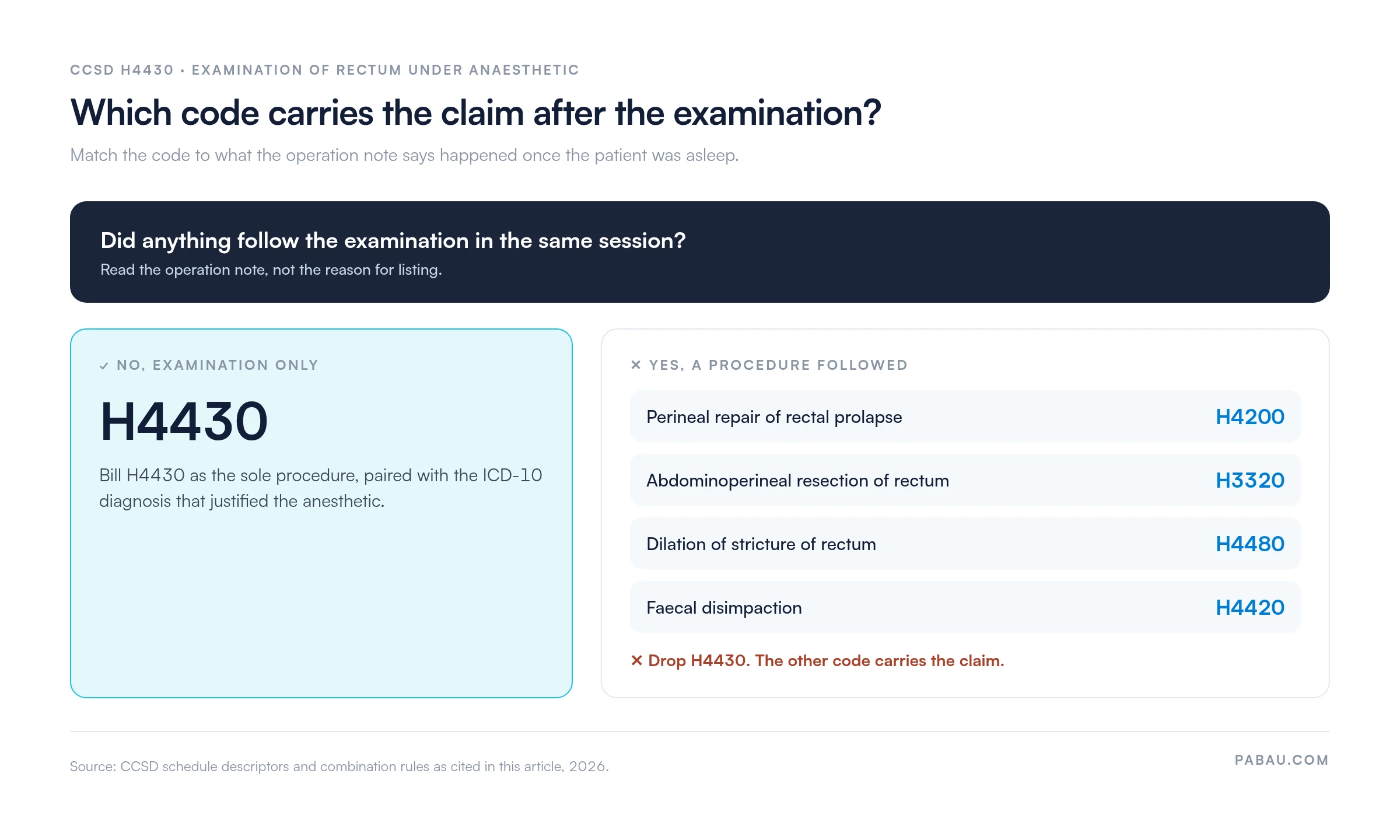
The CCSD schedule lists unacceptable combinations with H4430, including:
The schedule also lists AC100, G4520, H2510, brachytherapy codes and anterior resection codes. In each case, the examination is treated as part of the larger procedure. Billing both lines invites a rejection. Even when a pair gets paid, an insurer audit can claw the money back later.
Anesthesia is the other boundary. The anesthetist bills their own fee to the insurer, so it never sits inside the surgeon’s H4430 line. Insurers also review bundling rules on their own schedules, so confirm them with the insurer where the session was unusual.
Several codes near H4430 cover the same anatomy. Our CCSD guides for consultants walk through many of them one by one. They differ in what the surgeon did once the patient was asleep. Match the code to the operation note, not to the reason for listing.
Insurer clinical reviewers compare the code with the operation note. If the note mentions a biopsy, a dilation or a disimpaction, H4430 will not hold up on its own.
Every CCSD claim needs an ICD-10 diagnosis code. UK insurers use the WHO edition of ICD-10, not the US ICD-10-CM. For H4430, the diagnosis should explain why the rectum needed examining under anesthesia.
Use the confirmed diagnosis wherever you have one. When the examination finds nothing, code the sign or symptom that justified it. Then record the negative finding in the note.
Insurers audit claims after payment, and the operation note is what they read. For H4430, it has to show an examination and nothing more.
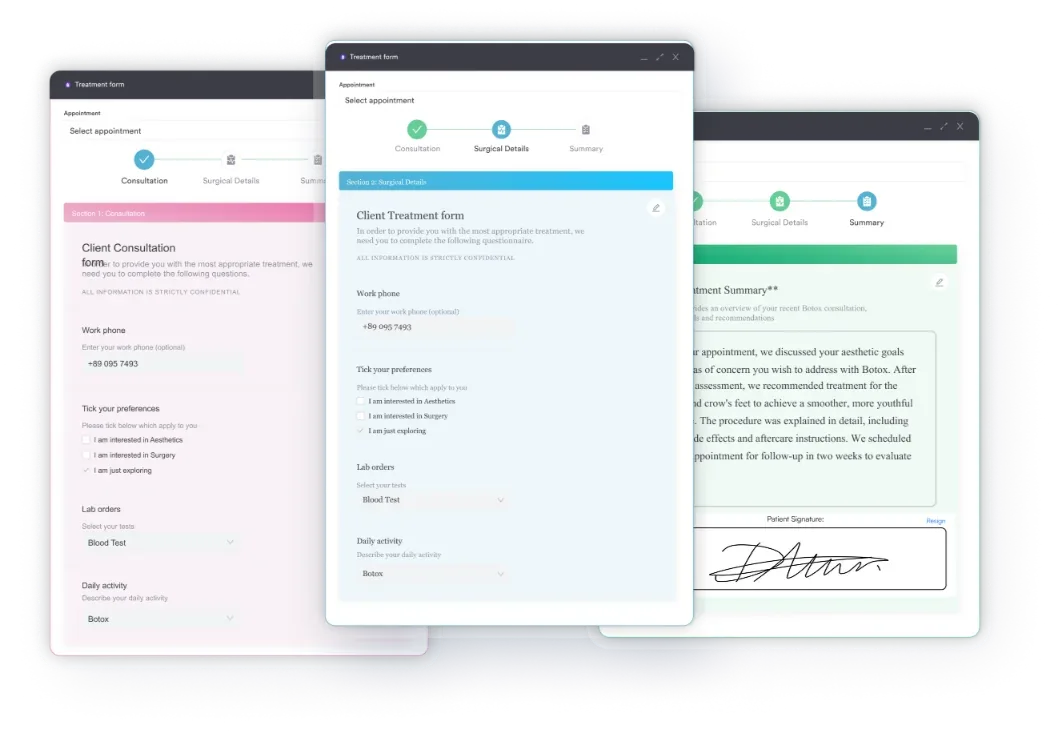
Pabau, the practice software we build, collects consent and pre-procedure questionnaires through digital forms before the list date. The signed copies land in the patient record, so you can answer an insurer’s evidence request quickly.
Pre-authorization for H4430 depends on the insurer and on the patient’s policy. Rules also change without public notice. Treat the table below as a starting point, and confirm with the insurer before the list date.
Treating without an authorization the policy requires is a reliable way to lose the fee. Get the approval in writing and keep the reference number for the claim.
Request pre-authorization when the examination is listed, not on the day. Some insurers will not back-date an approval, even when the clinical case is clear. Make a confirmed authorization a condition of booking the theater slot.
Healthcode is the main electronic billing route for UK private medical insurance. Many insurers, including Bupa, AXA Health, Aviva and Vitality, take claims through it. Coverage still varies, so confirm your patient’s insurer accepts electronic claims before you rely on it.
Where Healthcode is not an option, most insurers accept an invoice sent to their provider team. Paper claims take longer, though, so electronic submission is the better default.
A two-minute check before submission saves weeks of rework. Tick each line against the operation note.
Rejections on H4430 follow a few patterns. Most come down to the code and the note telling different stories.
To appeal, write to the insurer’s provider team with the claim number and the supporting notes. Appeal windows vary by insurer, so check the deadline as soon as a rejection arrives. The Bupa CCSD codes guide covers Bupa’s own billing rules in more detail.
No single fee applies to H4430. Each insurer sets its own rate and reviews it periodically. Rates can also differ by the consultant’s recognition arrangement, and third-party figures go out of date fast.
To check the fee that applies to your practice:
When the fee exceeds the insurer’s rate, the balance becomes a patient shortfall. Some policies cover part of it, while others do not. Explain any likely shortfall at the consultation, before the examination is booked.
Review your fee schedules with each insurer once a year. Insurers update rates at different times, so a fee that was within schedule last year may now create a shortfall.
In many consultant practices, a secretary still copies the code and diagnosis into each insurer’s portal by hand. Then someone chases every claim by phone. Each retyped field is another chance for a rejection.
Pabau integrates with Healthcode, so your team sends the claim from the patient record instead of a separate portal. Its claims management view then shows the status of each submitted claim in one place.
Before the list date, Pabau’s digital forms collect consent and pre-procedure questionnaires. The signed forms stay in the patient record, so you can send evidence the day an insurer asks. The result is fewer retyped claims and faster answers to queries.

Pabau sends Healthcode claims from the patient record and shows each claim’s status in one place, so queries get answered sooner.

Treat H4430 as the code for one kind of session. The patient goes under, the surgeon examines, and the session ends there. Once a biopsy, dilation or repair follows, the other code carries the claim.
Claims hold up when the note, the diagnosis and the authorization agree. Check all three before the list date, rather than after the rejection letter arrives. Book a demo to see how Pabau sends Healthcode claims and tracks their status for your practice.

Billing a prolapse repair after the examination? CCSD code H4200 explains how perineal repair of rectal prolapse is coded and claimed.
Did the examination lead to fistula surgery? CCSD code H5520 covers laying open of a high anal fistula and its claim rules.
Coding a major rectal resection? CCSD code H3320 walks through abdominoperineal resection of rectum billing.
Billing other Bupa CCSD codes? Bupa CCSD codes guide covers the wider Bupa procedure code framework for private practitioners.
EUA stands for examination under anaesthetic. The surgeon examines an area while the patient is anesthetized, usually because an awake examination would be too painful or incomplete.
Yes, as long as no other procedure was performed. Code the sign or symptom that justified the examination, and record the negative finding in the note.
No. H4430 requires the patient to be under anesthesia. An awake examination in outpatients is coded differently, so check the CCSD schedule for the right entry.
No. H4430 covers the surgeon’s fee for the examination. The hospital bills its theater, bed and nursing charges to the insurer separately.
Usually, yes. Most patients go home the same day, though the setting depends on the patient’s health and on what the surgeon finds.
Yes, if the later session is a separate episode on a different date. A planned procedure in the same session absorbs the examination instead.