
Pabau Engage inbox

Pabau Engage is here: every patient conversation in one inbox.

Learn more
Book a demo Book a demo
☰
CCSD Code

CCSD code H5020 – Repair of anal sphincter


Code Definition

H5020 is the CCSD code for repair of anal sphincter (including sigmoidoscopy). It covers surgical repair of a disrupted internal or external anal sphincter. The sigmoidoscopy done in the same operative episode is bundled into the code.

H5020 sits in section 11.6.0 Rectum/Anus of the schedule's abdomen chapter. UK private insurers expect preauthorization for elective cases and an operative note that confirms the sigmoidoscopy.

Group
11.0.0 Abdomen (excl. urinary & reproductive organs)
Category
11.6.0 Rectum/Anus
CCSD reference
Fk.100
Billable
No
Code also known as
sphincteroplasty, anal sphincter repair, overlapping sphincteroplasty, sphincter reconstruction, anal repair surgery
Save time. Improve accuracy. Get paid faster.
Automate coding with Pabau

Let Pabau's smart automation suggest the right codes, reduce claim denials, and keep your practice compliant—effortlessly.

  • AI-powered code suggestions
  • Real-time compliance checks
  • Faster claims, fewer denials
Why practices choose Pabau
Save hours every week

Automate repetitive tasks and focus on what matters most—your patients.

Improve accuracy

Reduce coding errors and ensure compliance with the latest regulations.

Get paid faster

Clean claims, fewer denials, and faster reimbursements.

Grow with confidence

Powerful insights and reporting to help your practice thrive.

HIPAA compliant SOC 2 certified GDPR-compliant Trusted by 4,000+ clinics worldwide

Key takeaways

Key takeaways

CCSD code H5020 covers repair of the anal sphincter, with an intraoperative sigmoidoscopy in the same operative episode included in the code.

The sigmoidoscopy is bundled into H5020. A separate sigmoidoscopy code such as H2510 in the same episode is unbundling, and insurers reject it.

Bupa, AXA Health, Aviva, Vitality, and Cigna all require preauthorization before an elective sphincter repair admission.

The operative note must confirm the sigmoidoscopy, describe the defect, and name the technique, or the claim invites queries and refusal.

Pabau, the practice management platform we build, helps teams capture the documentation insurers ask for in structured operative notes.

CCSD code H5020: Official descriptor and scope

CCSD code H5020 is the Clinical Coding and Schedule Development (CCSD) code for repair of the anal sphincter. Its official descriptor reads Repair of anal sphincter (including sigmoidoscopy). It sits in section 11.6.0 Rectum/Anus of the schedule’s abdomen chapter, under reference Fk.100. The words “including sigmoidoscopy” make the anorectal assessment part of the procedure, so it is never submitted as a separate code.

The code applies when a colorectal surgeon repairs a disrupted or deficient external or internal anal sphincter, with a sigmoidoscopy done under the same anesthetic. The sigmoidoscopy checks the rectal mucosa for injury and guides the surgical field before or after the repair itself. Deliberately dividing the internal sphincter to heal a fissure is a different operation, billed as code H5620.

What the procedure involves

Anal sphincter repair under H5020 typically runs through four steps.

  1. Sigmoidoscopy: A rigid or flexible sigmoidoscope is passed to check the rectal mucosa and the anorectal junction. It also rules out a full-thickness tear into the rectal lumen.
  2. Sphincter identification: The disrupted ends of the external anal sphincter (EAS) are identified, freed from surrounding scar tissue, and mobilized. Where the internal anal sphincter (IAS) is also defective, it is repaired separately before the EAS.
  3. Repair technique: Under Association of Coloproctology of Great Britain and Ireland (ACPGBI) guidance, the leading technique is overlapping sphincteroplasty. The mobilized muscle ends are overlapped and secured with interrupted sutures. End-to-end repair remains acceptable where tissue allows. The CCSD descriptor does not mandate a technique, so both are captured under H5020.
  4. Closure: The perineal skin and subcutaneous tissues are closed in layers. Closure is part of the repair and is not separately billable.

Endoanal ultrasound (EAUS) or anorectal MRI is routinely done before surgery to characterize the sphincter defect. Imaging is not part of H5020. It is coded separately as a diagnostic procedure in an earlier episode.

Clinical indications for H5020

H5020 fits a confirmed structural sphincter defect causing symptomatic fecal incontinence that conservative management has not controlled. The main clinical scenarios are below.

  • Obstetric anal sphincter injury (OASIS): Third- and fourth-degree perineal tears after vaginal delivery are the most common indication. NHS and ACPGBI guidance both recognize OASIS sphincter disruption as a surgical indication. A delayed repair, done months or years after delivery, is coded under H5020 exactly like an immediate one.
  • Traumatic sphincter injury: Perineal trauma from road traffic accidents, impalement, or iatrogenic injury during anorectal surgery may disrupt the sphincter complex and need formal repair.
  • Post-surgical defect: A sphincter defect after fistulotomy, hemorrhoidectomy, or lateral internal sphincterotomy may be repaired under H5020 when it causes significant incontinence.
  • Failed conservative management of fecal incontinence: Surgery is indicated when pelvic floor physical therapy, dietary changes, and biofeedback have failed. Imaging must also confirm a defect. The clinical record must show that those options were tried.

H5020 is not appropriate for fecal incontinence caused by pudendal neuropathy without a structural sphincter defect. Where incontinence is neurogenic and imaging shows no defect, payers will not support sphincter repair and typically refuse the claim.

What H5020 includes and excludes

Knowing where H5020 stops prevents the most common claim errors. The table below maps each component or add-on to its billing status.

Component Included in H5020? Notes
Intraoperative sigmoidoscopy Yes, included Never billed as a separate endoscopy code in the same operative episode. Unbundling this component is the leading cause of H5020 claim rejection.
Perineal and skin closure Yes, included Wound closure is part of the repair. No separate closure or wound management code should be added.
IAS and EAS repair in the same episode Yes, included H5020 captures a combined internal and external sphincter repair in one sitting. No additional sphincter repair code is billable in the same episode.
Anesthesia (general or spinal) No, billed separately The anesthetist submits anesthetic fees under their own CCSD anesthesia code for the procedure time.
Assistant surgeon fee No, billed separately if covered Most UK PMIs permit an assistant surgeon code alongside H5020, but reimbursement varies by insurer. Confirm with the payer before submitting. Some insurers require the assistant to hold recognized colorectal credentials.
Preoperative endoanal ultrasound No, billed in an earlier episode Imaging done in a diagnostic outpatient episode before the operative admission is coded independently.

Neighboring CCSD codes and how to choose between them

Several codes from the same part of the CCSD code schedule are routinely confused with H5020. The wrong code either draws an immediate denial or triggers a clinical audit. The table below sets out the key distinctions. Rectal prolapse surgery is one of them, so a laparoscopic ventral rectopexy without a mesh bills as CCSD H3580.

CCSD code Descriptor (summary) Use instead of H5020 when…
H5020 Repair of anal sphincter (including sigmoidoscopy) This is the correct code when sphincter repair and intraoperative sigmoidoscopy are performed together.
H5510/H5520 (fistulotomy) and H5530-H5580 fistula codes Anal fistula surgery (various techniques) The primary pathology is an anal fistula tract, not a sphincter defect from trauma or obstetric injury. Fistula surgery may enter sphincter tissue, but it is not a formal sphincteroplasty.
H4200 (perineal repair of rectal prolapse) and H3501/H3502/H3580-H3584 (rectopexy) Rectal prolapse repair (perineal repair or rectopexy) The primary procedure addresses full-thickness rectal prolapse. Sphincter function may improve indirectly, but no formal sphincter repair is performed.
H2510 Rigid sigmoidoscopy, including proctoscopy and biopsy The sigmoidoscopy is a standalone diagnostic procedure, outside an operative sphincter repair. When H5020 is submitted, H2510 or a flexible sigmoidoscopy code must not be added in the same episode.
H5100 Haemorrhoidectomy (including sigmoidoscopy) The primary procedure removes hemorrhoidal tissue. H5020 is not billable alongside H5100 unless a separately documented sphincter repair is performed, which is unusual.
H5080 Repair of anal trauma The operative note describes repair of anal trauma rather than a formal sphincter repair.

For a trauma case, check the operative note against H5080 before settling on H5020. A hemorrhoid case belongs under H5100 unless a separate sphincter repair is documented.

A diagnostic sigmoidoscopy in an earlier outpatient episode is billed as H2510 in that episode, never on the H5020 claim. Fistula surgery that enters sphincter tissue is still coded from the fistula range, starting at H5510 for a low fistula.

Sometimes the operative note documents a sphincter repair plus an incidental finding treated endoscopically in the same episode. Ask the insurer or a qualified medical coder before adding any supplementary code. Under CCSD’s general bundling principle, a component procedure named in a descriptor is not separately payable.

Documentation requirements for H5020 claims

The operative report is the single most important document for a successful H5020 claim. Vague documentation is a leading cause of insurer refusal, particularly when the note never confirms the sigmoidoscopy. Record each operative element at the time of the procedure, while the detail is fresh.
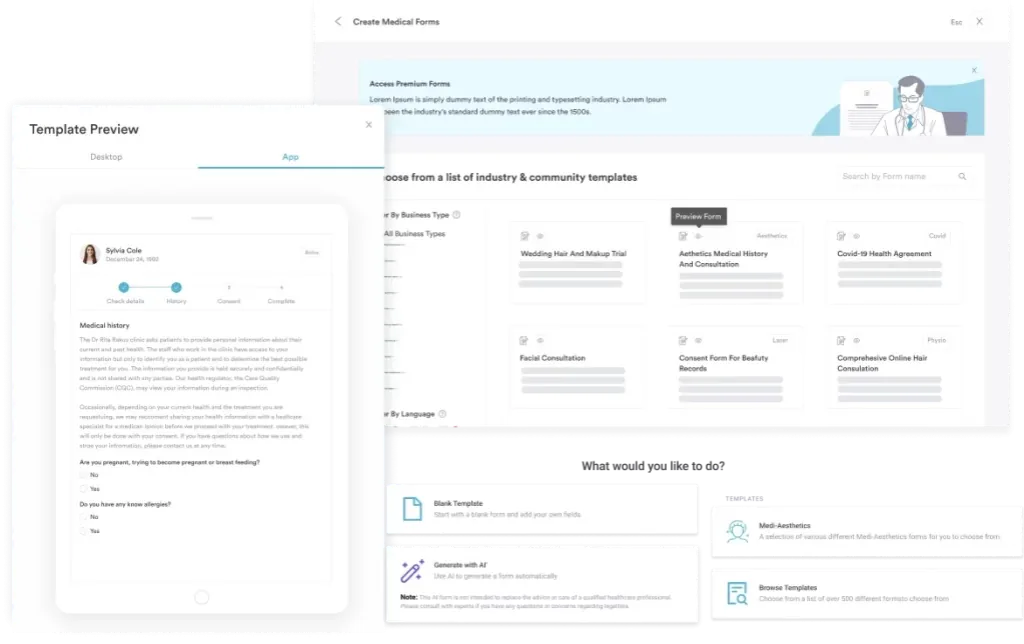
Digital forms
Pabau’s digital forms turn the sigmoidoscopy findings and the defect description into required fields, so an H5020 note is complete before billing starts.

The operative note must include each of the following.
  • Confirmed diagnosis with ICD-10 linkage: State the clinical diagnosis that justifies the procedure. For H5020 this is typically a code for fecal incontinence (R15.x), obstetric anal sphincter injury (O34.x, O70.x), or sequelae of perineal trauma. The diagnosis must map to a sphincter defect or functional sphincter disruption. Non-specific bowel codes are frequently rejected.
  • Explicit confirmation of intraoperative sigmoidoscopy: The note must state that sigmoidoscopy was performed, with which instrument (rigid or flexible), and what was seen. “Sigmoidoscopy performed: No mucosal injury identified; anorectal junction intact” meets the standard. Without that line, an insurer may treat the sigmoidoscopy as unperformed and reject the whole H5020 claim.
  • Sphincter defect description: Document the extent of the defect (EAS only, or combined EAS and IAS) and its location (anterior, posterior, lateral). Add the assessment of tissue quality and sphincter thickness, which supports medical necessity.
  • Surgical technique: State whether overlapping or end-to-end sphincteroplasty was performed, and record the suture material and configuration. Payers auditing outlier claims expect technical specificity.
  • Surgeon grade and specialty: Some insurers, including Bupa, require the named consultant to hold recognized colorectal surgery or coloproctology credentials. The note should name the consultant and confirm them as operating surgeon, not merely supervising.
  • Admission type and anesthetic: Confirm whether the procedure was a day case or an overnight inpatient admission, and state the anesthetic type. This decides which facility and anesthesia codes accompany the claim.
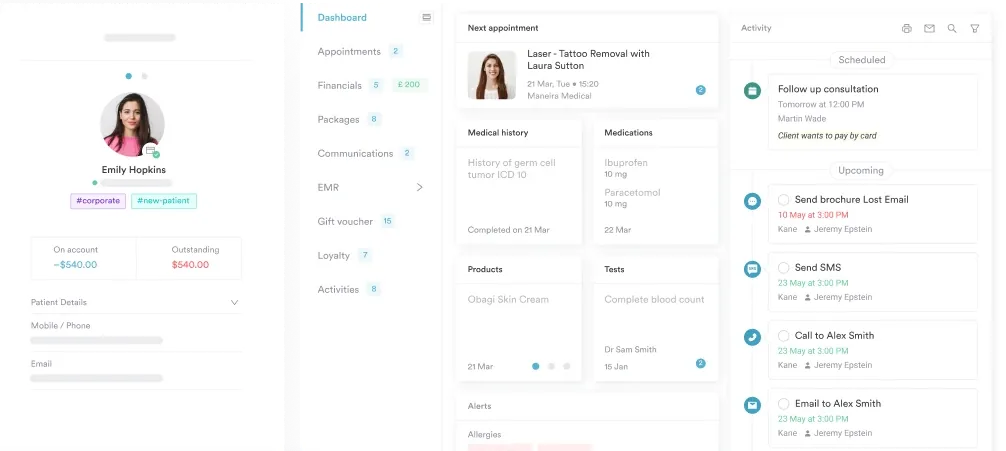
Detailed client records in Pabau
Pabau’s patient records hold the operative note, imaging, and referral letters in one file, so evidence for an H5020 query is close at hand.

Pro Tip

Create a dedicated H5020 operative note template with a mandatory sigmoidoscopy findings field. When the field is left blank, the system flags it before the note can be finalized. That one structural change helps teams capture the documentation insurers ask for on every H5020 case.

Preauthorization and payer requirements

All major UK private medical insurers (PMIs) treat H5020 as a major elective surgical procedure. Every elective case needs preauthorization before admission. A Healthcode claim without a valid preauthorization reference is rejected on receipt, whatever its clinical merit.

The payer portals and information requirements below apply. The Bupa CCSD code guide covers Bupa’s full coding requirements alongside its preauthorization steps.

Insurer Preauthorization portal Clinical information typically required
Bupa Bupa provider portal / Healthcode Specialist referral letter, confirmed diagnosis, proposed CCSD code, consultant GMC number, intended hospital, admission type
AXA Health AXA specialist forms portal Clinical justification letter, referral details, proposed procedure code, confirmed diagnosis, expected length of stay
Aviva Aviva provider fee schedule / Healthcode GP or specialist referral, diagnosis confirmation, procedure intent, inpatient versus day-case indication
Vitality Vitality provider portal / Healthcode Authorization request form, diagnosis, proposed CCSD code, consultant credentials, hospital details
Cigna Cigna provider portal / Healthcode Prior approval request, clinical summary, procedure code, treating consultant details

An emergency sphincter repair, such as one after acute perineal trauma in the delivery admission, may proceed without prior authorization. The claim still goes through Healthcode promptly afterward, with retrospective notification to the insurer. Most PMIs expect emergency claims to be notified within 48 to 72 hours of admission. A significantly delayed notification can lead to refusal or partial payment.

Fees for H5020 are agreed individually between the named consultant and each insurer. The Aviva fee schedule and the Healix fee schedule publish CCSD-based rates for recognized consultants. Verify your rates directly with each payer rather than relying on historical or estimated figures. No single fee applies to H5020 across all UK PMIs.

Common claim rejection reasons for H5020

H5020 claims fail for a predictable set of reasons. Most are preventable with structured documentation and correct code selection.

  1. Unbundling the sigmoidoscopy: This is the most common rejection trigger. Insurer claims systems flag a rigid or flexible sigmoidoscopy code submitted alongside H5020 in the same episode as unbundled billing. Remove any standalone sigmoidoscopy code when H5020 is submitted.
  2. Missing sigmoidoscopy confirmation in the operative note: The sigmoidoscopy is not billed separately, but reviewers still check for it. If the note does not record it, they may query whether it was done. A note reading only “sphincter repair performed” invites queries and a downgrade.
  3. No preauthorization reference: Elective H5020 claims without a valid preauthorization number on the Healthcode submission are rejected on receipt. The reference must sit in the designated field on the claim, not only in accompanying letters.
  4. Incorrect ICD-10 diagnosis code: A general constipation or abdominal pain code does not map to sphincter pathology. It gives the reviewer grounds to question medical necessity. The diagnosis must reflect the indication: Fecal incontinence, OASIS sequelae, or traumatic sphincter injury.
  5. Non-recognized consultant: Insurers commonly refuse claims from a consultant they do not recognize for colorectal surgery. The same goes for a trainee acting as primary surgeon without documented supervision. GMC specialist registration in the relevant surgical specialty is typically required.
  6. Late submission: UK PMIs set time limits for claim submission, typically six months from the procedure date, though this varies. Claims submitted outside the insurer’s window are refused without clinical review.

How to submit H5020 on the Healthcode platform

Healthcode is the standard electronic route for CCSD-coded claims to UK PMIs. The diagram below sorts every line an H5020 claim might carry, and the steps after it follow the usual workflow on the platform.
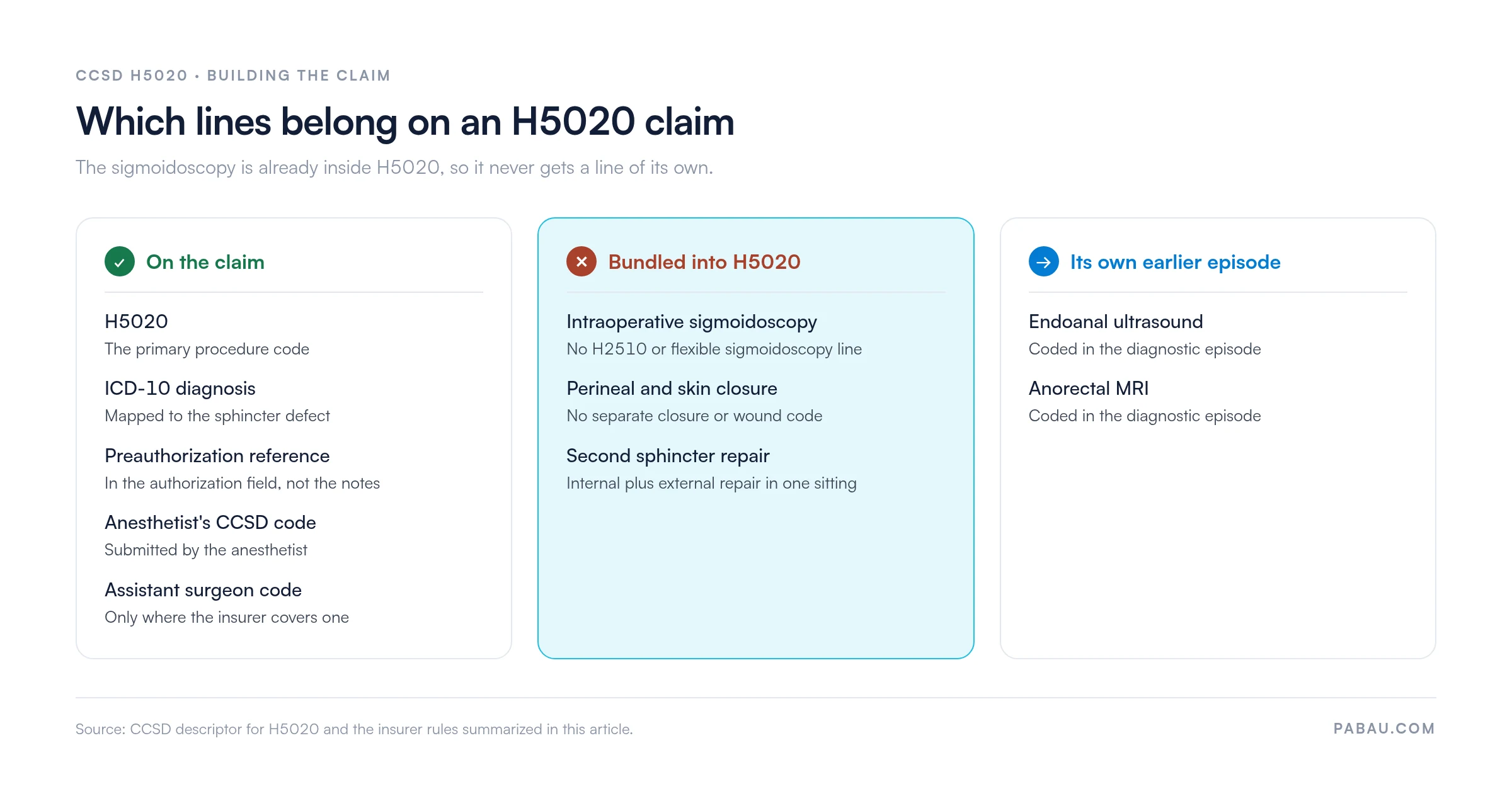
Three-column diagram of an H5020 claim. On the claim: H5020, the ICD-10 diagnosis, the preauthorization reference, the anesthetist's CCSD code, and an assistant surgeon code if covered. Bundled into H5020: intraoperative sigmoidoscopy, perineal and skin closure, and a second sphincter repair. Billed in an earlier episode: endoanal ultrasound and anorectal MRI.
Only five kinds of line belong on an H5020 claim, and the sigmoidoscopy is never one of them. Built from the CCSD descriptor and the insurer rules above.
  1. Open a new claim for the patient episode and confirm the insurer, policy number, and admission date against the patient record.
  2. Enter H5020 as the primary procedure code. Do not add a sigmoidoscopy code (H2510 or equivalent) alongside it. The bundled component never appears as a separate line on the claim.
  3. Attach the linked ICD-10 diagnosis code in the diagnosis field. Use the code for the confirmed indication (fecal incontinence, OASIS sequelae, or traumatic sphincter defect), not a symptom or generic bowel code.
  4. Enter the preauthorization reference number in the designated authorization field. The insurer issues it at approval, and it must match exactly. A single wrong digit causes automatic rejection.
  5. Add ancillary codes where applicable: The anesthetist’s CCSD code for the procedure time, plus an assistant surgeon code if the insurer covers one. These go in as supplementary codes alongside H5020, never as replacements for it.
  6. Confirm the admission type (day case or overnight inpatient) and the facility details. Submit, then keep the Healthcode submission reference for follow-up.
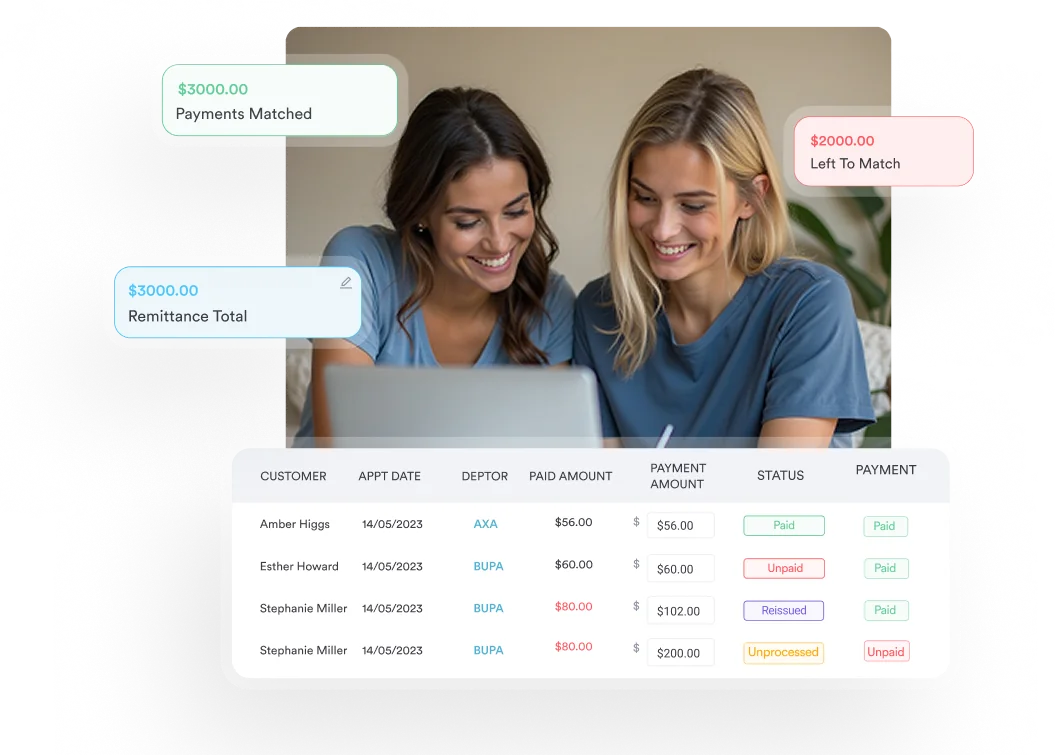
Fully Integrated with Pabau Billing
Pabau’s billing tracks each H5020 claim from submission to payment, so a missing preauthorization or a rejected line shows up before the insurer’s deadline passes.

Pro Tip

Before submitting H5020 on Healthcode, run a three-point check. Confirm the preauthorization reference is in the authorization field, not a notes field. Verify that the ICD-10 code maps to sphincter pathology. Then confirm no sigmoidoscopy code appears as a separate line. The check takes under two minutes and covers the top three rejection triggers for this code.

How Pabau keeps H5020 notes and claims in step

In many surgical practices, the operative note and the claim are built by different people, days apart. A coder reads a free-text note, hunts for proof of the sigmoidoscopy, and chases the surgeon when it is missing.

Pabau’s claims software for surgical teams works from the same record as the operative note. Templated note structures prompt for the sigmoidoscopy findings, the defect, the technique, and the anesthetic. Those fields exist before the claim does.

Billing teams can then track H5020 submissions, watch outstanding authorizations, and see which claims are nearing an insurer’s submission deadline. The result is fewer insurer queries about missing detail, and fewer late-submission refusals.

Cleaner H5020 claims start with the note

Pabau’s structured clinical notes help colorectal and surgical teams record each part of an H5020 procedure. The claim then goes out with the operative detail insurers ask for.

Pabau clinical documentation for surgical billing

Conclusion

H5020 claims rarely fail on the surgery. They fail on paperwork: A sigmoidoscopy billed twice, an operative note that never mentions it, or a preauthorization reference in the wrong field.

The fix sits upstream of billing. Build an H5020 note template with a required sigmoidoscopy field, and run the three-point check before every Healthcode submission. A team that does both answers fewer insurer queries and resubmits fewer claims.

To see how Pabau helps surgical teams capture the documentation insurers ask for, book a demo.

Continue your research

Continue your research

Need a full reference for Bupa CCSD coding rules? Bupa CCSD codes covers how Bupa applies the CCSD schedule, its preauthorization requirements, and code-specific billing guidance for recognized consultants.

Looking to reduce claim errors across your surgical practice? Pabau’s claims management software tracks submission status, outstanding authorizations, and approaching deadlines across every open claim.

Coding a rectal prolapse case instead? CCSD code H4200 covers perineal repair of rectal prolapse and how to bill it.

Operating on a high anal fistula? CCSD code H5520 covers laying open of a high anal fistula and its billing rules.

Frequently asked questions

What does CCSD code H5020 cover?

CCSD code H5020 is the procedure code for repair of the anal sphincter, with intraoperative sigmoidoscopy included as a bundled component. It covers surgical repair of a disrupted external or internal anal sphincter, with a sigmoidoscopy done under the same anesthetic. Overlapping and end-to-end sphincteroplasty are both captured under the code.

Is sigmoidoscopy included in H5020 or billed separately?

Sigmoidoscopy is included in H5020 and must not be billed separately in the same operative episode. Under CCSD’s bundling rule, a component procedure named in the descriptor is not independently payable. Here that component is “including sigmoidoscopy”. Submitting a standalone sigmoidoscopy code alongside H5020 is the most common cause of claim rejection for this code.

Does H5020 require preauthorization from UK private insurers?

Yes. Bupa, AXA Health, Aviva, Vitality, and Cigna all require preauthorization before elective admission for H5020. An emergency sphincter repair may proceed without it, but the insurer needs retrospective notification, typically within 48 to 72 hours of admission. Claims submitted without a valid preauthorization reference are rejected automatically on Healthcode.

What documentation is required to support an H5020 claim?

The operative note must confirm that intraoperative sigmoidoscopy was performed and record its findings. It must also carry an ICD-10 diagnosis that maps to sphincter pathology, a description of the defect, and the surgical technique. Add the named consultant’s grade and specialty and the admission type. A note that never mentions the sigmoidoscopy is a leading cause of H5020 claim refusal.

Which CCSD codes are commonly confused with H5020?

The codes most often confused with H5020 are the anal fistula codes (H5510/H5520 and H5530-H5580) and rectal prolapse repair (H4200, with H3501/H3502/H3580-H3584 for rectopexy). Standalone rigid sigmoidoscopy (H2510), haemorrhoidectomy (H5100), and repair of anal trauma (H5080) also come up. H5020 is correct only when a formal sphincter repair is the primary procedure, with the sigmoidoscopy in the same episode.

What are the most common reasons H5020 claims are rejected?

The leading reason is unbundling, where the sigmoidoscopy goes on the claim as a separate code. Next come an operative note that never confirms the sigmoidoscopy, and a missing or mistyped preauthorization reference on Healthcode. Insurers also reject an ICD-10 code that does not map to sphincter pathology, and a consultant without recognized colorectal credentials. Late submission is the last, typically after six months from the procedure date.

Can H5020 be billed alongside anesthesia and assistant surgeon codes?

Yes, subject to insurer rules. The anesthetist submits anesthesia fees separately under the relevant CCSD anesthesia code. Most UK PMIs accept an assistant surgeon code, but reimbursement is not universal. Confirm with each insurer whether it covers an assistant for H5020 and whether the assistant needs colorectal credentials. Never add a standalone sigmoidoscopy code alongside H5020, whatever else is on the claim.


×

