CPT Code 86160: Complement component billing and coding guide
CPT code 86160: Official descriptor and definition CPT code 86160 is defined by ...

Last Updated: Nov 26, 2026
H5400 is the CCSD code for anorectal stretch, the manual dilation of the internal anal sphincter performed under general or regional anesthetic. It covers the stretch technique only, not lateral sphincterotomy (H5620) or excision of an anal fissure (H5640).
The code sits in the CCSD Rectum/Anus chapter (11.6.0). Insurers usually expect it paired with ICD-10 code K60.1 for chronic anal fissure, and pre-authorization before the procedure.
Let Pabau's smart automation suggest the right codes, reduce claim denials, and keep your practice compliant—effortlessly.
Automate repetitive tasks and focus on what matters most—your patients.
Reduce coding errors and ensure compliance with the latest regulations.
Clean claims, fewer denials, and faster reimbursements.
Powerful insights and reporting to help your practice thrive.
HIPAA compliant SOC 2 certified GDPR-compliant Trusted by 4,000+ clinics worldwide

CCSD Code H5400 covers anorectal stretch (manual sphincter dilation), not surgical sphincterotomy or botulinum toxin injection.
Chronic anal fissure with a hypertonic internal sphincter is the main indication, so pair the claim with the matching ICD-10 diagnosis code.
Most UK private insurers, including Bupa and AXA Health, expect pre-authorization before the procedure, and a missing authorization is a leading cause of denial.
CCSD lists H4430 and H5620 as unacceptable combinations with H5400, so bill only the procedure the operative note describes.
Pabau, a practice management platform, keeps the operative note, the authorization number and a Healthcode-ready invoice on one patient record.
CCSD Code H5400 is the code for anorectal stretch, the manual, non-surgical dilation of the internal anal sphincter performed under general or regional anesthetic. It belongs to the CCSD procedure schedule, which holds the standard procedure codes for the UK private healthcare sector. CCSD files H5400 in chapter 11.6.0 Rectum/Anus, next to the other anal procedure codes in our CCSD code library. Hemorrhoid surgery is filed in the same section, and laser hemorrhoidectomy with sigmoidoscopy is billed as H5101.
The code covers the manual stretch technique, historically linked to Lord’s procedure (described by P.H. Lord in 1968). It does not extend to surgical incision of the sphincter or to injection-based treatments, which carry their own codes. Billers who confuse it with those surgical alternatives risk repeated denials.
An anorectal stretch is a proctological procedure in which the surgeon manually dilates the internal anal sphincter to lower resting sphincter pressure. It is typically performed to relieve the spasm of a chronic anal fissure or a hypertonic sphincter. The procedure is done under general or regional anesthetic as a day case in a private hospital or outpatient surgical setting.
The clinical steps are broadly as follows:
Anorectal stretch has largely fallen out of favor for chronic anal fissure since lateral internal sphincterotomy and botulinum toxin injection became widespread. Both offer more controlled outcomes. The Association of Coloproctology of Great Britain and Ireland (ACPGBI) now favors lateral internal sphincterotomy for chronic fissure-in-ano. H5400 is still billed in private practice, but insurers may ask why it was chosen over the current-evidence alternatives.
The following diagnoses are the main clinical justifications for billing H5400 in private healthcare. The treating clinician assigns the diagnosis code, and the biller confirms that the operative note supports the stated indication before submitting the claim.
Always confirm the diagnosis code with the treating clinician before submission, because a diagnosis-code mismatch is a preventable denial. Chronic anal fissure, the most common indication, is coded K60.1 on the claim.
Several H-series codes sit alongside H5400 in the CCSD schedule. They extend to major resections such as H0410, panproctocolectomy. Knowing when each one applies, and when two cannot share a claim, prevents both undercoding and unbundling denials. Each insurer sets its own fees, such as the Bupa fee schedule, so verify current figures with the insurer before invoicing.
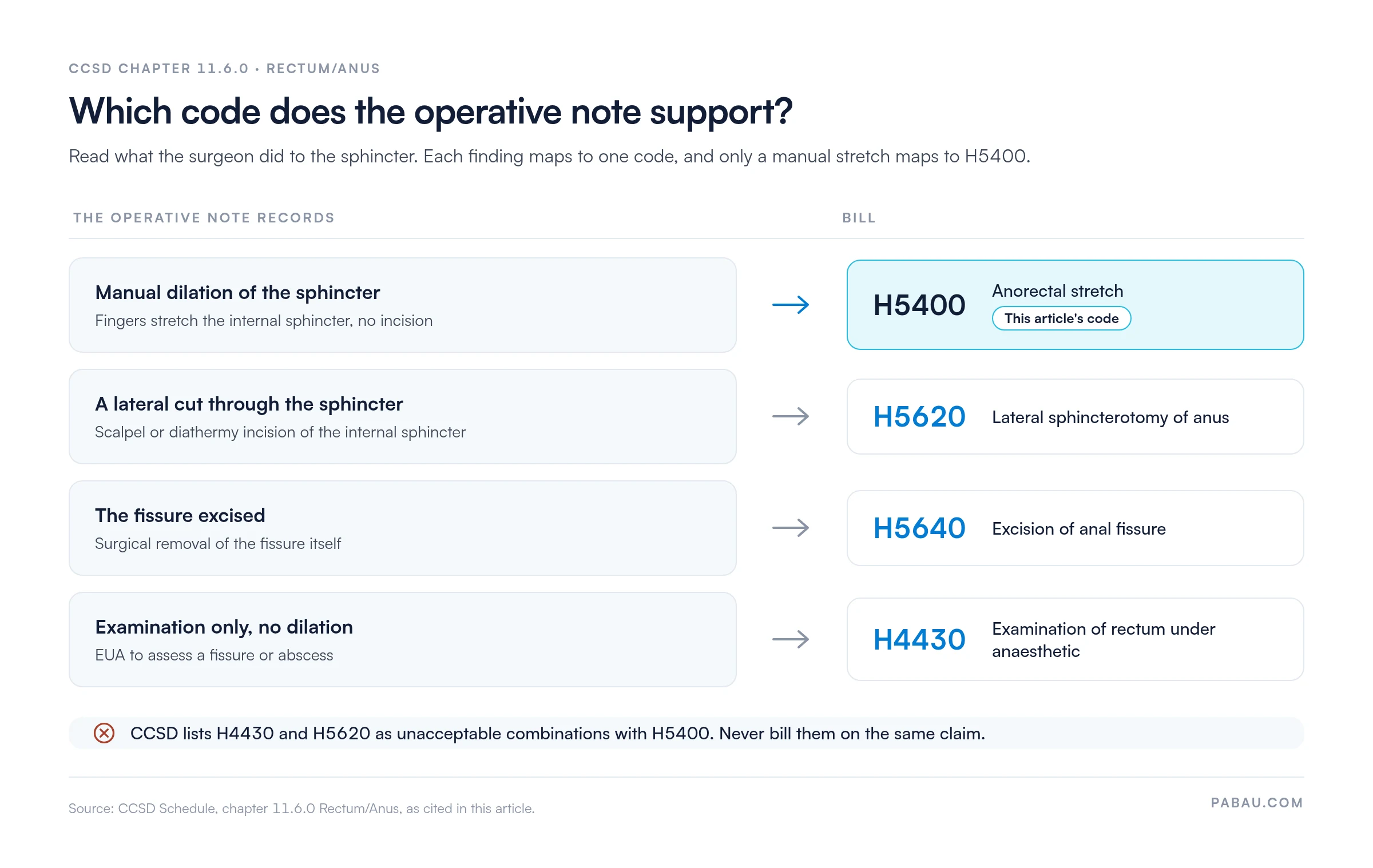
These procedures are routinely mistaken for H5400 by billing staff unfamiliar with the procedural differences. CCSD lists both H5620 and H4430 as unacceptable combinations with H5400, so the operative note decides which single code applies.
The chart below maps each finding in the operative note to the one code it supports.
A complete operative note is the most important document for a successful H5400 claim. Payers validate its fields on receipt, and a missing entry is treated as an incomplete submission. That triggers either a request for further information or an outright refusal.
Keeping structured patient records from the first consultation through to the operative note captures every required data point before the claim leaves the practice. The minimum required fields for an H5400 operative note are:

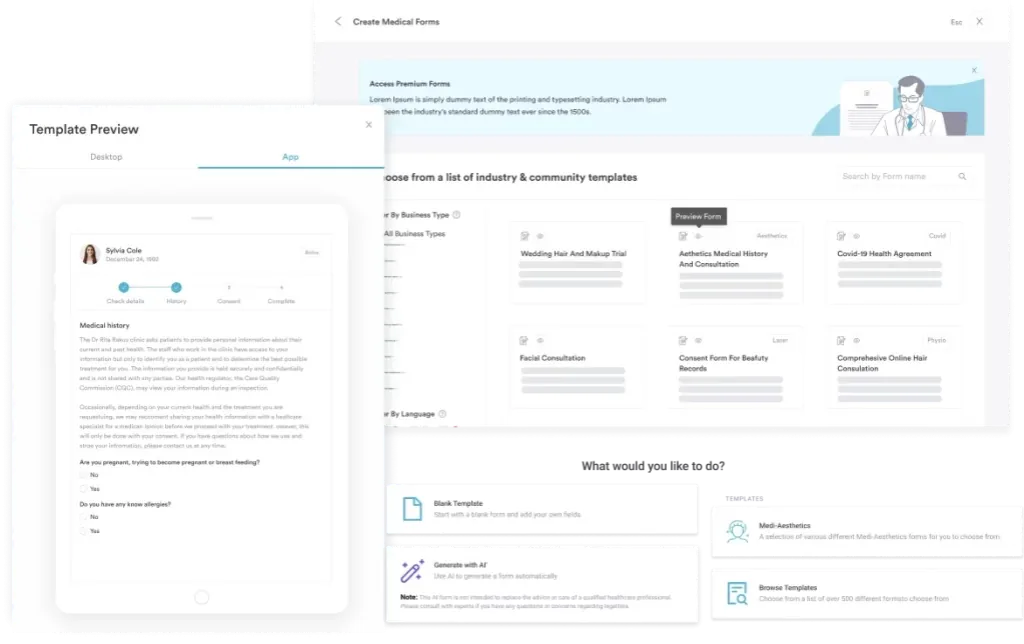
Digital clinical forms for operative notes and procedure records keep these fields present, consistently structured and ready when the invoice is generated. Handwritten notes that cannot be retrieved at invoicing are a common cause of delayed submissions and avoidable denials.
Before submitting any H5400 claim, cross-check the operative note against your insurer’s minimum dataset. Bupa, AXA Health, and Vitality each publish their documentation requirements in their provider portals. A five-minute pre-submission check prevents the most common refusals.
Most UK private insurers expect pre-authorization before an elective procedure coded H5400, so confirm each insurer’s rules before the procedure date. Proceeding without it is a common cause of outright claim refusal, and an insurer may decline to pay after the fact regardless of clinical merit.
The general pre-authorization workflow for anorectal stretch across major UK insurers is:
For Bupa’s own procedure code rules and coverage, see Bupa CCSD procedure codes. The Bupa code search portal lets providers check whether H5400 is covered under a patient’s specific policy.
H5400 claims fail for a consistent set of reasons. Most are preventable at the documentation or pre-submission stage.
The examination under anesthetic is the combination to watch on an H5400 claim. CCSD lists H4430, examination of the rectum as a sole procedure, as an unacceptable combination with H5400. An examination carried out with the stretch is therefore part of H5400 and is not claimed separately. When a separate procedure, such as laying open a fistula, was also performed, each code needs its own operative note entry with its own findings.
The Healix fee schedule guidelines provide explicit unbundling rules for anorectal procedure combinations. Aviva’s fee schedule similarly specifies which code combinations are permitted on a single claim. Consult each insurer’s current guidance before submitting multi-code anorectal claims.
When in doubt about bundling, call the insurer’s provider helpline before you submit, rather than after the denial arrives. Payers will advise whether a specific combination is permitted under the patient’s policy. Record the advice and the name of the person you spoke with.
Healthcode is the electronic billing network most UK private insurers use, so confirm each insurer’s submission route before you send an H5400 claim. The workflow is:
Built-in claims management software maps CCSD codes straight to Healthcode-formatted invoices. That cuts the field-level errors behind silent rejections at EDI validation.
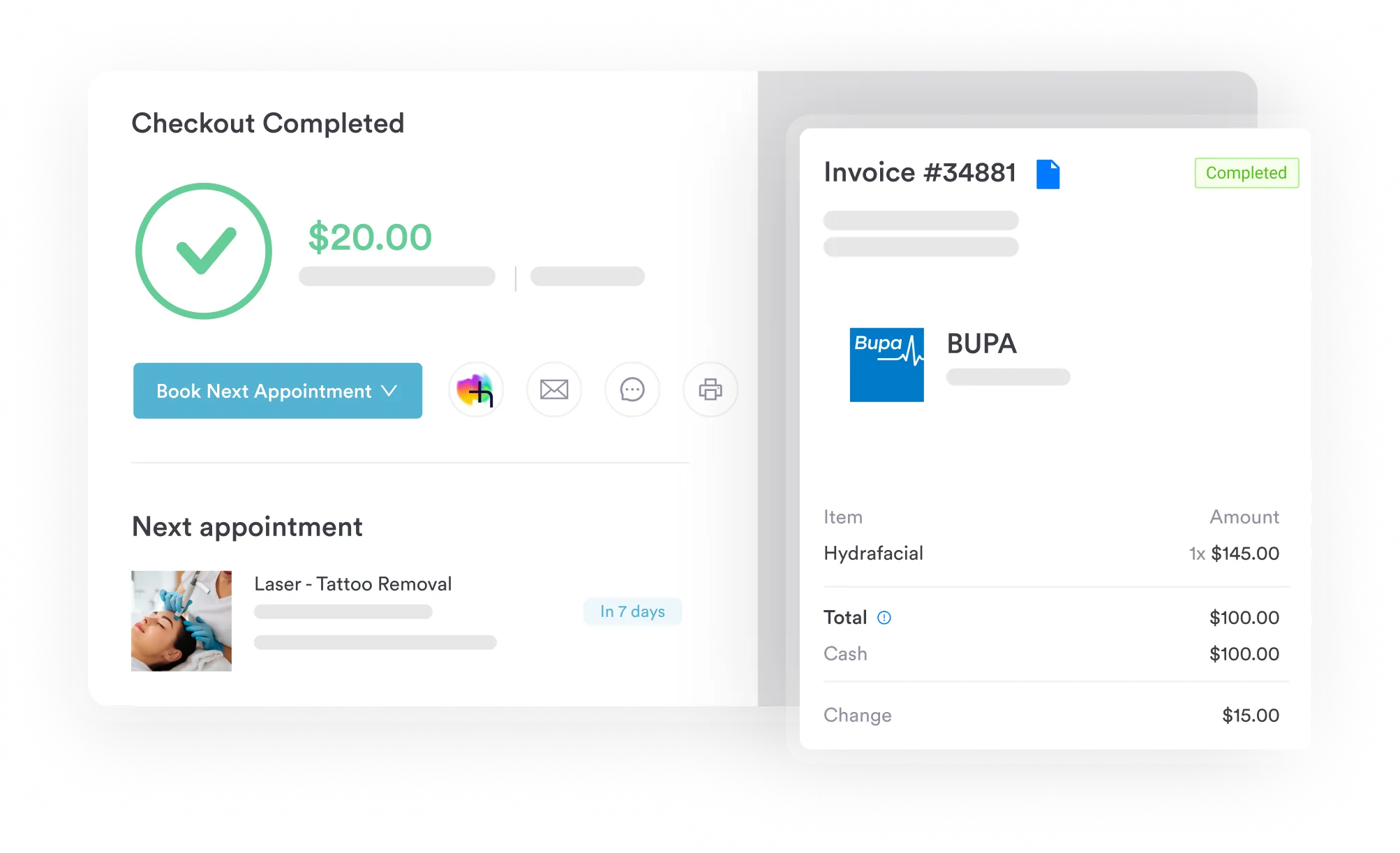
The denials above trace back to three records that usually live in different places: the operative note, the authorization number and the invoice. When a biller has to chase each one by hand, a missing field only surfaces once the insurer rejects the claim.
Pabau holds all three in the patient record. Digital forms capture the technique, anesthetic type and findings in the operative note, and the authorization number sits on the same record as the invoice.
Invoices then go to Healthcode with H5400 and the matching ICD-10 code already mapped. Your team spends less time reworking refused claims and more time on the next surgical list.

Pabau handles pre-authorization records, Healthcode-ready invoicing, and operative note documentation in a single system, so your H5400 claims go out complete and on time.

An H5400 claim pays when the operative note, the code and the authorization all describe the same manual stretch. Before you submit, check the note records a dilation, keep H4430 and H5620 off the same claim, and put the authorization number on the invoice.
Anorectal stretch is now a less common choice for chronic fissure, so expect insurers to ask why it was chosen. A specialist letter recording failed conservative treatment answers that question before the claim goes out. Book a demo to see how Pabau keeps operative notes, authorizations and Healthcode invoices together for every anorectal claim.

Need the full Bupa CCSD procedure code guide? Bupa CCSD codes covers how Bupa’s procedure code schedule is structured and how to navigate it for UK private practice billing.
Looking for a complete overview of the Bupa fee schedule? Bupa procedure code fee schedule provides current fee schedule context for CCSD-coded surgical procedures including H-series anorectal codes.
Want to reduce claim denials across your practice? Claims management software from Pabau handles Healthcode EDI submission, claim tracking, and pre-authorisation record storage in one place.
Billing a sphincterotomy instead? CCSD code H5620 covers lateral sphincterotomy of anus, the surgical alternative to an anorectal stretch.
Laying open a low anal fistula on the same list? CCSD code H5510 explains the documentation that fistulotomy claim needs.
CCSD Code H5400 is the billing code for anorectal stretch, the manual, non-surgical dilation of the internal anal sphincter performed under anesthetic. It does not cover lateral sphincterotomy (H5620), excision of an anal fissure (H5640) or botulinum toxin injection, which are coded separately.
H5400 covers manual (finger) dilation of the sphincter, a non-incisional technique. H5620 covers lateral sphincterotomy of anus, a surgical incision of the internal sphincter. The two are clinically distinct, and billing one for the other is a mismatch that triggers denial and can flag the account for audit.
Usually, yes. Most UK private insurers, including Bupa, AXA Health and Aviva, expect pre-authorization before an elective H5400 procedure, so confirm each insurer’s rules. Proceeding without written authorization is a common reason H5400 claims are refused outright.
Not on the same claim. CCSD lists H4430, examination of the rectum under anesthetic, as an unacceptable combination with H5400. An EUA performed with the stretch is not billed separately. Bill H4430 alone only when no dilation was performed.
Chronic anal fissure (ICD-10 K60.1) is the most common indication. Hypertonic internal anal sphincter, anal stenosis and, historically, hemorrhoids have also been treated with anorectal stretch. ACPGBI guidance now favors lateral internal sphincterotomy for chronic fissure, so insurers may ask for evidence that conservative treatment failed.
The most common H5400 denial reasons are missing pre-authorization and a wrong procedure code, such as H5620 or H5640 submitted for a manual stretch. Others are a diagnosis-code mismatch, an operative note missing technique or anesthetic type, and an EUA (H4430) billed on the same claim.