

HCPCS Code Q4185: Cellesta flowable amnion billing guide
HCPCS Code Q4185: definition and official descriptor HCPCS Code Q4185 is the Lev...

Last Updated: Nov 20, 2026
P2530 is the CCSD code for repair of rectovaginal fistula. It covers surgical closure of an abnormal tract between the rectum and the vagina, whichever route the surgeon takes.
UK private medical insurers, including Bupa, AXA Health, Vitality and Aviva, use it on surgical claims. They generally expect pre-authorisation before the operation.
Let Pabau's smart automation suggest the right codes, reduce claim denials, and keep your practice compliant—effortlessly.
Automate repetitive tasks and focus on what matters most—your patients.
Reduce coding errors and ensure compliance with the latest regulations.
Clean claims, fewer denials, and faster reimbursements.
Powerful insights and reporting to help your practice thrive.
HIPAA compliant SOC 2 certified GDPR-compliant Trusted by 4,000+ clinics worldwide

CCSD Code P2530 is the UK private insurance code for surgical repair of a rectovaginal fistula, by any route.
The CCSD Group of insurers maintains the code, and each insurer sets its own fee for it.
Pair P2530 with ICD-10 N82.3, and code the cause, such as Crohn’s disease, alongside it.
A defunctioning stoma or a separate bowel operation is not part of P2530, so agree its coding with the insurer first.
Most rejections trace back to a missing pre-authorisation number, the wrong fistula code or a diagnosis that doesn’t match the operation note.
CCSD Code P2530 is the code UK private medical insurers use for repair of a rectovaginal fistula. The schedule is maintained by the CCSD Group of insurers: Bupa, AXA Health, Vitality and Aviva. Grant Thornton UK LLP administers it on the group’s behalf.
The same UK private insurance codes are used by other insurers too, such as WPA. That gives consultants, hospitals and insurers one shared language for each operation.
A rectovaginal fistula is an abnormal opening between the rectum and the vagina. Patients usually report wind, mucus or stool passing through the vagina. P2530 pays for the operation that closes that tract, whichever route the surgeon takes.
The P prefix reflects where the code sits. CCSD code numbers broadly follow the NHS OPCS-4 classification, where chapter P covers the lower female genital tract. P2530 lines up with OPCS-4 P25.3, repair of rectovaginal fistula, in the vagina and perineum section. Bartholin gland surgery sits early in that chapter, which is why marsupialisation of a Bartholin cyst is P0320 in CCSD.
The cause shapes the operation. Most fistulae follow a perineal tear in childbirth, but Crohn’s disease, pelvic radiotherapy and earlier pelvic surgery account for many others. Surgery on the perineum alone, with no fistula to close, is billed under CCSD code P1300 instead. An incision to widen a tight vaginal opening, again with no fistula involved, takes code P1400.
Colorectal surgeons and gynaecologists both perform the repair. A low fistula is often closed through the vagina, the perineum or the anus, sometimes with an advancement flap. A high or radiation-damaged fistula may need an abdominal approach.
Where the tissue is thin or scarred, the surgeon may bring in healthy tissue to support the closure. A Martius flap from the labial fat pad and a gracilis muscle flap are the usual examples. Some patients also need a temporary stoma so the repair can heal.
Each of those choices matters for billing, because the insurer reads the operation note to confirm the code. A note that only says “fistula repaired” leaves the reviewer guessing which fistula and which route.
The descriptor names the repair, not the technique, so the route and any flap don’t change the code. Here’s how the pieces of a typical case fall:
Insurers publish their own rules on extra codes. Bupa’s procedure code lookup is the quickest check for a Bupa patient, and our guide to Bupa CCSD codes walks through how it works.
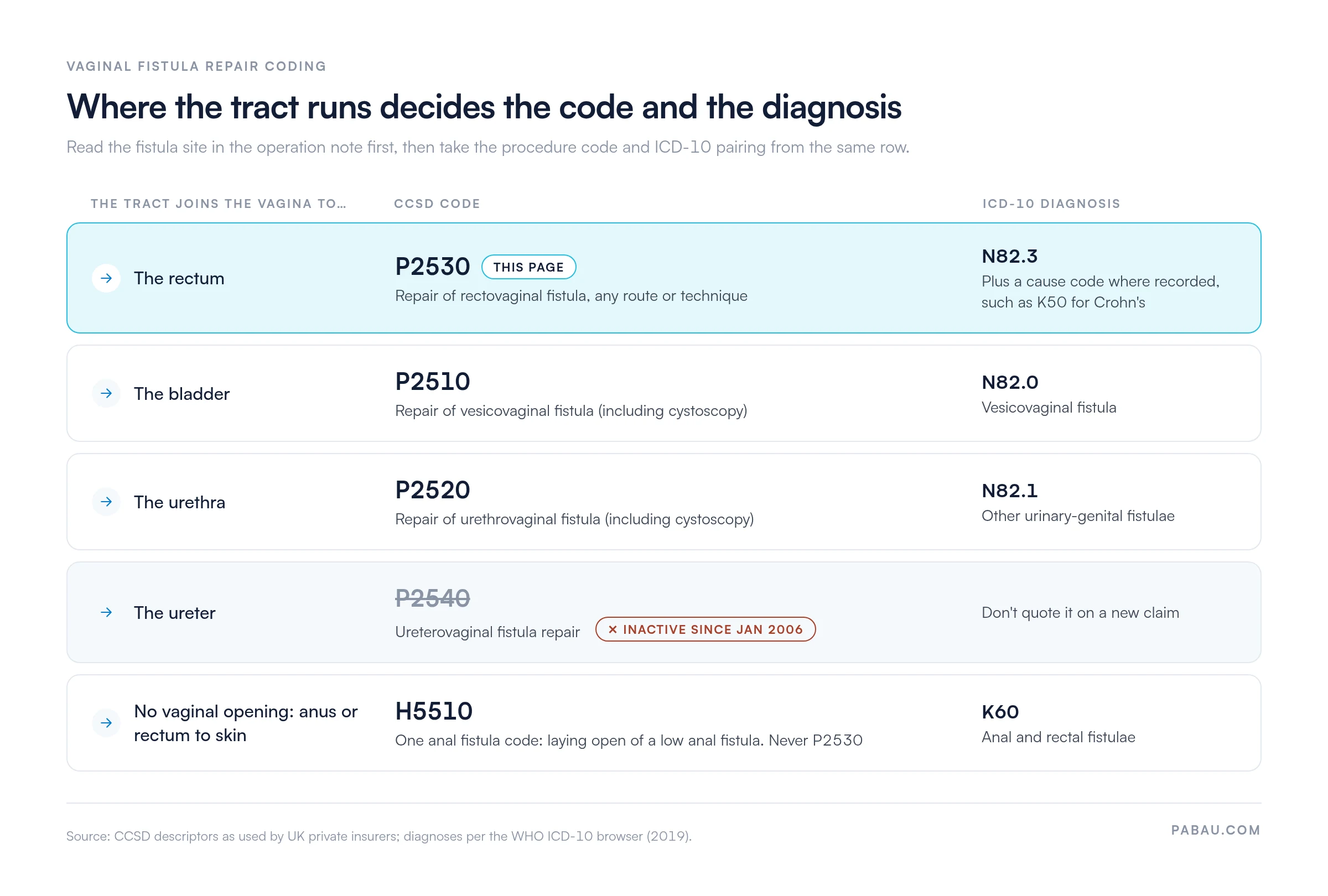
The vaginal fistula codes sit side by side, and the wrong one is an easy slip on a busy list. The deciding question is which structure the tract connects to the vagina.
A fistula that runs from the anus or rectum to the skin, without reaching the vagina, is an anal fistula. It takes a colorectal code instead, never P2530. Laying open a low anal fistula, for example, is H5510.
UK private insurers expect an ICD-10 diagnosis next to the procedure code. For a rectovaginal fistula, N82.3 is the usual choice. In the WHO ICD-10 browser, it covers fistula of the vagina to the large intestine, and the rectovaginal type is listed under it.
Code the cause alongside it where the note records one. A Crohn’s fistula, for example, carries a K50 Crohn’s disease code as well. The obstetric chapter describes the delivery itself, so it is not used for a repair months later.
Watch three near misses. N82.0 is vesicovaginal fistula and N82.1 covers other urinary-genital fistulae, which belong with P2510 and P2520. K60 codes describe anal and rectal fistulae that don’t reach the vagina, so they don’t fit P2530 on their own. The chart below lines up each tract with its procedure code and diagnosis.
Surgery claims follow the same broad route at most UK insurers. Each step hands something to the next, so a slip early on surfaces as a rejection weeks later.
Each invoice carries the consultant’s GMC number and the provider number the insurer has issued to them. If the operation changes on the day, such as an added stoma, the insurer needs to hear before the invoice arrives.
An insurer that queries P2530 will ask for the operation note first. Make sure it shows:
Keep the consent form and the pre-authorisation number on the same record. Pabau, the practice management and billing platform we build, has digital forms for this. A structured operation note template makes sure each of these fields gets filled every time.

Take an illustrative patient who notices wind and stool passing through the vagina some months after a difficult delivery. Examination and an endoanal ultrasound show a low rectovaginal fistula above a healed perineal tear.
The practice quotes P2530 with N82.3, and the patient gets an authorisation number. On the day, the surgeon closes the fistula through the perineum in layers. The surgeon’s invoice carries P2530 alone, and the anaesthetist and hospital bill separately for the same date.
Most P2530 rejections trace back to paperwork, and they follow a handful of patterns:
Each insurer runs its own review and dispute process for providers, so start there. Ask for the rejection reason in writing before you resubmit. A second submission with the same fault simply restarts the clock.
Send the operation note, the authorisation number and a short letter from the surgeon that answers the stated reason. If the dispute concerns the patient’s cover, the patient can use the insurer’s complaints process and then the Financial Ombudsman Service.
In many private gynaecology and colorectal practices, the pieces of a P2530 claim live in different places. The operation note sits in one system, the authorisation number in an email, and the invoice in a spreadsheet. Matching them up happens when the insurer asks.
Pabau keeps them on one patient record. Operation notes, consent forms and the authorisation number sit together. Your billing team can then check the code against the note before the invoice goes out.
From there, Pabau’s claims management sends UK insurance claims through Healthcode. You can see which invoices are paid, part-paid or queried, so shortfalls get raised with patients early.

Pabau keeps operation notes, consent and authorisation numbers on one patient record and sends UK insurance claims through Healthcode. See how surgical practices cut avoidable P2530 rejections.

P2530 rewards a precise note. The code doesn’t care which route or flap the surgeon chose, but the insurer does care which fistula was closed. A claim gets paid when the note, the diagnosis and the authorisation all describe that same operation.
Do the checking before surgery, when a fix still costs only a phone call. Confirm the fistula type, agree any stoma with the insurer and log the authorisation number. Those three steps prevent most of the queries that slow these claims down.
Book a demo to see how Pabau keeps surgical notes, authorisations and insurer claims on one record for your practice.

Is the tract a high anal fistula rather than a rectovaginal one? CCSD code H5520 covers laying open of a high anal fistula, with its own diagnosis pairings and claim rules.
Did the surgeon repair a rectocele rather than a fistula? CCSD code P2310 explains anterior and posterior colporrhaphy, a posterior wall repair that takes its own code, not P2530.
Checking what Bupa pays for P2530 and related codes? The Bupa procedure codes and fee schedule guide sets out how Bupa lists procedure codes alongside its fees.
Want an operation note that holds up to insurer review? Our free operation notes template gives you a structured way to record the procedure, findings and technique.
P2530 covers surgical repair of a rectovaginal fistula, an abnormal opening between the rectum and the vagina. It applies whatever the route, and includes excising the tract, closing it in layers and any tissue flap used for the repair.
N82.3, fistula of vagina to large intestine, is the usual pairing. Add a code for the cause where the note records one, such as a K50 code for Crohn’s disease.
UK private insurers such as Bupa, AXA Health, Vitality and Aviva generally expect it for inpatient surgery. The patient calls the insurer with the code, diagnosis and hospital, and receives an authorisation number to quote on every invoice.
NHS hospitals record the operation under OPCS-4 P25.3. Private insurers use the CCSD code P2530 for the same operation on their claims.
CCSD sets the code, not the fee. Each insurer publishes its own fee for P2530, so check the patient’s insurer before quoting. Any amount above that fee is billed to the patient as a shortfall.
A defunctioning stoma is a separate procedure and is not part of P2530. Agree with the insurer how it should be coded at pre-authorisation, and record it clearly in the operation note.
Colorectal surgeons and gynaecologists both perform the repair, and either may bill P2530. The invoice carries the consultant’s GMC number and insurer provider number, and the operation note must support the work done.





