

HCPCS Code L0472: Hyperextension TLSO billing guide
HCPCS code L0472: Official descriptor and device definition HCPCS code L0472 des...

Last Updated: Nov 5, 2026
H5620 is the CCSD code for lateral sphincterotomy of anus. The surgeon divides part of the internal anal sphincter at a lateral position so a chronic anal fissure can heal, leaving the external sphincter intact.
The code sits in the CCSD Rectum/Anus chapter (11.6.0), reference Fk.108. Insurers usually expect it paired with ICD-10 code K60.1 for chronic anal fissure, and pre-authorization before surgery.
Let Pabau's smart automation suggest the right codes, reduce claim denials, and keep your practice compliant—effortlessly.
Automate repetitive tasks and focus on what matters most—your patients.
Reduce coding errors and ensure compliance with the latest regulations.
Clean claims, fewer denials, and faster reimbursements.
Powerful insights and reporting to help your practice thrive.
HIPAA compliant SOC 2 certified GDPR-compliant Trusted by 4,000+ clinics worldwide

CCSD code H5620 covers lateral sphincterotomy of the anus, a partial division of the internal anal sphincter coded apart from fistulotomy and sphincter repair.
K60.1 (chronic) is the usual companion ICD-10 code, while K60.0 (acute) supports the claim only when manometry shows high resting pressure.
Most insurers want documented failure of conservative treatment before they grant pre-authorization for lateral sphincterotomy.
Missing pre-authorization and operative notes that don’t separate sphincterotomy from fistulotomy are the leading causes of H5620 denials at UK private insurers.
Pabau, the practice management platform we build, supports preparing insurance claims and sends them to UK insurers through Healthcode, so colorectal teams re-key less.
CCSD code H5620 is defined by the CCSD schedule as “lateral sphincterotomy of anus.” It sits in the schedule’s Rectum/Anus chapter (11.6.0), under reference Fk.108. The code applies when a surgeon deliberately divides part of the internal anal sphincter (IAS) at a lateral position, leaving the external anal sphincter intact. Fissure excision, fistula surgery and sphincter repair each carry codes of their own.
Coders sometimes apply H5620 to any perianal procedure involving a sphincter incision, which is incorrect. The table below sets it beside the neighboring anal procedure codes, and the full CCSD code library lists the rest of the schedule.
Coders should verify current descriptors against the Bupa CCSD procedure codes schedule. The CCSD Group updates the schedule regularly, and descriptor wording can change between editions.
In a lateral sphincterotomy of the anus, the colorectal surgeon divides a measured portion of the internal anal sphincter at a lateral position. That is typically the 3 o’clock or 9 o’clock position, and the cut relieves the high resting pressure that stops an anal fissure from healing. The external anal sphincter is not touched. The procedure is done as a day case under general, spinal or local anesthetic.
Two recognized techniques exist, and the distinction matters for coding documentation:
Both techniques map to the same CCSD code H5620. The operative note must name the technique, because insurers and auditors use it to confirm the procedure performed matches the code billed.
H5620 is the correct code when the operative note documents a lateral sphincterotomy of the anus done for a clinically justified indication. The primary indication is a chronic anal fissure that has not responded to conservative measures. Aviva’s provider invoicing guidance requires each procedure to match a recognized indication, backed by a diagnosis code on the claim. For a chronic fissure, that diagnosis code is K60.1.
The accepted clinical indications for H5620 are:
CCSD code H5620 does not cover anal stretch (Lord’s procedure), sphincter repair after obstetric injury, or surgery aimed at a fistula tract. Each of those has its own CCSD code. Anal stretch is H5400 (Anorectal stretch), haemorrhoidectomy is H5100, and sphincter repair is H5020. Surgical repair of a traumatic laceration or avulsion of the anal canal is coded H5080.
The codes most often submitted in error for CCSD code H5620 are H5510/H5520 (fistulotomy), H5640 (excision of anal fissure) and H5020 (sphincter repair). The mix-up usually starts when a coder sees “sphincter” or “fissure” in the operative note and picks the nearest-sounding code. Reading the pathology first, then the procedure, settles it, as the map below shows.
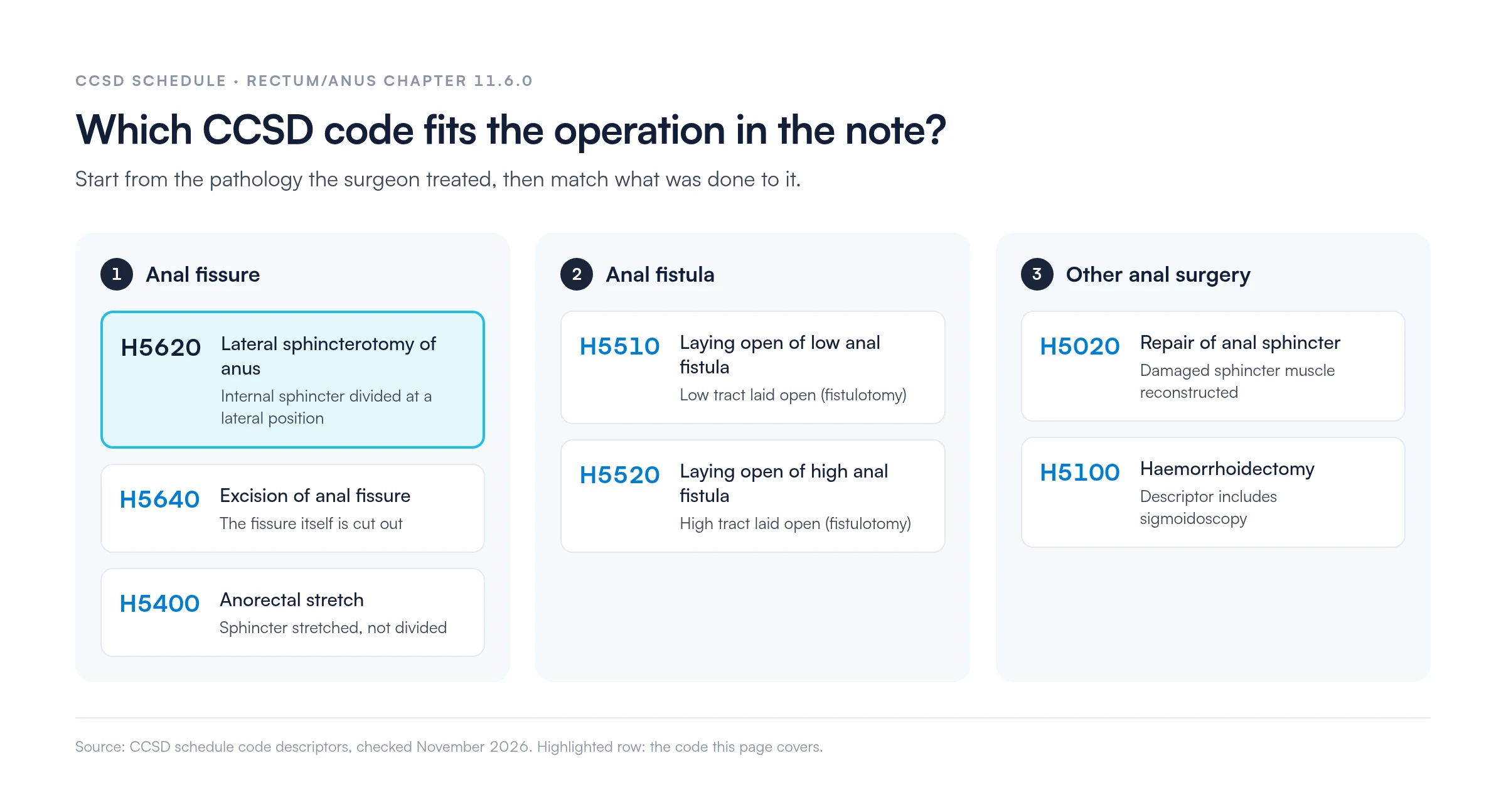
Written correctly, the operative note makes CCSD code H5620 unambiguous. The pathology is an anal fissure rather than a fistula, and the target is the internal anal sphincter. The incision reduces resting sphincter pressure and does not drain or excise a tract.
When the note does describe a fistula operation, the code depends on the tract’s height. A low fistula laid open is H5510, and a high one is H5520.
Submitting an H5620 claim without a complete operative note is the most reliable way to trigger a denial or a request for more information. For this code, the operative note carries the clinical justification on its own. Structured operative note templates help here, because they surface missing fields at dictation rather than at claim review.
The claim bundle for H5620 should include the following elements:
UK private health insurers treat lateral sphincterotomy as elective surgery, so pre-authorization (pre-auth) is typically required before the operation. An H5620 claim for surgery done without prior authorization is likely to go unpaid, however strong the clinical case. Payer rules change between policy years, so check the insurer’s current provider manual before booking the patient.
When submitting through Healthcode, enter CCSD code H5620 in the procedure code field exactly as the CCSD schedule lists it. The companion ICD-10 code (K60.0 or K60.1) goes in the diagnosis field. A mismatch between the codes on the pre-auth and those on the claim is a routine, avoidable denial trigger.
CCSD code H5620 claims are denied for predictable reasons, and pre-submission checklists with consistent operative note templates prevent most of them. These are the rejection triggers seen most often on lateral sphincterotomy claims in UK private practice.
In standard practice, lateral sphincterotomy of the anus is a unilateral procedure. It is done at one lateral position, most often the left, to lower sphincter pressure without compromising continence. Bilateral sphincterotomy, dividing both the left and right lateral IAS, is unusual in elective fissure surgery. Billing it as two procedures would need explicit clinical justification in the operative note.
Three scenarios need specific coding attention:
Lateral sphincterotomy has recognized complications that can lead to separate clinical encounters and additional codes. Coders and surgeons should document them in a way that doesn’t create claim patterns that trigger fraud review.
Complication encounters should never reuse H5620 as the procedure code unless a second lateral sphincterotomy was performed. Billing the original surgical code for follow-up visits looks like duplicate billing to an insurer’s reviewer.
Before billing a complication follow-up separately, confirm it isn’t covered by the original procedure’s global or warranty period under the insurer’s terms. Some UK private health insurers count complications within 30 days as part of the original authorization. Check the insurer’s current provider manual before raising a secondary claim.
Private colorectal practices billing CCSD code H5620 work with little margin for error. The code set is UK-specific, insurer rules differ by payer, and clinical reviewers read the operative note in full. Each handoff between surgeon dictation, coding and claim submission is a point where a detail can drop out.
Pabau keeps those handoffs inside one patient record, with error-checked claims management built in. It cuts H5620 coding errors in three ways:
Clinical notes created during billing fall under UK GDPR, so keep an audit trail of coding decisions. It supports compliance and gives you evidence if a claim is disputed.

Pabau prepares each insurance claim from the patient’s invoice, sends it through Healthcode, and tracks it to payment. Structured operative note templates keep the detail insurers check in the same record.

H5620 is a narrow code, and that works in your favor. Name the lateral sphincterotomy, quantify the division and pair it with K60.1 or K60.0. The claim then leaves an insurer little to question.
Fix the note template before you fix anything else. A template that forces technique, extent and laterality at dictation stops most denials before a coder sees the case. The trade-off is a minute more of the surgeon’s time per operation, which costs far less than one appeal.
Book a demo to see how Pabau keeps colorectal operative notes and Healthcode claims in one record.

Coding the fissure behind the operation? ICD-10 code K60.1: Chronic anal fissure covers the chronic fissure diagnosis that typically supports an H5620 claim.
Billing the same surgery for a US patient? CPT code 46080: Anal sphincterotomy explains the US equivalent of lateral sphincterotomy and its billing rules.
Treating haemorrhoids in the same sitting? CCSD code H5100: Haemorrhoidectomy sets out the code and documentation for a procedure often done alongside sphincterotomy.
Not sure whether it was a fistula operation? CCSD code H5520: Laying open of high anal fistula shows how fistula surgery is coded so you can avoid the most common H5620 mix-up.
Repairing the sphincter after a complication? CCSD code H5020: Repair of anal sphincter covers the code for sphincter repair when incontinence follows earlier surgery.
CCSD code H5620 covers lateral sphincterotomy of the anus. Part of the internal anal sphincter is divided at a lateral position to relieve the pressure that stops a chronic fissure from healing. It does not cover fistulotomy (H5510 or H5520), sphincter repair (H5020), haemorrhoidectomy (H5100) or anal stretch (H5400).
H5620 (lateral sphincterotomy) divides internal sphincter fibers to treat an anal fissure. H5510 and H5520 (fistulotomy) lay open a low or high anal fistula tract. The pathology differs too. A fissure is a tear in the anal lining, while a fistula is an abnormal tunnel between the anal canal and the perianal skin. The operative note should state which condition was present and which structure was operated on.
Insurers expect an operative note that names the procedure as lateral sphincterotomy and states the technique, the extent of sphincter division and the laterality. It should also record the anesthetic type, the surgeon’s GMC number and the companion ICD-10 code (K60.0 or K60.1). Keep the pre-authorization showing the procedure was approved before the operation date.
Bupa generally covers lateral sphincterotomy as an eligible elective procedure, subject to the member’s policy terms and pre-authorization. Bupa typically wants evidence that conservative treatment, such as topical therapy, was tried before surgery. Check the current Bupa code search and provider manual before booking the operation.
The most common reasons are a missing pre-authorization and a wrong code, such as H5510, H5520, H5640 or H5020 instead of H5620. Insurers also deny claims whose operative note doesn’t describe a lateral sphincterotomy specifically. A diagnosis code that differs from the authorization, or an outdated CCSD schedule, causes the rest. A structured pre-submission checklist prevents each of them.
The operative note should state the indication (chronic anal fissure) and the technique (open or closed). It should also give the position, such as left lateral at 3 o’clock. Add the extent of division, for example the lower third of the IAS, plus the anesthetic type and the wound’s condition. Generic phrases such as perianal procedure or anal surgery won’t satisfy an insurer’s reviewer.



