CCSD Code L6230: Reconstruction for popliteal aneurysm
CCSD Code L6230: Definition and clinical scope CCSD Code L6230 has the official ...

Last Updated: Nov 2, 2026
H5080 is the CCSD code for repair of anal trauma. It covers surgical repair of a traumatic injury to the anal canal or perianal tissue, such as a laceration or avulsion. The repair must be the main purpose of the operation.
The code sits in CCSD chapter 11, sub-chapter 11.6.0 Rectum/Anus. Where the anal sphincter itself is the repair target, including after an obstetric injury, CCSD's separate code H5020 applies instead.
Let Pabau's smart automation suggest the right codes, reduce claim denials, and keep your practice compliant—effortlessly.
Automate repetitive tasks and focus on what matters most—your patients.
Reduce coding errors and ensure compliance with the latest regulations.
Clean claims, fewer denials, and faster reimbursements.
Powerful insights and reporting to help your practice thrive.
HIPAA compliant SOC 2 certified GDPR-compliant Trusted by 4,000+ clinics worldwide

CCSD code H5080 covers surgical repair of traumatic injury to the anal canal and perianal tissue, in sub-chapter 11.6.0 Rectum/Anus.
Where the anal sphincter itself is the repair target, including sphincter damage from childbirth, CCSD’s dedicated code is H5020 rather than H5080.
The operative note should record the mechanism of injury, the tissues repaired and the technique, because insurers check the claim against it.
CCSD’s principles for H4800, H5620 and H5640 list H5080 as an unacceptable combination, so check the schedule before billing two anal codes together.
Pabau, the practice management platform we build, submits CCSD-coded claims electronically and tracks their status inside the billing workflow.
CCSD code H5080 is the CCSD schedule code for repair of anal trauma. It covers the operation that restores the anal canal and perianal tissue after an injury. The Clinical Coding and Schedule Development Group maintains the schedule and lists H5080 in chapter 11, sub-chapter 11.6.0 Rectum/Anus.
Most UK private insurers use CCSD codes for procedure billing, so the code on the invoice shapes how the claim is assessed. Check each insurer’s requirements, because not every insurer adopts every code or principle.
H5080 applies only when repairing trauma is the main purpose of the operation. A pre-existing condition such as a fistula, a fissure or prolapse takes its own code, and so does a repair aimed at the anal sphincter. The CCSD code reference lists the neighbouring anal codes.
Consultants moving from NHS work into private practice should note that CCSD coding works differently from OPCS-4 classification. CCSD groupings, combination rules and insurer fee schedules each need separate familiarisation.
Repair of anal trauma is the surgical correction of injury to the anal canal or perianal tissue. The surgeon aims to restore tissue integrity and continence and to prevent complications such as fistula formation and chronic pain.
Three broad types of injury come up when coding this repair:
During the operation, the surgeon assesses the extent of injury, debrides devitalised tissue and closes the wound in layers with absorbable sutures. Where the sphincter is the structure being repaired, H5020 is the dedicated code. The operative note should make clear which structure the repair targeted.
H5080 fits when the operative note confirms that the main purpose was repairing a traumatic injury to the anal canal or perianal tissue. These scenarios support its use:
H5080 is the wrong choice for a repair aimed at the anal sphincter. That includes elective sphincteroplasty for faecal incontinence and repair of an obstetric sphincter tear. CCSD lists anal sphincter repair as H5020. Haemorrhoid operations with minor mucosal trauma and wound closure after abscess drainage also take their own codes.
Delayed repair after an old obstetric injury needs the same check. If the operative target is the sphincter defect, H5020 describes it better than H5080. When unsure, read the CCSD principles for both codes or ask the insurer before submitting. The guide below maps each operative target to its code.
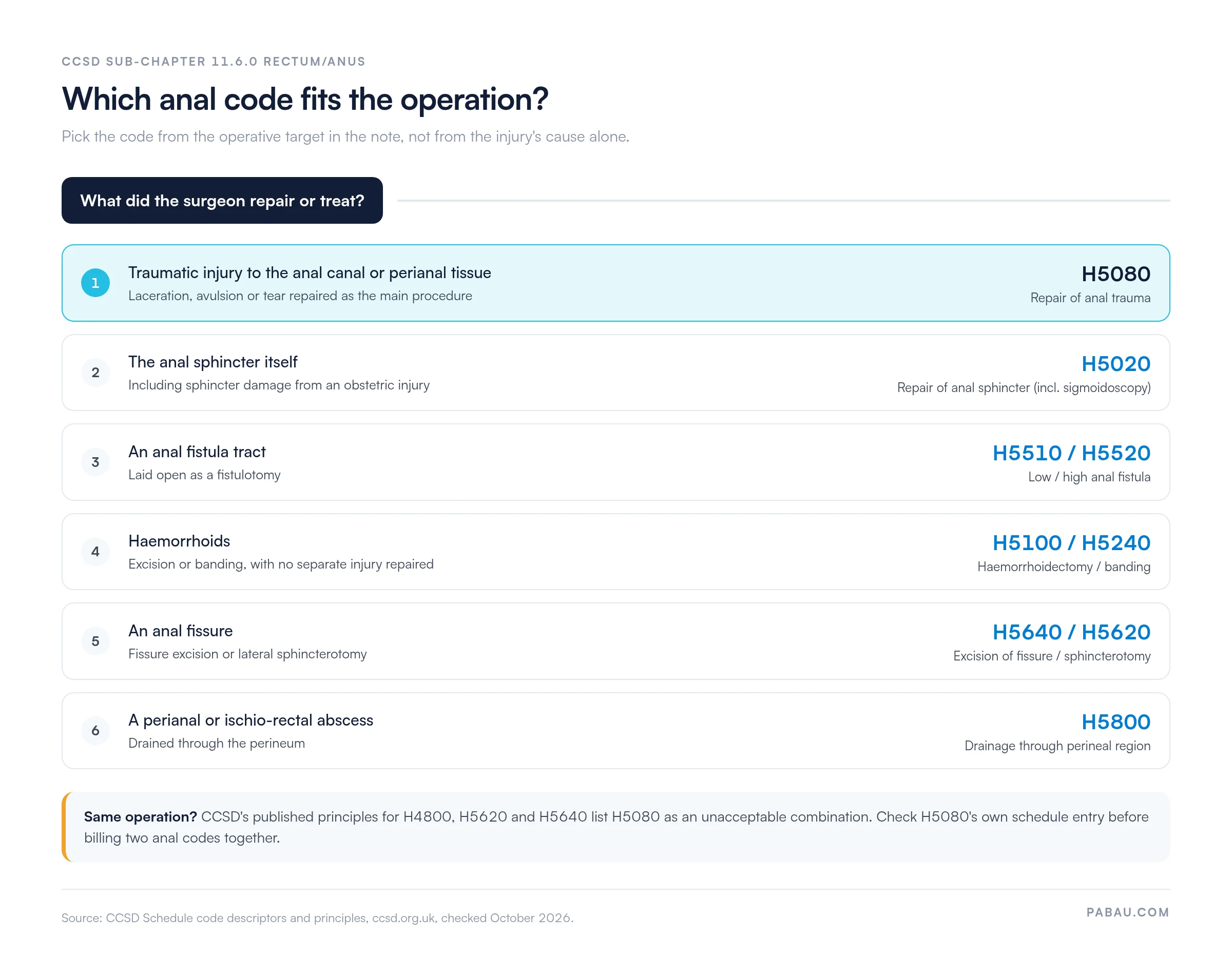
Choosing a neighbouring code by mistake is a common reason for an H5080 claim to be queried. The table maps the main CCSD anal codes against H5080 to show when each applies.
The distinction that matters most is between H5080 and H5020. If the note describes sphincter repair with no traumatic injury to the canal or perianal tissue, expect the insurer to query H5080. Fistula surgery splits by tract height, with H5510 for a low fistula and H5520 for a high one.
Download the CCSD Technical Guide from ccsd.org.uk and keep it to hand for your coding team. For anal procedures, review the combination rules in sub-chapter 11.6.0, because some codes cannot be billed together in one operative episode.
Insurers check H5080 claims against the operative note. A clinically accurate note that leaves out key billing details can still draw a query or refusal. Include these elements:
Structured operative note templates with fields for mechanism, technique and tissue layers make omissions less likely before submission. They can also cut query rates and shorten reimbursement cycles for colorectal procedures.
Most major UK private medical insurers require pre-authorisation for surgical procedures, including H5080. It confirms that the treatment is covered under the patient’s policy before the procedure. For an emergency presentation needing immediate repair, many insurers accept retrospective notification within 24 to 48 hours.
Requirements vary by insurer. As a general guide:
Missing a required pre-authorisation is a common, avoidable reason for refusal. Build the authorisation step into booking so it happens when the procedure is scheduled.
Knowing why H5080 claims are refused lets a practice fix the cause instead of resubmitting the same claim.
When several procedures happen in one session, the CCSD principles and each insurer’s rules decide which codes can be claimed together.
CCSD’s published principles for H4800, H5620 and H5640 each list H5080 as an unacceptable combination. Those codes cover excision of lesion of anus, lateral sphincterotomy and excision of anal fissure. Check H5080’s own schedule entry for other listed combinations, including H5020 anal sphincter repair, before billing two anal codes together.
Subject to those rules and each insurer’s schedule, these are usually billed alongside H5080:
For a multi-procedure session, document each procedure separately in the operative note and confirm the combination rules with each insurer. Explain the clinical rationale in a cover letter when the pairing is unusual.
Before billing H5080 with another anal code, check each insurer’s multiple-procedure rules. Insurers such as Bupa, AXA Health and Aviva set their own payment rules for a second procedure in the same operative episode.
Entering H5080 correctly in your practice software is the last step before submission. A wrong code saved to a template repeats across every claim that uses it.
Many practices still re-key codes from the operative note into an insurer portal and chase claim status by phone. Pabau’s claims management with tracking keeps electronic claim submission and status checks inside the billing workflow.
The claim draws on the data already in the patient record and goes to Healthcode electronically. Your team sees a query sooner, and the audit trail is ready if an insurer asks for more information.

Pabau’s claims management sends CCSD-coded claims electronically and tracks each one’s status, so your team sees an insurer query before payment stalls.

H5080 gets paid when the note and the code tell the same story. That story is a traumatic injury to the anal canal or perianal tissue, repaired as the main operation. Where the sphincter was the repair target, H5020 is the code, and forcing H5080 invites a query.
Settle the code before theatre, while pre-authorisation is requested, and check the combination rules whenever a second anal procedure is planned. That single check addresses several of the refusal reasons above.
To submit and track CCSD claims for your colorectal list from one system, book a demo of Pabau.

Need a structured overview of Bupa CCSD codes? Bupa CCSD codes guide covers Bupa’s procedure code schedule, fee checks and claim requirements for UK private practice.
Want to submit and track CCSD claims in one system? Claims management software from Pabau sends claims electronically and tracks their status inside the billing workflow.
Billing a high fistula rather than an anal injury? CCSD code H5520 explains laying open of a high anal fistula and what the code includes.
Treating haemorrhoids in the same clinic list? CCSD code H5240 covers banding of haemorrhoids and how one charge applies per session.
CCSD code H5080 covers surgical repair of traumatic injury to the anal canal or perianal tissue, such as a laceration or avulsion. It does not cover repair aimed at the anal sphincter, which CCSD codes as H5020. Haemorrhoid, fissure and fistula operations also take their own codes.
Use H5020 when the anal sphincter itself is the repair target, including sphincter damage from an obstetric injury and planned sphincteroplasty. Use H5080 when the repair targets traumatic injury to the anal canal or perianal tissue. Check the CCSD principles for both codes before submitting.
The operative note should record the mechanism and nature of the injury, the structures involved and the repair technique. It should also give the suture materials, haemostasis and the consultant’s GMC number. Where pre-authorisation was required, the insurer’s authorisation reference must appear on the invoice and the claim.
H5080 applies when a traumatic injury to the anal canal or perianal tissue is surgically repaired. Haemorrhoid codes such as H5100 cover operations on haemorrhoidal tissue, and fistula codes such as H5510 cover laying open a fistula tract. Claiming the wrong one is a coding error, however close the structures are.